


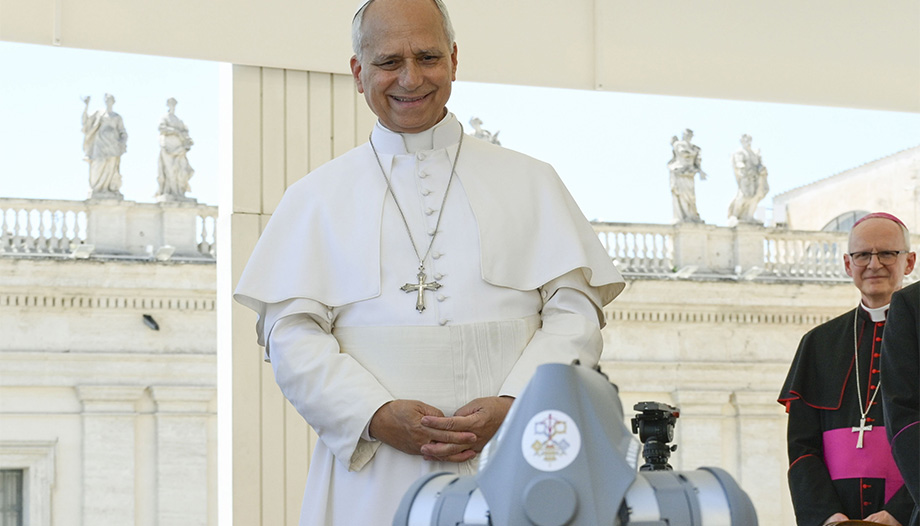
With summer now behind us, enough time has passed for a leisurely reading of Leo XIV's first encyclical: Magnifica humanitas (May 15, 2026). A text whose subject is not artificial intelligence, but rather, as the subtitle states, “Protecting Human Dignity in the Age of Artificial Intelligence".
At the same time, it outlines what the contribution of Christians should be toward building a more humane and fraternal city. The prelude and the finale frame the symphonies. It is worth paying special attention to the beginning and end of the encyclical—even though they are brief—to fully grasp the content of its message.
The Prelude: Babel or Jerusalem?
During the time of Leo XIII What was new was the Industrial Revolution, with its advances and risks. Today, the Pope says, we need to carry out a “shared discernment”that will help us, in this “"change of era”to answer some fundamental questions:" “Where are we headed? What goal do we wish to pursue? What direction should we choose as a human community and as peoples?”” (No. 6).
To build responsibly in our time, the Pope proposes two biblical “images”: the building of the Tower of Babel (cf. Gen 11:1–9) and the rebuilding of the walls of Jerusalem (cf. Neh 2:6) after the exile in Babylon (cf. nos. 7–10).
“The first choice is not between a ‘yes’ or a ‘no’ to technology, but between building Babel or rebuilding Jerusalem: between a power that seeks to dominate the heavens and a people who, in God’s presence, set to work together to rebuild the walls of fraternal coexistence.”” (no. 9).
León XIV states that, in fact, “this collaborative work” It is an expression of the way Christians build their lives: “To direct our actions toward God, so that, in His light, pluralism does not dissolve into disorder but, through the practice of synodality, becomes the space in which humanity rediscovers its solid foundations and its ultimate purpose” (no. 10).
Thus, one might say, a Christian anthropology of work takes shape, culminating in the gift of the definitive City of God: Heaven, the fulfilled Kingdom of God, the Church—the communion of saints in a reconciled and transformed world. “For us Christians, this vision of grace is a call to work together, fostering a peaceful, just, and dignified life in community in today’s ‘cities.’" (Ibid.).
Conditions for “Building Up What Is Good”
For this “construction on the property”The Pope points out four conditions (cf. nos. 11–14): to build upon the foundation of one’s relationship with God and the longing for happiness that dwells in the human heart; “to accept the limitations and fragility of humanity, without viewing them as a mistake that needs to be corrected”; work with “a courageous shared responsibility” and a “shared responsibility”; use a “Gospel language".
What does Leo XIV mean by this last point?: “Let’s avoid words that humiliate or create conflict. Let’s choose clarity that enlightens and candor that opens doors. Let’s not endorse naive enthusiasm or fuel unfounded fears.” (no. 14). It adds that criteria should be based on human dignity and guided by the principles of justice and peace.
What's at stake for us in the world is “to remain deeply human”. From the very beginning of Christianity, this has been part of the proclamation of the Gospel message; for Christ reveals to humanity what it truly means to be human in its fullness (cf. Gaudium et spes, 22).
Here is the proposal for which he invokes divine protection, so that God may dwell in the heart of man: “Let us be builders of communion, not architects of Babel; servants of the Kingdom to come, not masters of towers destined to collapse" (n. 16).
Discernment in Caring for Humanity: Between Technique and Domination, Power and Love
In the main body of his encyclical, Leo XIV presents the social doctrine of the Church as a dynamic way of thinking faithful to the Gospel (Chapter 1), capable of interpreting history in light of the Christian message and guiding humanity toward its fullness. He then sets forth the Fundamentals and Principles of the Social Doctrine of the Church (Chapter 2), as decisive criteria for personal and social discernment in the digital age. The central criterion is human dignity, which every human being possesses by virtue of existing. From this derives the common good as a set of conditions that make personal maturation possible. This implies the universal destination of goods, including intangible and digital ones; subsidiarity, which safeguards the responsibility of the individual, the family, and intermediate bodies against any abuse of power; and solidarity as an awareness of the interdependence of individuals and peoples.
In the following chapter, analyze the relationship between technique and mastery against the backdrop of the greatness of the human person (Chapter 3) and in the face of the misleading proposals of transhumanism and posthumanism, which seek to transcend the limits of the human person by redefining human potential beyond political and moral responsibility. The document states that “‘Human beings do not flourish ’in spite of‘ their limitations, but often ’through” them." (No. 118); thus, fragility and vulnerability are the ground in which interpersonal relationships, care, and openness to others mature. God’s grace and Christian humanism are the only guarantee of true “more than human”, by transcending oneself out of love.
As for artificial intelligence, it can be a valuable aid, but it requires careful consideration; furthermore, it can undermine personal judgment and creativity, have a negative impact on the environment, and is not morally neutral. The criteria of social doctrine can help prevent AI from being exploited to the detriment of humanity.
But in the digital age, what is at stake, above all, is, Safeguarding What It Means to Be Human Amid Transformation: Truth, Work, Freedom (Chapter 4). It highlights the need for reliable public communication and critical thinking education, as well as for ensuring access to decent work and genuine freedom for all. All of this requires fair standards, shared responsibility, and quality education.
Ultimately, two approaches are at odds with each other: The Culture of Power and the Civilization of Love (Chapter 5), which can be viewed in relation to the Augustinian expression: “Two loves created two cities”: self-love versus love of God, which entails love for others.
The culture of (mere) power is associated with war and violence, even if it stems from an algorithm. The civilization of love is associated with the “building communion”based on the principles of justice, fraternity, and dialogue, and on the path to peace.“With peace, nothing is lost, whereas with war, everything can be lost” (no. 219).
Taken as a whole, and understood in this way, “Social doctrine becomes a theology of communion in history” (no. 27).
Contemplation and Eucharistic Spirituality
The final movement of a symphony, the finale, it tends to have a powerful impact. At the end of the encyclical, as the curtain falls on this symphony, the condition—the spiritual and theological dimension that underpins and preserves its ultimate meaning—is revealed in a simple yet intense way. But it is neither a cultural proposal nor a sociopolitical theory.
Under the heading A Spirituality for Our Time (Conclusion), wishes to offer us “a sober and demanding path of Christian life by which to live through this changing era in the light of the Gospel” (no. 229). Here are the four steps of that path: “It is a path that begins with contemplation of God’s plan, lives out ecclesial unity by drawing strength from the Word and the Eucharist, works for the good of the world, and prays together with the Virgin Mary" (Ibid.). A “finale” in four words: contemplation, unity, work, and prayer.
Above all, contemplation of Christ: “As a believer among believers, I invite you to contemplate, in the face of the Son, a magnificent humanity that also illuminates the age of AI. In Christ, we understand that humankind is called to be a partner in the work of creation, and not a resigned spectator in the face of technological processes that limit our freedom and responsibility” (no. 233).
Christ does not despise what is authentically human; rather, he embraces it: “In this plan, nothing that is truly human will be lost; rather, everything will be purified and gathered into Him who gathers every fragment of life, every tear, and every authentic human achievement to rescue them from nothingness and deliver them, redeemed, to the Father" (Ibid.).
Second, Eucharistic spirituality; for the self-giving of Christ, the Word of God made flesh, remains present and active in the Eucharist (cf. nos. 234–235), the “sacrament of unity,” according to St. Augustine. The Eucharist “It is a deeply personal encounter with the Lord, and yet it is never merely an act of individual devotion.”. (Benedict XVI, Homily April 21, 2011). This, says the Pope, is “the Church of Christ,” which we Christians form in unity with Him, as expressed in the episcopal motto of Leo XIV: In illo uno unum.
In doing so, he highlights the social dimension of the Eucharist: “The Eucharist inspires us to justice and sharing, with a special concern for those who bear the burden of poverty and marginalization” (no. 235). And it expresses this in the context of our digital age: “And while new economic and technological networks can lead to exclusion, isolation, and dependency, the Church, nourished by the Eucharist, is called to make another kind of approach visible—by safeguarding bonds, giving a voice to the invisible, and steering processes toward the dignity of the person" (Ibid.).
Work and Prayer
All of this involves work. “In this work –the creation of goodness in the world– We are called to take an active role, without taking refuge in spiritualism or in our own little worlds: we must be faithful to the truth, invest in education, nurture relationships, and love justice and peace” (no. 236). These are various areas of work.
Working to Remain Faithful to the Truth: “In this scenario —“notes Leo XIV”— It is important to guard a heart that loves the truth, that desires what is just more than what is most appealing, that seeks wisdom more than immediate impact. The truth we must not lose is that of God and that of human beings, just as Christ has revealed it to us.” (no. 237).
Work in education: “Let’s invest in education—starting with ourselves!”” Specifically, “We all need to be educated so that we can live in the digital world in a humane way, as an integral part of our education in the faith and in the virtuous life of the Gospel” (no. 238). And all of this takes place within the context of an art of education that today needs to expand and share educational partnerships.
Working to nurture relationships: Our times, Leo XIV warns, need “hands capable of tenderness, attentive minds, and kind words”. Always, and especially today, physical presence: “sharing a meal, the Christian community gathering together, visiting those who are alone, serving the poor” (no. 239).
To work, ultimately, for the sake of justice and peace. “Every technical or economic decision becomes a point of spiritual discernment, an opportunity to assess whether advances in AI open up spaces for justice and participation or concentrate wealth and power in the hands of a few. I invite you to take a clear-eyed look at digital production networks, the working conditions hidden behind our devices, and the mechanisms that exploit manipulation and war.” (No. 240).
As a grand finale, Leon XIV recalls Mary's “Magnificat” (see nos. 243–245). It is a symbol of what our prayer should be: praise and joy, realism and prophecy from those who are committed to being “Weavers of Hope".






 Español
  English
  Italiano
  Français
  Deutsch
  Polski