


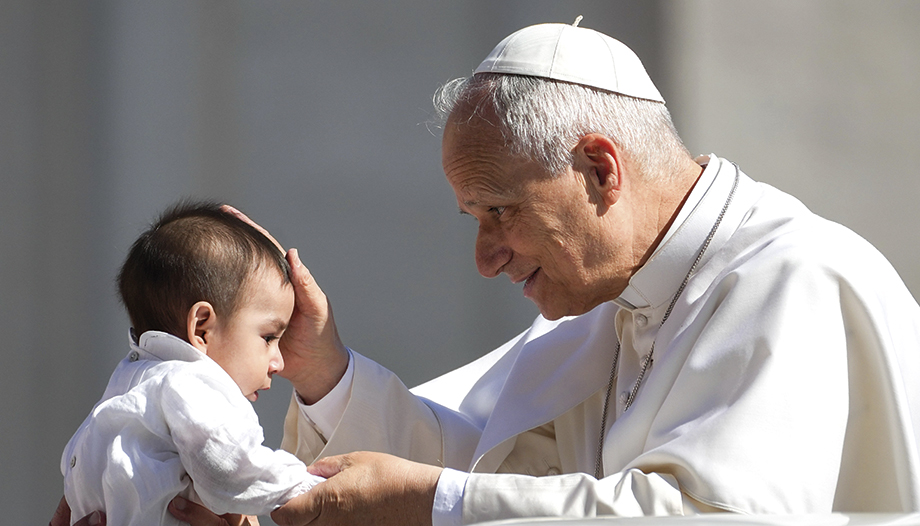
In the catecheses that he is developing in line with the documents of the Second Vatican Council, Leo XIV has concluded the section corresponding to the dogmatic constitution Lumen gentium on the Church.
We can present it here in three parts: the mystery of the Church and the Church as the People of God throughout history; the hierarchy, the laity and the consecrated life; the eschatological and Marian dimensions of the Church.
The Church, “sacrament of unity” with God and among peoples
The Pope points out that St. Paul explains the origin of the Church by recourse to the Pauline term ‘mystery’. “It is God's plan that has one objective: to unify all creatures thanks to the reconciling action of Jesus Christ, an action that took place in his death on the cross.”(General Audience 18-II-2026). This, adds Leo XIV, is experienced above all in the assembly gathered for the liturgical celebration (especially the Eucharist); for there the diversities are relativized, we find ourselves together and attracted by the Love of Christ, who has broken down the wall of separation between persons and social groups (cf. Eph 2:14). This is the Christian mystery.
Now this convocation," the Pope observes, "is not limited to a group of persons, but is destined to become the experience of all human beings. This is indicated in the Lumen Gentium when he says as soon as he starts: "The Church is in Christ as a sacrament, that is, a sign and instrument of intimate union with God and of the unity of the whole human race." (n. 1). And further on he calls it "universal sacrament of salvation" (n. 48).
Human dimension and divine dimension
In the second catechesis (cfr. General Audience, 4-III-2026), Leo XIV looks into the expression of Lumen Gentium 8: the Church is a “complex reality”, because it is constituted with its human and divine dimension, without separation and without confusion.
The human dimension, which is also manifested in its institutional organization, is evident, for, as the Pope affirms, “the Church is a community of men and women, with its virtues and its defects.”. But the Church also has a divine dimension which “.“does not consist in an ideal perfection or in a spiritual superiority of its members, but in the fact that the Church is the fruit of God's plan of love for humanity, realized in Christ.".
In order to illustrate this way of being of the Church, Vatican II refers to the life of Christ: “The flesh of Christ -says the Pope., his face, his gestures and his words visibly manifest the invisible God.e”. It is God's method.
Hence, as Benedict XVI pointed out, there is no opposition between the Gospel message and the ecclesial institution or structures. “Does not exist -confirms Leo XIV an ideal and pure Church, separated from the earth, but only the one Church of Christ, incarnated in history.".
The Church, “Messianic People”.”
Already in its second chapter, the Lumen Gentium explains the Church as the People of Godduring history, which was prepared by the covenant with the Chosen People. This is what Leo XIV dealt with in the General Audience of 11-III-2026.
Vatican II calls the Church “messianic people”, The Church has Christ as its head, and its members are grafted as children of God in Christ. Consequently, as Pope Leo XIV points out, “the law that animates relationships in the Church is love, as we received it and experienced it in Jesus; and its goal is the Kingdom of God, towards which it journeys together with all humanity.”. The Church must be open to all. And we believe that all, even those who have not yet received the Gospel, from different nations, languages and cultures, are called and called to be open to all. “oriented” towards God and the Church (Lumen Gentium 13, y 17).
"This -says Leo XIV means that in the Church there is and must be room for everyone, and that every Christian is called to proclaim the Gospel and to bear witness in all the environments in which he or she lives and works. This is how this people shows its catholicity, welcoming the riches and resources of different cultures and, at the same time, offering them the newness of the Gospel to purify and elevate them. (cfr. Lumen Gentium 13).
Priestly, prophetic and royal people (royal)
At the General Audience of 18-III-2026, the Pope emphasized that Baptism anoints the faithful by giving them the condition of the common priesthood to worship God with their whole life, and by Confirmation strengthens their mission to be witnesses to Christ.
As for the prophetic character of the faithful, Leo XIV points out, it manifests itself in the “sense of faith”. This is, according to the doctrinal commission of the Council, “as a faculty of the whole Church, thanks to which in her faith she recognizes the transmitted revelation, distinguishing between the true and the false in matters of faith, and at the same time penetrates more deeply into it and applies it more fully in life.”.
Vatican II teaches that when the faithful universally give their consent in matters of faith and morals, they participate in that infallibility which the Church shares from God under certain conditions (as, moreover, the Pope, when he defines dogmas, or the bishops in communion with the Roman Pontiff, whether in the ordinary universal magisterium or solemnly during an ecumenical council) (cf. Lumen Gentium 27 y 12). All the faithful are called to bear witness to the unity of the faith which the Magisterium protects. To this end they have many gifts and charisms at their disposal, such as, for example, those of the consecrated life or those corresponding to associative forms of the faithful.
The foundation of the Apostles
Leo XIV went on to explain how the Catholic Church finds its foundation in the apostles (cf., 25-III-2026), which Christ willed as living columns of his Mystical Body; and it possesses a hierarchical dimension that works at the service of the unity, mission and sanctification of all its members. Chapter III of Lumen Gentium. The hierarchical structure is not a human construction, but a divine institution whose purpose is to perpetuate until the end of time the mission that Christ gave to the apostles.
The document focuses on the “ministerial or hierarchical priesthood”.”, which differs “essentially and not only in degree” of the common priesthood of the faithful; and reminds that “they are ordained one to the other, for they both share in their own way in the one priesthood of Christ.” (Lumen Gentium 10).
The Second Vatican Council recalls several times and in an effective way the collegial and communion character of this apostolic mission, reaffirming that “the task that the Lord entrusted to the shepherds of his people is a true service, which in Sacred Scripture is properly called diakonia, that is, ministry.” (Lumen Gentium 24).
The laity, “living stones in the Church and witnesses in the world”.”
And so the Pope arrives at his re-reading of the fourth chapter of Lumen Gentium, which deals with the laity (cf. General Audience, April 1, 1920). The Pope points out how the Council explains in a positive way the mission of the laity, after centuries in which they had been seen simply as those who are not part of the clergy or consecrated. “The dignity of all the members is common, deriving from their regeneration in Christ; common is the grace of filiation; common is the call to perfection: one salvation, one hope and undivided charity.” (Lumen Gentium, 32).
Along with dignity, the Council underlines the mission of the laity in the Church and in the world. “By the name of the laity are designated here all the Christian faithful [...] who, inasmuch as they are incorporated into Christ by baptism, integrated into the People of God and made sharers, in their own way, in the priestly, prophetic and kingly function of Christ, exercise in the Church and in the world the mission of the whole Christian people in the part that pertains to them.” (Lumen Gentium 31).
As John Paul II taught in the Christifideles laici (1988), the broad field of the lay apostolate is not limited to the space of the Church, but extends to the world. The Church, in fact, is present in every place where her children profess and witness to the Gospel. “be imbued with the spirit of Christ and achieve its purpose more effectively in justice, charity and peace.” (Lumen Gentium 36). And Leo XIV exclaims: “And this is possible only with the contribution, service and witness of the laity!”.
Holiness and evangelical counsels in the Church
Lumen Gentium chapter V is devoted to the “universal vocation to holiness”.” that all the faithful have (cf. General Audience, April 8, 2012). This call, the Successor of Peter reminds us, commits us to strive for the perfection of charity, that is, to the fullness of love for God and neighbor, and to bear witness to the faith, if necessary even to the point of martyrdom (cfr. Lumen Gentium 42 y 50). Holiness is a gift of Christ, the Pope observes, “as an interior transformation, whereby the life of every person is configured to Christ by virtue of the Holy Spirit.” (cf. Rom 8:29; Lumen Gentium 40).
Consecrated life is situated in this perspective, to which the consecrated life Lumen Gentium dedicates Chapter VI to it. It is a prophetic sign of the Kingdom of God, already present in the world through the evangelical counsels of poverty, chastity and obedience. These are not obligations which fetter freedom, but “liberating gifts of the Holy Spirit, through which some of the faithful are totally consecrated to God.". “So -states- consecrated persons witness to the universal call to holiness of the whole Church, in the form of a radical discipleship”.”, even to the cross and for love.
The Church on pilgrimage in history towards the heavenly homeland
In Chapter VII of Lumen Gentium the eschatological dimension of the Church is presented (cf. General Audience, "The Eschatological Dimension of the Church")., 6-V-2026). The Church," the Pope points out, "has as her final horizon the Kingdom of God, which includes a communitarian and cosmic dimension of salvation in Christ. The Church knows that she is the place and the means where union with Christ is realized. “more closely” (Lumen Gentium 48), and, at the same time, “recognizes that salvation can be given by God in the Holy Spirit as well.outside its visible limits".
Believers thus live between the “already” and the “not yet,” sustained by hope and called to reject what destroys life and to support those who suffer. As a sign and instrument of the Kingdom, the Church does not proclaim herself, but Christ. And Leo XIV details: “None of the ecclesial institutions can be absolutized; rather, since they live in history and in time, they are called to a constant conversion, to the renewal of forms and the reform of structures, to the continuous regeneration of relationships, so that they can truly respond to their mission.".
Mary, model of the Church
Finally, Lumen Gentium wanted to dedicate the last chapter to the Virgin Mary, who is “both the model, the excellent member and the mother of the whole ecclesial community”. Leo. XIV dedicated to him the General Audience, 13-V-2026.
The Pope says: “One could express all of these characteristics of the Virgin Mary by speaking of her as the woman icon of the Mystery.", "i.e. of the divine design of salvation, at one time hidden and revealed in fullness in Jesus Christ".
In it is also reflected the mystery of the Church, which “.“recognizes in her the very archetype, the ideal figure of what she is called to be.”. His example leads us to ask ourselves (which can serve as a synthesis of these catecheses): “Do I live my membership in the Church with humble and active faith? Do I recognize the covenant community that God has given me to correspond to his infinite love? Do I look to Mary as model, excellent member and mother of the Church, and ask her to help me to be a faithful disciple of her Son?".






 Español
  English
  Italiano
  Français
  Deutsch
  Polski