


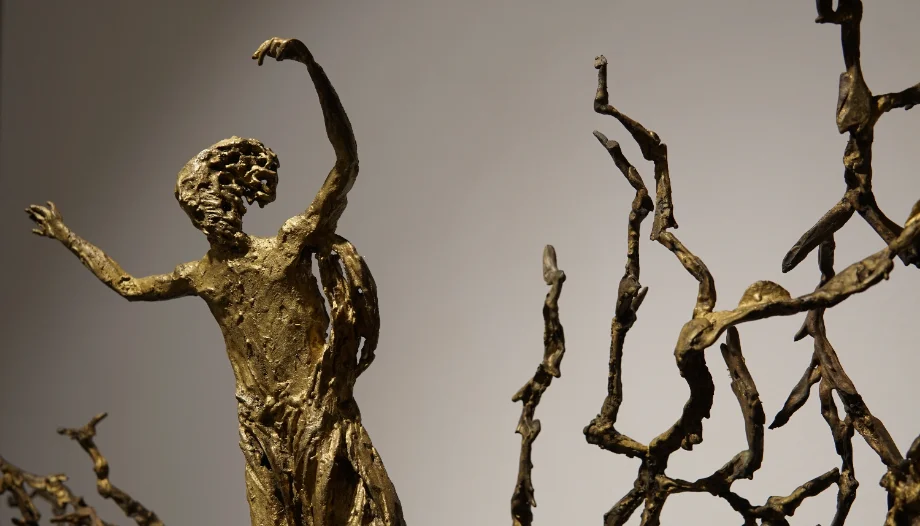
It seems that this reality of the resurrected body in its final destiny does not resonate with much forcefulness and clarity in our times, not even in this liturgical time of Easter when it is even more appropriate.
At Christmas, for example, faith, liturgy and culture go hand in hand and there is no one who doubts what we are celebrating. Something similar happens during Holy Week. The mysteries of the birth, passion and death of our Lord Jesus Christ overflow from the liturgy and are expressed in a rich and deep-rooted culture of traditions that popular piety supports: lights, nativity scenes, Christmas trees, parades, dinners, carols and gifts, processions, Nazarenes, mantillas, penitences, purples and blacks, and candles. All these signs and more are part of the same meanings that the Church remembers in these liturgical times.
On the other hand, Resurrection Sunday opens Easter and, inside the churches, the Easter candle is used for the first time, the white candle becomes the protagonist and the Alleluia is sung. Beyond these signs of the liturgy, the end of Easter arrives with Pentecost Sunday and the people - in their streets and in their people - have hardly expressed the joy of the resurrection. Well, yes, perhaps with little knowledge of the meaning, Easter eggs do.
There is no doubt that, in order to increase the resonance of the resurrection of Jesus Christ (and ours), there is a lack of traditions (and catechesis) in Easter life. In order to place the resurrection of the body at the center of Easter, a true and experiential pedagogy of Easter is lacking.
The light of the Theology of the Body on the resurrection of the body.
Today, the catecheses of St. John Paul II on human love are an expansive anthropological wave that reaches and focuses with more light on the resurrection of our bodies.
If our bodies are theological, if - as we discovered in the Theology of the Body- the body is a way of knowing God, if theology can be done from the body... the body cannot arrive and meet the limit of death, the body must be resurrected, it must reach God and be able to remain in Him for eternal life.
For this, the first lamp that the Polish Pope lights is that of Revelation. John Paul II gives the ON in that «practical case» that the Sadducees put to the Lord about the law of levirate marriage, about that woman who had been the wife of seven husbands who were brothers: «After them all, the woman died. Then, in the resurrection, whose wife will she be of the seven, for they all had her» (Mt 22:27-28; Mk 12:22-23; Lk 20:32-33).
From the Lord's answer (I encourage you to meditate on the passage of Lk 20:34-38), John Paul II begins the third cycle of his Theology of the Body on the resurrection of the flesh and, through nine catecheses, he makes a «theological reconstruction» of what will be the «eschatological man», the man and woman resurrected in their bodies for eternal life. We summarize in twelve, some of its features:
1. Resurrection as a completely new state of human life itself..
The resurrection, although it means the recovery of corporeality and the reestablishment of human life in its integrity through the union of the body with the soul, is an entirely new state of human life itself. (That is why the disciples did not recognize the risen Lord).
2. Resurrection as perfection of the personal.
In the future resurrection, men will resume their bodies in «the fullness of the perfection proper to the image and likeness of God». The resurrection will consist in the perfect realization of what in man is personal, proper and exclusive to each one.
3. The resurrection of masculinity and femininity.
In the resurrection the male or female peculiarity will be maintained: we will be resurrected as male or female. Although the sense of being male or female in the body will be constituted and understood in the «other world» in a new and different way than it was «from the beginning» and in the whole dimension of existence on earth.
4. Marriage and procreation are not part of this resurrection future.
Therefore, «when they rise from the dead, they will neither take a wife nor a husband» (Mk 12:25). Marriage belongs exclusively to «this world»; it is a historical reality. In «God's world», God will fill «all in all» (1 Cor 15:28).
Nor is procreation part of man's eschatological future. The «other world» is the definitive fulfillment of the human race, the definitive closure of the beings who were created in the image and likeness of God.
It may be complicated to understand, but it is so: marriage and procreation in themselves do not definitively determine the original and fundamental meaning of being body or of being, as body, male and female-what John Paul II calls in his Theology of the Body the «spousal meaning» of the body. Marriage and procreation give only a concrete reality to that meaning in the dimensions of history. Resurrection indicates the end of the historical dimension.
Therefore, the words «when they rise from the dead, they shall neither take wife nor husband» (Mk 12:25) not only express what meaning the human body will not have in the future world, but also allow us to deduce that the spousal meaning of the body in the resurrection will correspond perfectly both to the fact that man, as male-female, is a person created in the «image and likeness of God,» and to the fact that this image is realized in the communion of persons: the spousal meaning of the body as a perfectly personal and communal meaning at the same time.
5. The perfect spiritualization of the resurrected man.
Being «like angels in heaven» allows us to deduce a spiritualization of man according to a dimension different from that of earthly life (and from that of the «principle» itself). This does not mean that human nature is transformed into an angelic nature (purely spiritual). We will still retain our psychosomatic nature but with another degree of spiritualization: our body will be a «spiritual body»: without reciprocal opposition of spirit and body, with the perfect participation of all that in man is corporeal in what in him is spiritual; being a body impregnated with spirit; with a perfect harmonization of the activity of the spirit with that of the body; in a perfect sensitivity of the senses... The highest and most perfect heights of all that is human in the body, a true trans-humanization by the supremacy of the forces of the spirit in the body.
6. The fundamental divinization of humanity.
The divinization of the human has roots of divine filiation. The children of the resurrection are children of God. Therefore, divinization in eternal life is incomparably superior to that of earthly life, not only in degree but also in kind. This is a fruit of grace, of God's communicating himself to the whole man (soul, body and spirit), in the most personal gift of God to man.
7. The glorification of the body:
The fruit in the afterlife of this divinizing spiritualization is the simplicity and splendor of the glorious body, the glorification of the body: all the joy and peace and light of the bodies as distinctive signs of having been created in the visible world; of having experienced our bodies as means for reciprocal communication between persons, as authentic expression of the truth and love with which we have built the communion of persons.
8. Communion with God, «the vision face to face».
Communion with God is full participation in the interior life of God, in the Trinitarian reality itself. Thus, from God's gift of self to man and man's reciprocal gift of self to God will be born in man a love of such depth and strength of concentration on God himself that it will completely absorb his entire psychosomatic subjectivity, his whole self, also his body (virginal state of the body).
9. The communion of saints.
Such a concentration of knowledge and love on God will be the source of man's rediscovery of himself (of the subjectivity of each one); and, from it, the rediscovery of that union which is proper to the world of persons and which is a union of communion (the intersubjectivity of all), the communion of saints.
10. Life in the Spirit.
Each of us, with the Resurrection of the body, will participate fully in the gift of the life-giving Spirit, that is, in the fruit of Christ's Resurrection.
11. We all bear the image of Adam and the image of the risen Christ.
What the human body is in the historical experience of man is not totally detached from the other two dimensions of his existence: the origin and the final destiny. Man carries, in a certain sense, these two dimensions deep within the experience of his own being.
The humanity of the first Adam carries within it a particular potentiality to become the second Adam, Christ. Our corruptible humanity carries within it the potentiality of incorruptibility. The earthly experience (including death and the destruction of the body) is the substratum and the basis of the new state of existence in the «other world».
In this sense, the Russian philosopher and theologian Solovyev said that the Christian artist is the one who sees in what he has before him what he will be when he resurrects and transmits the intuition of the resurrection.
12. The wounds of the resurrected bodies.
The new fullness of humanity in the next world is not only restitution, it is not simply a return to the beginning. This would leave aside the experience of sin (and its imprint).
The fullness of the other world will tell the whole story of man: a story shaped by the drama of the Tree of the Knowledge of Good and Evil and, at the same time, permeated by the mystery of redemption. Redemption is the path to resurrection. That is why our wounds will prevail like those of Christ, and the light of Eternal Glory will pass through them.






 Español
  English
  Italiano
  Français
  Deutsch
  Polski
  简体中文
简体中文