



 Opus Dei begins the countdown to its centenaryOpus Dei focuses on its I Centenary: "It will not be just a party"."Ocáriz outlines lines of work for Opus Dei's centennial anniversary
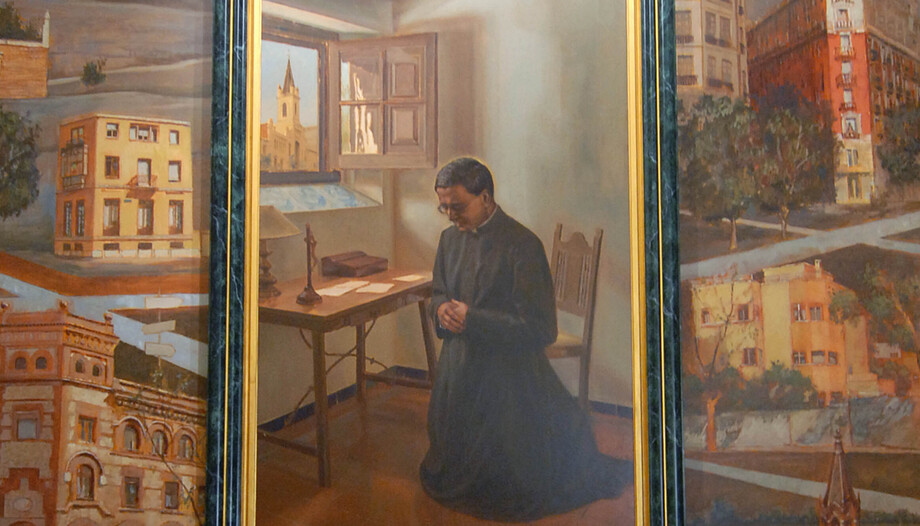
 On Tuesday, October 2, 1928, Josemaría Escrivá, At twenty-six years old, he was doing spiritual exercises in a house of the Vincentians on García de Paredes street, in Madrid.
Between conversations, he remained alone in his room, read some papers where he had been writing things down for years, and saw the illumination of the Work.
He knelt, gave thanks, and heard the bells of Our Lady of the Angels. "Those bells have never stopped ringing in my ears," he would repeat for the rest of his life.
Years later he summed it up in a few verbs: he began to deal with people, to form groups, "either praying or making others pray.".
Nothing remains of the vision but that. But he returned to it without naming it, always with the same images.
Fire
Fire: to express what burned within him, he repeated some words of Christ, "I have come to bring fire to the earth, and how I wish it were already kindled!"; on that phrase he defined the Work as "close and intimate participation in Jesus' impatient desire to spread the fire he had come to bring to the earth.".
Light
Light: he called his followers "children of light, brothers of light," and in 1931 he described the entire Work as a torch that "will go close to the ground, seen by very few, but igniting all souls.".
In a letter she brought the two together and named the place they came from: "We must be light and burning fire, that fire that will always burn on the altar.".
That altar is in the last book of the New Testament. There, an angel offers incense along with the prayers of the faithful, then fills his censer with coals from the same altar and pours it out on the earth (Rev 8:3-5). Prayers rise, fire descends: pray and encourage others to pray.
White garments
The book dresses what he saw in white robes. What he saw that morning was a multitude: "the lives of thousands and thousands of people, throughout the centuries.".
In the Apocalypse, that multitude appears clothed: "After this a multitude appeared that no one could number, from every nation" (Rev 7:9), and they are "those who have washed their robes and made them white in the blood of the Lamb" (Rev 7:14); "The armies of heaven, clothed in pure white linen, followed him on white horses" (Rev 19:14).
The book tells us who gives this clothing and what it is made of: «They gave him a garment of fine, clean linen, which stands for the good works of the saints» (Rev 19:8). It is given to him as a gift, and it is woven by the works of the one who wears it.
The Bride of the Lamb wears that garment, and the book identifies her with a city, the new Jerusalem that comes down out of heaven (Rev 21:9-10). The Council called the Church "the spotless bride of the spotless Lamb" (Lumen Gentium, 6).
The garment, therefore, belongs to the Church, and it is sewn by the works of countless saints, almost all of them nameless. Each one contributes thread.
Serving the Church
Pope Opus Dei It is not fire: it spreads. It lifts the light it receives with the lampstand, and from the Bride's garment it places a thread.
Its purpose is that of the Mystical Body to which it belongs. That is why the founder wanted nothing other for the Work than to serve the Church "as she wishes to be served." It is not a courtesy, it is a mission.
Ninety-eight years is a short time. The dress is still being sewn.
Of that multitude dressed in white, the book says one last thing: «He who sits on the throne will dwell among them» (Rev 7:15). In the midst of the world, around the throne.
That's what Escrivá preached.






 Español
  English
  Italiano
  Français
  Deutsch
  Polski
  简体中文
简体中文