



 Vatican warns St. Pius X Priestly Fraternity: episcopal ordinations will amount to "schismatic act"León XIV writes to the Priestly Fraternity of St. Pius X: "With a heavy heart, I feel it is my duty to ask you to abandon your plan."
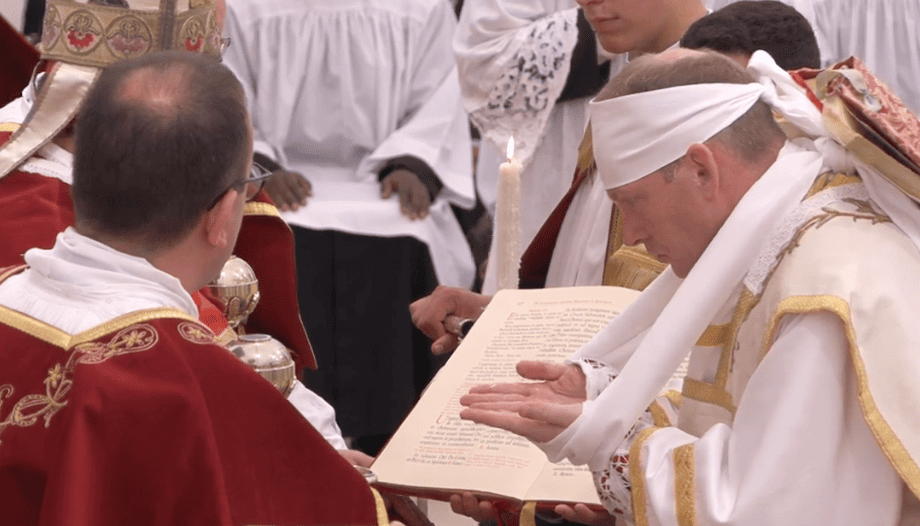
Today, July 1, 2026, in Écône, the Priestly Fraternity of St. Pius X consecrated four bishops without a papal mandate. Thirty-eight years earlier, Marcel Lefebvre did the same, in the same place. A bridge spans these two dates, built on two letters and a single plea: do not break the unity.
The first was written by John Paul II on June 9, 1988, shortly before those consecrations. It was not a legal document, but a father’s letter: he asked Lefebvre, «by the wounds of Christ our Redeemer,» not to take a step that could only be understood as schismatic, and reminded him of the Lord’s prayer on the eve of his Passion: «that they may all be one.».
Weeks later, in the motu proprio Ecclesia Dei, John Paul II identified the root of the problem where it truly lay: not in the love for the ancient liturgy—which is legitimate and respected—but in «an incomplete and contradictory notion of Tradition.» That is the crux of the matter, then and now. Tradition is not a relic to be safeguarded in opposition to the Pope; it is a living reality that is handed down with him and under his ministry. No one is faithful to Tradition if they sever the bond with the one to whom Christ entrusted the unity of his Church. Anyone who pits Tradition against the Papacy has misunderstood both.
The Fraternity cites a «state of necessity»: aging bishops, the urgent need to ensure ordinations and confirmations, and the duty not to abandon a work that sustains the faith of many souls. Their superior general, Father Davide Pagliarani—who is not a bishop—maintains that they are not seeking to separate from Rome, but rather to serve «a mother who is going through a serious difficulty»; and they insist that this is not the whim of each community, but rather an exceptional and objective crisis within the Church. It is a sincere but invalid objection: determining when necessity excuses one from communion with Peter is, precisely, something no one can decide on their own.
Rome has not stood idly by since 1988. Benedict XVI authorized the traditional Mass in 2007 and, in 2009, lifted the excommunication of the four bishops; years of doctrinal discussions followed. Pope Francis granted the priests of the Fraternity the authority to hear confessions (in 2015, on a permanent basis starting in 2016) and regulated attendance at their weddings (2017), to protect the faithful. For nearly four decades, the hand was extended. That is why a new unilateral consecration hurts so much: it slams the door shut in the face of an open one.
On May 13, 2026, Cardinal Víctor Manuel Fernández, prefect of the Dicastery for the Doctrine of the Faith, warned that consecrating bishops without a mandate would constitute «a schismatic act,» with excommunication of both the consecrator and those consecrated already provided for in Ecclesia Dei (based on the former canon 1382, now 1387). On June 29, 2026, Leo XIV addressed Father Pagliarani in language identical to that of John Paul II: «Filled with Christian affection, I beg and implore you with all my heart: Turn back!» And he added, without closing any doors: «The Church is open to a path of dialogue and understanding.» Only then does the image that gives these lines their title appear: «Tearing the seamless Tunic of Christ is a sin of the utmost gravity.».
What is most revealing is that the Fraternity responded by appropriating that very image. Father Pagliarani thanked the Pope for his «paternal concern» and, far from retracting his statement, wrote that he felt a duty to «mend Christ’s tunic, torn by forces and pressures incompatible with an authentically Catholic spirit»; and asked that the sincerity of his intention be recognized: «It is not too late yet.» It is a clever argument: both sides claim to defend the seamless robe. But that robe is not mended by tearing off a shred to keep it separate, nor is it sewn from the outside. Whoever truly wants it whole does not consecrate bishops against the Pope: he remains at his side, even while suffering. Communion is not the price of Tradition. It is its home.
The Fraternity puts forward yet another, more subtle argument: that the Pope’s writing to them «as a father to his son» would prove that there is no schism, since no one treats a stranger that way. But this reasoning is turned on its head. The fact that Rome continues to treat those who have broken away as children does not prove that there is no rupture, but rather demonstrates the father’s patience—a patience that does not legitimize the son’s disobedience and is therefore a source of sorrow. Nor does the fact that some bishops have recognized the Fraternity’s Catholic spirit resolve anything. One can love the doctrine and yet break communion in the very act of consecrating without a mandate.
In 1988, many priests who shared that same love for Tradition heeded the call of John Paul II and founded the Priestly Fraternity of St. Peter. They preserve the traditional liturgy in its entirety, along with the same formation and the same reverence, and they do so in peace, in full communion with the Successor of Peter. They are living proof that Tradition does not require schism.
Two popes have pleaded for the same thing thirty-eight years apart: one for Christ’s wounds, the other for his seamless robe. The wounds and the robe speak of one thing: that unity is paid for with blood and cannot be torn apart without pain. This is not an internal matter for the Church: Jesus asked that all may be one «so that the world may believe» (Jn 17:21), and every schism makes the Church less credible. May this plea be heard this time, and may many choose to live out the Christian tradition alongside the one who is their true rock: Peter.





 Español
  English
  Italiano