


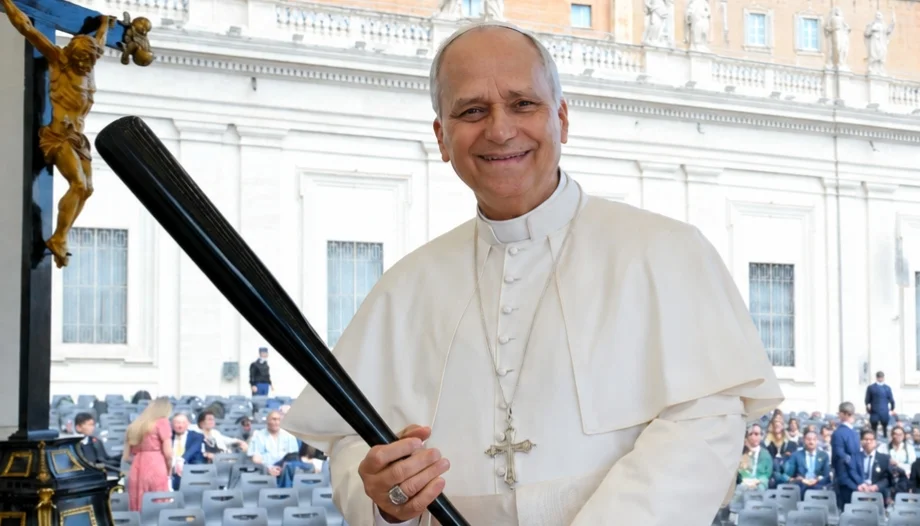
 Lion XIV responds: “I am not afraid of the Trump administration”.”A glimpse of Pope Leo XIV's first interview: clues to his pontificate
 A few days ago, at the end of his summer stay in Castelgandolfo and before leaving for San Marino, Leo XIV gave an important interview to NBC. Many topics were discussed, although the Pope highlighted these two as particularly positive traits of the United States: the love of freedom and the ability to welcome people of all backgrounds and ethnicities. But more than the topics discussed, perhaps the interview’s special significance lay in bringing the American Pope into the spotlight for the first time. In this regard, it seems necessary to try to explain what the Pope’s birth in the United States adds to him, and what the existence—for the first time in history—of a Pope with American roots adds to the United States.
American Influence on the Pontificate of Leo XIV
The fact that he was born in the United States has influenced the pontificate of Leo XIV in various ways.
First, he has firsthand knowledge of how U.S. democratic institutions function, of the country's political culture, and of the role that religion plays in a pluralistic society.
The United States is home to one of the world’s largest Catholic communities, although it is marked by divisions over both doctrinal and political issues. In recent years, American Catholics have been embroiled in debates over abortion, immigration, religious freedom, gender identity, social justice, and partisan polarization. In this context, Leo XIV has sought to project an image of unity, reminding everyone that the Church cannot become a tool in the service of any political ideology. Indeed, one of the main effects of his election has been to strengthen the international visibility of the U.S. Catholic Church. León XIV’s election was interpreted by many American Catholics as recognition of the maturity that Catholicism in the country has achieved.
However, the Pope himself has insisted from the beginning of his pontificate that his responsibility transcends any national identity. On numerous occasions, he has pointed out that the Bishop of Rome does not represent the interests of a specific state, but rather exercises a universal ministry directed toward the entire Catholic Church.
As for his influence on the United States, Leo XIV has sought to become a moral authority rather than a political actor. His statements have aimed to remind people that democracy requires dialogue, respect for institutions, and the pursuit of the common good, while avoiding fueling the growing polarization that characterizes American politics.
The Pope and Donald Trump
One of the issues most widely covered by the media has been the relationship between Leo XIV and President Donald Trump. Since the beginning of his pontificate, Leo XIV has maintained an attitude of institutional respect toward the U.S. government, following the Vatican’s diplomatic tradition of cooperating with all legitimately constituted governments. However, this has not prevented disagreements on certain ethical and social issues.
The most visible differences have arisen over immigration policies. Leo XIV has repeatedly argued that migrants must be treated with dignity and that states have an obligation to balance the protection of their borders with respect for people’s fundamental rights.
This position is fully in line with the social doctrine of the Church and has been interpreted by numerous analysts as an indirect criticism of some of the immigration policies promoted by Donald Trump. However, the differences between the two do not imply an institutional rift. The Holy See maintains stable diplomatic relations with the United States and continues to collaborate on issues related to religious freedom, humanitarian aid, the defense of persecuted Christian minorities, and the search for peaceful solutions to various international conflicts.
A Pope Above Political Labels
With regard to the major U.S. political parties, Leo XIV has avoided any ideological alignment. Although some conservative circles believed that a U.S.-born pope might be particularly close to the Republican Party due to his defense of life, family, or religious freedom, his early actions have revealed a much more complex position. While upholding the Church’s traditional doctrine on moral issues, he has also firmly defended social justice, the protection of workers, the welcoming of immigrants, care for the environment, and the fight against poverty—issues that typically receive greater attention from the Democratic Party.
From an international perspective, the election of an American pope has also had significant diplomatic implications. Numerous observers noted that his nationality could strengthen the capacity for dialogue between the Vatican and Washington. However, the first year of his pontificate shows that Leo XIV has chosen to maintain a foreign policy based on active neutrality, international mediation, and the pursuit of dialogue among states. His actions confirm that the pontiff’s national origin does not automatically determine the Holy See’s diplomatic priorities.
Ultimately, Leo XIV stands out as a unique figure in the contemporary history of the Catholic Church. The fact that he is the first Pope born in the United States constitutes a historic event of enormous significance, although his international pastoral experience and his long-standing work in Latin America have shaped a clearly universal leadership. Rather than acting as a representative of U.S. interests, Leo XIV has sought to consolidate a papacy oriented toward dialogue, peace, social justice, and the promotion of human dignity, reaffirming the global nature of the Petrine ministry in an international context marked by political polarization and profound social challenges.
Professor Emeritus at the Complutense University and Honorary President of the International Ibero-American Union of Jurisprudence.





 Español
  English
  Italiano