



 List of conscientious objectors or list of those conscientiously singled out?The suspicious mirage of Catholicism"Inconvenient truths for autonomous people": a dissection of the tumors of our society.
No one wakes up knowing that today will change their life, or that it will be their last and they will suffer a fatal heart attack at the age of 50, without any previous heart problems, as happened to Monsignor José Antonio Álvarez Sánchez, auxiliary bishop of Madrid, a few months ago. Or that you are going to lose your legs at the age of 26 in a multiple collision while unloading a van, as happened around that time to a worker on Antonio López Street. Or that you are going to die, along with three other people, in the collapse of a building on Hileras Street, also shortly after the start of this academic year.
These are events that surprise and overwhelm you, because life is pure novelty and there is little or nothing we can do about it. Or rather, what we can do is accept and trust in God's incomprehensible will. These tragedies in Madrid, and all tragedies in general, reveal our fragility, contingency, and exposure. Although we naively live, in many cases, as if this did not concern us and our end would never come. That is, as if it did not affect us at all and we were above life.
But death does not always take you by surprise. There are cases in which life leads you down a narrow, winding, uphill path that brings you closer to your end. It is as if God wants you to prepare yourself in greater detail and with more care for your journey to the afterlife. This is the case of another Madrid native, Fernando, a freelance painter who is no longer with us.
Fernando and the race against leukemia
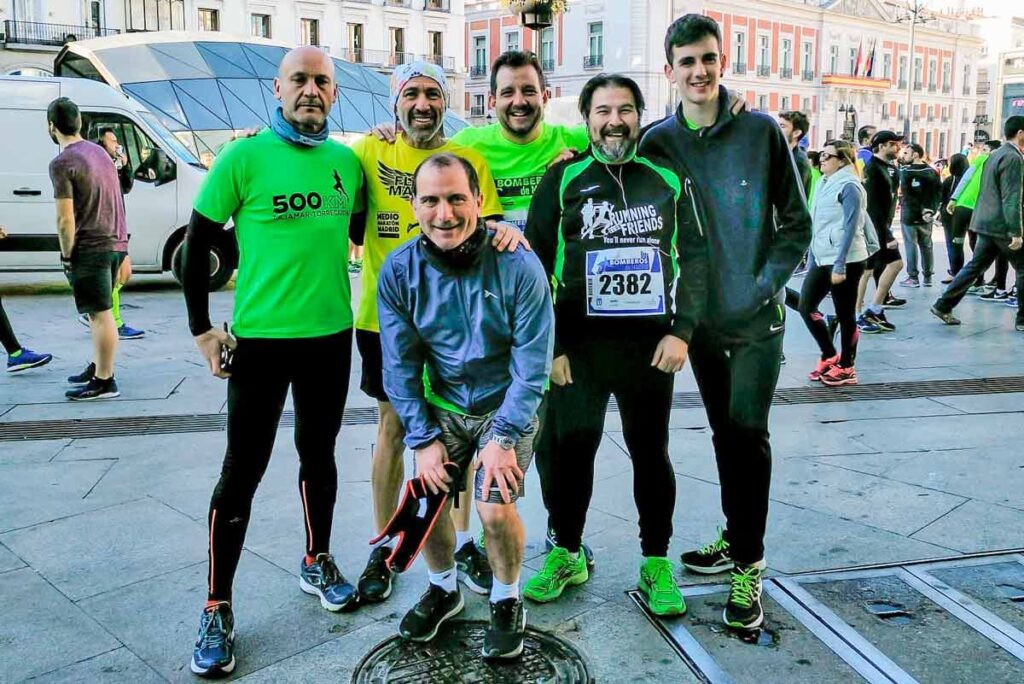
Almost every Sunday, Fernando would run an “eight at eight” (8 km at 8 p.m.) through Moratalaz with his friends and then stay for the “after party,” recounting the week over sparkling water, a non-alcoholic beer, or a beer. He also frequently participated in popular races such as the San Silvestre, the half marathon, or “Madrid corre por Madrid» with that group of runner friends. Until, in 2023, leukemia knocked on his door.
The shock was much less severe for him than for the rest, as he had the opportunity to start this new journey soon, along the “path of his healing,» thanks to his optimistic attitude toward life, accompanied by the same people he saw every Sunday, as well as many other friends and family members. It was a time of great unity and hope, and he and his family were well supported and cared for.
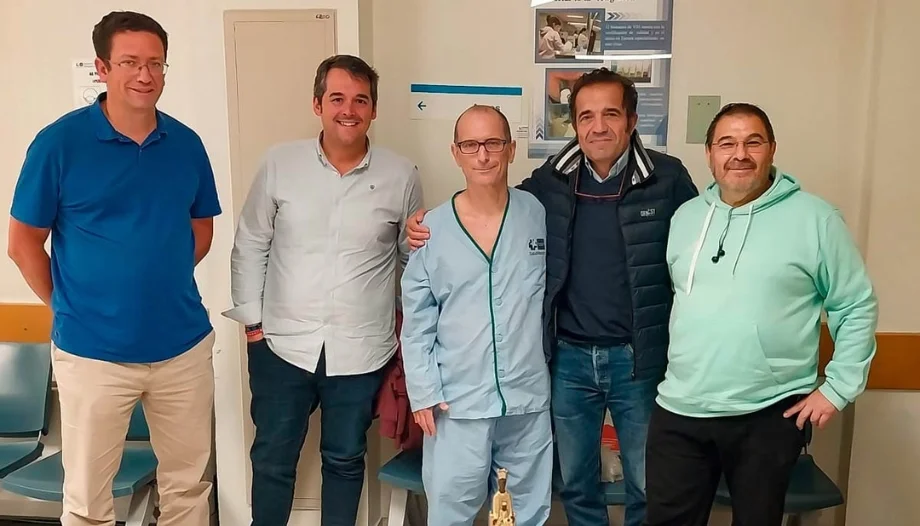
In October 2024, the “runners» brought him a statuette of the Virgin of Torreciudad, purchased after a few days of retreat at a house near the shrine, which stood at the head of his bed throughout his stay in the hospital and to which he entrusted himself. This led him to increase his faith and his trust in God and the Virgin Mary, as he said in a testimony: “I thought I was in heaven, with the Virgin at my bedside, my friends praying for me, and my wife and children by my side giving me their love.”.
Until the first crisis of pain arrived, and in that acute phase Fernando thought: ”There were many dark nights where the pain became unbearable, where faith was put to the test. Where is God now? Why doesn't the Virgin Mary at my bedside help me? What good are my prayers if only fentanyl and morphine bring me relief, that is, only science helps you and prayers don't?” as he later told his friends.
“However, the hospital had a secret weapon,” according to Fernando... The daily visit from the hospital chaplain with communion, which he requested, and the regular conversations with this close priest, led him to achieve great peace: “I said to myself, how lucky I am that the Lord comes to visit me in the hospital, just like my family and friends.”.
Hope alongside the Virgin of Torreciudad
His devotion to the Virgin Mary also helped him through difficult times...: “Anxiety and pessimism began to creep in... There were days when I didn't know how or didn't want to project an image of joy and peace around me. There were days when I responded badly to those around me. But at this point in my stay, when I was alone at night because my wife had gone home, I stayed with the Virgin at my bedside and took advantage of those moments to chat with her for a while. I have to confess that, at times, I would get angry with her, which would prompt me to immediately call my wife to apologize for my bad language, and everything would be fine”...
Over time, Fernando improved and was discharged from the hospital in January 2025. His family and friends were delighted and hopeful when, after a second bone marrow transplant, the results of the follow-up tests showed 0.00 traces of cancer cells. But it was only a mirage along the way. After a few months of improvement, malignant cells began to reappear, leading to a phase in which multiple tumors appeared throughout his body, which were treated with radiation. Then in July, after contracting COVID-19, his leukemia flared up and doctors lost control of the disease.
On July 31, he was admitted to the emergency room at Marañón Hospital, and after some tests, it was confirmed that there was no possible treatment to cure him, nor any medication to slow the disease. The only option left was palliative care, such as sedation, not euthanasia, which was administered in his final moments. He passed away on August 13.
Fernando, as a freelancer and entrepreneur, shaped himself as a person. This made him strong and resilient in the face of adversity. It taught him to value what was truly important in his life: God, his family, and his friends. Ramón, a close friend of his, highlights how normally he talked about his therapies and doctor's appointments, as if they were normal everyday activities that had nothing to do with him, even when he was going through the most difficult moments, as his friend recounted: “This is very difficult to find in a dying person who knows they don't have long left.» Fernando remains present among his loved ones, his wife, family, and friends, above all because he was a model of consistency in his daily life, downplaying his illness and living very naturally, which for others would have been a tragedy. The conversation continues with him.




 Español
  English
  Italiano