


 The Echo of the Loaves and the Fish
 Echoing the historic and timeless «Do not be afraid!» with which St. John Paul II began his pontificate, Pope Leo XIV has left a profound mark during his recent visit to Madrid. Those words, which invited people to throw open the doors to Christ, seemed to take on a new and vibrant life in the Plaza de Lima, perfectly encapsulating the spirit of a Prayer Vigil that defied the prevailing trends of today’s society.
From the very beginning, the Pontiff’s message was direct, devoid of hesitation or half-measures. Addressing the impressive sea of more than 500,000 young people flooding the Castellana, Leo XIV emphasized the urgency of personal commitment. «Never be afraid to consider a vocation,» he declared firmly in response to young Marina’s question. This call to courage was immediately complemented by his response to Fernando, reminding the entire audience that marriage and building a family constitute, in and of themselves, a vocation that should not be feared either.
To guide this demanding process of discernment, the Pope shared his own points of reference, building a bridge between modernity and the living Tradition of the Church through saints who, despite the passage of centuries, continue to challenge people today. Thus, he recalled how the figure of St. Augustine, in the fifth century, and his existential honesty led him in his youth to ask himself: «If they were capable, why not me?» Alongside the saint from Hippo, he highlighted the boldness of St. John Chrysostom, a giant of the fourth century whose eloquence sprang from the absolute consistency between what he preached and how he lived; a shepherd who did not fear raising his voice before the Emperor himself in defense of justice.
The Pontiff also turned his attention to figures of Hispanic heritage who exemplified remarkable charity and social commitment. He mentioned Saint Thomas of Villanueva, the 16th-century Augustinian reformer known as «the Bishop of the Poor,» who strongly exhorted his brothers in the clergy «to persevere in prayer, in a life of chastity, and in obedience.» In the same vein, he highlighted Saint Toribio de Mogrovejo, the 16th-century missionary who zealously fought against the abuses and corruption of his time on Peruvian soil. All of these figures demonstrate that holiness is not an abstract concept to be displayed in a showcase, but rather an attractive model that goes against the grain. They are examples—like those of many good people living today—that invite us to look beyond the headlines and discover what Pope Francis calls «the saints next door.».
However, the big question that hung over the Castellana was how to tune into God’s frequency in a world saturated with stimuli and hyperconnected. Pope Leo XIV’s response to the deep concern raised by young Manu was clear: inner silence. The Holy Father warned against the «clamor of a thousand voices» and the deceptions of social media, which peddle lies and fleeting ideologies, contrasting them with a sincere search for the truth. In his own words, it is in the experience of silence that we decide which noises to ignore and where the truth remains unchanging.
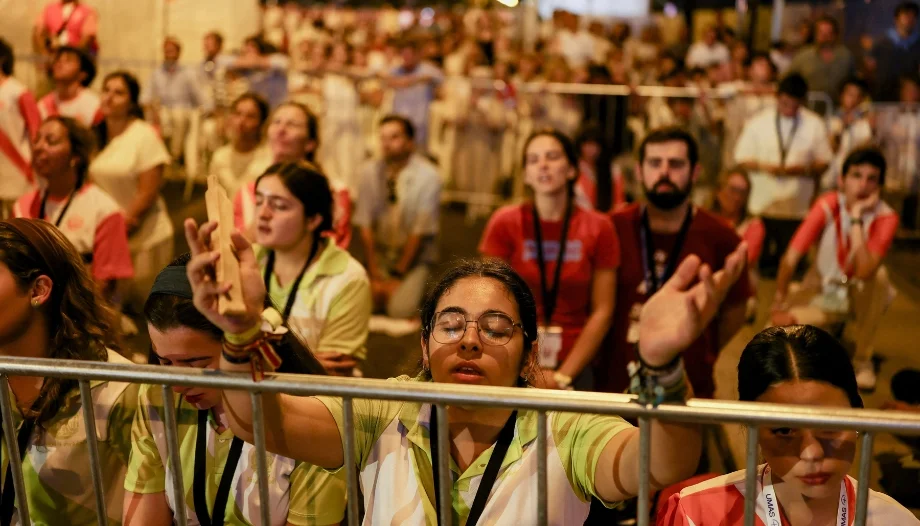
That theoretical silence became astonishingly tangible and palpable when the vast crowd, for the most part, knelt to worship Jesus in the Monstrance. In a scene almost unthinkable given the usual pace of a major capital city, Lima’s Plaza de Lima was transformed into a new Bethany. Amid the crowd, a space of absolute intimacy was created—like the one shared by Martha, Mary, and Lazarus with the Master—ideal for pouring out concerns, sufferings, and plans. An intimate and profound experience that, far from being an isolated oasis, is repeated time and time again in so many parishes where Eucharistic Adoration is an essential part of their pastoral ministry.
It is precisely in that haven of peace that the most serious and courageous question a young person can ask takes on its full meaning: «Lord, what do you want from me?» God, just like mothers and fathers with their children, has a beautiful story in store for each one of us. Ultimately, the Pope’s call is an invitation to existential courage—the very same courage a priest recalled when explaining the Chapel of the Blessed Sacrament and the Christ figure that forms its altarpiece to a group of hesitant young people. A lesson that, in my view, is deeply meaningful both for everyone who was on the Castellana and for those who followed it through the media—and whose final recommendation continues to resonate strongly in my memory:
«Go for it! Go in there, look at him, and tell him you don't love him.».





 Español
  English
  Italiano