The Vatican

Vatican finances, the balance sheets of the IOR and of the St. Peter's Obligation

There is an intrinsic relationship between the budgets of the Oblates of St. Peter's and the Institute for works of Religion.

Andrea Gagliarducci-July 12, 2024-Reading time: 4 minutes

There is a close relationship between the annual declaration of the St. Peter's obolus and the balance sheet of the Istituto delle Opere di Religione, the so-called "Vatican bank". Because the Obolo is destined to the charity of the Pope, but this charity is also expressed in the support of the structure of the Roman Curia, an immense "missionary budget" that has expenses, but not so many incomes, and that must continue to pay salaries. And because the IOR, for some time now, has been making a voluntary contribution of its profits precisely to the Pope, and these profits serve to lighten the budget of the Holy See. 

For years the IOR has not had the same benefits as in the past, so that the portion allocated to the Pope has decreased over the years. The same situation applies to the Obolo, whose income has decreased over the years, and which has also had to face this decrease in the IOR's support. So much so that in 2022 it had to double its income with a general divestment of assets.

That is why the two budgets, published last month, are somehow connected. After all, the Vatican finances have always been connected, and everything contributes to helping the Pope's mission. 

But let's look at the two budgets in more detail.

The St. Peter's Oblong

Last June 29, the St. Peter's Oblates presented their annual balance sheet. Revenues were 52 million, but expenses amounted to 103.4 million, of which 90 million were for the apostolic mission of the Holy Father. Included in the mission are the expenses of the Curia, which amount to 370.4 million. The Obolo thus contributes 24% to the budget of the Curia. 

Only 13 million went to charitable works, to which, however, must be added donations from Pope Francis through other dicasteries of the Holy See totaling 32 million, 8 of which were financed directly through the obolo.

In summary, between the Obolus Fund and the funds of the dicasteries financed in part by the Obolus, the Pope's charity financed 236 projects, for a total of 45 million. However, the balance deserves some observations.

Is this the true use of the St. Peter's Obligation, which is often associated with the Pope's charity? Yes, because the very purpose of the Obligation is to support the mission of the Church, and it was defined in modern terms in 1870, after the Holy See lost the Papal States and had no more income to run the machine.

That said, it is interesting that the budget of the Obolus can also be deducted from the budget of the Curia. Of the 370.4 million of budgeted funds, 38.9% is earmarked for local Churches in difficulty and in specific contexts of evangelization, amounting to 144.2 million.

Funds earmarked for worship and evangelization amount to 48.4 million, or 13.1%.

Dissemination of the message, that is, the entire Vatican communication sector, represents 12.1% of the budget, with a total of 44.8 million.

37 million (10.9% of the budget) was allocated to support the apostolic nunciatures, while 31.9 million (8.6% of the total) went to the service of charity - precisely the money donated by Pope Francis through the dicasteries -, 20.3 million to the organization of ecclesial life, 17.4 million to the historical heritage, 10.2 million to academic institutions, 6.8 million to human development, 4.2 million to Education, Science and Culture and 5.2 million to Life and Family.

Income, as mentioned above, amounted to 52 million euros, 48.4 million of which were donations. Last year there were fewer donations (43.5 million euros), but income, thanks to the sale of real estate, amounted to 107 million euros. Interestingly, there are 3.6 million euros of income from financial returns.

As for donations, 31.2 million came from direct collection by dioceses, 21 million from private donors, 13.9 million from foundations and 1.2 million from religious orders.

The countries that donate the most are the United States (13.6 million), Italy (3.1 million), Brazil (1.9 million), Germany and South Korea (1.3 million), France (1.6 million), Mexico and Ireland (0.9 million), Czech Republic and Spain (0.8 million).

IOR balance sheet

The IOR 13 million to the Holy See, compared to a net profit of 30.6 million euros.

The profits represent a significant improvement over the €29.6 million in 2022. However, it is necessary to compare the figures: they range from the 86.6 million profit declared in 2012 - which quadrupled the previous year's earnings - to 66.9 million in the 2013 report, 69.3 million in the 2014 report, 16.1 million in the 2015 report, 33 million in the 2016 report and 31.9 million in the 2017 report, to 17.5 million in 2018.

The 2019 report, meanwhile, quantifies profits at 38 million, also attributed to the favorable market.

In 2020, the year of the COVID crisis, the profit was slightly lower at 36.4 million.

But in the first post-pandemic year, a 2021 still unaffected by the war in Ukraine, it returned to a negative trend, with a profit of only €18.1 million, and only in 2022 did it return to the €30 million barrier.

The IOR 2023 report speaks of 107 employees and 12,361 customers, but also of an increase in customer deposits: +4% to €5.4 billion. The number of clients continues to fall (they were 12,759 in 2022, even 14,519 in 2021), but this time the number of employees also decreases: they were 117 in 2022, they are 107 in 2023.

Thus, the negative trend of clients continues, which should give us pause for thought, bearing in mind that the screening of accounts deemed not compatible with the IOR's mission ended some time ago.

Now, the IOR is also called upon to participate in the reform of Vatican finances desired by Pope Francis. 

Jean-Baptiste de Franssu, president of the Council of Superintendence, highlights in his management letter the numerous accolades the IOR has received for its work in favor of transparency over the past decade, and announces: "The Institute, under the supervision of the Authority for Supervision and Financial Information (ASIF), is therefore ready to play its part in the process of centralizing all Vatican assets, in accordance with the Holy Father's instructions and taking into account the latest regulatory developments.

The IOR team is eager to collaborate with all Vatican dicasteries, with the Administration of the Patrimony of the Apostolic See (APSA) and to work with the Investment Committee to further develop the ethical principles of FCI (Faith Consistent Investment) in accordance with the Church's social doctrine. It is crucial that the Vatican be seen as a point of reference."

The authorAndrea Gagliarducci

The World

Israel to allow Church leaders to celebrate Holy Week at holy sites

Following the controversy, Israeli President Isaac Herzog called Cardinal Pizzaballa to express his "deep regret for the unfortunate incident.".

OSV / Omnes-March 30, 2026-Reading time: 6 minutes

By Junno Arocho Esteves, OSV News

The Latin Patriarchate of Jerusalem announced that an agreement has been reached with the Israeli authorities to allow Holy Week and Easter celebrations to take place in the Church of the Holy Sepulcher, after they were initially forbidden to celebrate Palm Sunday.

In a statement issued on March 30, the Latin Patriarchate affirmed that «access has been guaranteed to representatives of the Churches for the celebration of liturgies and ceremonies and for the preservation of the ancient Paschal traditions in the Church of the Holy Sepulcher.».

«Naturally, and in view of the current state of war, the restrictions in force on public gatherings remain in place for the time being. Consequently, the Churches will ensure that liturgies and prayers are broadcast live to the faithful in the Holy Land and throughout the world,» the communiqué reads.

Context of the problem

The agreement was reached a day after Israeli police prevented Cardinal Pizzaballa and Father Francesco Ielpo, custodian of the Holy Land, from entering the church on March 29, sparking worldwide condemnation.

In a statement released shortly after the incident, the Latin Patriarchate of Jerusalem said that preventing Catholic leaders from celebrating the start of Holy Week set «a grave precedent and disregarded the sensitivities of billions of people around the world who, during this week, look towards Jerusalem.».

Following the controversy, Israeli President Isaac Herzog stated that he called Cardinal Pizzaballa to «express my deep regret for the unfortunate incident that occurred this morning in the Old City of Jerusalem».

«I clarified that the incident was due to security concerns in the face of the continued threat of missile attacks by the Iranian terrorist regime against the civilian population in Israel, following previous incidents in which Iranian missiles landed in the Old City area of Jerusalem in recent days,» he explained.

Church Appreciation

Herzog also reaffirmed Israel's «unwavering commitment to religious freedom for all faiths and to maintaining the status quo at Jerusalem's holy sites.».

In its March 30 communiqué, the Latin Patriarchate of Jerusalem expressed its gratitude to Herzog «for his prompt attention and valuable intervention.».

«We also extend our thanks to the Heads of State and officials who acted swiftly to convey their strong positions, many of whom personally reached out to express their closeness and support,» the statement said.

International reaction

Religious and political leaders from around the world quickly denounced the Israeli authorities after news spread on March 29 that the two Catholic leaders had been banned from entering the church. .

The report of the Palestinian mission to the United Nations, published by X, stated that the actions of the Israeli authorities against the religious leaders were not without precedent, since «for decades, Israel has always denied Palestinian Christians access to the Church of the Holy Sepulcher with impunity.».

In a subsequent publication, Palestinian government authorities stated that the ban on religious leaders from performing their religious rites «constitutes a crime and an illegal military measure, and represents a flagrant violation of the basic rights of the Palestinian people, foremost among which is freedom of worship.».

The Israeli police's actions, he added, demonstrate a disregard for «the feelings of hundreds of millions of people around the world, an affront to the feelings of Christians and Muslims who share the sanctity of the city of Jerusalem and its religious and historical status, and a violation of the existing legal and historical status quo.».

Prominent Western leaders also took to social media to denounce the incident.

Among the immediate reactions were those from Italy, where the country's foreign minister, Antonio Tajani, called the incident «unacceptable» and announced that he had summoned Israel's ambassador to Italy «to receive clarification on the decision to prevent Cardinal Pizzaballa from celebrating Palm Sunday.».

Mike Huckabee, U.S. ambassador to Israel, issued an unusual condemnation, acknowledging that while the holy sites in Jerusalem's Old City were closed for security reasons, preventing leaders from Catholics entering the church was «an unfortunate excess (that) is already having major repercussions around the world».

«Home Front Command guidelines restrict meetings to 50 people or less. The four representatives of the Church Catholic were well below that limit,» he wrote. «That the Patriarch was barred from entering the church on Palm Sunday for a private ceremony is hard to understand or justify.».

In messages published in French, Hebrew and Arabic, French President Emmanuel Macron expressed his support for Cardinal Pizzaballa and the Christians of the Holy Land, stating that «the free exercise of worship in Jerusalem must be guaranteed for all religions.».

«I condemn this decision by the Israeli police, which adds to the alarming proliferation of violations of the status quo of the Holy Places in Jerusalem,» he wrote.

The Spanish government

Spanish Prime Minister Pedro Sanchez, who has criticized the US-Israel-led war against Iran, directly blamed Israeli Prime Minister Benjamin Netanyahu for the incident, stating that he «prevented Catholics from celebrating Palm Sunday at the Holy Places in Jerusalem. Without any explanation. Without reason or motive.

«The government of Spain condemns this unjustified attack against religious freedom and demands that Israel respects the diversity of beliefs and international law. Because without tolerance, coexistence is impossible,» he wrote.

Kaja Kallas, head of European Union diplomacy, said that preventing Cardinal Pizzaballa and Father Ielpo from entering the Church of the Holy Sepulcher was «a violation of religious freedom and existing protections governing holy sites.».

«Freedom of worship in Jerusalem must be fully guaranteed, without exception, for all religions,» he wrote in X. «The multi-religious character of Jerusalem must be protected.».

Polish President Karol Nawrocki also used Channel X to express his strong opposition to «the refusal to allow the celebration of Holy Mass in the Church of the Holy Sepulcher in Jerusalem.».

«Palm Sunday marks the beginning of Holy Week, and Christians prepare for the resurrection of Jesus Christ,» wrote the Polish president, who is Catholic .

«The actions of the Israeli police, which I condemn, are a sign of disrespect for Christian tradition and culture.»

Netanyahu's traditional allies also voiced unusual criticism, including Hungarian Prime Minister Viktor Orbán, who called the situation «painful.».

«This is unacceptable for us as Christians, even taking into account the war situation and general security measures,» he wrote. «We must not allow war to exclude the followers of any religion from our common holy city, Jerusalem.».

Easing tensions

In response to the incident, Israel's prime minister's office noted in a series of tweets that Iran «has repeatedly targeted the holy sites of the three monotheistic religions in Jerusalem with ballistic missiles» and that fragments of a missile from one of the attacks crashed near the Church of the Holy Sepulcher.

He explained that the police prevented Cardinal Pizzaballa and Father Ielpo from entering the church «out of special concern for their safety» and affirmed that «there was no malicious intent».

«However, given the sanctity of the week before Passover for Christians around the world, Israel's security services are drawing up a plan to allow religious leaders to worship at the holy site in the coming days.»

Several hours later, in a post on his personal X account, Netanyahu said he had instructed the authorities to grant Cardinal Pizzaballa «full and immediate access to the Church of the Holy Sepulcher in Jerusalem.».

«While I understand this concern, as soon as I learned of the incident with Cardinal Pizzaballa, I instructed the authorities to allow the Patriarch to hold religious services as he wished,» he wrote.

In response to Netanyahu's publication, Huckabee said he was glad that Netanyahu «intervened personally and quickly to allow Cardinal Pizzaballa access to the Church of the Holy Sepulcher.».

«All holy sites have restrictions due to Iranian missiles and security concerns, but private access on Palm Sunday was reasonable and the problem is now resolved,» the U.S. ambassador tweeted.

Cardinal Pizzaballa also tried to calm things down after the incident. In an interview with TV2000, the television channel owned by the Italian Bishops« Conference, the Latin patriarch affirmed that the incident was the result of a »misunderstanding".

«There were no confrontations; everything took place with a lot of courtesy. I don't want to force things; we want to take advantage of this situation to better clarify in the coming days what to do, respecting everyone's safety, but also the right to prayer,» he said.

He also noted that, while the Palm Sunday incident was important, it should be seen in «a broader context».

«There are people who are in a much worse situation than we are and who cannot celebrate for very different reasons,» he said. «Once again, we celebrate a sober Easter.».

The authorOSV / Omnes

Read more
The Vatican

The 10 most important messages of the Pope in Monaco

Hope, lived faith and the courage to give oneself to God.... These are some of the keys to Pope Leo XIV's speeches in Monaco.

Paloma López Campos-March 30, 2026-Reading time: 4 minutes

During his brief visit to Monaco, Pope Leo XIV addressed not only the Catholics of the country, but also those of the whole world. Being the first Pontiff of modern times to visit this small state, the Holy Father held several meetings and here are some of his most important messages.
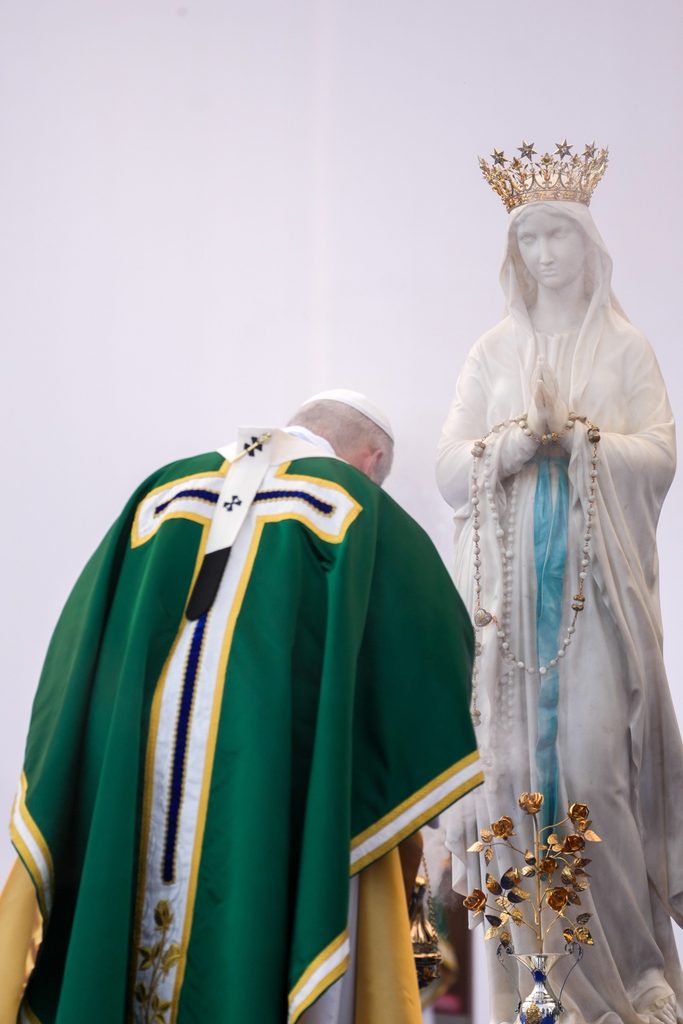
“It is necessary to trust in God's Providence”.”

In the courtesy visit to the Prince of Monaco, Leo XIV pointed out that “it is important to trust in God's providence even when a sense of powerlessness or inadequacy prevails, because we believe that the Kingdom of God is like a tiny seed that grows into a tree”.
Despite this confidence, the Pope continued, “this faith only changes the world if we do not shirk our historical responsibilities.”.

“The Catholic faith places us before the sovereignty of Jesus.”

In the same speech, the Pontiff referred to the importance of living as Catholics in society. He said that this faith “places us before the sovereignty of Jesus, who commits Christians to be in the world a kingdom of brothers and sisters, a presence that does not crush, but liberates; that does not separate, but unites; ready to always protect with love every human life, at any time and in any condition, so that no one is ever excluded from the table of fraternity”.

“Unprecedented challenges are met with a free heart.”

In the same vein, Leo XIV concluded his address to the Prince of Monaco by encouraging everyone to deepen this “ancient faith”, which will make them “experts in new things; not so much by pursuing goods that pass away, often novelties that grow old in a season, but by facing unprecedented challenges, which can only be met with a free heart and an enlightened intelligence”.
“The Church is called to be in the world a reflection of God's love which is no respecter of persons.”

During his meeting with the catholic community of Monaco, Pope Leo XIV pointed to Christ as “the just one” who “does not come to carry out a condemnatory judgment, but to offer to all his mercy that purifies, heals, transforms and makes us part of the one family of God”.

The Holy Father pointed out that Jesus does not do this with all of us “poor” and “sinners” “to support evil, but to free them from oppression and slavery and make them children of God and brothers and sisters among themselves”. For this reason, the Church is “called to be in the world a reflection of God's love, which is no respecter of persons”.

“Proclaim the Gospel of life, hope and love.”

In this reflection of God's love, Leo XIV continued, the Church's message must “enlighten the human person and society so that, in the light of Christ and his Word, they may discover their own identity, the meaning of human life, the value of relationships and social solidarity, the ultimate purpose of existence and the destiny of history”.
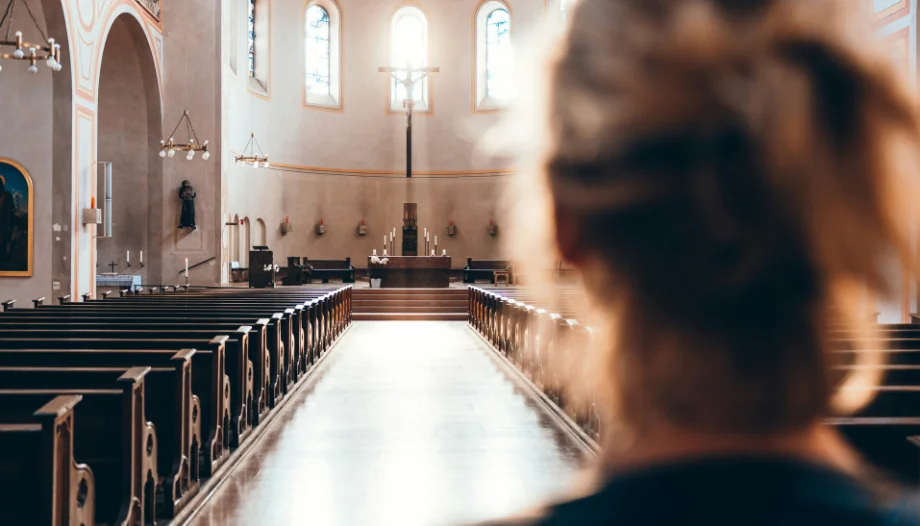
For this reason, the Pope encourages all Catholics to “proclaim the Gospel of life, hope and love; to bring the light of the Gospel to all so that the life of every man and woman from conception to its natural end may be defended and promoted; to offer new maps of orientation capable of curbing those impulses of secularism that risk reducing man to individualism and founding social life on the production of wealth”.

“A living faith is always prophetic”

Finally, Leo XIV pointed out that “a living faith is always prophetic, capable of raising questions and offering provocations: are we really defending the human being? Are we protecting the dignity of the person in the protection of life in all its phases? Is the current economic and social model truly just and inspired by solidarity?”.

“What gives solidity to life is love.”

By maintaining a meeting with young people, The Pope wanted to remind everyone that “what gives solidity to life is love; the fundamental experience of God's love, first of all, and then, by extension, the enlightening and sacred experience of mutual love”.

In the same vein, the Pontiff explained that “to love one another mutually, if on the one hand it requires openness to grow and therefore to change, on the other hand it demands fidelity, constancy and readiness to sacrifice in daily life”.

“Do not be afraid to give yourselves completely to the Lord and to others.”

At the end of his address, the Holy Father told the young people “not to be afraid to give everything-your time, your energies-to God and to your brothers and sisters, to give yourselves completely to the Lord and to others. Only in this way will you find an ever new joy and an ever deeper meaning in life”.

Moreover, the successor of St. Peter reminded them that “the world needs your witness to overcome the aberrations of our time and to face its challenges, and above all to rediscover the good taste of love for God and neighbor”.

“God does not forget the promise that prepares the world for salvation.”

In the Mass During his trip to Monaco, Pope Leo XIV delves into the condemnation of Jesus to death after the resurrection of Lazarus. Delving into the passage, the Holy Father points out that “if men forget the Law that commands them not to kill, God does not forget the promise that prepares the world for salvation. His providence makes this homicidal verdict the way to manifest a supreme design of love; although evil, Caiaphas prophesied ‘that Jesus would die for the nation’”.
“It is mercy that saves the world.”

“In the story of Jesus,” Leo emphasizes, “the story of all of us is summed up, beginning with the least and the oppressed. But the Holy Father recalls that ”in the face of the persistence of evil, there is the eternal justice of God, who always rescues us from our graves“.

Through Christ, “it is mercy that saves the world; it takes charge of every human existence, in each of its frailties, from the moment it is conceived in the womb until it grows old”.

Spain

Government breaks its word and will not attend to all abuse victims

The new protocol does not develop one of the points of agreement signed last January, in which the government committed to investigate sexual abuse in all areas of civilian life.

Javier García Herrería-March 30, 2026-Reading time: 4 minutes

In a move described as a «historic moral commitment», the Spanish Church, the Government and the Ombudsman have sealed on the morning of March 30, 2026, the definitive protocol for the comprehensive reparation of victims of sexual abuse in the ecclesiastical sphere.

This agreement builds on the pact reached last January 8th and sets in motion an unprecedented institutional mechanism for the state to monitor the adequacy of the claims handled by the PRIVA plan (the Church's reparations plan). It will also allow victims to go directly to the new platform created by the government to process their claims against the Church.

The government's position

The new agreement does not develop the first point of the agreement signed last January, in which it was assured that the government would address «the comprehensive reparation of victims of abuse in any area of social life”. This exclusion from the basis of the original agreement means, in practice, renouncing a comprehensive and cross-cutting response that would have given this step a fully historic character for all victims.

During the press conference following the signing, when asked about the extension of these measures to all those affected, the Minister of the Presidency, Felix Bolaños, affirmed that the document signed today strictly adheres to the road map established last January 8. However, this declaration eludes the first point of that original commitment, in which the Government expressly obliged itself to address the integral reparation of the victims of abuses in “any area of social life”.

Forgetting the Ombudsman's recommendations

After signing the agreement, Bolaños stressed that the new protocol complies with the central recommendation of the Ombudsman's report of 2023, which urged the public authorities to establish a reparation plan under an institutional guardianship independent of the Church. The minister welcomed the fact that, through this system, it will be the State that guarantees an objective and professional assessment of the damage suffered by the victims.

However, the executive has avoided pronouncing on another of the key recommendations of this investigation: the need for reparation and prevention measures not to be limited exclusively to the ecclesiastical sphere. 

For his part, Ángel Gabilondo reiterated his wish that studies and avenues of reparation be addressed in the future in other social contexts in the same way that has been initiated today with the Church. However, the Ombudsman has not specified deadlines or timetables for the implementation of this universal response, which his own report described as a reparation obligation of the State.

What is new compared to the previous situation?

Until today, the Church operated mainly through PRIVA (Plan de Reparación Integral a Víctimas de Abusos), an internal system that since February 2025 has handled 131 applications. 

The great novelty of this protocol lies in the fact that victims who wish to do so will be able to manage their claims directly through the state and, in addition, the state will supervise the resolutions of the PRIVA plan. It is no longer only the Church that evaluates and proposes reparations; now a team of independent experts comes into play under the umbrella of the Ombudsman, who will have the last word in case of discrepancies.

Another important novelty is that the Government has shielded the compensation, so that the money received by the victims will not be taxed in the IRPF, ensuring that the reparation reaches those who suffered the damage in full.

New protocol

  1. A single state window is created so that the victim does not have to go to the ecclesiastical structure if he/she does not wish to do so. On the one hand, the Ministry of the Presidency, Justice and Relations with the Courts will create a «Processing Unit» that will receive the applications, offer guidance for the presentation of the same and will take care of the communication with the parties, the notification of the proposals and the collection of the necessary reports. The deadline for submission of applications opens in two weeks, on April 15.
  2. On the other hand, the Ombudsman will set up the «Victims Unit», which will be in charge of carrying out -with a team of independent professional experts- the individualized evaluation of the applications.
  3. For the first time, in case of disagreement between the Church and the evaluators on a case, the Episcopal Conference and the Confederation of Religious will be in charge, through the PRIVA advisory commission, of issuing a report on each of the assessments of recognition of victim status and reparation formulated by the Victims Unit of the Ombudsman. 
  4. In case of discrepancy, a mixed commission will study the case, which will ultimately be established by the Ombudsman after hearing the president of the EEC or CONFER, as the case may be. As Minister Bolaños pointed out in the aforementioned press conference, “the last word on reparations will be left to the state”.

Types of Repairs

The document signed this morning offers three dimensions for comprehensive healing. On the one hand, symbolic reparation, focused on acts of public and institutional recognition that validate the testimony of the victims and dignify their memory. It will also offer human and spiritual accompaniment, including formal requests for forgiveness and access to specialized treatment to address the physical and psychological sequelae of abuse.

Finally, it also establishes the economic reparation, which will be determined on an individualized basis, taking as a criterion the seriousness of the facts and the impact of the damage caused in the survivor's life.

This mechanism will be in effect for an initial period of one year, with the possibility of being extended for an identical period. 

Read more

What is the Roman custom of the seven Eucharistic Monuments?

The custom of visiting Eucharistic Monuments is a way of making up for what the 12 apostles did not know how to do: to be awake praying with Him, the night before His death.

March 30, 2026-Reading time: 4 minutes

"Wounds that heal”is the latest book by Erik Varden. It is based on a poem by St. Arnulf of Louvain about the wounds of Christ, which has a healing effect on the reader's soul. In a similar way, a custom of long tradition, on the night of Holy Thursday to Good Friday, which also has a restorative action and is a sign of correspondence to the Love of Christ, is to visit the seven Monuments.

The Eucharistic Monument is the name given to Jesus, made Eucharist, after the celebration of the Last Supper, in the offices of Holy Thursday. That is to say that Jesus Christ, with the appearance of bread, is exposed in a place prepared with floral and ornamental decorations, very careful. On that day the institution of the Eucharist, the Priestly Order and the commandment of love, which is manifested by the washing of the feet, are commemorated. All this happened during the commemoration of the Jewish Passover in Jerusalem, at the Passover supper, which Jesus and his apostles did, the night before his death.

Origin of the custom

The origin of the custom of visiting Eucharistic Monuments is in the comings and goings of Herod to Pilate, after Jesus was imprisoned in Gethsemane, which is popularly called “bringing you from Herod to Pilate”. These seven moments appear in the Gospel, are:

  • Jesus' prayer and agony in the Garden of Olives.
  • Jesus is seized and taken to the house of Annas.
  • From the house of Annas he is transferred to the court of Caiaphas.
  • Caiaphas orders him to be brought before Pilate to the Praetorium.
  • Pilate in turn sends him to Herod's palace.
  • From Herod he is brought back to Pilate, after being scourged, to be crucified.
  • Jesus carries the Cross on the road to Calvary.

There is also talk of the seven moments in which Jesus had effluvia of blood, throughout this agonizing process. But the custom crystallized in Eucharistic visits to monuments exposed in seven churches. St. Philip Neri, in the 16th century, made it fashionable in Rome to visit the seven monuments of the seven historic churches, recalling those seven moments of “bringing you from Herod to Pilate”. These are the four main Basilicas (St. Peter's, St. Mary Major, St. Paul Outside the Walls and St. John Lateran), and the churches of San Lorenzo, Santa Croce and San Sebastiano. 

The custom of the Monument is a way to compensate for what the 12 apostles did not know how to do: to be awake praying with Him, the night before His death. What they failed to do, that is, to pray and accompany Jesus so that the will of his Father be done, is what we do. So these visits to the Monuments serve to accompany Him, to speak to Him with intensity, to increase our love for Him and to heal our wounds.

What is the custom of the Stations of the Cross?

The Way of the Cross consists of remembering the fourteen moments of the Passion of Christ, which took place in specific places in the Holy Land (where Jesus lived, died and resurrected), more than two thousand years ago. We know them, almost all of them, thanks to the Christians who have been saving the location of these holy places. Especially thanks to the Franciscans, religious who since the thirteenth century have kept these sites. 

Since it was not always possible to visit these places, they began to draw and make sculptures of what happened in these holy places. At first, these images were placed in the churches of Jerusalem. Later, they took them to other countries. The first to start this pious custom was Spain in 1419, thanks to Blessed Alvaro de Cordoba, who after visiting the Holy Land and being impressed by seeing the holy places and churches there, decided to bring the images to his country. He then moved on to Sardinia (now Italy) and then to the rest of Europe. Later, St. Leonard of Port Maurice, between 1731 and 1751, took it upon himself to put up many Stations of the Cross. And how many is many? He put up five hundred and seventy Stations of the Cross in Italy! 

These fourteen moments of Jesus“ journey, from his condemnation to death until his burial, are called ”stations". In the following, we will indicate what happens in each of the stations, naming them with their usual title.

- 1st Station: Jesus is condemned to death

- Station II: Jesus carries the cross

- III Station: Jesus falls for the first time

- Station IV: Jesus meets Mary, his Blessed Mother

- V Station: Simon helps to carry Jesus' cross

- Station VI: A pious woman wipes Jesus' face

- Seventh Station: Jesus falls for the second time

- Station VIII: Jesus consoles the daughters of Jerusalem

- IX Station: Jesus falls for the third time

- X Station: Jesus is stripped of his garments

- XI Station: Jesus is nailed to the cross

- XII Station: Death of Jesus on the Cross

- XIII Station: Jesus is unclothed and handed over to his Mother

- XIV Station: Jesus' body is buried

To contemplate the Stations of the Cross

Books have been written about these scenes to contemplate the Passion, in a church or anywhere else, to increase our knowledge of God's love for us and to increase our appreciation of Jesus Christ. One of them is the one written by St. Josemaría. It is in text and audio, free of charge on the internet, on the Opus Dei website. There is also a paper version available from Rialp Publishers. In addition, the text of St. Josemaría's Way of the Cross with images of Mel Gibson's Passion is on Eduardo Ares' Youtube channel. https://www.youtube.com/watch?v=TiGVQcbf3LI&list=PLTTqO7YWK8G1vq_D_pvPf2HXzUoiSII66&ab_channel=EduardoAresMateos   

On the other hand, for children over 10 years old and teenagers, there is the book from Casablanca publishing house: “The top moments of the biggest influencer in history”.” https://libreria.sanpablo.es/libro/los-momentos-top-del-mayor-influencer-de-la-historia_233920 

Both customs, the seven monuments and the Stations of the Cross, are two very good ways of living Holy Week, uniting ourselves to the cross, healing our wounds and making up for what the apostles did not do.

The authorÁlvaro Gil Ruiz

Professor and regular contributor to Vozpópuli.

Gospel

Accept or reject Love. Holy Thursday (A)

Vitus Ntube comments on the Holy Thursday (A) readings for Thursday, April 2, 2026.

Vitus Ntube-March 30, 2026-Reading time: 2 minutes

«Having loved his own who were in the world, he loved them to the end.» (Jn 13:1). At this sacred moment of Holy Week - the mother of all weeks, the most important week of the liturgical year - we enter the Easter Triduum with today's celebration. The Sacred Triduum begins with that which most profoundly characterizes God and Christianity: love. Tonight we celebrate the Mass of the Lord's Supper, the institution of the Holy Eucharist.

Today's liturgy is marked by love in action. St. John, in his account of the Last Supper, introduces the scene with a profound affirmation: Jesus «he loved them to the end». It is not a half-hearted love. It is a love taken to the extreme, a love taken to its fullness and fulfillment. John tells us that Jesus knew that his «hour» had come - the hour of his passion. The Cross was to be the most radical manifestation of his love, because «Greater love hath no man than this, that a man lay down his life for his friends». However, even before this supreme act, the Lord offers his disciples a concrete sign of this love: he washes their feet. It is, so to speak, an anticipation of the mystery of the Cross.

God loves us so much that he comes down to meet us at our feet. He comes down from divine glory, takes on the condition of a servant and meets us in our fragility and misery. In Christ Jesus, God kneels before humanity. He performs the work of a slave, washing our dirty feet, purifying us so that we can sit at his table and participate in the Eucharistic banquet.

The first reading recounts the eating of the Passover lamb-the prefiguration of the Lord's Supper in the Old Testament. The second reading, taken from St. Paul's first letter to the Corinthians, presents the fulfillment of this prefiguration in the New Testament and shows how this mystery has been transmitted to us. In the Gospel, however, we see the inner attitude that moves everything: love. Love is the force that impels Christ to give himself completely.

In the face of such extreme and complete love, we can respond in two ways: like Peter or like Judas. Jesus' love is so overwhelming that it leaves Simon Peter bewildered. When Jesus approaches him, Peter protests: «Lord, will you wash my feet?» Jesus responds: «What I do, you don't understand now, but you will understand later.». Pedro initially resists: «Thou shalt never wash my feet.», Jesus answered him: «If I don't wash you, you have no part with me.».  Peter struggles to understand, but in the end he allows himself to be loved. Faced with such humility and such radical love, he hesitates, but does not close his heart.

Judas, on the other hand, responds differently. Jesus says: «You are clean, though not all of you.«. John explains that Jesus knew who was going to betray him. Judas does not openly question or protest. Rather, he silently rejects such extreme and complete love. It is the rejection of love - not wanting to be loved, not loving - that makes man impure.

Are we capable of accepting such a complete love, or do we easily reject it because we do not understand it? Jesus has remained in the Eucharist out of love. He loves us also in radical ways. Lack of understanding should not lead us to rejection, but to deeper communication with God. Are we open to love or closed to it?

The Vatican

Pope prays on Palm Sunday for Middle East Christians and peace

At the celebration of Palm Sunday and the beginning of Holy Week, Pope Leo XIV called Jesus “King of Peace” and prayed to him especially for the Christians of the Middle East and for him to open concrete paths of reconciliation and peace.

Francisco Otamendi-March 29, 2026-Reading time: 4 minutes

Before more than forty thousand pilgrims and faithful gathered with the Pope to celebrate the solemn celebration of Palm Sunday and the Passion of the Lord, Leo XIV blessed the olive branches and palms next to the obelisk in St. Peter's Square. 

And in the Àngelus said that “with our prayer we are closer than ever to the Christians of the Middle East who suffer the consequences of an atrocious conflict and, in many cases, cannot fully live the rites of these holy days”.

Then, after the Eucharist and before praying the Angelus, he appealed for unity. “Precisely, while the Church contemplates the mystery of the Lord's Passion, we cannot forget those who today participate in a real way in his suffering.”. 

“The earth, the sky and the sea have been created for life and for peace.”

“The ordeal they are undergoing challenges the conscience of all,” the Pontiff continued. “Let us raise our supplication to the Prince of Peace, that he may sustain the peoples wounded by war and open concrete paths of reconciliation and peace.”.

The Pope also commended to the Lord “all the sailors who are victims of war: I pray for the dead, for the wounded and for their families. The earth, the sky and the sea were created for life and for peace”.

He also asked that “we pray for all migrants who have died at sea, in particular for those who have lost their lives in recent days off the coast of the island of Crete”.

Leo XIV, at Holy Mass on his first Palm Sunday as Pope in St. Peter's Square at the Vatican, March 29, 2026. (CNS photo/Lola Gomez).

Jesus, King of Peace

The Pope made his request by the hand of the Virgin Mary, to whom he turned “entrusting all our petitions to her intercession. Let us allow ourselves to be guided by her in these holy days, to follow Jesus, our Savior, with faith and love”.

In the homily of the Mass of the Palm Sunday, The Pope's most frequent appeal was ‘Jesus, King of Peace’, and it was on Him that he directed his meditation. 

“Brothers and sisters, this is our God: Jesus, King of peace. A God who rejects war, whom no one can use to justify the confrontation, who does not listen to the prayer of those who make war and rejects it saying: ‘No matter how many prayers you multiply, I do not listen: your hands are full of blood!’ (Is 1,15).

In Jesus “we see the crucified of humanity”.”

“Looking at him, who was crucified for us, we see the crucified of humanity. In his wounds we see the wounds of so many men and women today,” the Pope stressed.

“In his last cry addressed to the Father, we hear the cries of those who are despondent, of those who lack hope, of those who are sick, of those who are alone. And, above all, we hear the groan of pain of each one of those who are oppressed by violence and of each victim of war”.

“God is love! Have mercy! Lay down your arms!”

Christ, King of peace, continues to cry out from his cross: “God is love, have mercy, lay down your arms, remember that you are brothers”, has cried out Pope Leo.

In concluding, the Pope recalled “the words of the servant of God, Bishop Tonino Bello,” to “entrust this cry to Mary Most Holy, who stands beneath the cross of her Son and weeps also at the feet of the crucified of today.”.

Pope Leo XIV celebrates Mass at the Louis II Stadium on March 28, 2026, in Monte Carlo, Monaco. This one-day visit marks the Pope's second apostolic journey and the first Papal visit to the Catholic principality of Monaco in the modern era (Photo OSV News/Simone Risoluti, Vatican Media).

Are we really defending the human being? 

Regarding his trip to the Principality of Monaco yesterday, the Pope urged the Catholic community, among other messages, “to give passionate and generous service in evangelization. Proclaim the Gospel of life, hope and love. Bring the light of the Gospel to all, so that the life of every man and woman from conception to its natural end may be defended and promoted”.

He went on to ask: “Are we really defending the human being and are we protecting the dignity of the person in the protection of life in all its phases?.

In front of the Church of Saint Devote, patron saint of the Principality of Monaco, Leo XIV met with young people and catechumens and spoke to them about the example of the saint. martyr and St. Carlo Acutis. “The witness of faith is a seed that can reach and fertilize hearts and faraway places, far beyond our expectations and possibilities,” he said.

The authorFrancisco Otamendi

Debate

7 ideas for correctly interpreting God's violence in the Bible

God reveals himself progressively to men and the fullness of his message comes with Jesus Christ, not in the more obscure passages of the New Testament.

Javier García Herrería-March 29, 2026-Reading time: 7 minutes

For the contemporary reader, opening the Old Testament can sometimes be a bewildering experience. Between psalms of praise and surprising stories, stories emerge in which the divinity seems to act with a violence that clashes head-on with the “God is love” of the New Testament. How can we reconcile the God who orders the extermination at Jericho with the Christ who forgives his executioners from the cross?

The answer lies not in hiding these passages, but in learning to read them in the light of the great Tradition of the Church. As Benedict XVI pointed out in his exhortation Verbum Domini, These “dark pages” of the Bible contain a mystery of salvation that requires two fundamental keys of reading: progressivity in revelation and the interpretation of the Old Testament in the light of the New Testament, that is, of Jesus Christ.

1. Scenes without context

The most violent biblical scenes are regularly proclaimed in the liturgy, because the Church does not hide difficult texts or eliminate them. It should be noted, however, that isolated fragments are often read without the broad narrative context that allows us to understand the reasons for the most severe punishments.

In many ancient cultures, practices now considered aberrant were common: human sacrifice, infanticide or deeply degrading sexual behavior. This context helps to understand why, on certain occasions, God commands the Israelites to completely destroy their enemies (including women, elders, and children), as in the case of the Amalekites, the capture of Jericho and of some Canaanite city.

A complete reading of the texts allows us to appreciate that God acts with patience and mercy before resorting to punishment, which appears as a last resort when there are no other ways left. Nevertheless, the difficulty of justifying the death of the innocent persists, a question that will be addressed later.

2. God's pedagogy is progressive

God does not reveal himself fully and immediately, but through a pedagogy that adapts to each era. He adapts himself to the language, culture and mentality of men in order to progressively elevate them.

St. Augustine explained that the punishments of the Old Testament constituted a necessary medicine for a people whose hardness of heart would not have understood any other language. God enters history by assuming the categories of his time in order, once the relationship with the people has been established, to purify their understanding of justice.

Ancient societies lived with a heightened awareness of their vulnerability. In this context, it is understandable that they expected protection from the divinity against their enemies. This is how they understand episodes such as the plagues of Egypt or the destruction of Pharaoh's army in the sea..

3. Medicinal justice

Throughout Scripture there are moments in which divine justice is manifested in an extreme form, but with a background that the Christian tradition has interpreted in terms of mercy. St. Ambrose and other Fathers of the Church maintained that these acts do not respond to a logic of vengeance, but to a corrective purpose.

By putting an end to situations of structural evil, God prevents human beings from continuing to accumulate faults that would compromise their ultimate destiny. In this sense, the flood or the destruction of Sodom and Gomorrah are presented as interventions aimed at halting the advance of evil and preserving the possibility of conversion for future generations.

On other occasions, the manifestation of divine power seeks to reaffirm the authority of those who have been chosen as mediators. This is the case with Moses, in episodes such as the punishment after the worship of the golden calf, when he commands to drink the melted gold of the calf execute 3,000 Israelites.

«Put every man's sword on his thigh; go through the camp from gate to gate, killing every man his brother, his friend, and his kinsman.» Thus the Exodus contains words of particular harshness. However, the reading of the preceding chapters shows that the divine punishment comes after repeated warnings to the people to rectify. The alternative would have been to annul or limit human freedom in order to force faith, a possibility that will be discussed later.

In the face of the people's unbelief in God's deliverance through Moses, various punishments of a pedagogical nature follow one after the other, aimed at showing the origin of true salvation. This occurs in the rebellion of Korah, when the earth opens up and engulfs the rebels; or in episodes such as Taberah, where fire punishes the complaints of the people in the desert, and the plagues of poisonous snakes that cause many deaths..

4. Treat the sacred with respect

Some passages may seem disproportionate from a contemporary sensibility, but they underscore a central idea: the holiness of God demands reverent treatment. According to St. Augustine, these external signs served to instill in a still immature people an awareness of the divine majesty.

In this way, it is understandable that God orders the stoning of Achan and his family as punishment for stealing sacred objects. Similarly, Nadab and Abihu die for offering “strange fire” on the altar, thus violating the sacredness of the cult.

The demand for respect for the sacred is also underlined in the most “violent” scene of Jesus Christ in the Gospel: the expulsion of the merchants from the temple. Although the text does not indicate that Christ struck anyone directly, it does relate that he made a whip of ropes -probably to frighten or scare animals- and overturned the tables of the money changers.

This demand for glory due to the Creator alone is not exclusive to the archaic ages of the Old Testament; it manifests itself with equal force at the dawn of the Church. This is attested to by the New Testament in the book of Acts, when it narrates the end of Herod Agrippa (who ruled from 41 to 44 A.D.). By allowing himself to be cheered by the crowd as if his voice were that of a god and not of a man, the story shows us that was smitten by an angel and eaten by worms for allowing himself to be treated as a god.. This episode underlines a fundamental continuity: the majesty of God and the seriousness of the sacred do not change with the passing of the testaments, confirming that the God of Jesus Christ is the same Lord of history who claims for himself what is proper to him.

Possibly the even more striking episode of “divine violence” is the death of Uzzah, struck down when he touched the Ark of the Covenant to prevent it from falling to the ground. At first glance, it might seem an extreme rigor: to die for an act of apparent good intention. However, when the full context is considered, it becomes clear that his mistake began much earlier. According to the book of Numbers, the Ark was to be carried exclusively by Levites of the clan of Kohath, on their shoulders and with wooden poles, without anyone touching their bodies directly, under the warning that touching the holy could cause death.

In the case of Uzzah, David and his people transported the Ark in an ox cart, following a Philistine practice foreign to Israelite tradition. By treating the Ark as a commodity, they had lost the ritual respect demanded by divine law. The theological lesson of this passage underlines that good intentions are no substitute for obedience to the sacred: Uzzah considered the ground more impure than his own sin-scarred hand, but God teaches that the sacred cannot be manipulated outside his rules.

As a consequence, the biblical account indicates that David was filled with fear, realized that he could not move the Ark to Jerusalem as a political trophy and waited three months before moving it again, this time in strict compliance with divine provisions.

5. Christ, fullness of revelation

Christian tradition holds that Scripture must be read in a Christocentric key, for Christ constitutes its ultimate meaning. In the light of Calvary, the most difficult passages acquire a new perspective.

On the cross, God does not unload his justice on others, but takes it upon himself. The God who in the Old Testament appears to punish the sinner is finally revealed as the one who bears the sin of the world. From then on, the Christian response to evil is oriented towards forgiveness and self-giving.

In the second book of Kings, a particularly moving episode is narrated: God responds to the prophet Elisha's imprecation against a group of boys who were rebuking him, and allows two bears out of the forest to kill forty-two of them. (Important note: Elisha was insulted for being bald, so take note: beware of bald people).

This passage, at first sight disconcerting, has been the object of constant reflection in the theological tradition. From this perspective, the so-called “The ”wrath" of God, frequent in the Old Testament, should not be interpreted as a vengeful reaction, but as the expression of the radical rejection of God for sin that harms human beings.. This is emphasized by patristic theology, which understands these stories in a pedagogical and salvific key.

Along these lines, St. Augustine affirmed that “the God of the Old Testament is the same as that of the New Testament; what changes is man's capacity to understand his justice and mercy. This affirmation allows us to situate these texts in a horizon of continuity, where divine revelation unfolds progressively in history.

The most difficult pages of Scripture, therefore, are not a defect in revelation, but the witness of a God who is fully involved in human history. A God who, far from remaining aloof, assumes the contexts of violence and harshness proper to each epoch in order to lead them, from within, toward their transformation. Read in the light of the spiritual tradition, these scenes reveal that, even in their severity, God acts as a Father who tirelessly seeks man's conversion and return.

6. God gives us freedom, but truly

From this perspective, it is worth asking why God permits evil. He could have created a world without the possibility of error, but that would have meant eliminating human freedom.

An existence without freedom would turn life into a mechanism without merit or authentic love. By granting God free will to human beings, he accepted the risk that this power would be used to turn his back and generate evil. Therefore, it is not strange that one of the works of St. Augustine, at the beginning of the fifth century, was dedicated to reflecting on whether God was right to make us free, since man runs the risk of offending him and condemning himself eternally.

7. God, author of life

Finally, the theological tradition stresses that God is the author and sustainer of all life. Therefore, his decisions cannot simply be equated with human actions. From this perspective, the biblical passages in which God orders the death of certain persons would only be morally problematic if they implied a real injustice towards those who suffer it.

However, the ultimate good of the human being is not exhausted in the prolongation of earthly life, but consists in attaining eternal life. To this is added a decisive element: the impossibility of knowing fully the measure of the gifts received by each person and the degree of responsibility that will be demanded of him in the particular judgment.

In this sense, the divine rigor that appears in numerous biblical texts does not lend itself to simplistic judgment from exclusively human categories. It is indeed possible that those who are punished in this life may receive mercy in the next.

Episodes such as that of Lot's wife, turned into a pillar of salt after disobeying the divine command by looking back at the destruction of Sodom, can also be understood from this double dimension: as a pedagogical warning for believers, a call to obedience that leads to true good, and as an event that does not exclude, in the last analysis, God's saving action.

Read more
Father S.O.S

7 stewardship practices that work in the U.S.

Are good stewardship practices directly transplantable from one country to another, from one continent to another? What are parishes in the United States doing to make their parishioners grateful and committed disciples?

Diego Zalbidea-March 29, 2026-Reading time: 3 minutes

In previous articles in this section I have referred to the U.S. experience, which has a culminating point in the 1992 Pastoral Letter of the Bishops titled Stewardship: Response of the Disciples. Whenever I talk about these good practices I am met with frowns and reluctance because “.“we already know that the culture and the tax deductions for donations in that country are very different from those in Europe, Latin America and the rest of the world.”. These “objectors” are absolutely right and that is why I will try to point out those practices that can be transplanted independently of that culture and its fiscal regime. 

Creation of a group of the faithful. I have already mentioned the importance of this small group that encourages and inspires co-responsibility in the whole parish. Its mission is basic because this spirituality, this way of being grateful disciples, is not easy to emerge without the commitment and dedication of some of the faithful who offer their time and qualities to guide the parish. 

Training for the faithful and for members of the stewardship group. Once this group of the faithful has been formed, it is important to take special care in its formation. There are numerous materials on the web, and some parishes that have been working for many years can be a good guide to recommend texts and materials that will help us to know better everything that underlies co-responsibility, its biblical roots, its theological foundation and its pastoral fruitfulness. 

Homilies that address and deepen co-responsibility. Co-responsibility cannot be associated in the imagination of the faithful with the moments when their financial collaboration is requested. That would be a real burden for their commitment and dedication. For this reason, it would be very good if throughout the year homilies made reference to stewardship and thanksgiving to God for the gifts and blessings we have received from his generosity. 

Testimonies from lay people on what stewardship has meant in their lives. It has proven to be one of the most helpful things for parish communities to hear firsthand from some lay people about the impact that stewardship has had on their daily lives. Specifically, how this spirituality has helped them to recognize the gifts and talents they have received from God and how they have learned to put them at the service of the Church's mission with joy and gratitude. 

Annual Stewardship Plan. To prevent stewardship from being a matter associated with annual campaigns or certain urgent financial needs, it is very useful to have a series of activities throughout the year that help the faithful discover the gifts they have received and inspire them to become grateful disciples. 

Annual co-responsibility report. It is very encouraging for the faithful to see how other faithful are already putting their talents, time and prayer at the service of the parish. Such a report is a source of inspiration about possibilities for involvement in the life of the parish, beyond its walls, financial needs and official activities. 

Accountability and transparency. All experts agree that accountability and transparency, not only in financial matters, are key to inspiring the faithful and getting them to adopt a stewardship lifestyle. The ways to achieve this are varied: creating open forums to suggest and comment on the parish budget and balance sheet, reports in the parish bulletin, data breakdowns on the parish website, personalized reports sent by mail, and communication of results at Sunday Masses. When several of these accountability channels are combined, their effectiveness is multiplied exponentially. 

These good practices are already working in parish communities outside the United States. It is true that there they have a well-established tradition and a way of living co-responsibility that is very unfocused on the economic aspect. I think that this is the main challenge for parishes to adapt this way of life that has given so much fruit in the service of evangelization. Creating grateful communities should not be a local privilege of any Church. The experiences that are being consolidated in other countries such as the Philippines or Spain augur a future of joyful and grateful commitment of the faithful who rediscover their irreplaceable role in the building of the Kingdom.

The authorDiego Zalbidea

Professor of Canon Property Law, University of Navarra, Spain

Integral ecology

Diego Poole: «If we want to be safe in the world, it is necessary to respect natural law».»

Founded last summer, the Iuris Naturalis Societas is a network of jurists dedicated to spreading the importance of natural law throughout the world.

Javier García Herrería-March 28, 2026-Reading time: 8 minutes

In July 2025, the Iuris Naturalis Societaswas founded, an international association of jurists and law professors whose goal is to promote the legal and political relevance of natural law. It currently has nearly one hundred members from a wide variety of countries. We interviewed Diego Poole, one of these scholars, who is based in Spain

Why is natural law necessary today?

ーNatural law is as necessary as the sun or the law of gravity. Its validity does not depend on our recognition of it. Natural law is inexorably fulfilled, just as the sun rises every morning. Perhaps there is some politician so ambitious that he intends to repeal it. As if he wanted to ban… the rain. 

If we want to align ourselves with reality and walk safely through this world, we must know that law and respect it. Natural law, in its broadest sense, is the law of nature. And nature is that which man has not created—which is almost everything around us, including ourselves, for we too are nature. 

We see that the world has an order, that things do not act at random, but according to a prior intention. Things that lack knowledge do not tend toward their end unless directed by someone with knowledge and intelligence, just as an arrow does not fly toward its target unless guided by the archer. Therefore, we can say that all of nature is like “God’s artifact.” That meaning, purpose, or raison d’être, imprinted on nature by its Creator, is expressed in the law of nature. 

It is true that, since St. Augustine, tradition has called the law governing the cosmos the “eternal law,” and reserves the name “natural law” for man’s participation in that law. The irrational beings (animals, plants, the sea, the heavens...), being directly moved by God through the law of nature (or “eternal law”), participate “passively” in this order. Human beings, on the other hand, participate “actively and responsibly” in this law, which they come to know by knowing themselves and by contemplating the world around them.

Man is the only creature in the material world who has the capacity not only to understand the law that governs him, but also to reject or accept it. This acceptance is called “participation” in the proper sense, because it consists not only in saying yes to God’s plan for man and the world, but also in actively cooperating with God in the governance of nature (of oneself and of the entire world), discovering its demands and enacting them. For this reason, for St. Thomas, the eternal law is extended into natural law, which is what man discovers when he becomes a participant in God’s plan. Natural law is a real “participation” in God’s governance of the world; a participation in which man becomes, in a certain sense, a co-legislator with God in the course of the universe.

Is iusnaturalism compatible with scientific development?

Natural law theory embraces the scientific paradigm of “intelligent design,” according to which nature expresses and responds to a creative rationality, because it is evident that the world has an order, that things do not operate by chance, but in accordance with a prior intention. A paradigm that is not merely a matter for philosophers or theologians, but also for scientists, such as Max Planck (Nobel Prize in Physics, 1918), Albert Einstein (Nobel Prize in Physics, 1921), Werner Heisenberg (Nobel Prize in Physics, 1932), Arthur Compton (Nobel Prize in Physics, 1927), Brian Josephson (Nobel Prize in Physics, 1973), and many more—and the list is growing. By the way, there is a wonderful recent book that explains this very well, titled “God, Science, and the Evidence,” written by two Frenchmen: Michel-Yves Bolloré and Olivier Bonnassies, and already translated into several languages. In that book, there are many quotes from world-class scientists regarding God’s intelligent design of the universe. Einstein said that “serious scientists are the only men who are deeply religious” and that “chance is God walking incognito.”God, science, evidence”written by two Frenchmen: Michel-Yves Bolloré and Olivier Bonnassies, already translated into several languages. In this book there are many quotations from world-class scientists concerning the intelligent design of the universe by God. Einstein said that «serious scientists are the only men who are deeply religious» and that «chance is God walking incognito».

Let’s be clear: acceptance of natural law is intimately linked to the recognition of God. There is no law without a lawgiver. There are only two possibilities: chance or causality. But chance is not binding on anyone. To accept that nature is the result of chance or random processes would imply the meaninglessness and absurdity of the world. This was, among others, the stance of existentialism, which, by denying the existence of God, concluded, consistently, that nature has no more meaning than whatever meaning each person chooses to give it. 

The denial of nature’s inherent meaning and, therefore, of natural law is the basic premise of gender philosophy, adopted as state philosophy by most Western countries.

The denial of nature’s inherent meaning—and, therefore, of natural law—is the basic premise of gender philosophy, adopted as state philosophy by many Western countries. It is no coincidence that one of the precursors of gender ideology (Simone de Beauvoir) was the lover of Jean-Paul Sartre, the precursor of existentialism.

Is the natural law philosophy you advocate a utopia in a secularized and relativist world?

Quite the contrary. It is a commitment to realism. To respect nature and its laws is to recognize the consistency of the world, because things are defined by their ends. Things do not first exist, and then become good or bad. For example, a plasticine hammer is not strictly speaking a hammer. It is not even a “bad” hammer. It is simply not a hammer, because it does not in the slightest fulfill the purpose of a hammer. Things are, and are good or bad, by reference to the end for which they were created. This has many, many consequences. For example, natural realities, including human beings, progress or corrupt to the extent that they approach or move away from their proper end. If there were no meaning or purpose, we could not speak of “better” or “worse,” nor of “progress” or “corruption” (neither physical nor moral). All evolution would be nothing more than change or movement. 

Incidentally, we could not speak of beauty or ugliness either, because beautiful things are those that realize their form and figure (beauty comes from “formosa,” meaning “having form”); therefore, deformed beings are also ugly, precisely because they lack the form that corresponds to them according to their nature. Natural law theory also seeks to explain why what is natural is good and beautiful. 

People are not outraged because the law is violated, but because a person is violated, who exists before and above the law.

Positive law seeks to regulate human coexistence, but it does not define what is natural. The law should not define man or his natural communities, such as the family. The law proceeds from a reality that is already defined, that precedes it and binds it. If the law contradicts nature, it contradicts reality. It is not we who invent good and evil, and certainly not politicians. People are not outraged because the law is violated, but because a person is violated—a person who exists before and above the positive law. 

The rejection of natural law does not stem so much from positivism (which, incidentally, means very different things) as from ethical relativism. And relativism is the expression of the world’s meaninglessness. Natural law, by contrast, is an invitation to common sense, realism, and respect for reality. 

What activities does the Iuris Naturalis Societas promote? 

ーI answer this question in a video we made to introduce the association

The Association’s primary objective is to disseminate initiatives, publications, and events related to natural law, promoted by professors and jurists from around the world.

The first objective of the Association is to disseminate initiatives, publications and events related to iusnaturalism, promoted by professors and jurists from all over the world. Likewise, the Association seeks to foster mutual knowledge among its members, so as to give rise to common projects, joint publications and normative proposals. 

The second objective is to make ourselves known to the international academic community as a broad collective of researchers who defend natural law.  

The third objective is to offer high-quality intellectual resources: books, articles, tutorials, videos, and teaching materials of all kinds—whether produced by us or by others—that highlight the legal and political relevance of natural law.

A fourth objective is to organize and publicize national and international conferences and workshops on natural law. In the short time we have been active, we have already organized several events, which can be viewed on our website.

How does the Iuris Naturalis Societas’s view of human dignity differ from the modern narrative of human rights that we see in international organizations?

It is said that legal positivism is already a thing of the past, which is quite true, but it is trying to return to the realm of legal science disguised as a grandmother, like the wolf in the fairy tale. And what is that disguise? The relativist rhetoric of human rights—rights that have been stripped of their essence and reduced to collective interests. We are now witnessing a crisis in the understanding of human rights, because when the normative force of human nature is denied, that force is grounded in mere self-interest. Now, for example, people are demanding the human right to euthanasia, to abortion, to sex reassignment… Soon, with the Therians knocking at the door, it will be the right to change species, or to be treated like a… traffic light. Without going any further, the right to sex with children is gradually gaining ground, with the age of sexual consent being lowered more and more. I am not exaggerating; there is a website www.nambla.orgthat attempts to “intellectually” justify pedophilia. 

We are currently witnessing a crisis in the understanding of human rights, because when the normative force of human nature is denied, that force is grounded in mere self-interest.

If human rights are merely manifestations of the capacity for self-control, in exercising that capacity, one could “renounce” all one’s rights. This renunciation is presented as a “different way” of exercising the right. For example, someone who renounces life is not renouncing the “right to life,” but rather exercising their right to “dispose of their life,” since the essence of every right would be freedom as pure self-determination.

If, as liberal thought argues, rights are manifestations of each individual’s capacity for self-determination, the priority of one right over another will be determined by each person’s preferences. There will be no objective criterion that transcends subjective preferences; there will be no criterion that serves as a measure to determine the prevalence of one right over another. We see how today certain rights “come into conflict” with one another: the right to life and the right to abortion; the right to freedom of expression and the right to religious freedom; the right to one’s own culture and the right to asylum; the right to mobility and the right to health... And when we speak of “balancing” rights—which our Constitutional Court frequently does—we will not really know how they are “balanced,” measured, or compared.

Universality in a pluralistic society: How do you propose to defend the existence of “universal” and “permanent” truths in a society that tends toward ethical relativism?

ーThe question is based on the assumption that universality is incompatible with pluralism, but this is not necessarily the case. First, we must define what we mean by pluralism. From a realist perspective, pluralism is not defined as the coexistence of opinions that are equally valid simply because they are held by different people, but rather as the coexistence of diverse ways of life, cultures, and traditions within a common framework of truth and the good. I do not believe that the problem can be solved by rules of rational dialogue alone: what is needed is the common acceptance of a substantive good that enables dialogue. A pluralistic community can only exist if there is a shared minimum that makes coexistence possible. Aristotle said that one can engage in dialogue about many things, but with someone who argues that one should strike one’s own mother, there is no debate, nor any pluralism that justifies respect for such an opinion. If we form a community, it is precisely because we have something in common that we wish to preserve.

I do not believe that the problem can be solved by rules of rational dialogue alone: what is needed is the common acceptance of a substantive good that enables dialogue.

Relativism is often presented as a guarantee of freedom and respect for diversity, but in practice it tends to undermine freedom and respect. If all values are reduced to subjective preferences, any rational criterion for resolving conflicts of preference disappears, and the result is the imposition of the strongest views, and sooner or later, the breakdown of coexistence. 

If a teacher is explaining geography and a student raises their hand to say that the teacher is “marginalizing” the group of flat-Earth students by not also providing an explanation that respects their “sensibilities” as an alternative perspective, the teacher will have no choice but to explain that there is no alternative narrative for that group, because the Earth is round, not flat. Academic discourse is measured by its truthfulness, not by its political correctness. 

Natural Law has lost ground in university curricula. What strategies do you propose to encourage future lawyers to reconsider these philosophical foundations?

ーWe bear a great responsibility, since without knowledge of natural law, we will not be in a position to judge positive law. In most courses in the program, students learn to judge “according to positive law.” However, with a solid grounding in the philosophy of law, they will also be able to judge positive law. Without knowledge of the philosophy of law, jurists become mere instruments in the service of power and dominant interests, but not of justice.

The first strategy to restore the prominence of natural law is very simple: explain natural law, its justification, and the danger of ignoring it

The first strategy to restore the central role of natural law is very simple: explain natural law, its justification, and the danger of ignoring it. When professors of Philosophy of Law limit themselves to explaining only the theory of interpretation and argumentation, legal informatics, or bioethics, without saying anything about justice or natural law, they are devaluing the subject. And when the subject is devalued and curricula are scaled back, the first things to be eliminated are the devalued subjects.

Read more
Cinema

‘In search of the Messiah’: what moves 9 prominent Jews to conversion

The premiere on April 10 in Spain of the film ‘In Search of the Messiah’, will bring together for the first time in the cinema prominent Jewish converts from various countries and their profound experiences with Jesus and the Virgin Mary.

Francisco Otamendi-March 28, 2026-Reading time: 3 minutes

Jesus the Messiah, the Jewish people, and well-known Jews who open their souls and tell their conversion stories, either personally or through various experts, are the protagonists of the latest documentary report by Goya Producciones, which is distributing the film together with European Dreams Factory. 

Andrés Garrigó's documentary reportage asks whether the conversion of Israel announced by St. Paul can begin to become visible today. The film, which opens on April 10 in Spanish theaters, grips from minute 1 to 81’ in an excellent display of storytelling, and will reach Latin America and the United States in the coming months.

The film explores the relationship between Jews and Catholics over the centuries, without political connotations, Garrigó stresses, despite the coincidences in time with the current war in the Middle East, and begins with a contextualization by Professor Cayetana Heidi Johnson, a specialist in biblical archaeology and Judaism. 

Unpublished testimonies and recreations

With international production and shooting in the United States, England, France, Switzerland, Italy, Brazil and Spain, In search of the Messiah addresses for the first time on film the delicate subject of the conversion of Jews to Catholicism. It uses unpublished testimonies that reveal what moved these Jews to accept the Messiah rejected by their ancestors, and some brief recreations. 

Still from ‘In Search of the Messiah’ (@In Search of the Messiah).

According to director Andrés Garrigó, the project seeks to answer fundamental questions about the identity of the awaited Messiah and the role of the chosen people in current and future times: Why are the Jewish people God's chosen people, and why is it the only one that continues to exist after more than three thousand years? What role do the Jews have to play in these turbulent times? However, the docudrama avoids the political approach, and focuses exclusively on the spiritual realm.

“More than ever we live in uncertain times,” says Garrigó, “in which people are thirsty for truth and for a peace that only God can give. This film could be the spark that brings those people closer to the faith that the protagonists of this story have discovered”.

Fascinating figures, search for truth

Some Jewish converts who tell their stories in the film are as follows.

1. Roy Schoeman: was a professor at Harvard Business School. His conversion was born of a double mystical experience.

2. Fabrice HadjadjFrench philosopher and writer, who moved from atheism and nihilism to the Catholic faith. Hadjadj says, for example, that “it was Nietzsche who brought me closest to Christ”.

3. Robert AschBritish literary critic and Chesterton expert, who found in music and literature the key to approach Christ.

4. Dawn EdenAmerican writer and journalist, known for her transition from rock music to teaching theology and canon law.

5. Edgar Leite Ferreira Neto: president of the Brazilian Academy of Philosophy. He was a rabbi and an encounter in the grotto of Lourdes changed everything.

In addition, the film pays tribute to characters century, also converts from Judaism, and also converts from:

6. Eugenio Zolli, who was Chief Rabbi of Rome, defended the Hebrews against anti-Semitic laws and in 1944 resigned from his post to convert to Catholicism. The professor explains Giovanni Maria Vian, former director of L'Osservatore Romano. 

7. Edith Stein, German philosopher and then a Carmelite nun and saint, as described by the professor Milagros Muñoz, author of the thesis “Pedagogy with meaning in Edith Stein's thought”.

8. Max Jacob, French painter and poet murdered in Auschwitz and great friend of the Malaga painter Picasso, as commented by the scholar Patricia Sustrac.

9. Bernard Nathanson, a gynecologist who went from killing tens of thousands of babies in his clinics, according to his own confession, to being a world pro-life leader and finally converted in 1996 at St. Patrick's Cathedral in New York City, according to a report from Terry Beatley.

Nostra Aetate: Judaism and the Catholic Church 

The declaration Nostra Aetate (1965), promulgated during the Second Vatican Council, marked a profound change in the Catholic Church's relationship with the Jewish people. Some of its key ideas are reflected in the film.

For example, the condemnation of anti-Semitism, or the fact that “not all Jews, neither then nor now, can be held responsible for the death of Jesus, correcting a historical interpretation that had caused a lot of suffering” (Goya Productions).

The authorFrancisco Otamendi

United States

New York Times very surprised with the number of baptisms in the U.S.

In an extensive report, it gathers the testimony of a dozen people with diverse profiles, without judging or questioning their motivations, giving a direct voice to the protagonists.

Javier García Herrería-March 27, 2026-Reading time: 3 minutes

The Catholic Church in the United States is experiencing an unexpected upturn in the number of faithful. As reported with surprise by the religion correspondent of the New York Times, Elizabeth Dias, thousands of people are joining the Church in different parts of the country, reaching numbers that have not been registered for more than a decade in several dioceses.

This Easter, “the Archdiocese of Detroit will welcome 1428 new Catholics into the Church, its highest number in 21 years. The Archdiocese of Galveston-Houston will have its highest number in 15 years. In the Diocese of Des Moines, the number is 51 percent higher than last year, going from 265 people to 400,” comments the text of the American newspaper.

In Washington, for example, 1,755 people are expected to enter the Church, surpassing last year's 1,566, already the highest number in at least 15 years. Enthusiasm among the bishops is evident, although there is also some puzzlement about the causes of this increase. “What's their number?”, “What's their number?”, Cardinal McElroy related that they were asking each other during a recent bishops' conference.

This phenomenon is occurring in the first year after the election of Pope Leo XIV, the first American pontiff, and coincides with a widespread trend in many dioceses across the country. The new faithful will be officially welcomed during the Easter Vigil, the night before Easter Sunday, which this year is celebrated on April 5.

Possible causes of the boom

The New York Times collected data from some 20 dioceses, both large - such as Los Angeles and Phoenix - and smaller, rural dioceses, including Gallup (New Mexico) and Allentown (Pennsylvania). Although there is no single explanation, church officials point to several factors.

These include the search for community in an increasingly fragmented society, social and political instability, and the impact of isolation caused by technology and the pandemic. “Technology has isolated us from each other, and covid has amplified that isolation,” say sources consulted by the newspaper.

The phenomenon seems particularly intense among young adults. Several dioceses have detected a notable growth in the 18-35 age group, a segment considered by some to be particularly affected by loneliness.

However, overall data continues to show that conversions are in the minority among the faithful. According to a study by the Pew Research Center, the most frequent reasons for taking the step include marriage, spiritual seeking and the influence of friends or relatives.

The process of incorporation into the Church is usually done through the Order of Christian Initiation of Adults, a formative program that accompanies the new faithful. In some cases, the path is more personalized, as happened with Vice President JD Vance, who converted to Catholicism in 2019 at the age of 35.

Also influential has been the rise of religious content on the Internet, especially podcasts such as those of Father Mike Schmitz, which have brought the faith to new audiences.

A different journalistic perspective

In contrast to what happens in many Spanish media, the article in the New York Times does not focus on elaborate interpretations to downplay the importance of this phenomenon or present it as a mirage.

The report, extensive and detailed, gathers the testimony of a dozen people with diverse profiles, explaining in first person what led them to approach the Catholic faith. Without judging or questioning their motivations, the newspaper chooses to give a direct voice to the protagonists.

Although all kinds of analyses and interpretations can be found in other sections of the newspaper itself, it is significant that a reference medium devotes a major space to presenting the facts and personal experiences of the converts.

It is, in short, an exercise in journalism that allows readers to understand firsthand the reasons behind this renewed interest in the Catholic faith in the United States.

Read more
Resources

Paschal and pre-Easter mentality

Pope Leo XIV invites us to move from a faith centered on sacrifice and fear to a Christian life that breathes Easter: joy, freedom and trust in the living Christ.

Bernardo Hontanilla Calatayud-March 27, 2026-Reading time: 9 minutes

Pope Leo XIV, in his first homilies and in his catecheses for the month of October 2025, frequently insists on the fact that «the paschal mystery is the axis of the Christian life».». Its message, although simple, contains an important revolution: “The Easter proclamation is the most beautiful, joyful and moving news in history.”. However, many believers live their faith looking more to Good Friday than to Easter Sunday. The cross occupies their horizon, but the light of the empty tomb is too dim.

This observation opens a profound question: do we live as if Christ had risen or as if he were still in the tomb? The whole spiritual life is at stake in this difference. There are pre-Easter Christians, who live the faith from fear, norm and renunciation, and Easter Christians, who live it from love, hope and joy. It is the same faith, but breathed in a different way.

An anecdote will help us understand this. In 1985, Prince composed Nothing Compares 2 U, but this song went unnoticed. The voice was very good, but it was accompanied by chords that were a bit rough. Five years later, Sinead O'Connor performed Prince's song with such deep emotion that it became a world anthem. The melody and lyrics were the same; the soul was different. The same could be true of Christianity: some live it in a minor key, somber and fearful; others sing it in a major key, joyful and hopeful.

Faith before Easter: the weight of fear

The disciples of Jesus before the Resurrection represent the pre-Easter mentality. They followed him, loved him, admired him, but did not understand his message. When he told them about his death and resurrection, they only heard the first part. The cross was understandable to them; the victory over death was not. Their way of thinking betrays many shortcomings: they fight to see who is the greatest in the kingdom of heaven, they urge to cast fire from heaven on a people, or they prevent children from approaching Jesus. This way of believing is that of one who trusts in God, but has not yet discovered the transforming power of his love. Psychologically, this attitude is sustained by the desire for control that encompasses even one's own path to holiness. 

For these Christians, wisdom and prudence continue to be Aristotelian dianoetic virtues, leaving little room for the action of the Holy Spirit who claims to have all the hairs on our head numbered. This believer seeks security, needs rules and certainties. His religion becomes a system of self-protection and the rules give him order, but not life. Faith is reduced to effort, fulfillment or merit and the norm or rule is fulfilled unconsciously, almost with a Kantian morality of “should be”. One lives with moral tension, as if the love of God depended on spiritual performance. It is a tired spirituality, which prays from fear and confuses obedience with trust. And all this is nothing more than succumbing to a subtle temptation against faith and hope. He asks favors from God, but negotiating in a mercantile way: if you give me I give you, and he becomes impatient if things do not turn out as he expects. He needs proofs and the mystery makes him uneasy. He forgets what the book of Wisdom teaches: “God manifests Himself to those who do not demand proof from Him and reveals Himself to those who do not distrust Him.” (Wis 1,2).

This mentality also generates a way of suffering. Those who live faith as an obligation interpret pain as punishment. The cross becomes a debt to be paid, not a redemptive embrace. The believer thinks that pain is a guarantee of holiness and distrusts joy, as if enjoying the things of the world were almost a sin. They think that every time they sin they sacrifice Jesus again, remembering the attitude of Moses who struck the rock twice in Meriva, and as a consequence did not enter the Promised Land. God is only struck once, he only dies once. Once Jesus is resurrected, he is spoken to, not struck, as God told Moses to speak to the rock before the water came out (Exodus 20). St. Paul confirms it: “we have died to sin on the cross. Jesus dies only once” (Romans 6:5-16).

But can a good father want his children not to enjoy the gifts he himself gives them and want to take them away immediately? Do we really think that God acts this way? The emotional consequence is obvious: anxiety, rigidity and sadness. Some Christians live in a kind of permanent Lent, struggling, but without joy. They find it difficult to enjoy life, their family, their work, even prayer. They compare themselves, they judge themselves, they always feel at fault. They have turned faith into a moral burden, when it should be an experience of freedom. Thus, religiosity is impregnated with guilt and fear. The habituation with the things of God is a frequent warning where the pious lie and reckless judgment is at ease in this mean-spirited mentality. And I wonder is it possible to get used to being with God? If so, then we should be bored when we are in Heaven. If one is really with God, it is not possible to get bored or get used to it! With God there is no getting used to it, there is a lack of faith and hope that leads to sadness. 

Pope Francis, in Evangelii Gaudium, he warned: “Some Christians live a Lent without Easter.”. It is the spirituality of effort without rest, of duty without gratitude. Those who live this way are more afraid of making mistakes than of not loving. He looks at life with distrust, fears change, avoids risks and is unaware of “love and do what you will”. Pope Leo XIV summed up the pre-Easter attitude with a phrase from St. Isaac of Nineveh: “The greatest sin is not believing in the energies of the Resurrection.”. The great enemy of the spiritual life is discouragement and nothing produces more discouragement than not leaning on the risen Jesus and the hope of Heaven. The Christian faith was not born to protect us from life, but to launch us to live it with confidence.

The logic of the Resurrection: faith that liberates

In the face of this rigidity, the paschal mentality emerges as a new form of “breathing”. It is the faith of the disciples themselves, but after the Resurrection, when they understood that death was not the end, but the beginning. Their fear was transformed into joy; their guilt, into mission; their sadness, into praise. The Easter Christian has experienced God's passage through his life. He has discovered that grace is neither negotiable nor deserved: it is received and he no longer sees himself as a servant but as a son. And this awareness changes his whole psychology. He no longer measures himself by what he achieves, but by what he loves. He no longer seeks to control, but to trust. From the human point of view, it is the passage from the religion of effort to the faith of encounter. In the first, the person lives pending on his works; in the second, he rests on the love he has received. This does not generate passivity, but inner freedom. He who knows he is loved acts better, not out of fear, but out of gratitude.

Easter faith does not ignore pain, but interprets it differently. It integrates it into the history of personal salvation. It knows that suffering does not destroy, but matures, and to refuse to believe in the power of God's love is to remain locked in the night of Good Friday. The Easter believer trusts, prays without anxiety, is grateful for what he has, laughs at himself. He lives with spiritual freedom, not because he does not suffer, but because he knows that evil does not have the last word. Humor becomes a sign of Christian maturity: he who trusts in God can allow himself to smile in the face of his own weaknesses. In daily life, this mentality also translates into more human relationships. The Easter person does not judge so much, does not impose, does not impose, does not pressurize, does not constrain. His faith is communicated by attraction, not by conviction, because he lives with joy and contagious serenity. As Von Balthasar said, “love is only credible when it is beautiful”.

In the Mass, the Easter person does not remain in the sacrifice, but celebrates the encounter with the living Jesus Christ. It recognizes that in the Eucharist we do not witness a repeated tragedy, but the living presence of Jesus who unites Heaven and earth. Communion is the kiss of God to the soul as quoted in the Song of Songs. It seems to be the same encounter between the risen Jesus and Mary Magdalene. The same expressions are repeated and the place and time are the same: in a garden, in the evening and in search of her beloved (Song of Songs 1, 2). The liturgy ceases to be a duty and becomes a loving appointment and recognizes that the Passover meal does not end at the Cross but in Heaven, when Jesus takes the new wine, the fourth cup, in the Kingdom of his Father (Mt. 26:29).

From control to trust: an inner transformation

About ten thousand confraternities in the world focus on celebrating the Passion of Jesus and about five hundred on the Resurrection. And I ask myself again: can someone who truly feels himself to be a disciple of Christ, who pretends to attract others and to be the light of the world, but who fundamentally only preaches a suffering God who has died, make the Christian religion attractive? The passage from the pre-Easter mentality to the Easter mentality does not happen overnight. It is a vital process, often painful. It happens when security collapses: a loss, an illness, a personal or professional crisis. In that void, the believer discovers that only God's love matters. It is then that he or she deeply understands Easter. From the psychological point of view, it is about moving from the religious ego to the trusting self. The spiritual ego needs to control everything, even the relationship with God. It wants to be perfect, to accumulate merits, to master faith as if it were a technique. The trusting self, on the other hand, abandons itself, knows it is weak, but is sustained, and God wants to give us life “and that they may have it more abundantly” (John 10:10). It is not a matter of surviving or of going along for the ride. To go along is not Christian.

Such reconciliation produces serenity, gratitude and a sense of humor. Whoever lives the inner Easter does not cling to the past or fear the future. He has learned to look at life with tenderness. He knows that mistakes do not define him, that pain does not annul him and that God's love does not depend on his performance. An example of this spiritual maturity is in Joseph, the son of Jacob. Sold by his brothers, years later he forgives them and says to them: “You thought to do evil to me, but God changed it into good.” (Gen 50:20). This phrase sums up an entire paschal psychology: to discover the good hidden in evil, the light in the wound. This attitude has not only spiritual but also psychological effects: those who live with confidence develop greater resilience, face pain without sinking, and preserve inner peace. He does not flee from reality, he embraces it. He knows that God does not eliminate problems, but transforms them from within. 

However, in order to maintain this mentality, humility becomes an essential virtue. Without it, one returns immediately to the desert, to the continuous “Lenten” exodus, desiring to return to Egypt: “Therefore let him who thinks he is secure beware of falling” (1 Corinthians 10:12). He feels like a child before God in such a way that spiritual childhood gives a lot of security. Now, he does not consider himself a saint, but “All to know him, and the power of his resurrection, [...]. Not that I have already attained or am already perfect: I press on, that I may attain to him, as I have been attained by Christ” (Philippians 3:10-12).

The joy of Easter

In the early Christian communities, Easter believers were easily recognized. They were joyful and serene, but not cold. They radiated a peace that did not depend on circumstances. In them the Pauline exhortation is fulfilled: "Rejoice in the Lord always." (Phil 4:4). Their joy is born of gratitude. They live from the risen Jesus and the Holy Spirit reminds them of this frequently. They see life as a gift, not as a burden. They do not speak much about God because they make him transparent in their lives. They enjoy the simple: a meal, a conversation, a job well done and have no difficulty in recognizing God in creation. They do not separate the sacred from the human, because they know that everything human can be sacred when it is lived with love. Finally, they know that Jesus did not come to say “love your neighbor as yourself” as described in Leviticus 19:18, the classic golden law, but that He came to tell us to love one another as He has loved us (John 13:34), which we could define as the platinum law. 

One priest told us, with a contagious smile, that he did not marry “because my heart is so in love with God that I cannot give it to a woman”. This answer sums up the secret of the Easter Christian: a heart full of love for God does not need any more possessions and knows how to love without holding back. He does not deny the cross, but goes through it with hope and understands that without the cross there is no Easter, but also that without Easter the cross has no meaning. The spiritual life then resembles the movement of the heart: contraction and expansion. If we remain only in renunciation or effort, the soul suffocates. Resurrection is the great expansion of the soul.

Living from the sun, not only from the roots

The paschal mentality is not a theological theory, but a way of living. It means looking at existence with trust and accepting imperfection, discovering God in everyday life. It means moving from guilt to gratitude, from rigidity to tenderness, from complaint to amazement. The Easter Christian is not naive: he knows pain, but he does not remain in it. He knows that all suffering, embraced with love, is transformed into fruitfulness. And for this reason he can smile even in the midst of trials. To believe in the Resurrection is not to accept a past event, but to allow its power to act today in concrete life. It is to allow hope in Heaven to become a habit and joy to be the natural tone of the soul. This joy does not ignore the cross, but illuminates it. It has some roots in pain, but happiness blossoms with the hope of the possession of Heaven that the living Jesus gives us.

To live in an Easter key is to live reconciled with one's own history. It means opening one's eyes every morning and saying: “Today Christ is risen in me too. It is to look at the world with gratitude, to accept fragility as a place of encounter with God and to let the sun of grace illuminate every corner of the soul. Those who live in this way do not need to proclaim it in words: their very life becomes a proclamation because the Easter Christian does not simply repeat that Christ is risen: he shows it.

The authorBernardo Hontanilla Calatayud

Full member of the Royal National Academy of Medicine of Spain.

Latin America

Romain de Chateauvieux: “Misericordia's DNA is Christocentric”.”

Romain de Chateauvieux is an architect, father of a family and director of Misericordia Foundation, who develops projects with the poorest in the peripheries of cities in France, Argentina, Chile and the United States. In this interview he delves into his vocation and his charism of evangelization.

Francisco Otamendi-March 27, 2026-Reading time: 7 minutes

The French missionary architect Romain de Chateauvieux is in the news, because the poor are in the focus of attention of the Church. They always have been, but the impression is that now, more so. 

His wife, the Brazilian Reina, was born and grew up in a favela, in a very poor family in San Salvador de Bahia. She converted after being visited by missionaries from her parish, which was run by a French priest, a very missionary, explains Romain de Chateauvieux. 

St. John Paul II visited that same parish on an apostolic trip, because he had the desire to go to the poorest places in the country. And one of them was the favela of Reina. In this conversation, Romain tells Omnes the story of his vocational discernment, his wife's vocation and his own. A family with six children fully involved in Mercy, a mission founded a month before the election of Pope Francis in 2013, who received them in Rome.

We are talking about the core of the foundational charism of Mercy, The projects in the peripheries of large capitals: “They are Christocentric. Christ is at the center of everything that is done. The close link between adoration and the presence of Jesus in the poor is common to the various Mercy projects.”.

How do you explain Mercy, What defines your charisma?

Mercy is defined as a work of the Church at the service of evangelization and the service of the poor in the peripheries of the great cities of the world. Our mission and vocation is to be the heart of Jesus that beats day and night for the poorest. To this task of compassion in the service of the poor and evangelization, proclamation of the Gospel, are joining mostly lay people -young singles, couples, families-, who come for six months, a year, two or more, as missionaries and live this radical life at the service of the Church and the poor.

There is also a way to get involved as a volunteer. These are people who have their lives in the world, and who come once a week to participate and support a Misericordia project. There is also the possibility of working for Misericordia on a contract basis. In total, today there are about 30 people of six different nationalities working in the different countries where Misericordia is present.

Where did you meet Reina, your wife? Tell us about her conversion, and yours?

-Reina experienced her conversion as a teenager by reading the Word of God in a Bible she found in her home after a visit from the parish missionaries. As she read the Passion she discovered that she was very much loved by the Lord, and she had a call to reciprocate that love. So she approached the parish. She received the sacrament of Baptism, First Communion, Confirmation, and asked to be welcomed in this small missionary community that a French priest had set up to serve the parish and the favela. She lived there for six years.

When I visited this French priest friend, I also experienced this conversion in contact with the poorest of the poor. It was a Good Friday, after having acted as Jesus on the Way of the Cross. Visiting a very humble person, I was able to have that contact with the living Lord in the poor and I heard a little phrase that said: “Romain, the happiness you seek in the service of the poorest, you will find it.”. And there I received the call to dedicate my life to serve the Lord in the poor, for love of Him and for love of the Church.

You had to discern if you had a vocation to marriage. How did you found Mercy?

Reina and I met in this small missionary community, we lived several months together, a very beautiful friendship, a fraternity of the soul. Then I returned to France. And being there in the discernment of my vocation, it was very clear the call to the matrimonial vocation, and a very clear call with Reina. So after graduating as an architect, I returned to Brazil, we were able to open our hearts, to discern together, and we got married in this same parish where the Pope had come to visit the poor.

We were sent on mission by the French Episcopal Conference for two years to the United States, and we had asked the Lord for those three marriage gifts: prayer, simplicity of life and missionary life. With these three gifts we went on mission to the United States in a ghetto populated by clandestines and migrants from all over the continent. 

And there, for two years, we set up a very nice missionary work that took shape in a missionary center that later became a parish. Then, with the contact of so many people from all over the continent, we felt a call to an itinerant mission, to the call of our neighbors who asked us to go to their neighborhoods, to their cities. 

We were sent by the Episcopal Council of Latin America to the sixteen countries of the continent for three years, to carry out this mission of compassion, serving the poor and evangelization. We went to the most remote and excluded places, where the Church did not reach in such a powerful way.

Later, at the end of that missionary journey, we felt a call to open this experience to more people, outside our family circle, Romain, Reina and the children. There were people who were asking to experience the mission in this way, and so we founded Mercy a month before the election of Pope Francis, with that intuition of the works of mercy both corporal and spiritual, which were found in the service to the poor, evangelization in the Heart of Jesus, in mercy, and there was founded Mercy

¿What underlies each social project of Mercy in the heart of neighborhoods in large cities, such as Santiago de Chile, Paris, Nantes, Buenos Aires or New York? 

What the different projects have in common is the DNA of Mercyare Christocentric projects. Christ is really at the center of everything we do, everything we live, especially through a very Eucharistic prayer life, through the celebration of the Holy Mass, through Eucharistic Adoration. For us, Adoration is really contemplating Jesus present in the Eucharist, to continue to contemplate Him, as Mother Teresa said, in the weary bodies of our poor.

This close link between Adoration and the presence of Jesus among the poor is very central and very common in the various projects of Mercy in the world. And also the fact that they are Christocentric projects, that is, they work around the chapel of Adoration, the presence of the Lord in the Eucharist. 

These are social projects of innovation and excellence that work in the neighborhoods like a magnet, attracting the neighbors because they are projects that respond very closely to their needs. The neighbors come to our projects and within the projects, in a transversal way, there is the evangelization content, which allows the neighbors to discover the great love of the Lord, to integrate the life of the Church, especially through the sacraments, and then to become missionaries themselves. This is very transversal in the different projects of Mercy in the world.

In reality, it is a proclamation of the Gospel... You speak of five steps.

As I was saying, it is compassion and evangelization. And evangelization is the proclamation of the Gospel, which is done through friendship. We say it is like five steps. 

1) To live with the people; to come to live, a little bit the same dynamic as the Incarnation. Jesus came to dwell with us. Emmanuel, God with us.

2) The second; listen, listen to the pains, to what is in the hearts of our neighbors.

3) The third; after having lived with and listened to, is to understand. When the life of our neighbors enters into our reason, we understand better the reason for their wounds, the difficulties, the sin that may be in drugs, delinquency, prostitution. This is understood after having lived, after having listened.

4) The fourth is that once understood with the head, it goes down to the heart and that is to let oneself be wounded, the love of compassion, to let oneself be wounded by it, by the pain, by the cross of the other.

5) The fifth step is, from that wound, to be able to love and proclaim. It is that love that springs from the wounded heart of Christ pierced by the lance. Then our love also wants to spring from a wounded heart, pierced by the pain and suffering of our neighbors.

So, evangelization is impregnated by this process of compassion, evangelization from friendship in the long term, with great joy, with great prudence and respect, as friends, as brothers, we share the greatest treasure we have, which is the treasure of faith. What I hold most precious, most valuable, I want to share, because I love you and trust you, so it is not proselytism, it is sharing a treasure that the other is free or not to receive and welcome.

Can you comment on how Pope Francis' teachings have influenced you? 

Pope Francis has been for us, well, for the whole Church, a great inspiration. He has confirmed for us that what was in our hearts through Misericordia, those intuitions of announcing the Gospel, serving the poor, were being confirmed with Pope Francis, with his exhortations, his encyclicals. It was as if the Holy Spirit was blowing in the same direction. We enjoyed very much his teachings, especially for the mission, for the young people, who are very present in our lives. Mercy, The service of the poor, the presence of Jesus there.

And perhaps also the desire for a poor Church for the poor, a Church going out, are many things that we live in Mercy, The words of the Pope, of the Vicar of Christ on earth, have confirmed this. It was very nice.

We also had the privilege of being with him in Rome, we were with our children. It was a very nice meeting. The Pope said: “I am very happy to know that the peripheries of the Church, through Mercy, are very well cared for”.”. There has been a very great communion of soul with the Holy Father. And his last encyclical on the Heart of Jesus has been a great light for us, and also a confirmation because Mercy is centered on the Heart of Jesus, from where mercy flows, and our vocation of wanting to be the heart of Jesus for the poor. It was a gift from the Holy Spirit through the mouth and teachings of Pope Francis.

Pope Leo XIV published Dilexi te.

-Indeed, the great surprise has come, which is perhaps the continuity of Pope Francis, united to the vision of Pope Leo XIV. For us it has been a great joy, which we are tasting in prayer, that centrality of love for the poor in the Church, in the living out of our faith, a place of new fruitfulness in the history of the Church. From there, from that poor Church for the poor, great saints emerge in the history of the Church. For us it is a very great exhortation to holiness, being close to the poor. 

Something that has marked us very much is the protagonism of the poor in the construction of the Church of today and tomorrow. The poor, says Pope Leo XIV, have a specific and indispensable intelligence in the construction of the Kingdom of God from the peripheries. For us it is also very important to give the poor their full place in the Church, not only as subjects but also as protagonists.

The Pope speaks of a very strong discrimination suffered by the poor, which is a discrimination of spiritual attention, and for us this is key. At Mercy, The works of charity are the means to reach our goal, which is the proclamation of the Gospel, the gift of faith, the sharing of the treasure of knowing that we have always been loved by the Lord from all eternity. Mercy is a very powerful exhortation to continue to be that fullness of the Church in the peripheries, to be able to give to the poor the beauty, the fullness of the liturgy, of evangelization, of formation, of the magisterium for the poor.

The authorFrancisco Otamendi

Read more
The World

Contraceptives, pornography, abortion, etc.: here's the moral compass of Americans

The latest Pew Research study reveals that while the use of contraceptives or the consumption of meat are fully accepted, issues such as abortion and pornography keep the country deeply divided internally.

Editorial Staff Omnes-March 26, 2026-Reading time: 2 minutes

The prestigious Pew Research Center has released the results of its latest survey on morality in the United States, and the data paint a picture of a society that has relaxed its judgments on historical issues, but remains adamant about breaking the marriage commitment.

If there is one thing Americans agree on, it is that extramarital affairs are unacceptable. A resounding 90% of adults believe it is «morally wrong» for a married person to cheat. It is by far the most socially disapproved of behavior.

The study highlights that the country remains split down the middle on two «culture war» fronts. On the one hand, pornography consumption is not acceptable for 52%, while abortion is rejected by 47% of respondents.

The Pew survey asks in each question not only whether it is considered moral or immoral, but also gives as an option to answer whether the issue is not even a moral issue (which shows the degree of acceptance it has for many people, who do not even consider that the issue should be discussed).

In this sense, hitting one's children or using marijuana are considered quite benign.

Morality in the United States

BehaviorMorally IncorrectMorally AcceptableIt is not a moral issueTotal: «Not bad».»
Marital infidelity90%7%2%9%
View pornography52%15%32%47%
Abortion47%21%31%52%
Homosexuality39%23%37%60%
Euthanasia (medical aid)35%34%29%63%
Death penalty34%38%26%64%
Gambling29%20%50%70%
Hitting children23%36%39%75%
Marijuana use23%24%52%76%
Divorce23%31%45%76%
To be very rich18%18%63%81%
Drinking alcohol16%29%55%84%
In Vitro Fertilization (IVF)9%42%47%89%
Contraceptive use8%40%51%91%
Eating meat4%41%54%96%

Among the controversial moral questions, the In Vitro Fertilization is the one with the highest social support, 42 %, surpassing even meat eating in terms of explicit moral acceptance.

On issues like alcohol, marijuana, or being a billionaire, there are far more people who say «it's not a moral issue» than there are people who say «it's acceptable.».

Death penalty vs. abortion: Interestingly, more people consider the death penalty «morally acceptable» (38%) than abortion (21%), even though the latter has somewhat higher total support (adding indifference).

Read more

The «compassion» of the guillotine

The message we are sending out as a society with euthanasia is that we are not willing to spend even the minimum to care for the weak.

March 26, 2026-Reading time: 3 minutes

A few years ago, Spain stepped on the accelerator of death, with the approval of the Law of euthanasia. Today, we contemplate, as in a kind of horror series, the media and social morbidity before the application of «assisted death», or rather, the compassionate liquidation of a girl whose cries for help have been systematically ignored by society.

For this reason, we bring up to date this reflection on the limits of a society whose «compassion» has given birth to an injectable guillotine that evidences, however, dehumanized cruelty, the horror of institutionalized violence and the denial of selfless love to those who need it most.

The excessive bet on death is one of those symptoms of our destructive path as a society. It is paradoxical that they want to present as progressive laws that underlie the same ideas and reasons used by the National Socialist government of Germany in the 30s of the last century.

Because no, Hitler did not begin by killing Jews and Gypsies, he began by applying “mercy” killing to a handicapped child at the beginning of 1939. From then on, a program was set up to apply these criteria to similar cases, shortly afterwards it was extended to the mentally ill and then..., well, we all know the story.

With the euthanasia, What we are saying to other people is: “it is better for you to die”.

Yes, you... for being old, for being depressed, for being handicapped, for having this or that syndrome... “It is better for you to die..., because I am not going to take care of you”.

Moreover, the approval of this law, together with the scant support existing in Spain for the development and universalization of access to palliative care, carries an additional message: “It is best if you die..., because I am not going to take care of you and I am not going to help others to do so”.

Thank God, yes, there are those others, health professionals, many and very good, who dedicate their lives to caring for those whom this law wants to kill because it has decided that a life in such and such a way is unbearable. 

Life, when there are means, not cruelty, when there are possibilities and, above all, when there is love, deserves to be lived.

The voice of health professionals, family members and people who find themselves in situations that are not exactly idyllic is unanimous when they emphasize that a terminally ill person does not ask for death: he or she asks for the elimination of suffering, not of life.

Euthanasia does not seek to put an end to the problem; it eliminates the person suffering from the problem, creating a situation of medical regression by limiting or preventing the search for new solutions to the ailment.

Yes, indeed, there are lives with greater or lesser dignity and truly unworthy deaths, such as those of those who remain at the bottom of the sea trying to reach a better life. What does not exist are unworthy people.

Our duty as a society is to help them to live. We are very clear about this, for example, in the prevention of suicide. Inducing death, and even more, wanting to force doctors to certify a provoked death as “natural”, seriously wounds the spinal cord of a humane society whose characteristic should be the attention, care and promotion of the weakest. Even if it is more comfortable to give a lethal injection and go out for drinks, than to spend a night holding the hand of an almost unconscious person.

However, what should be proper to man, to woman? I do not think I am wrong in the second option, because, in the words of the Dr. Martínez Sellés, A society that kills, even with a smile, is no longer humane“.

The authorMaria José Atienza

Director of Omnes. Degree in Communication, with more than 15 years of experience in Church communication. She has collaborated in media such as COPE or RNE.

The Vatican

Leo XIV appoints new Prefect of the Dicastery for Legislative Texts

The Pope appoints Australian Archbishop Anthony Randazzo prefect of the Dicastery for Legislative Texts.

OSV News Agency-March 26, 2026-Reading time: 2 minutes

- OSV News / Courtney Mares

Pope Leo XIV has appointed Australian Archbishop Anthony Randazzo prefect of the Dicastery for Legislative Texts, the Vatican body charged with interpreting the canon law of the Catholic Church.

The Pope's latest appointment, made on March 25, fills a position in the Roman Curia that had been vacant since September. Archbishop Randazzo succeeds Archbishop Filippo Iannone, whom Pope Leo appointed prefect of the Dicastery for Bishops in September.

Episcopal Conferences of Oceania

Archbishop Randazzo, 59, is bishop of Broken Bay (Australia) and president of the Federation of Catholic Bishops' Conferences of Oceania. On the occasion of this appointment, the Pope has granted him the personal title of Archbishop.

The Dicastery for Legislative Texts, formerly known as the Pontifical Council for Legislative Texts, acts as the authority of the Roman Curia in the interpretation of current canon law. It collaborates closely with the Church's tribunals, but has no independent legislative authority.

Born in Australia, Archbishop Randazzo was ordained a priest in Brisbane in 1991 and subsequently studied Canon Law at the Pontifical Gregorian University in Rome. He brings to this position direct experience in the Curia, having worked for five years in the Congregation for the Doctrine of the Faith beginning in 2004, a position that would have given him experience in the Vatican's disciplinary department in charge of abuse cases.

A former Sydney Auxiliary

Pope Francis appointed him auxiliary bishop of the Archdiocese of Sydney in 2016, and he was subsequently appointed bishop of Broken Bay in 2019.

Australia's Ambassador to the Holy See, Keith Pitt, welcomed the appointment, calling it “a proud moment for Australia and the Pacific as we continue to look forward to a papal visit to our region in 2028.”.

Archbishop Randazzo will remain in Broken Bay for three months as apostolic administrator before moving to Rome to assume his new duties. In a statement published on social networks, he said he felt “deeply grateful to Pope Leo for the trust he has placed in me”.


This news item was first published in OSV News. It is reprinted here with permission. You can read the original article HERE.

The authorOSV News Agency

Read more
Evangelization

Jesus according to the children: the hilarious explanation in ‘Good morning, Javi and Mar!’

The youngest members of the family explain the life of Jesus in their own way on CADENA 100, leaving Javi Nieves and Mar Amate speechless with their witticisms.

Editorial Staff Omnes-March 26, 2026-Reading time: < 1 minute

Neither theologians, nor historians, nor scriptural experts. Sometimes there is no better explanation of the life of Jesus than that given by children. Cadena 100's alarm clock program has once again moved (and made its audience laugh out loud) with one of its most emblematic programs: interviews with the little ones.

On this occasion, the central theme has been the figure of Jesus of Nazareth. The result is a portrait of sacred history passed through the filter of children's imagination, where logic and fantasy are mixed in a surprising way.

Javi Nieves and Mar Amate are one of the most beloved radio couples in Spain thanks to their «white humor» style, close and optimistic. Far from any blasphemous intention, their approach to interviewing children about the figure of Jesus is born from tenderness and absolute respect for the values of the radio station, which belongs to the COPE Group (linked to the Spanish Episcopal Conference).

Its purpose is not to ridicule the sacred, but to celebrate childlike innocence and that spontaneous logic that allows children to connect with faith in a human and everyday way.

Here you can see the answers of more children, regarding how the last supper was.

Spain

“The Cross is not a logo, it is the price of your life”, the campaign of the ACdP for Holy Week.

This initiative is in addition to the other four Easter campaigns with which the ACdP has sought to challenge the public in recent years.

Editorial Staff Omnes-March 26, 2026-Reading time: 2 minutes

The Catholic Association of Propagandists is launching this Holy Week the national campaign “The Cross is not a logo”, a proposal that seeks to give back to the Cross its original meaning, in a context in which symbols are emptied of meaning and become mere images. Far from being a decorative element or an empty cultural symbol, the Cross is - the campaign reminds us - the expression of Christ's radical love and the price of salvation for each person.

The main message, “The Cross is not a logo. It is the price of your life”, seeks to challenge both believers and non-believers during these holy days, proposing a deeper look: to contemplate the Cross not as a common image, but as the event that has transformed history and continues to offer hope to the world.

The creativity, which can be seen on billboards in different municipalities throughout Spain, places the viewer before an essential reality: a God who freely gives his life for each person. When contemplating the Cross, the campaign reminds us that there is Someone who has paid the price for our salvation.

However, the message does not stop on Good Friday. The ACdP stresses that the Christian faith is sustained by a proclamation that spans the centuries and grounds hope: “Jesus Christ is risen!”

A living sign

With this initiative, the Catholic Association of Propagandists wants to accompany society during Holy Week, bringing to the public space a message of depth, hope and meaning. A proposal that invites us to rediscover the Cross as a living sign, capable of questioning, consoling and transforming today.

The pieces will be present in bus shelters in various locations throughout Spain, in continuity with the public campaigns that the ACdP promotes at key moments of the liturgical calendar. From March 24 to April 6, the campaign can be seen in the Madrid Metro, as well as in different Spanish locations.

The fifth Easter campaign

This initiative is in addition to the other four Easter campaigns with which the ACdP has sought to challenge the public in recent years. Among them are “Are you happy?”, which led to an announcement of hope through QR codes; the direct message “He died for your sins. Even if you live as if he didn't exist.”; the campaign “Would you die for someone who doesn't know you? He would.”, focused on total surrender for love and the story of the Skateboard Hero, Ignacio Echevarría; and the proposal “Have hope, a thief was saved”, inspired by the story of the Good Thief. With “The Cross is not a logo”, In this way, the association completes its third proposal for these dates, reaffirming its commitment to bring Christian proclamation to daily life and to the streets of Spain.

Evangelization

6 times that Grace Kelly of Monaco expressed her Catholic faith

When she died, St. John Paul II said he was "deeply saddened by the death of Princess Grace, who always carried out her mission as a sovereign and as a mother of a family with a great spirit of faith and in a way that earned her the respect and sympathy of all".

OSV / Omnes-March 26, 2026-Reading time: 5 minutes

By Maria Wiering, OSV News

As Pope Leo XIV prepares to visit Monaco on March 28, Americans will no doubt remember another American-born Catholic monarch: actress-turned-princess Grace Kelly, who lived in Monaco after her marriage to sovereign Prince Rainier III in April 1956 until her untimely death in 1982.

An exemplar of elegance and serenity, Princess Grace was also a devout Catholic. Here are six ways she brought her faith to the forefront while she was princess of the world's second smallest country (after Vatican City, of course).

1. Large Catholic wedding 

On April 19, 1956, the 26-year-old movie star knelt beside Prince Rainier to receive Holy Communion during their televised wedding Mass at Monaco Cathedral before more than 600 guests. Princess Grace carried a small bouquet of lilies of the valley on a gold-edged missal entitled «Bride's Manual: Catholic Devotional Manual with Mass for the Marriage Ceremony and Nuptial Blessing,» which she later donated to the Philadelphia Museum of Art, along with her silk and lace wedding gown. The nuptial Mass took place one day after the civil ceremony, as required by the Napoleonic Code.

The couple was married by Bishop Gilles Barthe of Monaco, and Pope Pius XII sent his blessing through his nuncio in Paris. During the ceremony, Father John Carton, pastor of the Kelly family's parish in Philadelphia, «asked them both to make sacrifices ‘generously’ to preserve their union,» reported The New York Times.

After the ceremony, the prince and princess strolled the streets of Monaco, stopping at the Chapel of Sainte-Dévote, where Princess Grace left her bouquet as a token of devotion to Monaco's 4th century martyr and patron saint of Monaco, Saint Devote. The couple departed that evening for their honeymoon in the Mediterranean on a yacht christened with a motto of the prince's family: «Deo Juvante», Latin for «With God's help».

2. Maternity model

The royal couple had three children: Princess Caroline (born 1957), Prince Albert II (born 1958) and Princess Stephanie (born 1965). Princess Grace was known to be a loving and attentive mother. At a La Leche League convention in Chicago in 1971, Princess Grace advocated breastfeeding and the primacy of the mother-child relationship over other obligations. «In the beginning, when they needed me, and I needed them, there was no compromise. The state had to be at the service of the mother,» she said.

In August 1976, Princess Grace and Prince Rainier spoke about marriage and family during the 41st International Eucharistic Congress in Philadelphia. «The role of the wife and mother in the family structure is probably more difficult today than ever,» Princess Grace told a crowd of thousands. «With more and more women working out of necessity or desire ... their role is more complex, though essentially the same as ever: to hold the family, husband and children together as a harmonious unit and provide a bond between generations.».

When she passed away, St. John Paul II said he was «deeply saddened by the death of Princess Grace, who always carried out her mission as a sovereign and as a mother of a family with a great spirit of faith and in a way that earned her the respect and sympathy of all.».

3. Participation in devotional films

The Oscar-winning actress retired from Hollywood after her marriage, but appeared in three religious-themed films shortly before her death. Her friendship with Father Patrick Peyton, of the Congregation of Holy Cross and founder of the Family Rosary Crusade, led her to collaborate with his ministry of Family Theatrical Productions. In one Easter production, she prayed the rosary with Father Peyton, and in others, she narrated reflections on the life of Christ.

In a 1981 interview, Father Peyton said that Princess Grace «had always longed to do something for the rosary.» «At first, she had the idea of building a rose garden in honor of the rosary on the grounds of the royal palace in Monaco,» he said. «As they were filming the short films about the rosary, he told her, »This is really your rose garden.'.

4. Papal meetings

Princess Grace had audiences with three popes. In April 1957, Pope Pius XII received the princess and the prince on a state visit. He expressed his hope that «the splendor of the Christian faith may always be admired in you».

The couple also paid state visits to St. John XXIII in 1959, St. Paul VI in 1974, and Popes John Paul I and John Paul II, both in 1978. However, none of these popes visited Monaco, a Catholic principality; Pope Leo XIII's visit constitutes the first papal trip to the principality in the modern era.

Grace Kelly with John Paul II in 1978. ©OSV News photo/CPP

5. Humanitarianism towards refugees

Princess Grace used her influence to push for action to address the international refugee problem. In 1958, in an article published in America, the Jesuit magazine, she asserted that the problem was not «so complex as to be insoluble.» As recounted in her obituary, that essay highlighted the successful resettlement of Hungarian refugees displaced by the failed 1956 revolution in that country, adding, «When we truly set out to provide a solution to the tragic problem of homelessness, we can find it.».

He continued, «As individuals, we feel powerless to help these unfortunate people, but this is a mistake, as tragic for our own souls as it is for the lives of our fellow human beings. The actions of governments and private organizations must originate in the hearts and minds of each of us.» He also devoted his time to other charities and humanitarian causes.

6. Burial in the cathedral

When Princess Grace died at age 52 after a car accident caused by a stroke, she was buried in the Grimaldi family crypt at the Cathedral of Our Lady Immaculate, also known as St. Nicholas Cathedral, where she had married and had her children baptized.

In his homily at her funeral Mass, Archbishop Charles Brand of Monaco described her as an exceptional person, both humanly and religiously. In Philadelphia, nearly 2,000 people attended a memorial Mass at the Cathedral Basilica of Sts. Peter and Paul, officiated by Cardinal John J. Krol of Philadelphia. Prince Rainier was buried next to her after his death in 2005.

The authorOSV / Omnes

Read more
Evangelization

Javier Alonso: “I advise couples to talk about the role of pornography in their lives”.”

"A faith based only on experiences is weak. But it is also true that for me those experiences have been like oases in the desert.".

Javier García Herrería-March 26, 2026-Reading time: 4 minutes

Javier Alonso does not fit the clichéd profile of the prefabricated testimony. His account combines rawness, practicality and a surprising capacity for analysis of inner experience. At Beyond the labyrinth narrates his process of overcoming pornography and proposes a broader reading on masculine fragility, the search for meaning and the way in which faith can transform -without idealism- concrete life. 

Far from offering simplistic formulas, Alonso articulates an itinerary in which psychology (a career he studied), personal experience and a spiritual experience that he recognizes as decisive. He shares his experience in educational centers and Emmaus retreats, where he feels first-hand the effect of his testimony.

In the final part of the book you introduce a very suggestive idea: the “eight traps” of the Christian process. What exactly are they about?

-I discovered that being a Christian is not about fulfilling a list of things - going to mass, praying, behaving well - but about walking a path towards a goal. And as in any path, there are pitfalls. They are like cognitive biases in psychology: errors of the brain that one does not easily detect and that can lead you astray without realizing it.

Can you give an example?

-One of them is the “Pharisee's trap”: believing oneself better than others because one is a Christian, entering into a kind of moral competition for points. Another is the “isolationist trap”, which consists in focusing obsessively on one's own spiritual perfection, forgetting others.

There is also that of the “Aladdin”, which is to wait for God to grant you everything, as if he were a genie. I myself fell into that after living very strong experiences. But the reality is that many times God does not grant what you ask for, and that is also part of the path.

You also mention the “cab driver's trap”, which is striking.

-Yes, it has to do with how we look at others in everyday life. Sometimes we treat people as obstacles: the one who bothers in the subway, the one who delays the queue... But in reality they are people with deep stories. When you change your gaze, you even surprise yourself: this has led me to meet people who go unnoticed; I once spoke at length with a homeless man who had nothing and yet lived with a joy that unsettled me.

Although the book revolves around pornography, you insist that the problem is deeper.

-Of course. Pornography is the tip of the iceberg. Underneath there are insecurities, wounds, tiredness, loneliness... And behind that systematic production of fragile emotions, there is a specific personality that produces them. And that personality is forged from childhood. The problem is that it is very difficult for men to recognize this fragility.

Pornography is a widespread problem. In the young kids I talk to, I would say that practically 100% have had contact with pornography. And in adults it is still widespread, but hidden. It's a taboo subject: many couples don't even talk about it, and that complicates everything even more.

What advice would you give in this regard?

-Talk about it. Without drama, but with clarity. Avoiding the conversation only increases the problem. And besides, nowadays it is essential, because sooner or later you have to educate your children about it.

In your experience, is it possible to get out of an addiction only with psychological tools?

-Yes, it is possible. I myself managed it for a while with professional help, self-knowledge and discipline. But in my case it was not definitive. The definitive difference was a personal encounter with God. For me it was a real turning point. After that, as far as pornography was concerned, the attraction disappeared. It wasn't a gradual process, it was radical.

Does that mean there is no more fight?

-Not exactly. I'm still human and I have other temptations, of course. But in that particular area there was a very clear liberation.

You speak of a personal encounter with God. What would you say to someone who has not experienced something like this?

-That it not be satisfied. Many times we live our faith in a routine, almost utilitarian way. I would say to him: ask for more. You have to go all out in this sense. Ask God to experience his presence, even if you don't feel anything. And the best thing is that this advice is not only for people who believe in Him, but for everyone. And anywhere; you don't have to be in a church to be encouraged to do so. And anytime; for example, right now.

Isn't it dangerous to base faith on experiences?

-Yes, a faith based only on experiences is weak. But it is also true that, for me in particular, in moments of dryness, those experiences have helped me a lot. For me they have been like an oasis in the desert.

After that turning point, how has your growth process been?

-I have had a fairly intense period of formation. I spent two years in a program in the United States, with theory and practice, focused on living the faith in everyday life. I also participate in formation and leadership initiatives.

Is this balance between experience and training important?

-Fundamental... but I don't consider myself an example of balance. There are people who are super constant. I struggle to form myself and take my faith to the concrete. But then all sorts of things happen to me: I get distracted at Mass, I find it hard to concentrate when I pray, and many times I need to move because I can't stand still.

You come from a not particularly religious background. How did that influence your path?

-I had everything to keep me away from the faith. I had many prejudices regarding certain ecclesial environments. But with time I realized that it was not I who was looking for God, but He who was looking for me. After all that I have gone through in my life, I would say that what has changed is my “look”. Before, I was very focused on myself: my problems, my downfalls, my improvement. Now I try to look more outward, towards others and, of course, towards God.


Beyond the labyrinth

AuthorJavier Alonso
EditorialAlbada : Albada
Year: 2026
Number of pages: 143
Read more
Gospel

Holy Week, the mother of all weeks. Palm Sunday (A)

Vitus Ntube comments on the Palm Sunday (A) readings for March 29, 2026.

Vitus Ntube-March 26, 2026-Reading time: 2 minutes

We are now entering the final stretch of our Lenten journey. It is a week that contains three seasons of the liturgical year: Lent, the Sacred Easter Triduum and Easter.

This Sunday is known as Palm Sunday or, in other places, Palm Sunday. Whether it is olive branches or palms, it is not really the most important thing. The essential thing is that it is the Sunday of the Lord's Passion. This Sunday is one of those days when people make a visible expression of their faith, just like Ash Wednesday. It is a day when everyone leaves the Church with a visible sign of their participation: a branch of a tree. In the Gospel that is proclaimed during the procession, we read that «the crowd carpeted the road with their cloaks; some cut branches from trees and carpeted the roadway.». Jesus makes his entry into Jerusalem on his way to the Passion, and we see a large crowd involved in various ways.

The Passion that we read at Mass is long. The very length of the account of the Passion of Christ is a homily in itself and needs no commentary other than silence and a docile and attentive participation in the narrative. It is not enough to listen to it; we are offered a great opportunity to participate fully in the Passion of Christ. The way in which the readings are proclaimed allows us to assume different characters. The best way to enter into Holy Week is by being «as another character» in the scene of the Passion, as St. Josemaría Escrivá and so many other saints encouraged.

Anton Chekhov, in one of his short stories entitled The student, tells the experience of a theology student named Ivan at one of the events of Holy Week. Ivan, walking home on a cold Good Friday evening, felt miserable and discouraged, convinced that life has always been hard and hopeless, from ancient times to his own. He felt that history was nothing but an endless chain of suffering. On the way, he stops by a campfire where two widows, mother and daughter, were warming themselves. To pass the time, he tells them the Gospel story of Peter's denial, how Peter wept bitterly as he recognized his weakness. As Ivan speaks, he notices that the women are deeply moved; one of them begins to weep, clearly touched by Peter's pain. Ivan is deeply affected by this reaction. He then realizes that the feelings Peter experienced centuries ago - the fear, the love, the remorse - are still alive in people today. At that moment, Ivan understands that truth, beauty and goodness unite all generations, forming an unbroken chain throughout time.

As we begin Holy Week, we are invited not only to carry our palms, but also to participate fully in the Passion of Christ. As we hear the Passion as we begin this week, let our hearts be moved. Let us not look at the clock, or be distracted. Let us read it with our hearts.

The past is linked to the present by an unbroken chain of events that spring from one another. Touching one end of the chain should move the other. Listening to the Passion should be like touching one end of that chain: it will move us if we immerse ourselves in it as another character. Holy Week remains the mother of all weeks, the most important week of the Church's liturgical year.

The Vatican

Traditional Mass, Catholic education and abuse: the Pope's surprising letter to French bishops

Cardinal Parolin has sent a letter to the French bishops on behalf of Leo XIV. A courageous and clear text on very hot topics.

Editorial Staff Omnes-March 25, 2026-Reading time: 2 minutes

Cardinal Parolin, Vatican Secretary of State, has sent today - March 18 - a letter to the french bishops, gathered in Lourdes for their Plenary Assembly.

The text is the initiative of Pope Leo XIV who, in addition to sending his prayers for the fruits of this meeting, touches on many important aspects with remarkable clarity and courage.   

Education

The Holy Father shows his interest in several topics to be addressed by the prelates during these days. First of all, he highlights education, “a topic that especially resonated with Pope Francis because of its crucial importance both for the future of the world and for the proclamation of the Gospel.”. 

In a context of “growing hostility towards Catholic institutions and questioning of their distinctive character,” the Pontiff “encourages a firm defense of the Christian dimension of Catholic education, which, without reference to Jesus Christ, would lose its fundamental purpose.”.

Child abuse

In addition to continuing with the process of repairing reparations to victims that they have initiated in France and continue to develop prevention measures, the Pope explains that mercy must also reach “priests guilty of abuse” so that they also “become the object of your pastoral reflections”.

Leo XIV notes that after “years of painful crises, the time has come to look firmly to the future and offer a message of encouragement and confidence to the priests of France, who have suffered greatly.”.

Traditional Liturgy

Finally, the Holy Father asks to pay special attention to the communities linked to the Vetus Ordo, which are growing in number. Specifically, Parolin points out that “it is worrying that a painful wound in the celebration of the Mass, the very sacrament of unity, continues to open in the Church”. 

“To heal it, a new mutual perspective is certainly necessary, with a greater understanding of each other's sensitivities,” the letter continues. It encourages “a perspective that allows the brothers, enriched by their diversity, to welcome one another in charity and unity of faith” and concludes with the hope that “the Holy Spirit will suggest concrete solutions that will allow the generous inclusion of those sincerely adhering to the Vetus Ordo, according to the guidelines established by the Second Vatican Council in matters of Liturgy”.

Resources

Jack Valero's keys to understanding Opus Dei's controversies

Jack Valero, director of the Opus Dei Communications Office in Great Britain, clarifies in a podcast some of the controversies of the Work, such as the accusations of human trafficking or influence in the Vatican.

Paloma López Campos-March 25, 2026-Reading time: 4 minutes

Jack Valero, director of Opus Dei's Communications Office in Great Britain, has participated in the podcast Catholic Unscripted to talk about the situation of Opus Dei. The conversation is based on the book published by Gareth Gore, Opus“ and during the episode they deal with topics such as the influence of the Work in the Vatican, human trafficking and the coercion of minors.

“Opus Dei does not have a program to improve society.”

Regarding the alleged political connections that many attribute to the Work, Jack Valero declares that the objective of Opus Dei is “to improve people”.

Based on the freedom of which St. Josemaría spoke so much, Opus Dei allows its members to have their political opinions and there are no extreme right-wing pressure groups that seek to control governments, as some claim.

“Gareth Gore knows a lot of data, but understands very little.”

The corrections to the book “Opus Dei” published by the Opus Dei Communications Office are not a personal attack on the author, but clarifications to the incorrect information provided.

These errors, Jack Valero explains, are not limited only to biographical data of members of the Work, but the author also did not understand that a person could give himself to God for spiritual reasons, but thought that there must always be some other material motivation.

“The Pope is trying to figure out everything that's going on.”

Gareth Gore's audience with the Pope, in the eyes of Jack Valero, is not a way of endorsing the book “Opus”, but a sign that the Holy Father wants to hear both criticism and favorable opinions of Opus Dei.

“Aspiring members of Opus Dei cannot enter until they are 18 years old.”

Jack Valero also denies Gareth Gore's statement about minors being pursued to join Opus Dei. The director of the Communications Office explains that those who consider that they have a vocation within the Work, if they are minors, should go with their parents to speak with the director of the center.

“We categorically deny that the case of the auxiliary numeraries in Argentina was a case of human trafficking or exploitation.”

Valero also refers to the famous case of the former auxiliary numeraries in Argentina, who claim that they were exploited and that there is human trafficking in Opus Dei centers.

The director of the Work's Communications Office in Great Britain explains that there may have been irregularities in the payments, but that this is in no way equivalent to the crimes of which the Prelature is accused.

“Celibacy, just like starting to have sexual relations, is a decision of one's own.”

Jack Valero also speaks about the prejudices surrounding apostolic celibacy in the Work. He clearly explains that if we accept that adolescents begin to have sexual relations when they are minors, we must also accept the position of those who abstain, since both positions are decisions about their own sexuality.

Praising one perspective and condemning the other does not make much sense, since if there is maturity to begin sexual relations, we must also accept that there is maturity to decide for celibacy.

“Our program is to help people achieve holiness.”

The Work wants to remind everyone that “God cares deeply about each one of us,” says Jack Valero. As Catholics, Opus Dei members want to change the world, not through political agendas, but through the good they do in their ordinary lives.

“We have no power in the Vatican.”

In response to accusations that Opus Dei controls the Vatican, Valero states that this is clearly not the case. “We could not stop Gareth Gore and his visit to the Pope, despite the fact that as an interlocutor he presents a picture that is not complete and is inaccurate,” he declares.

“We also don't want to have any kind of influence on the Vatican,» says the director, “because our goal is to reach out to everyone and tell them that they can achieve happiness and holiness in ordinary life because God loves them and will help them to be good people where they are.”.

“Opus Dei is not interested in the positions of power of its members.”

Again, Jack Valero emphasizes that the fact that there are members of Opus Dei who hold high positions does not imply that this is the objective of the Work. Opus Dei's interest lies only in whether its members “are going to get to Heaven and whether they are going to be good people”.

“Opus Dei has no official position on stay-at-home mothers.”

The podcast's interlocutors mention that there are countries in which many mothers who are part of Opus Dei become housewives. Valero explains that this is not because the Work has an “official position” on the subject, but because in each country there are trends that depend on society, not necessarily on religious perspectives.

In fact, although he cannot give exact numbers, the director of the Communications Office points out that many mothers who are part of Opus Dei have jobs outside the home.

“We members of Opus Dei are free”.”

Valero insists that many of Gareth Gole's statements about Opus Dei stem from his lack of understanding of freedom. Gole is convinced that upon joining the Work one has to adhere to an agenda but, as the Communications Director points out, this agenda does not exist and everyone is free.

“Opus Dei just tells you to follow your conscience, be close to God, pray a lot and try to help a lot of people with your life,” Jack says.

“We are ready to participate in whatever the Pope asks of us.”

Jack Valero affirms that Opus Dei wants to collaborate in everything the Pope asks for in order to clarify the controversies of the Work, as well as in everything related to the new statutes that are still in process.

“We want to serve the Church in the way the Church wants to be served,” he says, quoting St. Josemaría. Opus Dei does not have a project for the Church, but is part of it.

Read more
The Vatican

Leo XIV: “Every vocation is an immense gift to the Church”.”

In his message for the 2026 Day of Prayer for Vocations, Pope Leo XIV affirms that "every vocation arises from the awareness and experience of a God who is love.".

Paloma López Campos-March 25, 2026-Reading time: 3 minutes

Vocation is “the discovery of the free gift of God that blossoms in the depths of the heart of each one of us”, affirms Pope Leo XIV in his message for the 2026 Day of Prayer for Vocations.

The Pontiff points to Christ, following the Gospel of St. John, as “a beautiful shepherd”, that is, “a perfect, authentic, exemplary shepherd, insofar as he is ready to give his life for his sheep, thus manifesting the love of God”.

The beauty of the call

Christ is, therefore, a “Shepherd who captivates” and “whoever looks at him discovers that life is truly beautiful if he follows him”. However, the Holy Father clarifies, “to know this beauty, the eyes of the body or aesthetic criteria are not enough”, but two conditions are necessary: “contemplation and interiority”.

For this reason, “only those who stop, listen, pray and accept his gaze” can follow Christ. And in this following, says the Pope, “by becoming his disciples, we in turn become ‘beautiful’; his beauty transfigures us.” Consequently, “the trait that distinguishes the saints, in addition to goodness, is the dazzling spiritual beauty that radiates from those who live in Christ.” Through them, Leo XIV affirms, “the Christian vocation is revealed in all its depth: to participate in his life, to share his mission and to shine with his beauty.

Love project

The Pope goes on to warn that a vocation “is never an imposition or a prefixed scheme to which one simply has to adhere, but a project of love and happiness”. In this sense, prayer and silence are necessary, that is, “the care of interiority”. A concern that the Pope encourages everyone to share because “only if our environments shine with living faith, constant prayer and fraternal accompaniment, can the call of God emerge and mature, becoming a path of happiness and salvation for each one of us and for the world”.

The Bishop of Rome insists on the importance of prayer, because “every vocation, in fact, arises from the awareness and experience of a God who is love”. It is the Lord, says the Pope, who “has devised a unique path of holiness and service for each one of us,” for “he knows us profoundly.” However, says Leo XIV, “this knowledge must always be mutual; we are called to know God through prayer, listening to the Word, the sacraments, the life of the Church and our dedication to our brothers and sisters”.

A word to the youth

This knowledge, he continues, “is not a matter of abstract intellectual or academic knowledge, but of a personal encounter that transforms life”. For this reason, the Pope invites young people to “listen to the voice of the Lord who invites them to live a full, fulfilled life, making their talents bear fruit and nailing their limits and weaknesses to the glorious cross of Christ”.

Continues the Pontiff advising young people that:

  • “Devote time to Eucharistic adoration.”,
  • “Meditate assiduously on the Word of God in order to live it every day.”,
  • “Participate actively in sacramental and ecclesial life.”.

Through these keys, the Pope assures, “they will know the Lord and, in the intimacy of friendship, they will discover how to give themselves to others, on the path of marriage, or the priesthood, or the permanent diaconate, or in the consecrated, religious or lay life”.

Leo XIV is very clear in pointing out all the calls, for “every vocation is an immense gift for the Church and for those who accept it with joy”.

The example of St. Joseph

From knowledge of the father “trust is born,” the Pope affirms. This is “essential both to accept a vocation and to persevere in it”. As an example of this, the Pontiff proposes St. Joseph, “an icon of total trust in God's plan: he trusted even when everything around him seemed to be darkness and negativity, when things seemed to be going in the opposite direction to what was foreseen”.

Moreover, Leo XIV warned that vocation is “a dynamic process of maturation, favored by intimacy with the Lord”. A process in which progress is made by:

  • “Being with Jesus.”,
  • “Let the Holy Spirit act in the hearts and situations of life.”,
  • “Reread everything in the light of the gift received.”.

The Holy Father also emphasizes the importance of “having a good spiritual guide to accompany the discovery and development of our vocation”.

Leo XIV concludes by saying that “vocation, therefore, is not an immediate possession, something ‘given’ once and for all; it is rather a journey that develops analogously to human life, in which the gift received, in addition to being cared for, must be nourished by a daily relationship with God in order to grow and bear fruit.”.

Read more
The Vatican

Leo XIV explains the hierarchy of the Catholic Church

Pope Leo XIV continues his catechesis during the Wednesday audience. On this occasion he delves into the hierarchical structure of the Church, based on chapter three of "Lumen Gentium".

Editorial Staff Omnes-March 25, 2026-Reading time: < 1 minute

Pope Leo XIV continues with the catechesis on “.“Lumen Gentium”during the hearings of Wednesdays. On this occasion, he delved into the hierarchical form of the Church, explained in chapter three of the dogmatic constitution.

First of all, the Pontiff pointed out that “the Catholic Church finds its foundation in the apostles, Christ wanted them to be living pillars of his Mystical Body. This hierarchy, he explained, ”works at the service of unity, mission and the sanctification of all its members“.

But this order, as stated in “Lumen Gentium”, “is not a human construction that serves for the internal organization of the Church as a social body, but is a divine institution whose purpose is to perpetuate until the end of time the mission that Christ gave to the apostles”.

The Holy Father then clarified what the dogmatic constitution means when it uses the adjective “hierarchical”. This refers to the “sacred origin of the apostolic ministry in the action of Jesus, the Good Shepherd, as well as its internal relationships”. In this sense, he continued, “the bishops, first of all, and, through them, priests and deacons, have received commissions that lead them to be at the service of ‘all who belong to the People of God’” (LG, 18).

Leo XIV pointed out that “the ‘Lumen Gentium’ recalls several times and in an effective way the collegial and communion character of this apostolic mission”. For this reason, he encouraged all Christians to ask God “to send to his Church ministers who are ardent in evangelical charity, dedicated to the good of all the baptized and courageous missionaries in every part of the world”.

Read more

The elephant that no one is talking about with regard to abuse awards in Spain

The public and political conversation is becoming too narrowly delimited to the responsibility of the Church, leaving a broader and more complex inquiry into causes, contexts and shared responsibilities in the background.

March 25, 2026-Reading time: 3 minutes

In recent weeks, various media outlets in Spain have intensified their criticism of the Catholic Church for its handling of sexual abuse cases, with a particular focus on the issue of victim compensation. According to this narrative, the ecclesiastical institution would not be responding adequately to the demands for reparations, which would justify government intervention to ensure satisfactory settlements.

However, this public debate raises relevant questions in terms of coherence, memory and approach that deserve further analysis.

Is the origin of the problem in the Church?

On the one hand, the historical contrast in the media treatment of certain cultural references is striking. In the 1970s, more than 69 French intellectuals signed a manifesto calling for the decriminalization of sexual relations between adults and minors. Among the signatories were such influential figures as Jean-Paul Sartre, Simone de Beauvoir, Michel Foucault, Gilles Deleuze, Jean-François Lyotard, Jack Lang -who later became Minister of Culture- and Bernard Kouchner, founder of Médecins Sans Frontières.

Many of these authors have been subsequently promoted, celebrated and turned into references by the same media spaces that today strongly denounce the abuses committed by part of the clergy. Without questioning in any way the unquestionable need to hold the Church accountable for the crimes committed within it, it is worth noting the absence of an equally rigorous scrutiny of those who, at the time, defended positions that today are socially and morally unacceptable.

Moreover, the media that contributed to extolling these figures have rarely been self-critical of their own role in the cultural legitimization of certain ideas. The paradox is hard to ignore: those who helped to normalize problematic postulates in the past, today strongly condemn their consequences without assuming any responsibility or even the slightest “mea culpa”.

This raises a fundamental question: is it appropriate to attribute moral responsibility for abuse almost exclusively to a single institution such as the Catholic Church, which has always doctrinally rejected these practices? Or should we also examine the role of certain intellectuals, cultural currents and media loudspeakers who, in other historical moments, contributed to eroding certain ethical limits?

Forgetting the majority of victims

In addition to this, there is another relevant fact: according to the Attorney General's Office, only 0.45 % of child abuse currently takes place in ecclesiastical environments. Despite this, news coverage tends to concentrate very significantly on this specific area, generating a public perception that does not always correspond to the real distribution of the problem.

In parallel, some policy proposals have raised the need to address the phenomenon in a comprehensive manner, investigating all the contexts in which abuse occurs -family, educational, sports or institutional- and establishing reparation mechanisms for all victims. However, these initiatives have not received comparable media attention, which reinforces the impression that the debate is biased.

All of this suggests that the public and political conversation is becoming too narrowly confined to the responsibility of a particular institution, leaving a broader and more complex reflection on causes, contexts and shared responsibilities in the background.

And here emerges the real “elephant in the room” of this problem: the absence of a truly universal approach to the recognition and compensation of victims. While the focus is concentrated almost exclusively on cases linked to the Church, the vast majority of victims of abuse in other areas are left without the same level of visibility or proposals for reparations. 

In this sense, the tendency to establish “categories” of victims selectively shifts the focus to certain perpetrators, so that the focus is no longer truly on the victims and their integral reparation. The result is an added injustice: those who have suffered the harm are further subordinated to a narrative that prioritizes who to point the finger at rather than who to repair.

Is the agreement fulfilled?

And, ultimately, the lack of interest of a large part of the press in the victims of abuse as a whole is evident, seriously eroding its moral credibility and its alleged professionalism. And if not, let's ask ourselves why no media is pushing for the fulfillment of one of the points that agreed by the government with the bishops' conference on January 8: 

“The development of this mechanism for reparations to victims of sexual abuse within the Catholic Church is part of the framework of the commitment of the Government of to promote the fulfillment of the purposes set forth in Organic Law 8/2021, of June 4, on the comprehensive protection of children and adolescents against violence, in order to address comprehensive reparations for victims of abuse in any area of social life". 

Will the Spanish bishops sign a reparations plan without the government having kept its word to make reparations to victims in other areas? Is this not a good occasion for the Church to reinforce its moral authority by demanding that the government investigate all victims of abuse? 

The authorJavier García Herrería

Editor of Omnes. Previously, he has been a contributor to various media and a high school philosophy teacher for 18 years.

Read more
Education

5 ideas to protect the home between screens and raise holy families

The tools of the digital world offer numerous opportunities to learn, create and enjoy at home. However, technological advances not only bring benefits, but also risks. Here are 5 ideas for educating between screens.  

OSV / Omnes-March 25, 2026-Reading time: 4 minutes

- Sister Nancy Usselmann, OSV News

Parents today are raising their children in a world very different from that of any other generation. Video games, social networks, streaming platforms, artificial intelligence-based chatbots and instant access to information on screens have transformed everyday life. Do we want to protect the home and raise the family?

The tools of the digital world offer numerous opportunities to learn, create and enjoy. The media convey ideas, values and ways of seeing the world that shape the way people think. If used correctly, they can open children's minds and hearts and enrich their imaginations.

However, technological advances not only carry benefits, but also risks. Harmful content can negatively affect children's emotional and spiritual health. Without guidance, children can, intentionally or unintentionally, be exposed to dangerous digital spaces, where content can undermine their faith and well-being.

For this reason, parents are called upon to supervise the use of technology and to help their children develop a critical view of the media. This responsibility is not just about setting rules or establishing limits: it also has a deep spiritual dimension. Here are 5 ideas.

1. Use technology, without letting it use us

Technology itself is not the enemy. Social networks, video games and artificial intelligence are the fruit of human creativity. However, like any tool, they can be used for good or evil.

Pope Leo XIV stresses that technology must be at the service of the human person, and not replace wisdom and human relationships. Parents, rooted in faith, have the mission to form and guide their children towards the beautiful, the true and the good.

Since young people are not mature enough to fully understand the messages conveyed by the media, they cannot always distinguish between useful and harmful content they find on the Internet. However, it is precisely these messages that shape their minds and hearts. For this reason, parenting should also include spiritual guidance in the digital world.

2. Forming the digital character of children

Being a responsible parent when it comes to media does not simply mean controlling the amount of time children spend in front of the screens. While this is important, it is also necessary to play and watch content together as a family. Accompanying children in the use of technology and sharing as a family allows us to talk about what we see and hear. This helps children to interpret these contents in the light of faith. Talking with children about their digital experience also allows them to develop the capacity for discernment, something fundamental as they grow up.

Parents should aim to shape their children's consciences, not just make sure they follow rules. It's good to encourage them to ask themselves questions about what they consume in the media. For example: How does this story make me feel? Does it reflect something good? Does it bring me closer to God?

When parents help their children distinguish between the good and the harmful in the digital world, they give them tools to take care of their inner life and grow in their relationship with God.

In a file photo, a family is seen praying during Mass at St. Patrick's Cathedral in New York City (OSV News/Gregory A. Shemitz photo).

3. Protecting the family through prayer

Helping to strengthen the spiritual life of children is one of the most effective ways to protect them in the digital age. When families pray together, they invite Christ into their home and take center stage in their relationships and activities.

Prayer strengthens children inwardly and helps to form their conscience. It reminds them that they are God's beloved children. When a family prays the rosary or blesses food, or when they present to the Lord their intentions related to the use of technology, God's grace strengthens family bonds. These moments teach children that God is present in all aspects of life, even in their digital lives.

Perhaps the most important factor in the formation of children is the parents' example, since children tend to imitate what they do. If parents are constantly distracted by devices, children internalize that behavior. But when parents pray together and lead the family in prayer, children learn the value and beauty of faith.

4. Transforming technology into a path to sanctity

Technology does not have to weaken faith. Families can strengthen their faith life if they use technology consciously. They can watch inspirational content together and talk about what they see, listen to Scripture recordings, learn about the lives of the saints and use digital tools to deepen their spiritual lives.

Raising children in the digital age is challenging. However, by setting clear boundaries, prohibiting the use of screens in bedrooms, establishing technology-free times and encouraging other activities, including prayer, parents can create an environment of balance and peace in their homes.

5. Watch a series or guide with practical tools

For more tips and ideas on how to raise children who are safe in the digital world and grow in holiness, we recommend the Digital Age Family Safety series, produced by Family Theater Productions and Pauline Media Studies, available at DigitalFamilySafety.org or on their YouTube channel.

The videos are short and are designed to help Catholic parents, who often have little time, to accompany their children in the digital culture with practical tools and simple ideas. The downloadable guides allow access to the content at any time.

Parents seek to raise children who are not afraid of technology, but who use it with maturity and responsibility; children who know how to take advantage of digital tools without being dominated by them. When families pray together, discern together and use media consciously, the home becomes a sacred space where faith is lived, hearts are strengthened and Christ takes center stage. At households thus, holiness can flourish.

————-

Sister Pauline Nancy Usselmann is director of the Pauline Center for Media Studies in Los Angeles and a specialist in media literacy education.

————-

The authorOSV / Omnes

Spain

Can the State impose mixed brotherhoods? Sagunto, the new case that divides Spain

A specialist explains the assets and rights that are at stake when the State forces mixed confraternities to exist.

Javier García Herrería-March 24, 2026-Reading time: 4 minutes

The decision of the Confraternity of the Immaculate Blood of Sagunto to maintain the exclusion of women in its ranks has reopened a debate that in Spain never quite closes: the difficult balance between equality and religious freedom. The internal vote, in which a majority of confraternities once again rejected the admission of women, has had immediate consequences -such as the possible withdrawal of the tourist recognition of the local Holy Week-, but above all it has brought back to the center a fundamental question: can the State impose criteria of equality in the internal organization of a religious entity?

The case is not isolated. It refers directly to the recent doctrine of the Constitutional Court in the conflict of the Cofradía del Cristo de La Laguna in 2024, a resolution that has been much discussed in the academic field. Among the critical voices is that of Santiago Cañamares, professor of State Ecclesiastical Law at the Complutense University of Madrid, and author of a publication on sex discrimination in religious entities (Dykinson, 2026, pp 145-169).

Confusion and misunderstandings

The problem is not so much the sentences issued, but the approach adopted by the courts. From this perspective, the first error is one of legal qualification. «The confraternities are not civil or cultural associations, but public associations of the faithful integrated into the structure of the Church,» explains Cañamares. This difference «implies that the laws that should be applied to them are not those of civil association law, but those of ecclesiastical law». However, says the professor, «the Constitutional Court would have treated these entities as if they were ordinary private associations, applying categories of civil law that do not correspond to them».

This confusion is compounded when the court justifies its intervention with the idea that the activities of the confraternities have a cultural dimension. «It is true that the processions are part of the historical and social heritage, but reducing them to that level means, in practice, stripping them of their religious significance,» says Cañamares. The fact that something has a cultural impact does not make it a cultural entity. Processions are cultural because they are religious, not the other way around.

An important precedent

As this line of criticism warns, the court ends up substituting the criterion of the religious entity itself for an external one, which directly clashes with the principle of neutrality of the State.

In essence, what is produced is a reinterpretation of freedom in an expansive key. It is understood that the right to equality must prevail even in areas where a wide margin of autonomy has traditionally been recognized, such as religion. But this view poses obvious problems. Equality, as case law has repeatedly pointed out, does not imply absolute uniformity, nor does it prohibit all differences in treatment, but only those that lack reasonable justification.

Cañamares considers that «the precedent of the Alarde de Irún is particularly illustrative». This festivity, which commemorates a military victory in 1522, maintains a traditional model where men parade as soldiers. In the late 1990s, the conflict over the exclusion of women reached the courts and ended up in the Supreme Court (SC), which established a key distinction in 2008.

According to the SC, not all exclusion on the basis of sex is unlawful if it occurs within the scope of private entities. The key was to distinguish between public and private: when the event is organized by an administration, equality is strictly enforceable; when it is organized by a private entity, freedom of association prevails. Thanks to this doctrine, different models coexist today without one being imposed on the other.

Applied to the case of the confraternities, the parallelism is clear. The Church does not prevent the existence of mixed or even exclusively female confraternities. Forcing a particular confraternity to modify its statutes does not extend rights, but rather restricts the freedom of its members.

The ECtHR opinion

Here appears one of the most delicate but also most revealing arguments. If the State can impose the admission of women in a religious entity, what would prevent it from demanding in the future the admission of non-believers, excommunicated or even contrary to the doctrine that the entity claims to defend? The question ceases to be one of gender equality and becomes a structural problem of who defines the identity of religious communities.

It is no coincidence that this debate has transcended the national sphere. The case of the Canary Islands has already been brought before the European Court of Human Rights, whose jurisprudence has traditionally been clear in defending the autonomy of confessions. This court has reiterated that religious communities have the right to organize themselves according to their own rules, the definition of their doctrine or the selection of their members, as an essential part of collective religious freedom.

From this point of view, the intervention of the Constitutional Court is more than problematic. It is reproached for having applied a logic alien to the religious phenomenon, for having confused the cultural with the doctrinal, and for having taken the principle of equality beyond its reasonable limits. In short, it has intervened in an area where the State should maintain a position of neutrality.

The explanation for this phenomenon for Santiago Cañamares is clear: «the Constitutional Court is currently highly politicized», which facilitates a hegemonic and biased interpretation in some of its rulings.

The case of Sagunto, therefore, is neither a simple local controversy nor an internal dispute of a confraternity. It is one more episode in a larger debate about the limits of public power in a pluralistic society.

Cinema

“The Last Supper”, the Holy Week movie in Spanish cinemas.

Overall, The Last Supper is presented as a recommendable film for those who approach it with a willingness to appreciate its intention and message.

Javier García Herrería-March 24, 2026-Reading time: 2 minutes

Next Thursday, March 26th, the film will be released in Spanish theaters. The Last Supper, a new cinematographic approach to the final moments of the life of Jesus Christ. The film is presented with an overtly positive tone and a clear evangelistic zeal. Producers Michael Scott, David A.R. White, Troy Duhon and Shawn Boskie are the same people who produced the successful film of The case of Christ.

As with any portrayal of the life of Christ on the big screen, its reception will necessarily be mixed. Not even recent high-impact productions such as The Chosen have achieved unanimity among audiences. In this regard, The Last Supper will be no exception: your particular proposal may connect deeply with some viewers, while others may find aspects with which they do not connect.

The film opts for a well-defined narrative approach: it does not intend to cover the entire Passion, but to focus on the episode of the Last Supper and its immediate prolongation. This cut allows us to delve into an aspect that does not always receive so much attention on the big screen: the experience of these events from the point of view of the apostles, with St. Peter as the main protagonist.

One of the successes of the film is its effort to contextualize the Last Supper in its Jewish setting. The film clearly explains what the Passover celebration meant for the people of Israel, highlighting both the continuities and the novelties introduced by Jesus Christ. This pedagogical aspect adds depth and can help the viewer to better understand the theological meaning of the moment.

Likewise, the story places a notable emphasis on Peter's leadership and on his primacy, presented as an explicit choice of Christ. In parallel, an interesting contrast is constructed between Judas Iscariot and Peter himself: two figures marked by betrayal, but differentiated by their subsequent attitude. While Judas is defined by despair, Peter appears as an example of human frailty open to forgiveness.

From the technical point of view, the film is quite good. The shooting, editing and music effectively accompany the tone of the story, without great fanfare but with enough quality to sustain the narrative and its emotional charge.

However, there are also elements that may give rise to discrepancies (Attention, spoiler). The representation of Jesus Christ is always a complex challenge, conditioned by the personal expectations of each spectator. Moreover, the role of the Virgin Mary appears in a very secondary way. This aspect may be due to the nature of the production, the result of a collaboration between Catholic and Protestant sensibilities, which leads to a more neutral approach to potentially controversial issues. However, it cannot be said that it is a Protestant film or anything like it, since it shows very well the primacy of Peter and the Eucharist.

Overall, The Last Supper is presented as a recommendable film for those who approach it with a willingness to appreciate its intention and message.

Read more
The World

Jerusalem: prayer at the Holy Sepulcher despite “restricted access”.”

The Church of the Holy Sepulcher in Jerusalem remains a place of continuous prayer despite restricted access to the faithful, according to a statement issued over the weekend by the Franciscan Custody of the Holy Land, which also indicated that uncertainty persists regarding Holy Week and Easter celebrations.

OSV / Omnes-March 24, 2026-Reading time: 4 minutes

- Paulina Guzik, OSV News

The Basilica of the Holy Sepulcher in Jerusalem, the place where Jesus Christ was crucified, buried and resurrected, remains a place of ongoing prayer despite restricted access to the faithful, according to a statement issued March 21 by the Custody The Holy Land, which also noted that there is still uncertainty about the Holy Week and Easter celebrations.

The friars, now without faithful to pray for and not knowing how long the restrictions will last, have appealed to Catholics around the world to “unite in prayer for the cessation of war and violence.” And “for the paths of dialogue, diplomacy and responsible political action to be followed, as these are the only paths capable of building a just and lasting peace,” the communiqué said, calling the turbulent times a “time of testing.”.

Clarifications from the Franciscan Custody: prayer does not cease

“In recent days, various information has circulated concerning the closure” of the Church of the Holy Sepulchre and “the celebration of the upcoming Easter liturgies,” the statement said. “In this regard, the Custody of the Holy Land considers it appropriate to offer some clarifications.”.

The Franciscan community responsible for the site emphasizes that religious life within the basilica has not been interrupted.

“The community of Franciscan friars present in the Holy Sepulcher has never ceased, day and night, to carry out the scheduled celebrations, rites, daily processions and liturgical prayers as stipulated in the Status Quo,” the note adds.

«Even during these days, although access to the Basilica is restricted to the faithful for security reasons, prayer continues unabated in the Holy Places.”.

Members of the clergy pray in front of the Edicule, the traditional site of Jesus' burial and resurrection, during the Holy Thursday foot washing ceremony at the Church of the Holy Sepulcher in Jerusalem's Old City, April 17, 2025. (Photo by OSV News/Ammar Awad, Reuters).

Liturgical activity, a service to the universal Church

The Custody, which has maintained a presence in key Christian locations for centuries, framed its ongoing liturgical activity as a service to the universal Church.

“Our centuries-old presence at the Holy Places of the Redemption and the prayer that rises there every day are offered on behalf of the whole Church and for the good of all humanity,” the statement said.

Making the faith in the Holy Places visible in dramatic times

“In particularly dramatic times like those we are living now, this presence seeks to make visible the faith, hope and supplication of every baptized person, so that from these Holy Places a prayer for peace and reconciliation among peoples may continue to be raised.

The authorities indicated that it is still too early to determine how the Holy Week celebrations will be carried out.

An Ethiopian Christian woman prays in front of the Church of the Holy Sepulcher in the Old City of Jerusalem on March 4, 2026, the fifth day of the U.S.-Israel-Iran war (OSV News/Debbie Hill photo).


It is not possible to predict the celebrations

“For the time being, it is not possible to make predictions on the celebrations of Holy Week,” the statement said. “The Custody of the Holy Land is in constant dialogue with the competent authorities and with the other Churches responsible for the Holy Sepulchre. As soon as clear information on the celebrations becomes available, official communiqués will be issued through institutional channels.”.

Decreed by the Israeli authorities

On March 20, OSV News reported that the Israeli authorities had decreed the closure of the Church of the Holy Sepulcher of Jerusalem as part of a wider set of closures for security reasons, beginning on February 28, when Israel and the United States launched strikes against Iran.

A statement from the head of Israel's Civil Administration confirmed that “all holy sites in the Old City of Jerusalem, including the Western Wall, the Temple Mount and the Church of the Holy Sepulcher, will remain closed...for security reasons, in light of the current tensions in the region.”. 

Precautions

Joseph Hazboun, regional director of the CNEWA/Pontifical Mission for Palestine office in Jerusalem, said the decision was made as a precaution against possible attacks and to avoid mass gatherings during a period of high alert.

The Israeli Foreign Ministry reported on March 12 in X that a missile hit “a few hundred meters from the Old City, the Western Wall, the Al-Aqsa Mosque and the Church of the Holy Sepulcher. The protection of lives and the safety of worshippers are paramount.” he said.

Hazboun said he expects Holy Week and Easter services to be held at the Church of the Holy Sepulcher with only religious and clergy, as happened during the Covid-19 pandemic.

Measures also affecting Muslims

Joseph Hazboun added that on March 15, “on the 27th of Ramadan and Laylat al-Qadr - a particularly significant night for Muslims in Jerusalem and Palestine - the Israelis sealed off the Old City to prevent Muslims from entering and reaching Al-Aqsa (the mosque).”.

“Thousands of people ended up spending the night near the gates of the Old City. Moreover, even the residents of the Old City, including Christians, were not allowed to leave,” he said.

——————–

Paulina Guzik is international editor of OSV News. You can follow her on X @Guzik_Paulina

——————

The authorOSV / Omnes

Read more
Resources

The Church is holy. Even if its members are not

The Church is considered the holy people of God, and already on earth it is characterized by true holiness, although it is yet to be achieved.

Alejandro Vázquez-Dodero-March 24, 2026-Reading time: 3 minutes

Since God himself is the author of the Church - Christ gave himself for her, founding her - she is holy. And to preserve her holiness, the Holy Spirit enlivens her day by day. The Church, in herself, is holy: her holiness is found in her union with Christ and the fullness of the means of salvation she possesses, in particular the sacraments.

Our Faith confesses it, and it is so stated in the Catechism in no. 823, in pointing out that the Church cannot cease to be holy. Christ himself, whom with the Father and the Spirit is proclaimed “the only holy one,” loved his Church as his bride.

The Church, according to the Second Vatican Council, is considered the holy people of God, and already on earth she is characterized by true holiness, although it has yet to be attained (Lumen Gentium 12 and 48). Its members, as St. Paul himself says in his letters, are called “saints”.

Thus, the Church is holy in her divine and creative essence - Christ founds her - and her means. Even though, as we shall see, its members, pilgrims on earth and on their way to Heaven, sin and are in a constant process of purification and conversion.

Limitations -and sins- of the members of the Church

Every time we recite the Creed we affirm that the Church is holy, and this surprises many, when the defects and sins of its members - we could say especially those of its leaders, who are more conspicuous or “scandalous” - are very visible: abuses of multiple types, financial crimes, etc., in addition to other historical deviations such as coexistence with slavery, or the consensus regarding the wars of religion.

At this point we would like to underline the term “visible”, since one thing is what we observe, and even judge - and rightly so - and the other is what may happen in the hearts of those who represent the Church, that is, what may happen in the very heart of the Church.

In other words: should we focus on the sinful error committed, or rather on the capacity of the human heart to embrace God's forgiveness and heal the wound inflicted on the Church of which it is a part? With the passage of time, there are those who appreciate a restored work, which, although it has lost its immaculate condition because it has ceased to be the initial perfect work -in our discourse, the Church founded by Christ-, does not for that reason cease to show beauty -in our discourse, holiness-. This, holiness, as we know, is not associated with not making mistakes, but with rectifying and asking for forgiveness.

And who is able to sustain the lack of repentance of the representatives of the Church who have sinned? No one, only they themselves can verify their repentance and, therefore, request for forgiveness and healing.

The spiritual security of the faithful

On the other hand, referring to the hierarchy of the Church, we note that the unworthiness of its members does not prevent them from carrying out the ministry entrusted to them. Thus, a sinful minister can dispense the sacraments in spite of his sin: this is a sign of the holiness of the Church he serves. Naturally, unless there is some canonical sanction prohibiting him from carrying out such a ministry.

In this regard we would also refer to the term “Ecclesia supplet” - the Church supplies - a juridical principle referring to the fact that the Church validates sacramental or administrative acts that could be invalid due to an error of fact or law, or lack of jurisdiction. In this way, the spiritual security of the faithful is guaranteed, which is due precisely to the sanctity of the Church, and not to the limitations of its ministers.

Dossier

The Christian meaning of human suffering

Suffering is a moral mystery that the Christian faith does not seek to conceal, but to illuminate through the passion and resurrection of Jesus Christ. Although physical pain is inevitable, the “doctrine of the Cross” makes it possible to transform it into a redemptive experience of love and hope.

Ignacio Serrada Sotil-March 24, 2026-Reading time: 6 minutes

“Suffering is in a certain sense the destiny of man, who is born suffering, spends his life in afflictions and reaches his end, eternity, through death, which is a great purification through which we must all pass. Hence the importance of discovering the Christian meaning of human suffering”.”. These words of St. John Paul II, spoken on February 2, 1985, will never lose their timeliness. At first glance, they might seem to convey a pessimistic view of man and his existence. But if we are sincere with the reality that we so often live, we recognize that they illuminate in a certain way an inescapable part of our human experience.

We all want to be happy, to have a great life and to enjoy it. However, the experience of suffering in life is inevitable, and we must constantly reckon with it. The Polish Pope also said in another place: “We have to be happy.“Suffering and death are part of the human experience, and it is futile and wrong to try to hide or discard them.”. He added: “On the contrary, each one must be helped to understand, in the concrete and difficult reality, its profound mystery." (Evangelium Vitae, 97).

So the proper perspective for situating ourselves in relation to this reality is not to raise questions about suffering in itself, or about whether or not we would like to suffer it, but about the profound questions that arise when we experience it. And these, in one way or another, have to do with the question of its meaning. As Robert Spaemann stated: “The theme ‘sense of suffering’ is identical to the theme: sense of what we do not want, of what no one can want for himself.”. The question is rather expressed in this way: what are we really looking for when we ask ourselves about the meaning of suffering? The proper perspective, in the face of the mystery it represents for us, is not to try to find the solution to a problem, but to open ourselves to a light that has been given to us.

The moral character of suffering

To advance in this perspective, it can help to see the relationship and the difference that exists between pain and suffering. The constitutive vulnerability, proper to the person, implies that reality “hurts” us, affects us, and this in all the dimensions and levels of our being: biological, affective, psychological and spiritual. But we do not identify or experience all these affections in the same way. In Greek, the word αλγος (algos). From this term derive a great variety of words that are currently used in the medical field related to the semantics of pain, such as fibromyalgia, neuralgia, lumbago, analgesic, etc. The term suffering, on the other hand, comes from παθος (pathos, in Latin: passio), which opens up the semantic field related to suffering, to what we identify as suffer

In other words, pain and suffering express profoundly human experiences, always related, but also distinguishable. The former implies the physiological reaction to harmful stimuli, while the latter is considered a reaction as a consequence of an experience that affects the person and implies the question of its meaning in the sufferer. Physical pain y moral suffering, as they have sometimes been called, combine sensitivity and affectivity, leading to the person suffering from a life stage to a ethical phase: “The initial physical entity unwraps the moral affectivity that leads the individual towards an internalization of one's own pain that leads to suffering, as a moment of free and conscious re-activity involving will” (Zucchi-Honings). The key to identifying suffering lies in the configuration of the affective and moral sphere of the suffering person.

Suffering is a step beyond the fact of experiencing pain. It is not enough for us to find the causes of our ailments. It is here that we see the moral character of the experience of suffering emerge, by motivating questions that imply for the sufferer the question of the meaning of what he or she lives and suffers: “Wherever we fail to integrate a given situation within a context of meaning, that is where the suffering begins”.” (Spaemann). Suffering has a moral character of the first order in people's lives because it puts us at stake in the search for the meaning and the “what for” of what we live. We cannot stifle the questions that these experiences raise in us: who am I that I suffer? What is the meaning, why do I suffer? What am I to do when suffering appears on the path of life?

The answer to the question of the mystery of suffering

As stated by Professor Livio Melina: “The human being can even endure pain; what he cannot endure is suffering deprived of meaning. And man suffers when he experiences disproportion in relation to his desire for fulfillment.”. But how can we find this meaning and the answer to the questions it raises? The way is made easier by recognizing that the word that best accompanies the reality of suffering is “mystery”.

This term usually refers to something that we cannot come to know, something unattainable for our capacity of understanding. However, what it expresses in relation to suffering is that we are faced with a reality whose meaning is hidden from us, and must be revealed to us: “The solution to this dramatic question can never be offered only in the light of human thought, because in suffering is contained the greatness of a specific mystery that only the Revelation of God can reveal to us.” (Samaritanus Bonus, I).

Therefore, we are not the ones who can unravel the answer to the questions raised by the experience of suffering, but rather we must open ourselves to receive it. And from the Christian faith it is possible to listen to this answer that has been made known to us in the person of Jesus Christ. This is the way to enter into the Christian meaning of human suffering, as St. John Paul II explained in his Apostolic Letter Salvifici doloris (1984): “Christ gives the answer to the question about suffering and about the meaning of suffering, not only with his teachings, that is, with the Good News, but above all with his own suffering, which is integrated in an organic and indissoluble way with the teachings of the Good News. This is the ultimate and synthetic word of this teaching: “the doctrine of the Cross”.” (1 Corinthians 1:18)” (Salvifici Doloris, 18).

The core of redemption is not found in the overwhelming event of a very intense or unbearable pain, but the essential point lies in who Jesus of Nazareth is, and in the salvific and redemptive meaning that his suffering contains. Jesus Christ, being innocent, approached the world of human suffering, plunging himself willingly into it in a radical way, to the ultimate consequences. On the cross, Christ transfigured suffering by his redeeming love. The mystery of his passion and death is included in the paschal mystery. The eloquence of the resurrection manifests the victorious power of his self-giving for love, the sign of which are the signs of the passion that Jesus preserves in his risen body. The glory, which on the cross was totally veiled, shines forth in fullness through the resurrection, thus manifesting “the victorious power of suffering” (Salvifici Doloris, 25). 

Suffering has not disappeared after Christ's resurrection, but now we can live it united to him with a redemptive sense, until the new heavens and earth come, where there will be no death, no mourning, no crying, no pain, because the former has disappeared (cf. Revelation 21:4). Thus: “Although the victory over sin and death, achieved by Christ with his cross and resurrection does not abolish the temporal sufferings of human life, nor does it free from suffering the whole historical dimension of human existence, nevertheless, over that whole dimension and over every suffering this victory casts a new light, which is the light of salvation.” (Salvifici Doloris, 15). 

Do good to those who suffer

God's response to man on the meaning of suffering makes us sharers in the sufferings of Christ for the redemption of the world, and also opens for us a path of action in the gift of self out of love for those who suffer. Whether we are the needy because we suffer, or whether we are called not to pass by those in need, a dynamic of relationality emerges that involves us in the first person. The times of suffering in life are also times of relationships, in which a new gaze emerges, that of the “heart that sees,” characteristic of the Good Samaritan (cf. Samaritanus Bonus, II-III). 

The Christian sense of human suffering makes possible this gaze that discovers Jesus Christ himself in the one who suffers, as is indicated in the conclusion of the letter Samaritanus Bonus: “This vocation to love and care for others, which brings with it the gain of eternity, is explicitly announced by the Lord of life in this paraphrase of the Last Judgment: ”Receive the kingdom as your inheritance, for I was sick and you visited me. When, Lord? As often as you have done this to one of your least brothers, to one of your brothers who suffers, you have done it to me (cf. Mt 25:31-46).".

The reality of suffering will always remain shrouded in a certain mystery for us, but in the light of Christ's passion, death and resurrection it opens up a new meaning and a new hope to which we can open ourselves and in which we are made sharers. It also inaugurates a new way of acting towards those who suffer. It is true that we cannot take the place of those who suffer, but we can generate a relationship of help, listening and consolation, offering them all the good necessary to lift them from the wound of desolation and open in their hearts luminous cracks of hope. 

This is what, in a way, Sam Sagaz expressed in a critical moment of Tolkien's epic tale, at the end of that long road traveled with his friend Frodo Baggins, when faced with the tremendous weight that he carried and that prevented him from moving forward, plunged in the darkness of a terrible suffering, he said to him, moved by the deep love he had for him: “Come along, Mr. Frodo! I can't carry him for you, but I can carry you along with him - come on, dear Mr. Frodo!” (J.R.R. Tolkien).

The authorIgnacio Serrada Sotil

Faculty of Theology, Universidad de San Dámaso

Resources

Bishop of Oslo breaks a lance in favor of Confession

The Bishop of Oslo, Monsignor Hansen, has written a letter highlighting the value of Confession and explaining some key points of the sacrament.

Paloma López Campos-March 23rd, 2026-Reading time: 3 minutes

The Bishop of Oslo, Fredrik Hansen, has written a letter to all the faithful of his diocese by highlighting the sacrament of Confession. In his Lenten message he encouraged Christians to go to Confession in preparation for Holy Week and, now that these crucial days are approaching, he has once again insisted on the key points of this sacrament.

As a starting point, Bishop Hansen states that “all sin damages our relationship and our bonds with God, with the Church and with our fellow human beings”. The consequence of this is that “we are left alone, like the prodigal son in Jesus” parable“. The Norwegian Bishop then recalls the words of St. Paul: ”The wages of sin is death“ (Rom 6:23), therefore, ”sin is much more destructive in our lives than we often think".

The hope of mercy

However, the Christian cannot lose hope in the face of this reality, for “in confession, God forgives us in his mercy, restores divine life in us and restores us to friendship with him and unity with the Church”.

And here the Bishop of Oslo introduces a very important nuance: “we do not go to confession to obsess about our mistakes, but to encounter God's unfathomable mercy and receive his forgiveness and peace”.

The path of confession

Given the importance of the sacrament, Monsignor Hansen points out that “the path to confession must be (...) brief and without obstacles”. In addition, the Christian has to walk this path “regularly”, even “we must run every time we have committed serious sins”.

In this sense, the bishop insists, “sin should rather awaken in us a zeal to confess our sins and receive God's forgiveness”.

Regular attendance at the sacrament

“Every believer should go to confession regularly,” assures the Bishop of Oslo. This habit helps us “to examine our lives for sins of weakness, to understand ever more deeply the law of God and to seek with fervor the holiness to which the Lord calls us.”.

The prelate proposes three moments of the year in which he considers especially important to walk the path of Confession: Lent, Easter and Advent.

The preparation

Monsignor Hansen also warns of the importance of “preparing well for confession and thus fulfilling the requirements of the sacrament”:

  • “Sincerely repent of our sins.”
  • “Confess them with humility.”
  • “Faithfully fulfill our penance”.

It is necessary, therefore, “a deep reflection on our lives, in silence and prayer, in order to determine what sins we should confess and what we should expose concretely in the confessional”.

To make the examination of conscience, the bishop recommends turning, among other things, to “the Ten Commandments or other fundamental biblical texts”.

Example of priests

The bishop addresses a few words to the priests of the diocese, who know “how great the sacrament of confession is and how important it is in our own lives and in the lives of the faithful.” He encourages them all, including himself, “to set an example and to go to confession regularly and faithfully ourselves.”.

He also exhorts them to make “confession even more accessible, even easier to go to, even safer and, to a greater extent, a living encounter with God's infinite mercy”.

The reminder of Holy Week

The Bishop of Oslo concludes by pointing out that “from the mysteries of Easter, and above all from the death of Jesus on the cross for our sins, shines forth the victory over death and sin”. A victory that “becomes a reality in us in the sacrament of confession”.

Read more
Family

Aquilino Polaino: «No one can live well with himself if he rejects his father».»

At the heart of Polaino's discourse beats an uncomfortable truth: seeking a comfortable life is counterproductive to human happiness.

Javier García Herrería-March 23rd, 2026-Reading time: 8 minutes

Fifty years of clinical practice and teaching are enough to observe the human soul in all its lights and shadows. Aquilino Polaino, a referent of psychiatry in Spain and co-author of The art of getting married and having no regrets, reflects on what he has learned over the years about the person, the bonds and the structure of the family in a society that seems to have forgotten the instruction manual of commitment.

What are the changes that have surprised you the most in the five decades you have been in your profession?

ーFirst of all, the radical change, and I would almost say the opposite, of what the family used to be. It seems to me that the family, as we knew it, has fallen apart. Secondly, the immaturity of the parents' generation. It seems to me a very substantive change, almost paradigmatic. 

And, in third place -although already at a greater distance- I would put the situation of young people from adolescence onwards: the number of problems they have and the almost absolute lack of personal resources to face them. This causes them to collapse even more and they become the object of enormous uncertainty, in a context where there is a lack of exciting and enthusiastic youth policies, really designed for them.

To someone it might seem that your diagnosis focuses primarily on the lost.

ーNot all times past were better. I, at least, in the social relationships I maintain - with former students, with patients I once had - I continue to find isolated points, but which are of enormous value. If I compare those young people with those of my generation, in some things they clearly surpass us.

I don't like to call them “nuclei of resistance”, but they are. They open up a very real hope that change will come sooner or later. It may take fifteen or twenty years, but I am convinced that they will succeed. Why? Because they are very prepared, very serious people, who share old values, who have suffered a lot. They have discovered a world in which young people are in the way and are relegated to the back of the queue in the face of economic predators: underpaid, with housing problems, with male-female relationships that do not work. And yet, they are strong, have illusions and know what they want in life. That, sooner or later, has to turn the tables.

How do you interpret the phenomenon of the “Catholic turn” in Spain?

ーThere are many factors that have prepared this “turn” that we now see. One of them is very human: the ability to get fed up. There comes a time when you get fed up, and then you enter a crisis. The discomfort is so great that it can no longer be tolerated.

If we add a minimum idea of justice to this weariness, the person begins to change by himself. That is where the radical change takes place. The return to faith and religious values contributes very strongly to this change, as long as a necessary condition is met, although it is not sufficient: to distinguish between religion and emotion.

If they are confused, the result will be unsatisfactory, somewhat explosive and regrettable for many young people. Because religion cannot be reduced to a feeling. Faith needs affectivity, transforms it and has much to do with it, but it cannot be identified with mere affectivity.

Do you say this because of concrete situations, recent movements, Church documents?

I am not saying this because of a specific text but because of an underlying dynamic. Many young people who are now open to religion have seen and suffered as their parents went from being believers to an agnostic and non-religious stance. In extreme cases, they have seen their parents become apostates.

When the religious aspect of their lives takes root in them, they find that what should have been transmitted to them as an example and education was not. And there arises a love-hate problem towards parents. Sometimes it is justified, and it must be solved by resorting to forgiveness. Other times it is not justified, but it is also necessary to solve it, because otherwise the wound becomes chronic.

Today we see it, for example, in many young girls: everything positive they find in themselves -intelligence, sportsmanship, good heart- they attribute to themselves. The negative - laziness, consumerism, lack of industriousness - they blame on their parents. Parents become the scapegoat for everything bad. The good, on the other hand, would be the exclusive fruit of their own merit. This is a tremendous mistake.

What are the psychological consequences of this way of reading one's own biography?

ーParents accept children as they come, not knowing who their child will be. The parent does not choose the child, nor does the child choose the parents. There is a reciprocal acceptance supported by psychobiology and the nature of the human condition.

On that basis, parents should devote themselves to the human and religious education of their children, spending time with them and setting an example in a hundred thousand details. And the children, for their part, must observe their own defects and not project them onto the false scapegoat that is the parents. Otherwise, many psychological problems become chronic.

If a person does not accept his father as he is and only sees him surrounded by defects that he projects onto himself, he believes that he only harms his father, but the one who harms himself the most is himself, because he comes from his father. If he hates his father or lives in a permanent attraction-rejection towards him, he reproduces the same dynamic with himself. And no one can live well with himself if, at the same time, he rejects himself. 

Listening to you talk about youthful wounds, about how the family past is reworked, it is inevitable to remember Jordan Peterson. What do you think of his contributions and his influence?

ーAnyone who has professional experience with young people in psychology or psychiatry will have perceived phenomena very similar to those described by Peterson. In societies where about half of the young people have not had a good attachment to their parents, a generation is growing up that has never felt truly secure.

Many say that their father always corrected them in public, humiliated them, never gave them a big hug, emphasized only the negative. That image not recognized as valuable generates resentment. And a resentful person is a bitter person who seeks revenge through aggressiveness.

This aggressiveness is used against himself and others. He can insult himself and nothing happens, but whatever another says to him, he experiences it as an aggression that forces him to fight. From there it goes on to something very fashionable, also fed by certain trends ideologicalvictimology. Many young people have discovered that, if they present themselves as victims, politics offers them subsidies. An escape route has been constructed through subsidized victimization.

What are the social consequences of this logic of victimization and subsidization?

ーIf I declare myself a victim - rightly or wrongly - I conclude that society owes me justice, and should compensate for my pain with a subsidy. That is part of a great environmental materialism. But the victimizer will never get out of this false attitude by reaching out and asking for subsidies.

When the citizen's relationship with politics is reduced to being a subsidized class, dependent on the state, personal freedom is seriously eroded. There are more and more victims, more subsidies and more resentment and bitterness. What people want, deep down, is to be free, and this permanent economic dependence does not make people freer but more vulnerable to manipulation.

For the first time in decades, certain anthropological changes linked to transsexuality have found clear brakes in the public debate -in prisons, bathrooms or mixed sports-, with a clash between trans activism and feminism. Do you think we are facing a “this is as far as we have come” or is it just a parenthesis?

ーI think all these are slow brakes, they cannot yet be considered a consolidated trend. We are in a phase of self-awareness: of realizing the reality, of how many people have been manipulated and led down a wrong path, full of mistakes and great suffering.

The signs of change exist and come, to a large extent, from very capable people who have been able to see them. This means that we have emerged from the ideological and dogmatic hermeticism in which almost all of society used to live. There are points of light, more critical spirit, and what today are incipient signs may become a trend in a few years.

In the medical field this is very clear: hormonal treatment of adolescents with gender dysphoria has been restricted or banned in quite a few countries, after it was found that it was not really helping the patients.

What specific events seem to you to be the most significant in this change of medical course?

ーMany medical teams have observed that those who underwent hormone and surgical sex changes obviously continued to have the same biological cellular sex, and that their underlying problems were not resolved. Longitudinal follow-ups have shown elevated rates of severe psychiatric distress, including schizophrenia and suicide.

This has acted as a very strong deterrent among the professionals themselves. A paradigmatic case is the Tavistock Clinic in London, for years a world reference in the treatment of young people with gender dysphoria, which has had to close its service after complaints from parents of patients.

That a clinic with more than a century and a half of history, pioneering and influential even for American child and adolescent psychiatry, has taken this step is a wake-up call for the whole of English society and beyond. The fact that underage hormone therapy is now banned or severely restricted in England and in many states in the United States indicates that the issue is beginning to change in substance. I trust that, in time, colleagues who got it wrong will apologize for a malpractice that was often exercised with good intentions, but with little awareness of its consequences.

Before I finish, I would like to add a topic: the demographic winter. Why do you think it is so important?

ーBecause it's tremendous, and it's closely related to my last book, The art of getting married and having no regrets, written with a very young boy. I have always maintained that young people can do much more than they think they can, and I have seen it empirically. The problem is that, because they don't know themselves, they live in a very strange situation.

They overestimate themselves in what they are worth little and underestimate themselves in what they are worth a lot. A girl can consider herself very beautiful (overestimation) and yet hide or not value that she is very intelligent (underestimation) because she is afraid of being labeled a “nerd”. The boy puts all the emphasis on muscles, when he will never be a Real Madrid player. And at the same time he considers himself mediocre, stupid, incapable of achieving great goals. They underestimate his capacity for audacity, courage, leadership, for guiding his life well, for having a high biographical project and fighting for it every day.

Do parents share this distorted view of their teenagers?

ーMany times yes. They too get carried away by clichés and fears. They think that having a teenage child is almost an impossible mission, something close to heroic survival. And it's not true.

Adolescence is a difficult period of transition, because it is the first time freedom and the multiplication of impulses, but it is also a stage where the young person raises human and anthropological questions that border on the metaphysical. It is an accelerator of the radical change towards maturity.

This must be taken advantage of. Neither parents can underestimate or belittle their teenage children, nor can children disqualify their parents. However, a very erroneous state of opinion has spread that presents the adolescent child almost exclusively as a problem.

How does this connect to the declining birth rate and fear of parenthood?

ーToday many potential parents believe that having a child is to stop living well in order to live badly. They only put in the balance the effort, the dedication, the economic cost. They do not put on the other plate all that a child brings to the family.

Thus, the balance never stabilizes and the fear of filiation grows, which is basically a fear of paternity. Without children one cannot be a father. And parenthood has a biological and human dimension, but also a spiritual dimension: it is taking responsibility for someone other than yourself. It is precisely this responsibility that makes people “stretch”, that makes them improve, that makes them mature much more.

Instead of seeing children as a threat to the “good life”, we should see them as the best thing that can happen to a couple: a gift that is given to them so that they can educate, love, protect, support and form them, bringing out the best person possible. And, incidentally, so that they never feel alone again. Changing this narrative is essential if we want to reverse the demographic winter.

What would become of the parents without their children, you might ask? Quite simply, they would work less, consume more, delay and hinder their personal development, indulging in an adolescent and individualistic lifestyle. They would start a path towards individualism, at the end of which is the cold of loneliness and the perplexity of boredom.

Books

Catholic-Lutheran dialogue

The book “The Catholic-Lutheran Dialogue” is a good help to understand how two traditions that were at odds for centuries have managed to lay the foundations of understanding in recent decades.

Pablo Blanco Sarto-March 23rd, 2026-Reading time: < 1 minute

Luther was the initiator of a great revolution in the Church, which led to the division of the Church and the birth of an infinite number of communities, totaling one billion Christians. Therefore, when it comes to detecting the state of health of the dialogue - from the doctrinal point of view - with all these Protestants, the best thing to do is to study the dialogue with the Lutherans. The book “Catholic-Lutheran dialogue”is a good help to understand how two traditions that were at odds for centuries have managed to establish a basis of understanding in recent decades.

The origin of this dialogue can be traced back to the gestures of the Vatican Council II and how, from then on, there was a shift from an attitude of “mutual condemnation” to one of “search for unity”. This study analyzes milestones such as the V centenary of the beginning of the Reformation in 2017, where Pope Francis actively participated. But before that there were fundamental texts such as the “Joint Declaration on the Doctrine of Justification” (1999). This is the theological origin of the book, which details how the main conflict of the Reformation was resolved: How is the Christian saved? 

There, the conclusion was reached that salvation is the work of God's grace, even if it is expressed in different ways in each tradition. This book takes this technical document apart to make it understandable. But there are also major issues such as the nature of the Church, the sacraments, ministry and biblical hermeneutics. Thus, a further Joint Declaration on these issues, which this study dissects, would be necessary. The consensus reached after five hundred years must continue as the fruit of praying, working and studying together.

Catholic-Lutheran dialogue

AuthorPablo Blanco-Sarto
Editorial: BAC
Length: 272
Year of publication: 2026

Read more
Vocations

The Secret Behind “Forever”: Predictors of Success in Love

Elena Anaya, Ph.D. in neurosciences, argues in this article that success in marriage does not depend on luck or the intensity of initial romanticism, but on a set of conscious decisions, relational skills and emotional maturity that are built over time.

María Elena Anaya Hamue-March 22, 2026-Reading time: 8 minutes

The set of factors behind the “forever” in marriage is a question of interest. For my part, it has been the subject of an extensive article in the book ‘The Rebirth of the Family’, as you can see at the end of this text. 

This text summarizes that article, entitled “The Secret Behind ‘Forever’: Predictors of Success in Love”. In the article, instead of presenting married love as something spontaneous that “just happens,” it is approached as a dynamic reality that can strengthen or deteriorate depending on how the couple communicates, handles disagreements, expresses affection, and makes commitments.

The starting point is to recognize that life as a couple can be a source of joy, stability and growth, as well as a space of wear and tear, frustration and conflict. This difference has been extensively studied by researchers who analyze which variables increase the probability of satisfaction and permanence, and which increase the risk of crisis, separation or divorce. 

This article is supported by relevant scientific literature (with references to authors such as John Gottman, Howard Markman, Wilson, Mahoney and Ellison, among others) and also by the author's doctoral research in Jalisco, Mexico, developed between 2013 and 2021 within the AMAR (Antecedents of Marital Adjustment Research) project of the University of Navarra.

Married people: higher levels of happiness than single people

The following participated in this research 310 engaged couples about to get married, The data were used to analyze the relationship between the two groups, who provided extensive information about themselves and their relationship. With these data, the following were analyzed predictors associated with marital success or failure. The text stresses that understanding these predictors has practical value: it allows one to anticipate risks, correct harmful patterns and develop competencies that make a stable and satisfying relationship more likely.

Marital satisfaction as the core of marital success

A central theme of the article is the marital satisfactionMarital satisfaction is presented as a decisive component of success, closely related to the permanence of the couple and the emotional quality of its members. The text describes marital satisfaction as an experience that emerges from daily coexistence and from the way spouses treat each other, take care of each other and face challenges. In other words, it is not enough to “love each other” in an abstract sense; it is important to how this desire is expressed in actions, words, habits, decisions and interaction styles.

The conflicts themselves are not necessarily the problem.

In this regard, the contribution of John Gottman, whose research has emphasized that the affectivity and daily dealings have a decisive influence on stability. Kindness, mutual respect, the ability to be grateful, forgiveness and the way disagreements are handled are described as factors that not only help a marriage to last, but also help it to become a real source of well-being.

The text makes an important distinction: conflicts in themselves are not necessarily the problem; it is how they are managed that damages the relationship. When disagreements are discussed constructively, with respect and openness, they can even strengthen the bond. On the other hand, when they are discussed out of hostility or contempt, the conflict becomes corrosive and erodes trust and the sense of unity.

Factors that strengthen the relationship 

In addition, the article introduces the topic of emotional support and its link to well-being. It is mentioned that several researches have observed that, on average, married people report higher levels of happiness than unmarried people, This is partly due to having more constant affective support. Without idealizing marriage or affirming that it always guarantees well-being, the author suggests that, if the relationship is healthy, there is usually greater emotional support, which contributes to life satisfaction.

Along with this, practices that strengthen the bond are mentioned: talking about problems in a constructive way, sharing goals and projects, carrying out activities together and, in some cases, sharing religious practices. The author points out that some studies have found that when couples share religious practices, the frequency of serious conflicts, infidelity or violence may decrease. 

The idea is presented as a research finding (not an imposition) and is integrated into the overall argument: shared habits and common sense frameworks can support stability, as long as they do not substitute for daily emotional and relational work.

Predictors of success and failure: static and dynamic factors.

A central part of the article is dedicated to explaining the predictors of marital success or failure. Following Howard Markman, two types can be distinguished:

Static factorspremarital conditions that cannot be easily changed because they pertain to the past or to the background context of the person or couple. Examples mentioned include growing up in a home with divorced parents, having children from previous relationships, belonging to different religions, or marrying very young. These factors do not doom a relationship, but they can increase risks or pose specific challenges that need to be recognized realistically.

Dynamic factorsare variables related to daily interaction and the way of bonding. Unlike static variables, these can be worked on and modified. They include communication difficulties, unrealistic expectations, low commitment, or negative styles of discussion and conflict resolution.

This distinction is encouraging: while some initial circumstances are influential, many of the most important variables are developable. In other words, marital success is not just about “getting lucky” with the right person, but about building skills and habits that make love sustainable.

Hostility as a sign of high risk

Among the indicators of failure, the article highlights in a special way the hostility, This is one of the most dangerous factors. Findings are presented that associate relationships marked by hostility with a significantly higher risk of divorce. 

Hostility is understood here as a relational climate where attack, contempt, disqualification, hurtful tone or the intention to win at the expense of the other predominates. This type of dynamic not only damages communication, but also undermines the feeling of emotional and team security.

In line with this idea, Gottman's framework of destructive patterns in couple life, popularly known as the “four horsemen,” is incorporated: constant criticism, defensiveness, avoidance and, especially, contempt. In the text, these patterns function as warning signs: when they dominate the interaction, the relationship becomes more fragile. 

Systematic criticism targets the character of the other (not specific behaviors), defensiveness prevents taking responsibility, avoidance prevents necessary conversations, and contempt degrades the dignity of the bond. Together, these dynamics create emotional distance and resentment, factors that hinder repair and growth.

What characterizes well-functioning couples

In contrast, the article describes common traits of couples who achieve stability and satisfaction. Among them are:

Healthy communication skillsThe following are some of the key elements: speaking clearly, listening respectfully, validating emotions, and negotiating disagreements without humiliating or imposing.

Adaptation to changesability to adjust expectations and roles when life brings transitions (work, children, family crises, moves, etc.).

Open and respectful conflict resolutionwillingness to face problems rather than avoid them, with a solution-oriented style.

High commitmentA sustained decision to nurture the bond, even when initial enthusiasm wanes.

Knowledge and understanding of the otherGenuine interest in the partner's history, needs and limits; ability to read emotional cues and respond with care.

The text suggests that relational success is based on a realistic view: recognizing the other as he/she is (with strengths and limits), building agreements and maintaining a deep connection without losing individuality.

Attachment and bonding: an especially powerful predictor

One of the strongest points of the article is the assertion that one of the most relevant predictors of the future of a relationship is the type of emotional bond described from the attachment theory. It is explained that the experiences of love, care and security during childhood -and also what is observed between parents- influence how adult relationships are built.

A secure attachment is associated with trust, respect and closeness: people with this style tend to build more stable and satisfying relationships. They feel able to depend on their partner without losing autonomy, and to offer support without controlling.

A anxious attachment can make commitment difficult due to insecurity: there is often a fear of abandonment, an intense need for confirmation and emotional reactivity. This can generate cycles of demand and tension.

A avoidant attachment tends to avoid emotional closeness: it can manifest as distance, minimization of affective needs or resistance to vulnerability, making deep connection difficult.

These styles are not presented as fixed labels, but as patterns that can be identified and worked on. For a healthy marriage, it is proposed to build a bond where both can take care of each other, respect individuality and maintain connection without falling into either suffocating dependence or cold distancing.

Personality also matters

In addition to attachment, the article includes the influence of personality on marital stability. It is clarified that there is no “perfect profile”, but there are tendencies that are associated with a higher risk of conflict. Traits such as high anxiety, impulsivity and emotional instability (neuroticism) are mentioned as factors that can increase friction and increase the risk of separation. In contrast, traits such as agreeableness and responsibility tend to facilitate stronger and more satisfying bonds.

Factors that can increase friction

The text's approach avoids determinism: these traits do not dictate the fate of the relationship, but they do shape a terrain where some dynamics are more likely. Again, the implicit message is that self-knowledge and personal development are part of the path to a realistic “forever.”.

Courtship as a decisive stage: more than romanticism

Another central thesis of the article is that the courtship should not be a simple romantic anteroom, but a time of real acquaintance and preparation for a definitive delivery. 

At this stage, the couple can build a strong foundation if it is lived with authenticity, responsibility and depth. This involves talking about relevant issues, observing patterns of treatment, detecting how tensions are dealt with, and cultivating relational skills.

Married love, a daily decision to love each other realistically

It is worth warning against false expectations and patterns of living together that can hinder genuine commitment. The idea is that rehearsing forms of relationship that avoid commitment or are based on idealizations can prevent the couple from sincerely addressing issues that are decisive for their life together. Dating, if well lived, helps to choose with whom to share life even when the road becomes demanding and unforeseen events arise.

In this sense, conjugal love is described as something broader than shared attraction and dreams: it is a daily decision to love each other with realism, respect and perseverance. Mutual knowledge, realistic acceptance and genuine commitment increase the ability to withstand difficulties and remain united.

Closing: the “secret” of forever

The article concludes that the secret of “forever” is not in chance or romantic idealization, but in a sustained process of construction. Marital success is supported by identifiable and trainable predictors: affective communication, constructive conflict resolution, kindness, forgiveness, gratitude, genuine commitment and emotional maturity. 

Likewise, recognizing risk factors - insecure attachment, persistent hostility, emotional instability - allows couples to work in time to prevent burnout and strengthen the bond.

Overall, marriage appears as a daily and responsible choice that can become a space of growth, belonging and permanence, capable of renewal over time if the right skills and attitudes are cultivated.

Key ideas

Marital success is built, not accidental.

The dynamic factors (communication, conflict, commitment) are especially crucial because they can be worked on.

– Supernatural hostility and the contempt are signs of high risk.

The attachment (secure vs. anxious/avoidant) greatly influences stability and satisfaction.

The courtship should be a realistic preparation stage for shared life.

Forever“ requires dedication, fidelity y emotional maturity.

—————————

Elena Anaya is a doctor in neurosciences and director of Marca Familia. Mexico

This text is a summary of an article published by Dr. María Elena Anaya Hamue in the book “The Rebirth of the Family”. You can consult here the author's website.

The Rebirth of the Family

Author: Karl-Maria de Molina (ed.)
Editorial: BoD - Books on Demand
Pages: 300
Year: 2025
The authorMaría Elena Anaya Hamue

Read more

Memory rooms

Forgiveness allows one to reconstruct one's own history and to look at the other without rancor. It allows us to stop living bent over the wound and to discover that identity is not built by denying what we have lived through, but by learning to inhabit it.

March 22, 2026-Reading time: 4 minutes

At the beginning of “King Lear” by William Shakespeare there is a scene that has always struck me as disturbingly close. A father asks his daughters to declare how much they love him. The measure of love is subjected to a prior mold born of his own hubris. Lear does not listen, he compares. He does not seek the truth of the bond, he seeks confirmation of himself. When the word does not fit the form he has imposed, he interprets it as an offense. The only daughter who refuses to play this game is Cordelia. She keeps silent, a silence in the form of truth. This silence pays dearly. Lear banishes and disowns her. Eventually Cordelia returns when she learns that her father has fallen into disgrace.

A contemporary reading of this tragedy appears in “Casting Lear” by Andrea Jiménez. The play revisits Shakespeare's text and makes it resonate in our current sensibility. The stage becomes a place of inquiry about forgiveness and the fragility of human relationships.

The resonance of forgiveness

To ask for forgiveness is to acknowledge the harm one has caused. Saying “I forgive you” means acknowledging the harm received. There is also another, less visible phrase. “I forgive myself.” Forgiveness cannot undo what has happened because the past remains a historical fact. Its scope is different. It acts on the consequences of the harm. It opens the possibility of a different future where there seemed to remain only the repetition of the wound.

When Cordelia meets her father again, a silent question arises. His return can be understood as a gesture of reconciliation that allows to close the wound and rebuild one's own life. Forgiveness then appears as a way of recomposing what history has fractured.

Lear's tragedy can also be read as the collapse of an inner architecture. The king, who at the beginning thought he ruled everything, gradually loses the order that sustained his world. It is only in this openness that a new form of lucidity and the possibility of reunion appear.

There are moments in which each person finds himself before the pieces that compose him. Loose pieces that are difficult to recognize within one's own biography. Fragments of experiences, wounds, gestures of love. Then comes the time to try to fit them together.

The role of memory

Thinking about this I often return to the contemplation of Hammershøi's “Die vier Zimmer”. The painting shows a succession of rooms open towards each other. Silent spaces that are chained together in depth. One enters the first room and discovers another at the back, then another. The architecture of the painting suggests the way we go through our own memory. The space organizes the gaze. Time seems suspended in the stillness of the rooms, as if it were no longer the coordinate that marks the rhythm of life.

When we organize the agenda, we place activities in a place and time. Memory works in a similar way. It records events, encodes them, stores them and retrieves them. When they return, they do so mixed with affections. The memory is not a simple piece of data. It is the representation of an event charged with feeling. Most of these memories remain outside of consciousness even though they continue to shape our identity.

In “La Reina de las Nieves” by Carmen Martín Gaite, the house called Quinta Blanca functions as an architecture of memory. Its spaces help to order the time lived. Leonardo, the protagonist, walks through the house while trying to understand his own history.

Entering the house means crossing a threshold. This step demands attention. It is the instant in which one notices that one is moving from one place to another. Something similar happens when we pay attention to our thoughts. A passage opens up to a deeper part of ourselves.

Following the metaphor, memories that have long remained without light appear in basements. They emerge suddenly and it is difficult to find a place for them. Remaining there generates uneasiness. When going up to the main floor, these fragments are somewhat more illuminated and begin to be recognized as their own, although they are not yet ordered.

Above are the rooms where the bonds live. The family, the affection received, the affection offered. There, childhood scenes reappear. The security of sleeping in the parents' bed when a nightmare interrupts the night. In these rooms we also learn to look at ourselves in the mirror of others. Recognizing the other allows us to discover that identity is never built in solitude.

Three dimensions of experience appear at this level of the house. “Pathos” is the attention that something awakens in us. “Logos” is the consciousness that interprets the memory. “Ethos” is the possibility of recognizing ourselves in the other.

In the highest part of the house appears the tower. There the light is brighter. It is Leonardo's room, the place where he lived as a child. From there history can be contemplated with a certain distance. There lie the handwritten notebooks, the first books read, the words that have been left as a trace of the passage of time. Not everything is resolved in that place. The pieces begin to show their shape.

Traversing the interiority

In the end, the three works seem to weave the same reflection.

In William Shakespeare's “King Lear” the fracture appears first. The order that Lear believed to be firm crumbles and leaves him exposed to his own truth. Only in that openness can he recognize Cordelia and understand what had been hidden under pride.

Cordelia's gaze then introduces another movement. She returns without reproach, with a silent fidelity that opens the possibility of forgiveness. Her presence allows Lear to look again. In this encounter the father recognizes the daughter and the daughter recovers the father. Between them, the lost fragments of the relationship begin to reunite. Forgiveness does not erase history. It allows it to be re-inhabited.

The silent rooms of Vilhelm Hammershøi's “Die vier Zimmer” introduce another movement. The interior space where memory moves from one room to another. Each open door suggests a transit. Something of life is left behind and something begins to light up ahead.

In “La Reina de las Nieves” by Carmen Martín Gaite, this interiority finally finds an architecture. The house of Quinta Blanca allows to find a safe place, to go through the time lived and to order the pieces of one's own history.

Fracture, interiority, home. Three gestures that respond to each other. Life is broken, memory turns inward, history seeks a form to inhabit.

The key to forgiveness

– Supernatural Lent proposes a similar journey. A time to accept the fractures, to cross in silence the rooms of memory and to allow one's own history to find its place. There, forgiveness begins to open space. It does not erase what has been lived. It makes it possible to inhabit it without rancor and to continue the path with a new look.

One question remains: Can someone forgive without having found who he or she is?

Forgiveness seems to lead to this answer. It allows to recompose one's own history and to look at the other without rancor. It allows us to stop living bent over the wound. It allows us to discover that identity is not built by denying what we have lived, but by learning to inhabit it.

The authorPeca Macher

Peca Macher is an architect and art curator, founder of Präsenz, a project that integrates art, education and conscious leadership through pausing, looking and listening. With more than 25 years of experience in cultural management and reflection, she writes and researches about memory, aesthetic experience and art as a tool for personal and social transformation. She is the author of the book Präsenz. Art as a tool for human and educational transformation.

Read more
Integral ecology

Why Artificial Intelligence reveals the depths of our humanity

Millions of people, every night, before closing their eyes, ask questions to a machine with Artificial Intelligence (AI). They don't ask about the weather or a recipe. They ask: Does God exist? Why do I live? Why do I suffer? The phenomenon is real and profound. Not as a threat, but as a sign.  

Rafael Sanz Carrera-March 21, 2026-Reading time: 3 minutes

Questions that for centuries were entrusted only to the confessor, the wise old man or the silent darkness of prayer, such as "Does God exist," "Why do I live," or "Why do I suffer," are now asked every night, before closing our eyes, to an AI machine.

The phenomenon is real and profound. Not as a threat, but as a sign. Because if there is one thing that Artificial Intelligence has done with unexpected mastery, it is to reveal to us - with crystal clarity - exactly what we are.

The machine can respond. It can quote Thomas Aquinas, summarize the Book of Job, enumerate cosmological arguments. But - and here is the astonishing truth - the machine cannot ask the question. It does not need it. It does not feel it. It has no heart to hurt it.

The thirst that no screen can quench

We live in an age of an overabundance of answers and a growing hunger for meaning. We have access to more information than any previous generation, and yet spiritual loneliness is spreading like a desert. The contemporary human being, saturated with data, languishes for something that is neither downloaded nor stored in the cloud.

The technocratic culture - as the document of the International Theological Commission ‘Quo vadis, humanitas’ warns - is tempted to measure everything, to reduce man to function and performance. But man is not a function. He is someone who remembers with tenderness, who loves with vulnerability, who weeps before a sunset or at the foot of a tomb. Someone who, in the deepest silence of the night, feels that there is a voice calling his name.

– Supernatural Artificial Intelligence cannot know that voice. Not because it's small, but because it's just code. Brilliant, efficient, amazing code. However, the code doesn't bleed. It does not wait. It does not love.

The image of God in everyone

Herein lies the greatest astonishment: every time a machine does something we thought was exclusively human - writing, reasoning, composing - we discover, as if by luminous contrast, what no algorithm can replicate. The Catechism of the Catholic Church has always said it with beautiful simplicity: God's desire is inscribed in the human heart.

It is not a learned or programmed desire. It is born from the very experience of existing: from the amazement before a starry night, from the pain that cries out for justice, from that incomplete happiness that no earthly good can ever fulfill. St. Augustine knew it before anyone else: “You made us for yourself, Lord, and our heart is restless until it rests in you”.

The human being has been created in the image of God. Not as a pious metaphor, but as an ontological description of our deepest reality. We are capable of knowing the truth, of loving gratuitously, of opening ourselves to the eternal. No machine can be the image of God because no machine can search for God. And in that search -imperfect, painful, full of doubts and grace- lies all the greatness of the human.

Why this truth matters to us today

Deep down, the phenomenon of millions of people asking spiritual questions to a machine is not about the machines. It is about us. It speaks of a thirst that is never quenched, of a heart that finds no rest on any screen because it was made for a reality that no screen can contain.

– Supernatural Artificial Intelligence, Paradoxically, it gives us one of the oldest and most urgent questions: what am I that not even the most brilliant machine can be? The answer is not in the code. It has always been inscribed in the depths of your being: you are someone capable of loving, of suffering, of hoping, of searching. You are someone made for God.

An algorithm can answer the question “Does God exist?”. But only you can ask it with all the weight of your history, your wounds and your hope. And it is precisely in that search - fragile, courageous, unrepeatable - that religious experience begins. Life begins.

The authorRafael Sanz Carrera

Doctor of Canon Law

Culture

Fear in the West: Reading Jean Delumeau today

Six years have just passed since the death of the illustrious French Catholic historian Jean Delumeau (1923-2020). His book Fear in the West (1978) helps to understand today's world in which fear has not only not diminished, but has increased significantly.

Marta Pereda and Jaime Nubiola-March 21, 2026-Reading time: 3 minutes

In 1978, Jean Delumeau published in French his impressive book Fear in the West, which would be translated into Spanish by Taurus eleven years later (1989) with a subtitle that more precisely defines its theme XIV-XVIII centuries: A city under siege. The 2019 Spanish edition includes a luminous foreword by Amelia Valcárcel: “Delumeau wanted to write a new history of our world in which the keys could be sought outside the ordinary records. Not in economics or geopolitics, but in feelings. And he chose a particularly remarkable one, fear.”(p. xi). It is worth pausing here to consider what percentage of fear is in our personal and collective decisions and how much of that fear is reasonable. In the light of history and progress, we could perhaps establish how many acts, rightly or wrongly, occurred motivated by a completely unfounded fear.

"In fact -added Valcárcel. the world has recently ceased to be apocalyptic, if it has ceased to be apocalyptic at all, and this long peace of ours is not just a temporary suspension.” (p. xii). Perhaps that temporary suspension ended with the pandemic or with the wars in Ukraine and Palestine, in any case, the long peace no longer exists today and the world is beginning to appear apocalyptic again.

Categories of fears

Jean Delumeau talks about different types of fear: external, internal, psychological, spiritual... and how they are used for political purposes. Although his book is limited to the period between the 14th and 18th centuries, most of the fears that Delumeau identifies are still valid today: From the fear of disease - medieval and modern plagues became the threat of pandemics - to the fear of preservatives that may poison our food, to the endocrine disruptors that infest the creams we use to try to slow down the effects of the sun or age, to the social ostracism to which we may be subjected when we make an unfortunate comment on social networks. Even witchcraft, which we could equate to the ageism that surrounds us... After all, the average witch is an old woman; or to any kind of incident that ends in a witch hunt. Although the modern inquisition is more about social and psychological harm than physical torture, though not always. And, of course, the permanent fear of war, including nuclear holocaust.

In short, we have not evolved much in the West since medieval times when it comes to fear. Evidently, it is a human emotion that we don't seem to be getting rid of. Sharing and socializing fear sometimes seems counterproductive, yet should it be taboo?

The prism of emotions

Studying history from the point of view of emotions - or from any other approach other than political or economic - brings us closer to other human beings who have lived before us. Politics and economics require a more solemn, suit-and-tie approach, while emotions, feelings, relationships between people do not need a special wardrobe, nor a knowledge of specific and complicated terms; all people have feelings and emotions, and we act from them most of the time. Our decisions are not political, nor economic, they are largely emotional. And emotions, although the nuances are many, are more or less six: joy, disgust, anger, fear, surprise, sadness, depending, of course, on who you ask, the range can be extended. Who has not felt them not just once, but once every ten minutes? However, history is not traditionally studied from there; we do not study ourselves from emotions. That is why it is fascinating to delve into Delumeau's book.

If we were to make our own personal statistics by enumerating the occasions on which fear of something specific ended up closing, for example, a friendship, or by identifying how much time, which is our historical capital, we have lost because of fear. Would it have been worth it? In the end, Delumeau's review, more than a century after his birth, should make us grow individually, with the slight but irrefutable weight that our life has in the collective history of the West, and in particular, in the fear in the West, which, far from stopping, increases.

However, the title of the work and the theme should not mislead us. As Valcárcel points out at the end of the prologue: “His main thesis, often hidden by the enormous amount of data with which he supports it, is that Europe is above all Christianity and that this religion, its contents, have never been as accepted, known or dominant as we might suppose. That only now they are revealing themselves and becoming collective. That without them we cannot understand what we are and what characterizes us. It is a book, shall we say, of enormous historical self-analysis. Essential to understand what we can expect today.”(p. xv). Do we know how to distinguish clearly what is Christianity and what is the political history that has accompanied it? Can we separate the message from the envelope in which it has been wrapped? Undoubtedly, this is a decisive task for Christians in the 21st century.

The authorMarta Pereda and Jaime Nubiola

Read more
Culture

Adam and Eve on trial before God. Bassano Brothers «The counterclaim to Adam».»

This canvas captures the moment when God confronts Adam after the fall, an episode rarely represented in art. With great symbolism and natural richness, the work reflects the rupture between the divine and the human.

Eva Sierra and Antonio de la Torre-March 20, 2026-Reading time: 7 minutes

ARTISTIC COMMENTARY

The play captures the moment in salvation history after the fall of Adam and Eve, when God confronts Adam about his actions. The scene appears in Genesis 3:9-11. Although many works of art have focused on the fall of Adam and Eve or their expulsion from paradise, depictions of God rebuking Adam are rare. Earlier we examined the depiction of Adam and Eve chosen by Dürer as an excuse to showcase his artistic mastery in depicting the human body. In contrast, the scale of this oil painting, which deals with the moment after the fall, (191 x 287 cm) is used to represent Eden as an Arcadian landscape full of animals.

The composition places the three central figures-God, Adam and Eve-within a triangular structure. God occupies the apex of this triangle, although the biblical text suggests that He was walking in the garden. His elevated position reinforces His omnipotence and authority over all creation. Adam and Eve, on the other hand, are placed on either side of the base of the triangle. This physical arrangement reflects their separation from God after the fall, a visual representation of the breach caused by original sin.

Eva, sitting under a tree on the left side, partially hides behind a rose bush. Her gaze is fixed on the stream flowing beneath her feet, her face full of guilt. She avoids looking at God, and her body language reflects her inner torment. Around him are mythical creatures such as unicorns, and exotic animals such as the dromedary. In the 16th century, it was common for painters to use animal stencils in their works, as artists were unlikely to have seen many of these animals in person. Eve's disconnection from the conversation between God and Adam highlights her passive role at this point in the narrative.

Adam, on the other hand, is standing on the right side, looking directly at God. His left hand points toward Eve, accusing her of offering him the forbidden fruit, while his right hand seems to offer an excuse on his own behalf. This interaction captures the essence of the dialogue between Adam and God. The animals surrounding Adam are painted in greater detail than those surrounding Eve, especially the domestic animals such as the cats and the small dog. A white lamb, placed in the foreground near Adam's feet, symbolically prefigures Jesus Christ as the “Lamb of God,” who would later sacrifice himself to redeem humanity from the sin that began in Eden.

Eden after the fall

The canvas is filled with a wide variety of creatures, symbolic of God's generosity in creation. The contrast between the multitude of animals in the lower half of the composition and the relative emptiness in the upper half adds another layer of meaning. The empty sky and space around God in the upper half signify his separation from the earthly realm emphasizing the distance between humanity and the divine after the fall. God's outstretched hand seems to ask Adam: “Wasn't all this enough?” The cool tones of the overall composition evoke a sense of loss and broken confidence. Unlike Bosch's warm and vibrant depictions of Eden, the Bassano's palette suggests a world still lush and abundant, but now tainted by disobedience.

Although God is depicted here as rebuking Adam, the Bible presents him as a more fatherly figure. This tension between judgment and paternal love is reflected in the composition. God is above and beyond creation, but still involved in its narrative. God rebuking Adam offers a unique interpretation of an underrepresented moment in the biblical story of Adam and Eve.

The painting is part of the Spanish Royal Collection, although it is unclear who originally commissioned it. We know that the painting was in the possession of Prince Philibert of Savoy, who later gave it as a gift to Philip IV of Spain. Philip IV's father, Philip III, had acquired several works by Bassano during his visit to Venice in 1582. This canvas, therefore, not only represents a significant theological moment, but is also a testimony to the artistic and cultural exchanges between the courts of Europe in the late Renaissance.

CATECHETICAL COMMENTARY

The scene depicted in this splendid still life of animals painted by Bassano corresponds to what is narrated in the second part of the third chapter of the Genesis. If the first part showed the story of the temptation and fall of our first parents, which we saw painted by Dürer, the second part represents the judgment to which God summons them for their sin. The third part, which we will see in a painting by Masaccio, represents the sentence of this judgment.

Therefore, we have an iconographic representation of a biblical scene that is very appropriate for reflecting on the meaning of sin and its place in the relationship of human beings not only with God, but also with their fellow human beings and with the Creation entrusted to their care. In it, Sacred Scripture teaches that sin is not a simple error, nor a psychological defect or weakness, nor a crime to whose realization an unjust society conditions the person. Sin is a rupture of the covenant with God, due to an abuse of freedom, for which the human being has to respond.

The Alliance and its Judge

The covenantal context, which is the framework in which biblical revelation draws the relationship between God and humanity, is established in Genesis 2. The Creator has made by free initiative a covenant with his creature, endowed with freedom to respond to him in love for him and for his fellow men. The fruit of this covenant is the enjoyment of the Garden of Eden and interpersonal harmony. Its condition is to use freedom properly, modeling its acts according to the precepts of the Creator and avoiding the prohibition of overstepping the forbidden limits. The breaking of this covenant, abusing freedom, necessarily entails a meeting between the parties to carry out a judgment in which man will answer to God.

This is the meaning of every sin, which is shown with patent clarity in the sin committed by Adam and Eve. In fact, after sin, man does not contemplate God as the Father who in his Mercy walks through Eden with his creatures, but as the Judge who appears to manifest his Justice before the creatures who have just lost the grace of original holiness. Before this vision, and seeing himself guilty and full of shame, as shown by the allusion to the fear of his nakedness, the human being hides from God (Genesis 3, 8).

Adam and Eve had already hidden from each other. In fact, in Genesis 3, 7 both are ashamed of their nakedness, lose the mutual trust and intimacy they enjoyed and hide from each other by covering themselves with fig leaves. The gap opened between them by the original sin is thus seen. As can be seen in the painting, the Judge appears before a humanity that has already lost the sincere communion between them, having broken with their freedom the precept of the Creator.

The judgment is narrated primarily in Genesis 3:9-12, and begins with the arrival of the Judge. As is frequent in the language of the Old Testament, the presence of God as Judge (also as Savior) is given in the picture in the midst of an impressive theophany. God appears as a transcendent and righteous Judge, wrapped in a purple robe of Supreme Lawgiver and, as Scripture says, “wrapped in a cloak of darkness; like a canopy, dark downpour and thick clouds surrounded him”.” (Psalm 18, 12). Terrible darkness brought by sin, which in the picture comes to hide the brightness of the sun, the star placed by the Creator to illuminate the day.

On this night the culprit is summoned for questioning, as is shown, for example, in this passage of Scripture: “our God is coming, and he will not keep silent; raging fire precedes him, a violent tempest surrounds him; from on high he summons heaven and earth to judge his people: gather together those who sealed the covenant with a sacrifice; let heaven proclaim his righteousness; God himself will judge.” (Psalm 50, 3-6). God summons from above, no longer in a pleasant Arcadian stroll, and the human being hides in the depths, hiding his responsibility in the breaking of the covenant. The fact that Adam exculpates himself and accuses Eve, as shown by the masterful play of his hands in the painting, indicates how sin makes it difficult for human beings to answer worthily for their free acts and to keep justice with their fellow men. Since then, before the divine judgment to which our own conscience summons us, it is common to avoid answering for our own acts and to excuse ourselves in those of others.

Creation as a jury

In this trial also appears, albeit implicitly, a jury. Creation itself, present in an overabundant way in the painting, seems to give a verdict of guilty to the human defendant. In the end, sin also has repercussions on Creation, which not only suffers the absence of a worthy custodian, but also suffers as a curse the consequences that sin inflicts on it. The abuse of freedom often entails the abuse of the resources granted by the Creator, so that, because of man's sin, Creation is groaning and oppressed by corruption, as St. Paul teaches (Romans 8, 22). In Jewish writings contemporary to St. Paul, we can also see how the animals accuse humans before God and ask him for justice for their excesses and abuses. The ecological impact of sin and the need for human beings to respond to Creation can also be seen in this picture.

Finally, and also implicitly, a defense attorney appears in this trial. The lamb that stands at Adam's feet is an evident figure of Christ, the promised savior figure in the protoevangelium of Genesis In fact, in order to contemplate correctly the meaning of sin, it is necessary to know Christ as the source of grace and forgiveness, and thus understand the meaning of Adam as the source of sin. The lamb, with its allusion to Christ's sacrifice on the Cross, is a symbol of how Christ's sacrifice, in obedience to the precepts and plan of God, forgives and makes superabundant reparation for the disobedience of Adam and Eve in the first sin. This figure in the painting, then, emotionally represents St. Paul's teaching on sin and righteousness: “for as by one man's disobedience all were made sinners, so by one man's obedience all will be made righteous.” (Romans 5:19).

Title of the workThe counterclaim to Adam
AuthorBassano Brothers
Century: XVI
MaterialOil on canvas
Size: 191 x 287 cm
Location: National Museum of El Prado

The authorEva Sierra and Antonio de la Torre

Art historian and Doctor of Theology

Gareth Gore and the abuses of conscience in Opus Dei

And, above all, what happens when an interpretative framework does not admit nuances? If all influence is suspect, if all intense formation is potentially abusive, if all demanding dedication is seen as the result of coercion, then the conclusion seems inevitable: not only Opus Dei would be called into question, but a good part of religious life as it has existed for centuries.

March 20, 2026-Reading time: 3 minutes

In recent years, Gareth Gore and a number of other journalists have pushed an extremely critical narrative about Opus Dei, arguing that the institution has engaged in intense “spiritual abuse” of its members. 

According to this thesis, both minors and adults close to the institution would have been deprived of real freedom, having been trained - or even “captured” - in an environment that profoundly conditioned their decisions. Moreover, the institution acted in bad faith and instrumentalized people without seeking any real good for them. 

Leaving aside the fact that Gore's approach is based on listening exclusively to the dissatisfied former members of Opus Dei, The accusation is serious and deserves to be taken seriously. But it also raises an inevitable question: if we accept this interpretative framework without nuance, how far does it go? Where does it stop?

For if the core of the argument is that a person is not fully free when he or she has been intensely formed in a religious worldview from a young age, then the question ceases to affect only Opus Dei. It extends, almost naturally, to the Catholic Church as a whole.

Haven't millions of children been educated in the Catholic faith from an early age? Haven't they been taught to pray, to believe, to interpret reality from a certain worldview? Could it then be argued that this education constitutes, in itself, a form of “spiritual abuse” because it greatly conditions future freedom of choice?

If this logic is followed, what happens with parish catechesis, with religious schools, with the transmission of faith in the family environment? Does all religious socialization become a form of coercion? Is there any education - religious or not - that does not profoundly shape the conscience?

The argument becomes even more complex when one considers institutions such as minor seminaries, where adolescents discern a possible priestly vocation. Are these places of free accompaniment or structures that decisively condition the will? What about major seminaries, which are accessed by adults? Can it be said that those who decide to be ordained priests do so without any spiritual or institutional pressure?

Moreover, what about religious orders, where men and women profess vows of poverty, chastity and obedience? Should such obedience be interpreted as a form of submission incompatible with personal freedom, or as a conscious choice within a framework of shared meaning?

The question of spiritual direction - one of the points raised by these critics - also deserves a broader analysis. If guiding a person's conscience in a religious key is potentially problematic, where does one draw the line between accompaniment and manipulation? Does the same criterion apply to other forms of intense influence, such as the libertine and irresponsible sex education taught in many schools?

Of course, there are documented cases of abuses, malpractices and negative experiences within ecclesial institutions. But is it legitimate to extrapolate these particular cases into a total structural judgment? Can an institution be defined solely by its failures, without taking into account the diversity of experiences - including the positive ones - of those who have passed through it? To what extent is censure appropriate if many bad practices have already been corrected?

And, above all, what happens when an interpretative framework does not admit nuances? If all influence is suspect, if all intense formation is potentially abusive, if all demanding dedication is seen as the result of coercion, then the conclusion seems inevitable: not only Opus Dei would be called into question, but a good part of religious life as it has existed for centuries.

Is such a conclusion really acceptable, or should we rather refine the analysis and distinguish between legitimate influence and real abuse, between training and manipulation, between conditioned freedom - like all human freedom - and nullified freedom?

Because, ultimately, the question is not just about a particular institution. It is about how we understand freedom, education, and the human capacity to engage deeply with a way of life.

And if we take the argument to its ultimate consequences, the concern grows: will there be anything left standing?

The authorJavier García Herrería

Editor of Omnes. Previously, he has been a contributor to various media and a high school philosophy teacher for 18 years.

Evangelization

Eduardo Fuentes: “Clinging to Him with confidence turns deserts into oases.”

The life of Eduardo Fuentes Alonso (Jaén, 1969), took a radical turn after a horseback riding accident that left him quadriplegic in 2014. From prolonged suffering (spasticity, neuropathic pain), he went on to be able to breathe, and to encounter the Lord through Jesus the Eucharist. “With Him, the desert becomes an oasis.”, he tells Omnes.

Francisco Otamendi-March 20, 2026-Reading time: 5 minutes

Following a fall on horseback in 2014, “a provident Friday of Sorrows”.”, Eduardo Fuentes Alonso, a lawyer from Jaén, Spain, married to Guadalupe, “.“an angel”and with “two wonderful children, Eduardo and Ángela”He became a quadriplegic after twenty years as a lawyer in the private and public administration sectors.

After a year, his main and chronic problems remained “Reduced Mobility due to Spasticity - that straitjacket that sews itself to your skin, torments you and defies your limits - and neuropathic pain.”. And as “divine grace”to have as a new friend the “little company of my light blue and silver cane".

   Then, after thousands of hours of suffering and pain, “He looked for me”to the point of being able to say that “breathing without Him was just loneliness, but breathing with Him became prayer". "When God went from my head to my heart, it was at Emmaus.”he assures.

Eduardo, you state that your life trajectory is divided into a “before” and an “after”, after the 2014 accident.

-Indeed, after eight and a half years of struggle, a providential book (Take a Breath, by Mario Alonso Puig), introduced me to the practice of breathing, eradicating suffering, but not pain. The book was sent to me, without telling me, by my friend Agustín.

The book on breathing took away my suffering, but what gave me back the desire for everything was the Lord. I kept remembering what St. Teresa said about prayer, “I was so happy.“It is a plan that the Lord has been tracing for me, it is not mine. He told me: wait, first I am going to clean you up.".

How did you make that leap to Him? I don't know if you were a practicing Catholic before.....

-I have always believed, I have always practiced faith in an “inherited” way. But for me the important leap, when God passed from my head to my heart, was at Emmaus. First of all, when I walked the road, I was moved when I saw that beautiful picture of the Sacred Heart of Jesus, with the wounds on his hands, and then serving.

In Emmaus you walk only once, but you serve - you help - as many times as you want. I have served many times already, and also being a servant I began to have much more presence of what Jesus Eucharist is, with a living God. The Lord used Emmaus to meet me and that is where my friendship with Him began. I can explain myself better with a biblical phrase: “....“before I knew you only by hearsay, but now my eyes have seen you” (Job 42:5).

A book has just been published Emmaus Retreats. You have made the V Emmaus retreat for men in Cordoba, in the parish of Bethlehem. Tell me a sentence about this retreat.

-Only one thing: trust, open and rest your heart in stillness and silence and sit, in patient abandonment, to “listen” to Him, before Him.

In the book Elica, your friend Elías Cabrera points out that “.“there are people who come into your life all of a sudden and order everything”.”. And he adds that you are an example of effort because you have not allowed pain to make you bitter.

Look, if I look back, the effort has always been there, but in different ways. At the beginning it was that voluntary effort, full of illusion, like when I would take on challenges in nature, hiking in Cazorla or Segura, or in sports like basketball or horseback riding. Then came the necessary effort, as in my profession as a lawyer. And now, the vital-transcendent, after the accident that left me quadriplegic.

For me, effort is not giving up, not being toxic to oneself or to others. It has led me to be who I am, simply, a happy person who seeks to make others happy. Blessed be the effort that brought me my current “being”.

Who taught you to make an effort and what references have you had?

-At the beginning, the illusion was my teacher, without great figures as a reference. My family is and was key in my rehabilitation. Guadalupe as an angel, my children as a reason not to give up.

Today I lean on Blessed Lolo -Manuel Garrido Lozano- from Linares (Jaén), who lived in great pain and physically limited, but with overflowing joy; my -already in heaven- friend Rafa Benavides, whose suffering spread love and legacy; and Dr. Mario Alonso Puig, whose “spark” in his book helped me to eradicate, not the pain, but the suffering, in a little more than three months.

Let us return to the experience of God.

With Him pain and suffering took on meaning and purpose in my life. His “grace”led me to become a “soul of prayer".", For, already trusting in Him, He put on my path some beautiful words: “....“Prayer made in faith saves the sick”. And since then, my perseverance and fidelity to prayer is another firm resolution that I fulfill daily. Prayer -“The language of God's love”- was my root of salvation and sustains me.

Today I know that I don't have to worry about anything, just accept His “invitation” and give Him an unconditional and unreserved yes every day, and He takes care of everything. I simply abandon myself to Him and say to Him: “Jesus, You pilot!”

How far does the certainty of your faith go?

I have the guarantee - experienced certainty - that where my strength ends, He puts His own. I know that the gift he gives me - the instantaneous joy of living under the Holy Spirit - is undeserved and, for this reason, I am infinitely grateful to him.

I have understood that we must not be afraid of the cross.... The cross heals! -It always gives more than it takes away..., and it is the world that takes us up to the Cross and Jesus who takes us down! If I abandon prayer, He is not lost, I am lost. Clinging to Him with abandonment and infinite trust turns any desert into a continuous and precious Oasis. He is my daily guide.

How do you feel as you reflect on your life?

I feel amazement and gratitude for this life, “undeserved gift”. Gratitude to my friend Elias for including me in his book (Elica), but above all to Him, for pulling our strings - He pulls our strings better than anyone else, makes us brave and takes away our fears, which are never born of the Lord - for choosing me - an undeserved gift - for His Team. 

I would like that someday there would be in any hospital in Spain an area of “Respiroterapia” - I like to call it that way - where they worry, even before prescribing any medical treatment, including pain relief, to suppress the “suffering” of the patient, to simply “take care of his soul”. My next dream: to go up to Medjugorje with my family, training, despite the limitations that will make me need my neighbor, for love of Mary.

Two words on the prayer of abandonment, by St. Charles de Foucauld.

-A person very dear to me showed it to me, and I have been praying it every day for almost three years now. It is the following: “My Father, I abandon myself to you, do with me whatever you want, whatever you do with me I thank you, I am ready for everything, I accept everything, as long as your will is done in me and in all your creatures, I desire nothing more my God, I put my life in your hands, I give it to you, my God, with all the love of my heart because I love you, and because for me to love you is to give myself, to give myself into your hands without measure, with infinite trust, because you are my father!”.

The authorFrancisco Otamendi

The Vatican

Pope convenes summit to proclaim the Gospel to families

The Pope has called the presidents of the bishops“ conferences to a summit in October in Rome on marriage and the family. On the tenth anniversary of Pope Francis” Exhortation Amoris Laetitia, Leo XIV wishes to emphasize “the mission of proclaiming the Gospel of the family to the younger generation,” and "to learn to evoke the beauty of the vocation to marriage.".

Francisco Otamendi-March 19, 2026-Reading time: 3 minutes

The Pope's convocation in October 2026 to the bishops“ conferences aims to proceed, ”in a climate of mutual listening, to a synodal discernment on the steps to be taken to proclaim the Gospel to today's families, in the light of Amoris laetitia (AL) and taking into account what is being done in the local Churches.".

In its Message, Ten years after Amoris laetitia, the Pope is aware of “the anthropological-cultural changes” (AL 32), which have become more pronounced over the past thirty-five years”, and which “continue to affect families”, and that Pope Francis “wanted to commit the Church even more to the path of synodal discernment”. 

“The family is the foundation of society, a gift from God.”

And he specifies that it is not possible “to speak about the family without questioning families, listening to their joys and hopes, their sorrows and anxieties”. Consequently, the Successor of Peter wishes to continue to deepen the teachings of Amoris laetitia, and emphasizes that “the two Apostolic Exhortations Familiaris consortio - published by St. John Paul II in 1981 - and Amoris laetitia have stimulated the Church's doctrinal and pastoral commitment to the service of young people, spouses and families”.

In addition, the Pope briefly recalls the teachings of the Second Vatican Council - the family is ‘....‘the foundation of society’, a gift of God and ‘a school of the richest humanism’ - and emphasizes that “through the sacrament of marriage, Christian spouses constitute a kind of ‘domestic Church’, whose role is essential for the education and transmission of the faith”.

At Tor Vergata

The Pontiff also recalled the Jubilee of Youth last summer. There, “I had the opportunity to say to the young people gathered at Tor Vergata during the Jubilee of Hope, ‘I am very happy to have the opportunity to say to the young people gathered at Tor Vergata during the Jubilee of Hope, '....‘fragility [...], it is part of the wonder that we are’. We were not made ‘for a life where everything is firm and secure, but for an existence that is constantly regenerating itself in gift, in love’”.

Pope Leo XIV greets a baby and his family at the conclusion of his weekly general audience in the Vatican's Paul VI Hall, Aug. 27, 2025. (Photo by CNS/Vatican Media).

“Evoking the beauty of the vocation to marriage.”

The Pope recalls, as mentioned at the beginning, that “to fulfill the mission of proclaiming the Gospel of the family to the younger generations, we must learn to evoke the beauty of the vocation to marriage precisely in the recognition of its fragility, in order to awaken «trust in grace (AL 36) and the Christian desire for holiness”. 

We must also support families, Leo XIV points out, “particularly those who suffer so many forms of poverty and violence present in contemporary society”.

In his Message, dated the Solemnity of St. Joseph today, the Pope gives “thanks to the Lord for the families who, despite difficulties and challenges, live «the spirituality of family love [...] made up of thousands of real and concrete gestures» (n. 315). 

He expresses his “gratitude to pastors, pastoral workers, associations of the faithful and ecclesial movements involved in family pastoral care”.

The Church's commitment to those whom the Lord calls to marriage and the family

And he forcefully states that “our era is marked by rapid transformations that, even more so today than ten years ago, require a special pastoral care to families, to whom the Lord entrusts the task of participating in the Church's mission of proclaiming and bearing witness to the Gospel”. 

In fact, he adds, the Pontiff, "there are places and circumstances in which the Church ‘can only become salt of the earth’ through the lay faithful and, in particular, through families. 

Therefore, the Church's commitment in this area must be renewed and deepened, so that those whom the Lord calls to marriage and the family may live their married love in Christ and young people may be attracted to the intensity of the married vocation in the Church.”.

The authorFrancisco Otamendi

Read more
The World

Archbishop Kaigama of Abuja: “In Nigeria we suffer but we smile”.”

The Archbishop of Abuja (Nigeria), Monsignor Ignatius Ayau Kaigama, was the protagonist of the Omnes Forum on March 18, during which he shared with those present the reality of persecuted Christians in Nigeria.

Paloma López Campos-March 19, 2026-Reading time: 4 minutes

The Archbishop of Abuja (Nigeria), Archbishop Ignatius Ayau Kaigama, was the protagonist of the Omnes Forum held on March 18 at CEU San Pablo. During the session, many people came to listen to the testimony of persecuted Christians in Nigeria, in this event organized together with Aid to the Church in Need and several promoters: the CARF Foundation, Banco Sabadell and the Catholic Association of Propagandists.

The journalist Raquel Martin moderated the dialogue with the Archbishop, who began by expressing his gratitude for the affection for Nigeria that he had felt during his visit to Spain, as well as for the work carried out by Aid to the Church in Need. That same affection, he explained, he felt in his recent audience with Pope Leo XIV, “who listened attentively to all the problems and fears expressed by the Nigerian bishops” “The Pope assured us of his prayers”, he continued, “and encouraged us to continue in the struggle”.

Table of speakers during the Omnes Forum.

Persecuted Christians

Monsignor Kaigama mentioned from the outset the harsh persecution to which Christians are subjected in the country. “Just before I left, one of the priests in my diocese had to flee his home after an attack. Many parishes are left empty because the priests are threatened and cannot stay there, but at the same time at the doors of their houses there are bullet holes.”.

«The goal of the attackers is to weaken the Christian faith.».

The stories told by the archbishop were even personal, as he narrated that his nephew was kidnapped along with another fellow seminarian and were held for two weeks in the hands of the kidnappers, “handcuffed and chained in a bathroom”.

“People,” he continued, “are attacked and killed, for the sole reason that they are Christians. The aim of the attackers is to weaken the Christian faith”. Summing up the situation, Bishop Kaigama said: “Nigeria is suffering, Nigerians are suffering”.

Attendees at the Omnes Forum.

The Catholic Church, as persecuted as the other Christian denominations, suffers a lot in this situation. “People come to us when they are in trouble, because of the negligence of the government people feel abandoned and when they need help they come to the Church,” the archbishop explained. For this reason, “I no longer feel I am just a pastor, praying and blessing, but also a humanitarian worker”.

That is why the work done by institutions such as Aid to the Church in Need is so important and the speaker sincerely thanked them for their work and dedication. “With your faith and our faith, with your help and our determination, we will win,” said the priest.

Faith and prayer

“Faith and prayer are very powerful instruments,” Monsignor Kaigama assured. “We Nigerians are known to be a people of great faith and I believe that the reason Nigeria has not disintegrated is precisely because of this faith,” he said.

In this sense, the bishop recalled the European missionaries who throughout history went to Nigeria to evangelize. “You have taught us to pray, to forgive, to love,” he said. Something key, since the difficult conditions of the country lead many Christians to have, as the only resource for forgiveness, faith in God. “Humanly it is not possible, but with faith everything is possible,” he explained.

“I no longer feel like just a pastor, praying and blessing, but also like a humanitarian worker.”.

“In Nigeria we suffer but we smile,» said the Archbishop. Something that is only achieved through authentic forgiveness that is realized supported by faith. “I pray that forgiveness in the world will increase and that God will grant us all the gift of forgiveness,” he continued.

Need for action

But there is not only prayer in Christian communities. The speaker affirmed that Christians pray, but they also act and constantly ask the government to intervene. “We believe that God can touch the hearts of these people to move them to do the right thing,” he said.

He also sent a message to politicians around the world, saying that “we hope that other countries will also come, act and do something useful to end the root of this evil”. In this regard, he highlighted the crucial role of the media in showing what is happening and making a real impact.

The intercession of the Virgin Mary

In conclusion, Archbishop Kaigama highlighted the love that Nigerians feel for the Virgin Mary, to whom they always turn for help. “I always encourage the faithful to carry a Rosary with them, in their pocket, in their purse or wherever. Personally, so as never to forget to pray to Our Lady, I carry a Rosary in each pocket every day,” he said.

“The Virgin Mary is a pillar for us,” the speaker explained, “and we trust that she presents all our needs to the Blessed Trinity and that, by God's grace, we will overcome difficulties.”.

Joint prayer and blessing

At the end of the dialogue, José María Gallardo, president of Aid to the Church in Need in Spain, presented the campaign “....“Sana Nigeria: let persecution not have the last word”. Monsignor Kaigama then led a moment of prayer with those present and imparted his blessing.

Spain

Line 105 Xtantos in income 2026: the work of the Church in each diocese

The “Bus Line 105 Xtantos” (the number of the Church's box on the income tax return), which last year toured the various dioceses of Spain, returns this year with a "Next stop" in each diocese. The participants will travel to the heart of the ecclesial activity in the closest environment.

Francisco Otamendi-March 19, 2026-Reading time: 3 minutes

The Church wishes to further demonstrate the beneficial impact on the lives of the people with whom we share neighborhoods and streets by marking the 'X' on the income tax return, this year's income 2026.

For this purpose, the `Bus line 105 Xtantos', which last year toured the various dioceses of Spain, returns this year with a “Next stop” to continue showing that the gratuitousness of a small gesture such as marking the 'X' in favor of the Church, its social and spiritual work, has a great impact on lives. A decision that, as is well known, does not involve any economic cost and benefits society as a whole.

The initiative, whose name refers to the number of the Church's box on the income tax return (105), continues to open the doors so that any citizen can check the real destination and impact of their tax allowance.

Live it in person: how to participate, registration until April 15

This year, therefore, the bishops point out that “the next stop is in each of the dioceses. In this way, the participants of the `Line 105 XtantosThey will learn firsthand about the impact of checking this box on their tax return.

To experience it firsthand, they explained at a note, You only need to access, from the web site Línea105Xtantos.es, The registration form for each diocese is open until April 15. 

Afterwards, each diocese will contact the participants directly, a maximum of 15 people per route, to inform them of the day, time and meeting point for the visit, which will take place between April and June. Each diocese will design the format, by bus or on foot, and the days of the route according to its possibilities, although all will have in common to show how parishes and Christian communities live at the service of others.

Malaga, first stop of the new campaign

Raúl, Raquel, Juan, Myriam, Damián, Paola, Ana or Antonio have lived it in the previous experience that has been carried out in Malaga, explains the note. This year they are the faces and voices of this campaign. The testimonies of their experiences can also be seen on the website linea105ctantos.es

But to be able to tell the story, they have first lived it and have visited for 4 days various projects that transform the daily life of their city. 

In many cases, these activities do not receive subsidies and their survival depends directly on the generosity of those who decide, freely and at no cost, to check box 105.

Four stops, four projects

The first stop of this ‘Line 105 Xtantos’ in Malaga was the center for the elderly of the parish of Santa Maria de la Amargura, a refuge against the 'epidemic' of loneliness that affects so many elderly people in the neighborhood. 

The second is the Hogar San Carlos women's shelter, a family home where four Filipino nuns provide housing, food and training to four young mothers with small children.

The third stop was St. Paul Parish in the Trinidad neighborhood. Behind its doors, they were able to learn all that is involved in the proclamation, celebration and living of the faith. In addition, they were shown the work of the local confraternities and Caritas to build ‘a place of unconditional welcome’.

The fourth took place at the Cardenal Herrera Oria Diocesan School, where they learned about its Transition to Adult and Working Life program. An example of education understood as an exercise of care, service and social justice.

Change of perspective after ‘Line 105 Xtantos’.’

After the trip on Line 105, the perspective can be summarized as follows: “The impact of the Church's work has to be seen to be believed. There is a before and after ”Line 105 Xtantos'. If we all had the opportunity to ride this Line, we would be more objective with the Church.".

At the same time, passengers discover that "Putting the `X” in the box for the Church or in the `Other social purposes“ does not cost anything and they will not get back less”. and that "they can be part of what they have lived by allocating 0.7% of their taxes to these initiatives, without any economic consequence".

Duration and other campaign data

The campaign takes place from March 23 to June 30 (the deadline set by the Tax Agency to file the income tax return this year is from April 8 to June 30).

The investment is 2,827,000 euros + VAT, which is less than 1% of the amount raised in the previous year's campaign. And the media supports are spots on radio, television and digital formats, as well as in social networks and specialized publications. 

The Xtantos newspaper, printed on sustainable paper, has a circulation of almost one million copies, along with 31,330 posters, which are available in Spanish, Basque, Catalan and Galician. 

The authorFrancisco Otamendi

Spain

Boney M and the Gipsy Kings to perform at the 4th Resurrection Festival

The Resurrection Festival is back. This year 2026 will take place on April 11 in the Plaza de Cibeles and will be attended by Boney M, the Gypsy Kings, Hakuna and other relevant personalities in the world of Christian music.

Editorial Staff Omnes-March 19, 2026-Reading time: < 1 minute

On April 11, the Plaza de Cibeles will host the fourth edition of the Resurrection Concert organized by the Catholic Association of Propagandists (ACdP), “to commemorate the most important event in history: the Resurrection of the Lord”.

Two emblematic groups in the history of international music will add their special touch to an event that, in its third edition, gathered more than 85,000 people and that this year will take place on April 11.

Preparing for the Pope's visit 

Alfonso Bullón de Mendoza, president of the Catholic Association of Propagandists, wanted to emphasize that this year's feast of the Resurrection “will also be a very special feast because it will warm up the motors for the Pope's visit in June".

Pablo Velasco, secretary of the Catholic Association of Propagandists, was in charge of presenting this year's novelties, and of announcing the Music and Faith Award, given by the ACdP, which this year went to the young Madrid-born Ángel Catela. Catela will also perform on stage in Cibeles in this IV concert.

An international concert

The international artist Liz Mitchell, from the group Boney M and the French gypsies of the Gipsy Kings will be the guest and central artists of this musical event. “They are cross-cutting artists, who unite all the generations that attend the concert,” said Velasco, of these two groups.

One more year, the Catholic group Hakuna and the DJ music of El Pulpo will return to the stages of Paseo de Cibeles. An appointment of music and faith that, as Hadria, one of the members of Hakuna, pointed out, “the more we do this kind of things that make us move, all this nourishes the faith”.

Read more
The World

Ocáriz outlines lines of work for Opus Dei's centennial anniversary 

In a message sent to the members of Opus Dei, Ocáriz makes a strong appeal to the personal responsibility of each one to carry out the mission of this Catholic institution.

Maria José Atienza-March 19, 2026-Reading time: 2 minutes

Fernando Ocáriz, prelate of Opus Dei, has directed a comprehensive message to the members of the Prelature.

Dated on the Solemnity of St. Joseph, monsignor Ocáriz wanted to address a few words to his “sons and daughters” in a message framed in the next centenary of the institution, which will take place on October 2, 2028.

 Opus Dei “in your hands”.”

In this letter, monsignor Ocáriz makes a strong appeal to the personal responsibility of each of the members of the Work to carry out the mission of this Catholic institution: “the Work is in our hands”.

At the same time, he recalled and thanked the participants for their participation in the preparatory listening work for this anniversary: “Young and old, members of the Work, cooperators, friends and many people who were part of the Work at some point in their lives, you have stopped to consider how to incarnate today, with dynamic fidelity, the spirit that St. Josemaría received from God to serve the Church.

From the results of this participation, the prelate highlights three themes that he emphasizes in this message as the keys to living the vocation to the Work today: family, the work and training.

Bylaws still undated

Nor does Ocáriz avoid in this message the reality of the Statutes of Opus Dei whose process of revision and adaptation to the new apostolic constitution “Praedicate Evangelium” began “almost four years ago, and is still under study at the Holy See“.

The approval and publication of these bylaws, therefore, does not seem particularly imminent.

More vocations to family life, less to celibacy

The Prelate's words reveal a reality that is repeated in many ecclesial institutions: the growth of “people who seek him and who participate in the means of formation, the conversions that the Lord brings about through friendly relationships and new apostolic initiatives” and, at the same time, “the difficulties for young people to perceive the beauty of the call to apostolic celibacy”.

For this reason, Fernando Ocáriz points out that “with the passage of time, we will have to face the difficulty of the replacement of our elders, lay people and priests. This will make it necessary to look for new ways of continuing to fulfill our mission in each region. This situation will require - as has been unanimously pointed out in the Regional Assemblies - a priority focus on the apostolic work with young people and a genuine protagonism of the supernumeraries: to continue improving their formation so that we are all in the front line in this apostolate”.

Divine sonship, Eucharist and work

The prelate also wanted to look at the example of “the first Christians: men and women of every condition and origin who gave witness to their faith in Jesus Christ to the point of transforming society,” an analogy often used by the founder of Opus Dei.

Against this background, he points to the need to reflect on “central aspects of the spirit of Opus Dei: divine filiation, the Mass as the center and root of our existence, the value of ordinary life and the beauty of discovering that «something divine» hidden in the most common realities of work, family and civic life”.

Finally, Ocáriz called to consider “these three central teachings of St. Josemaría, with the desire to better serve the people around us, the Church and the whole of society” and to join in the Pope's intention for peace in the world in a special way.

Read more
The World

Scotland rejects euthanasia, affirms human dignity

Catholic bishops have welcomed the Scottish Parliament's decision on March 17 to reject the Assisted Dying for Terminally Ill Adults Bill. A bill that would have allowed these patients to receive professional assistance to end their lives.

OSV / Omnes-March 19, 2026-Reading time: 4 minutes

- OSV News

Members of the Scottish Parliament, known as Holyrood, “can rest assured that they have taken the right and responsible action,” the president of the country's bishops' conference said in a press release March 17.

‘Protecting the most vulnerable people’

“Their vote serves to protect some of Scotland's most vulnerable people from the risk of being pressed into premature death,” said Bishop John Keenan of Glasgow, who chairs the bishops' conference.

“Every human life has intrinsic value. True compassion is not expressed by ending a life, but by accompanying those who suffer and ensuring that they receive the medical, emotional and spiritual support that recognizes their dignity. No life is worthless,” the statement said.

The bill was introduced in March 2024 by Scottish MP Liam McArthur. Under the bill, eligibility requirements included being 18 years of age or older, suffering from a terminal illness, and possessing sufficient capacity to make and understand the decision. The bill was recently amended to raise the minimum age from 16 to 18. 

This bill would have been the first in the United Kingdom - of which Scotland is a part, along with England, Wales and Northern Ireland - to allow euthanasia for terminally ill adults. 

Freedom to vote

As reported by the Associated Press, Holyrood MPs “had been given a free vote on the euthanasia bill, which meant they could decide according to their conscience, rather than following party guidelines.”. 

“As a society, our responsibility is not to address suffering by eliminating the sufferer, but to surround each person with care, respect and dignity until their natural end,” the Scottish bishop wrote. He added that the March 17 decision “moves Scotland even further in that direction.”.

Strengthening palliative care is next priority

That, too, requires concrete measures, stresses the communiqué, posted on the bishops“ conference website, with an informative mention to The Tablet. »Our next priority must be to strengthen palliative care, ensuring that it is adequately funded and accessible to all who need it," it states.

A file photo shows a health care worker comforting an elderly patient. Volunteers with the Archdiocese of San Antonio's Hospital Ministry carry the presence of Christ in the Eucharist and help minister spiritually to the sick (Foot OSV/Hannah McKay, pool via Reuters).

A decisive and influential victory

Groups opposed to the measure called the 69 to 57 vote a “great victory” watershed moment, possibly influencing future debates across the UK. It was recently reported that the British Parliament could finally rejecting the legislation long-debated British law that would allow assisted suicide.

In its March 17 release, Right to Life stated that David Bol, deputy political editor of The Scotsman, described the final vote on the bill as “potentially the most important decision in the history of the Scottish Parliament,” a sentiment shared by other leading political commentators.

Right to Life stated that the Scottish public had “serious concerns about the legalization of assisted suicide and the negative impact it would have on Scotland's most vulnerable people,” citing recent statistics.

Concern for victims of domestic violence

Women's policy think tank The Other Half found that 7 in 10 Scottish women were concerned that victims of domestic violence might feel pressured to end their lives if euthanasia were legalized.

“After eating disorder activists warned that people with eating disorders would be eligible for assisted suicide under the bill, the think tank released a poll that found only one in five Scots would support legislation allowing anorexia patients to end their lives through assisted suicide,” the organization stated.

Meanwhile, advocacy group Not Dead Yet UK revealed that 69% of Scottish adults agreed that the Scottish Parliament should prioritize improving access to care for people with disabilities before an assisted suicide bill is introduced, according to Right to Life, which added that only 18% of Scots disagreed.

Protesters held a banner outside Parliament as British lawmakers debated the assisted dying bill in London Nov. 29, 2024, which continues to move through parliament. (Photo OSV News/Mina Kim, Reuters),

‘Principle of human dignity’

Expressing his gratitude to members of the Scottish Parliament, Bishop Keenan said he was “especially grateful to those who stood up for the principle of human dignity and advocated for the most vulnerable. Their principled commitment has not gone unnoticed.”.

While the UK Assisted Suicide Bill is expected to fail as a result of the Scottish Parliament's decision, concerns are growing about other life-related issues in UK law.

On March 18, the House of Lords will vote on an amendment to remove a clause in the Crime and Policing Bill decriminalizing abortion. Under this clause, it would no longer be illegal for women to have abortions for any reason, at any time up to or during childbirth.

Proposed amendment to the UK abortion law

“Clause 208, decriminalizing abortion, was inserted into the Crime and Policing Bill after an amendment was passed in the House of Commons last June after just 46 minutes of debate,” stated civil rights advocacy organization Christian Concern in a March 18 press release. In it, it announced a demonstration in London “to rally in opposition to the vote on abortion in the House of Lords.”.

Organized by Christian Concern, the Society for the Protection of Unborn Children, March for Life UK and other pro-life groups, the rally is expected to draw “hundreds” of people to call on members of Parliament to reject abortion up to the moment of birth.

The authorOSV / Omnes

Initiatives

Astier Foundation: the center of women who always smile

In Alcalá de Henares there is a house where live 149 women with intellectual disabilities who every day write their own history. The Astier Foundation, after a small revolution in the way of understanding assistance, has become a pioneering center in many aspects in the way of enhancing the dignity of the person above all things. Its protagonists tell the story.

Guadalupe García Corigliano-March 19, 2026-Reading time: 6 minutes

“Center for Women with Extraordinary Abilities”, is the self-described name of the Astier Foundation on its website, and it is something that is not far from reality. When we arrive at this house, we are invaded by an enormous warmth, which quickly dilutes the cold outside. Greetings that come forward and hugs that do not ask for permission. A new face is a novelty, and questions multiply as we begin to talk. 

Astier is home to 149 women with disability The intellectual and professional staff is made up of around 120 professionals and some 60 volunteers. But, beyond these numbers, there are concrete -and smiling- faces that welcome us. With a strong Mercedarian charisma, this center has 134 years of history and a long life ahead of it.

Isabel approaches with her briefcase of paints and waits for us. Because, for the interview, we have occupied the room where she usually comes to paint at this time and, of course, routines are routines. She shyly greets us and obeys our request to go somewhere else and see us later, just for today. However, she stays in the hallway and, every now and then, takes the opportunity to peek in and ask how much longer.

Wiping away all tears

What we know today as the Fundación Astier Centro San José had its beginnings in 1892 when Doña Sofía Astier y Balboa, a sensitive, committed and kind-hearted woman, contemplating the social inequalities of her time, founded the Asilo San José at 49 Ayala Street, for “handicapped” women who could not fend for themselves.  

Years later, in 1913, the Congregation of the Mercedarian Sisters of Charity, in keeping with the charism of redemptive charity bequeathed by their founder, Blessed Juan Zegrí, took charge of this social work.

In 1972, given the number of residents and the demands of the center, they decided to move to where they are located today, in Alcalá de Henares, Madrid. Nineteen sisters with 192 women carried forward the foundation of the Centro San José.

“The mission proposed by Father Zegrí was to ”cure all wounds, remedy all ills, soothe all sorrows, banish all needs, wipe away all tears, not to leave, if possible, a single abandoned, afflicted, helpless person in the whole world, without religious education and without resources". Loli, a nursing assistant for 25 years and a member of the pastoral team, remembers it.

In those years there was no universal social security and disability was hidden behind curtains. Zegrí was a “visionary” in his time: he understood that the first poverty is the lack of recognition and decided to give these women the dignity they deserved. 

Dignity before welfarism

For decades, the center functioned as a large family: those who had more autonomy helped, together with the sisters, those who needed more support. With the passage of time, and after more than half a century of history, complete professionalization became essential. Astier has experienced the transition from a traditional care model to a person-centered one.

Borja Lucas González, the first lay director of the center, is in charge of its management. Under his direction, three areas form the backbone of the house, guided by a Board of Trustees still made up of Mercedarian nuns. First, the technical part (social, psychosocial and health), development (communication, alliances, innovation and quality) and welfare (personnel, services and maintenance). Order and professionalization at the service of something much deeper: dignity.

“There used to be a different view of care,” Borja explains. “It was essential to prevent diseases, that they were clean and cared for. That is still important. But now we understand that what is essential is what makes each person a person, what their life project is.”. 

It is no longer just a matter of providing care, but of recognizing the existence of each woman and giving them a place in society. It seeks to promote the dignity and advancement of women with intellectual disabilities.

Leading with closeness

Borja came to the foundation in 2008 as a nurse. “I fell in love with this house and the congregation, which has a deep vocation of service to others,” he confesses. Five years ago, he took over the direction of Astier. He tours the wards every day, talks with teams and residents, detects needs on the ground. “It's a beautiful and very vocational job, but it's also hard and intense”.

After having worked in different areas of the hospital, she recognizes that the foundation allows for a broader vision of health, including prevention and community care: “Here you understand what dimensions make each person a person”. 

She speaks of close leadership, mentoring in the culture of change and humanizing the residence: each woman must be the protagonist of her own life project. “I would like Astier's example to inspire the sector to move towards the only possible path: treating people with disabilities as people.”.

In a corporate world where masks abound, Borja vindicates the naturalness of the residents. “They are spontaneous in a world where we all put on masks for everything”. And although he admits that, of course, there are difficulties, he highlights the capacity for affection and sensitivity that the women at Astier have. 

A day at Astier

“No day is the same here,” smiles Loli. Then she lists a series of routines: getting up, taking a shower, getting dressed, having breakfast, attending workshops according to each one's abilities. Daily habits that build autonomy: brushing teeth, grooming, tidying up one's own space.

On Sundays there are Mass in the chapel. Liturgical seasons and activities are celebrated with the Mercedarian community and many families accompany. Faith and the Mercedarian charism sustain the house. “The sisters are the ones who taught us how to do our work,” says Loli. 

But life at Astier is not only inside the center. The residents visit universities, institutes and companies. They give testimonials, explain who they are, break down prejudices. 

They also have an auditorium where there are performances, music, dance, always promoting friendship and good relations: “We seek to create spaces in which the atmosphere is as cordial, pleasant and fun as possible. Here we sing, dance and do everything”, describes Loli.

When a new woman arrives - often because her parents have aged and can no longer care for her - the initial fear usually dissipates quickly. “Experience tells us that they find relationships with equals, a world to discover,” says Borja.

An extension of the family

Loli's work, although it is rather “practical”, often also has to do with “wiping away many tears” as taught by Father Zegrí. She is passionate and dedicated to the task, and does not want her retirement time to come. 

When she speaks, her eyes water: “Today I wouldn't change this job for the world. She recalls that she sent in her resume without knowing anything about disability. Now Astier is not only her job, it is also her refuge: ”Many times I come here with worries... but when I walk through that door, I forget everything“.

She says that the residents detect her mood with surprising finesse: “If I come in with a bad face, they immediately ask me what's wrong with me. Some recognize her footsteps in the corridor and call out her name before they see her. A kind of sixth sense that is part of these ”extraordinary abilities“.

He has learned a lesson that he repeats almost as an examination of conscience: to do good at the right time. He recalls a deceased resident to whom he was unable to grant a small favor on the last day. “You always have to do things at the time because later it may be too late.” At Astier, tears are wiped away, yes, but more joy is received than given.

For Loli, the inmates are part of her family: “I love them like my family, I really do, because of course I know them and they know me,” she says, and emphasizes how they have taught her to value every moment and to be a better person.

Courage and humor

Charo is 72 years old and has lived in Astier since she was 18. She arrived just as the house was moving to Alcalá. She is blind due to a stroke. She used to scrub stairs from end to end; now she knits with an astonishing precision: “Everyone tells me that it looks like I'm doing it by machine”. Her new condition made her develop new manual and memory skills but, above all, a positive attitude towards life.

She remembers how, when she was young, they helped the younger ones: bathing them when there were no showers, dressing them, making beds if there was time: “This house we have managed with my companions who are in heaven and with the sisters. After losing her sight she developed tactile memory and an amazing ability to order colors in her head. ”In my life there are many important things: my cane and my illusion,“ she says.

She is the one who always says ‘yes’ to all activities: she has been a guide on tours of the city, she has been filmed for documentaries and always goes out when there are events. She is the natural ambassador of the house. At Christmas and summer she goes with her brothers and nephews; the family is always there. “For me, Astier is like being at home. I don't miss anything here. There are people who have nowhere to shelter; for me this place is welcoming.”.

When asked about his joy, he laughs and answers: “That's my character. With difficulties you have to have courage and humor. And he offers practical advice for those who lose their sight: ”Don't lose your memory, your sense of touch, your intelligence or your joy.

Extraordinary capabilities

The cultural change in Astier is also noticeable in the environments. With the latest renovation, the ‘Villa Delta’ involved them. “What would you like your home to be like?”, we asked the residents, says Borja. Each was encouraged to personalize her room and take care of it. Not as something decorative, but as an affirmation of identity. 

For years, disability was taboo. Today these women visit companies, universities, parishes. They show themselves without complexes. The Foundation also works on external communication so that families and institutions get to know the model and adapt it. Social integration is a daily practice.

“The most disadvantaged are God's favorites,” Loli reminds us. Here that phrase translates into health care, psychological support and spiritual accompaniment, guided by strong professional leadership. It's about being family. 

The Foundation has received recognition without seeking it. Professionals in the sector have stated, “What I have seen here I don't usually see anywhere else.” The person-centered model is beginning to be replicated. The knowledge generated serves other centers and families seeking guidance.

In times that measure value in productivity, Astier insists on something more radical: every life, with or without disability, has infinite value. And when it is given space to unfold, extraordinary capacities flourish - to a great extent.

The authorGuadalupe García Corigliano

Gospel

Raising the dead. Fifth Sunday of Lent (A)

Vitus Ntube comments on the readings for the Fifth Sunday of Lent (A) corresponding to March 22, 2026.

Vitus Ntube-March 19, 2026-Reading time: 2 minutes

Today our Lenten gallery places us before a tomb, a cemetery. We are in Bethany, the village of Mary, Martha and Lazarus, so close to Jerusalem, a short distance away. It is here, on the threshold between life and death, that the Gospel of the resurrection of Lazarus takes place (Jn 11:1-45).

The humanity of Christ is evident in these verses. We see a God who feels, who weeps, who consoles, who accompanies. We see friendship with Lazarus and with his sisters, Martha and Mary. 

At the center of this dramatic scene is a decisive revelation. Jesus says to Martha, «I am the resurrection and the life: he that believeth in me, though he were dead, yet shall he live.» (Jn 11:11). This same promise echoes in the first reading from the prophet Ezekiel, «I myself will open your graves, and bring you out of them.» (Ezekiel 37:12). God reveals himself as the one who brings life from what seems hopelessly dead, who restores hope where only dry bones remain. We are clearly presented with the theme of the restoration of life, the victory of life over death. We have, so to speak, a foretaste of the paschal mystery in today's readings. 

Before the tomb of Lazarus we find a place destined for the dead, but in the presence of Christ it becomes a place of life. A place of tears is transformed into a place of consolation. Moreover, Jesus shows us that the resurrection he proclaims is a real possibility and not just an idea or a future promise. Conversion, therefore, is not simply a moral improvement; it is a return to life. The essence of conversion is to find ourselves again in Christ.

Jesus once told his apostles that their mission would include: «Heal the sick, raise the dead.» (Mt 10:8). This mission is not reserved only for the apostles; it is entrusted to every Christian. When Christ gave this instruction, he was not referring only to raising dead bodies, but to restoring life to hearts burdened by guilt, pain or vice; to giving life to those who are spiritually dead; to restoring Christ to people's hearts. The parable of the prodigal son illustrates this eloquently. 

During Lent we are called to participate in this work of raising the dead. We are invited to help those around us to rediscover life in Christ and to allow Christ to resurrect what is dead within us. Sin and vice slowly suffocate the heart, but conversion restores life. Perhaps our own hearts, or those close to us, have been buried for four days, four weeks or even four months. Like Lazarus, they may seem sealed behind a stone, but Jesus knows how to remove stones. He is not repelled by the smell of death. He approaches with the heart of a friend who loves, who feels, who weeps, and it is precisely this love that moves the stone. In this time of Lent, we too are called to participate in this power of love: through a smile, a word of forgiveness, the willingness to listen, the patience to accompany someone in pain or difficulty.

We often remember that burying the dead is a work of mercy. Today, the liturgy reminds us of another equally urgent task, to raise the dead, especially the spiritually dead, as we prepare to celebrate Easter.