


Many of us go to Mass in automatic mode. We enter, we sit down, we respond to what is said and we leave. And yet, what happens at the altar is - in the words of Father José - “so overwhelming, so marvelous, that no other action in the Church is comparable to the Eucharist (so says the Second Vatican Council)”.
Perhaps the problem is not lack of faith, but lack of awareness. One cannot love what one does not know. The Holy Curé of Ars already said: «if we really understood the Mass, we would die of joy». Thus, this article is intended to help us understand, even if it is only a glimpse, of what happens at Mass. Because the Mass is not “heard”. The Mass is lived.
The big mistake: being a mere spectator
The Second Vatican Council placed a particular emphasis on the actuosa participatio exhorting the faithful not to attend the Eucharistic liturgy «as mute spectators or outsiders,» but to participate «consciously, piously and actively in the sacred action.» This means living the Mass with the heart. And this... how is this done?
To help us answer this question, the Synod Fathers have highlighted the personal conditions of each person for fruitful participation:
- To have a spirit of continuous conversion. A heart reconciled with God allows for true participation.
- For this interior layout, it is advisable to use the recollection and silence, The liturgy, at least a few moments before the beginning of the liturgy, fasting and, when necessary, sacramental confession.
- There cannot be a actuosa participatio in the holy Mysteries if one does not at the same time take an active part in the life of the Church in its totality, which also includes the missionary commitment to bring the love of Christ to society.
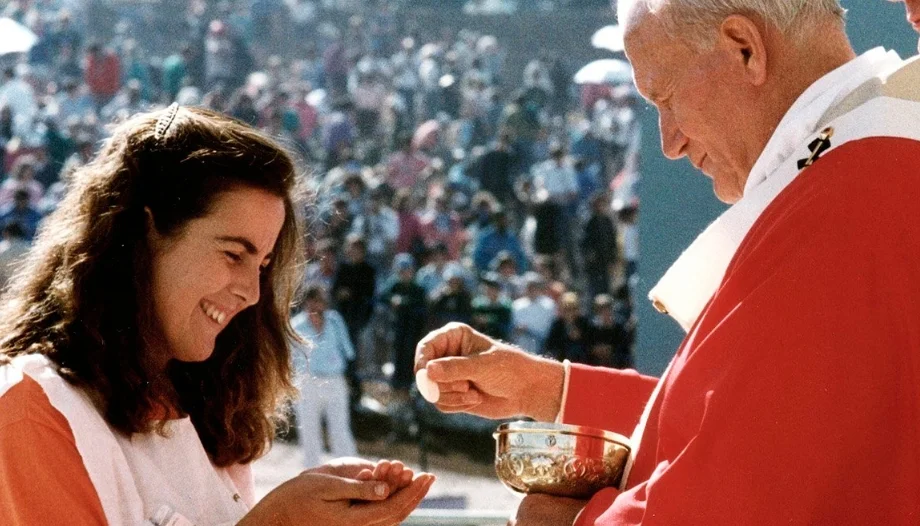
- Cultivate the desire for full union with Christ. Pay attention when receiving communion and be aware of what is happening: God wanted to be with you in your own body.
- If you are unable to receive communion, it is good to practice the spiritual communion, The Pope, recalled by John Paul II and recommended by so many Saints.
Before entering the Mass: «letting go».»
In the midst of a frenetic and busy life, one chooses to go to Mass. And as soon as one enters the silence that the Church offers, the mind begins to wander and to make a tour of all the worries that it rarely stops to process. It often happens that Mass is used as a pause to organize one's thoughts. And many may leave without having really listened to the Word of God and without realizing what has happened there. The priest Joel Guibert, in his book Eucharist, warns against this numbness and proposes to leave our worries before the altar:
"If we want to enter into prayer, we must begin by placing our concerns at the Lord's feet. Without this abandonment, it will be difficult for God to penetrate the soul and perfect it. How can he do so? If the pray-er remains clinging to his worries, polarized by his projects or his inner film, God cannot, in such circumstances, offer his presence, his grace, his wisdom. In fact, the pray-er is likely to end up even more overwhelmed by his worries after hours of prayer if he does not decide to give them to God.
And it is not surprising, because in the silence of his prayer, he must have devoted himself to thinking about his problems, unable or unwilling to open himself to God's gift.".
Once one's worries are offered to the Lord, one can be ready to attend to and enjoy the greatest gift that God gives us and which is full of wonders.
First wonder: Jesus with us
The first wonder of the Mass is the REAL presence of Jesus. The Church teaches us that every Eucharist has the same value. It is not “more” or “less” depending on who celebrates it or how we feel. Whether the celebrant is more eloquent or simpler, more fervent or weaker, the value is the same. Because the one who really celebrates is Jesus, the true protagonist. His greatness is infinite, because in every Mass the one and only sacrifice of Christ is made present.
When we speak of “memorial,” we are not referring to a simple remembrance, as when we evoke a friend who has died. In the Eucharist we really enter into the event of the Last Supper and the Cross, which are intimately linked. As the Desiderio Desideravi According to Pope Francis, the Supper and the Cross form a single mystery: in the Supper Jesus anticipates his self-giving, and in the Cross he consummates it. Without the Last Supper we would not fully understand the Cross.
To place our life on the altar
Another marvel is the sacrificial dimension: in it, Jesus offers himself to the Father. The entire Eucharistic prayer is addressed to the Father, and this reaches its culmination in the doxology: “Through Christ, with Him and in Him, to you, God the Father omnipotent, in the unity of the Holy Spirit....”. This sums up the whole dynamic of the Eucharist: through Christ, to the Father, in the Spirit.
Christ offered himself to the Father to save us, and in every Mass he makes that self-offering present. But the most amazing thing is that he unites us to his offering. When the priest says: “Pray, brethren, that this sacrifice of mine and yours...”, is stating that that sacrifice is also ours. Not because of our merits, but because Jesus takes us to Himself and presents us to the Father united to Him.
This is the culmination of participation: not to attend as spectators, but to offer ourselves with Christ. To place on the altar our life, our struggles, joys and sufferings, and to truly say “Amen”. That is real participation: a heart attentive and united to Jesus, becoming with Him an offering to the Father.
The first kiss
In order to experience the Mass as actors from the first moment, it is important to understand the meaning of the initial signs. When the priest enters in procession and kisses the altar, he is not making a merely symbolic or protocol gesture: the altar represents Christ himself, who is at the same time priest, victim and altar of sacrifice.
To kiss the altar is to kiss Jesus, who gave himself on the cross and who will sacramentally make present his self-giving for our salvation. Although the priest performs the gesture externally, he does it in the name of the whole assembly; therefore, the faithful must also unite themselves interiorly to this act with faith and love. From that moment we are reminded of something essential: the only protagonist of the Eucharist is Christ. Not the celebrant, nor the choir, nor those who intervene, but Jesus, who returns to offer his redemptive sacrifice. That initial kiss disposes us to enter consciously into the mystery and to participate with our hearts in the offering that is to be renewed on the altar.
Humble disposition
The first thing is to open my heart to the Lord, to recognize. It is a very important moment, because the Lord wants me to nourish myself with Him and to enter into me. Pope Francis spoke of how it is Jesus himself who attracts us and does everything possible for us to attend the Eucharist.
Priest José insists on the importance of recognizing our littleness in order to enter Mass with a humble disposition: «It is very sad when people measure how late they can be for Mass in order to fulfill the precept. We should not miss the penitential act because it prepares our heart. It is to say to the Lord: ‘Look, this is my heart, but I have come precisely so that you can sanctify it'».
The Gloria: the song of Heaven
Pope Gloria consists in making us deeply aware that in the Eucharist the whole Church is present: militant, purging and triumphant: «in any Eucharist, however modest it may be, there is the whole Church, and in a special way, the whole Church in Heaven». This is what St. Francis of Assisi said: «The Mass is the moment when heaven and earth are united».
Pope Gloria is the great song that we will sing in Heaven, and that is sung by the angels, the Virgin, the saints. In this way we really participate in the heavenly liturgy, the liturgy of Heaven.
The Word: a lover's letter
Many listen to the Word of God as a simple learning or mere moralism, forgetting from whom what they hear comes. Priest José maintains that «we should listen to the liturgy of the Word like a lover who receives a letter from her beloved. She receives it with illusion because she knows that her beloved wants to tell her how much he loves her».
After listening to the Word of God, the priest, with his preparation and humility, has the mission of helping each member of the faithful to be intimately united to the Lord, creating the conditions for the Spirit to act in each one through the homily. His words and gestures do not by themselves generate union, but they can dispose the faithful to welcome it, accompanying Christ's desire to meet each heart.
I believe, we believe
We must always carry our profession of faith with us, but we must also make it present in the liturgy. In the councils where the Creed was defined, “we believe” was said in the plural, because faith is not only individual: in saying “I believe” I unite myself to the whole Church, which supports me in my profession of faith. It is like singing in a choir: even if at some point I lose my way, the choir accompanies me and maintains the harmony. That is why, even in celebrations such as baptism, when we are asked “Do you believe in...?” and we answer “Yes, I believe”, we are expressing the faith of the whole Church. My personal faith is not alone; the Church sustains and accompanies it. Therefore, when we pray the Creed, our voice is united to that of the whole community, making present that unity and support of faith.
Presentation of offerings: offering to me
Then begins the presentation of the offerings: «It is very important to realize that we must offer ourselves. We offer ourselves and Jesus offers us too, inviting us to unite ourselves to what He does», affirms José.
«We present the bread and wine, which are really a gift that we have received, like all of creation. And what we receive we give back to him. This is, in the end, the dynamic of God's love: everything I do, I have received from him before. All I do is say “yes,” I want to unite myself to you, but with the conviction that everything has been a gift. I do not give anything to the Lord that He has not given me before», he adds.
What does the priest pray quietly during the offertory?
There is a gesture that perhaps we are not aware of and it would be good to know. First the bread is presented and then the wine and a drop of water are placed in the chalice. The wine can be prepared before, but the proper action of the priest is to pour the water. This gesture should be done by him, not by someone else.
As he does so, he says the following sentence: “By the mystery of this water and wine, grant that we may share in the divinity of the one who has deigned to share our humanity.”. And that drop of water represents my humanity, which is united to the blood of Jesus. In every Eucharist we are asking to share his divinity. This is the Christian way: that the Lord may gradually divinize us.
Then, the priest bows and prays: “Accept, O Lord, our contrite heart and our humble spirit; may this be our sacrifice today, and may it be acceptable in your presence, O Lord our God.".
These prayers are made in the name of all. They are not something private, but express our littleness and our humble attitude as we offer the bread and wine, which will become nothing less than the Body and Blood of Jesus.
Next comes the washing of hands, accompanied by another prayer: “Wash away my crime, Lord, cleanse me from my sin”. It is a gesture of inner purification.
Immediately afterwards, the priest says: “Pray, brothers and sisters, that this sacrifice of mine and yours...”. This reminds us that the sacrifice is everyone's, that everyone also offers himself.
The culminating moment: the consecration
The consecration is the central moment of the Mass. «As the priest pronounces the words of Jesus, we should be with absolute attention and emotion, as if we were at the Last Supper. That is where the miracle happens. The elevation afterwards is just a sign for us to worship, it is a ‘it is already accomplished'» explains José.
After the Eucharistic prayer and the doxology (“Through Christ, with Him and in Him...”), the preparation for communion begins. Everything leads to this moment. Jesus is waiting for us, like a lover who wants us to come closer to receive him. As St. Augustine said, «God thirsts for man to thirst for Him». That is why it is so important to prepare ourselves well.
Before receiving communion, the priest can pray this prayer (José likes especially the first one proposed in the missal): “The priest can say the following prayer: "Lord Jesus Christ, Son of the living God, who by the will of the Father, with the cooperation of the Holy Spirit, gave life to the world by your death, deliver me by the reception of your Body and Blood from all my faults and from all evil. Grant that I may always keep your commandments and never let me be separated from you".
This can be a very simple and profound prayer as we approach communion. And we do all this after recognizing with humility: “Lord, I am not worthy for you to come into my house...”. Because we really are not worthy, but, even so, He wants to come. And that is the most beautiful thing: He wants to enter into us.
Mother Teresa's concern
It is important to understand, when we go to Mass, that even if we go eagerly, it is He who first calls us to go and who is eager to see us. This thirst is reflected in the lives of many saints. Let us take as an example Mother Teresa of Calcutta who, when Jesus presented Himself to her, was particularly moved by this «I thirst».
This excerpt from his letter testament can help us better understand the magnitude of this thirst:
«I am concerned that some of you have not yet really encountered Jesus alone, just you and Jesus.
As long as you do not listen to Jesus in the silence of your heart, you will not be able to hear Him say: ‘I thirst. The devil will try to use the wounds of life, and even your own mistakes, to convince you that it is not possible for Jesus to truly love you. The saddest thing is that this is just the opposite of what Jesus wants and is waiting to tell you. Not only that he loves you, but that he ardently desires you. He misses you when you are not near Him. He thirsts for you. He loves you constantly, even when you do not feel worthy of Him. He. When others do not accept you, or you do not accept yourselves, He is the only one who accepts you. I thirst‘ is much deeper than simply saying ’I love you‘.
Until you understand, in your innermost being, that Jesus thirsts for you, you will not be able to understand who He wants to be for you, nor who He wants you to be for Him. What should be your attitude towards Jesus» thirst? There is only one secret: the closer you get to Jesus, the better you will understand his thirst".
The saints understood the greatness of the Mass
The saints were the ones who best understood, not only with their intellect but also with their hearts, the greatness hidden in every Mass. For them, the Eucharist was not a Sunday custom or just another rite, but the center of their lives. Their grateful wonder can teach us to look at the altar with different eyes. Here are some phrases about the Mass:
- «The Mass is not a spectacle, it is the sacrifice of Christ in which we must participate with reverence.» - St. John Paul II
- «The Mass is the greatest act of love we can offer to God.» - St. Maximilian Kolbe
- «A single Mass heard during life is more valuable than many material goods left as an inheritance». - St. John Bosco
- «If we knew the value of Holy Mass, what a great effort we would make to attend it!». - St. John Mary Vianney
- «The Eucharist is the food of the soul, without it, the soul dies.» - St. Teresa of Calcutta
- «The Mass is an inexhaustible source of grace». - St. Peter Julian Eymard
- «The Mass is the unbloody renewal of the sacrifice of the cross.» - St. Francis de Sales
- «The Mass is the sacrament of love; it signifies love, it produces love.» - St. Thomas Aquinas
- «The Mass is a school of prayer». - St. John Paul II
- «The Eucharist is the love of Christ made visible». - St. John Mary Vianney





 Español
  English
  Italiano
  Français
  Deutsch
  Polski