


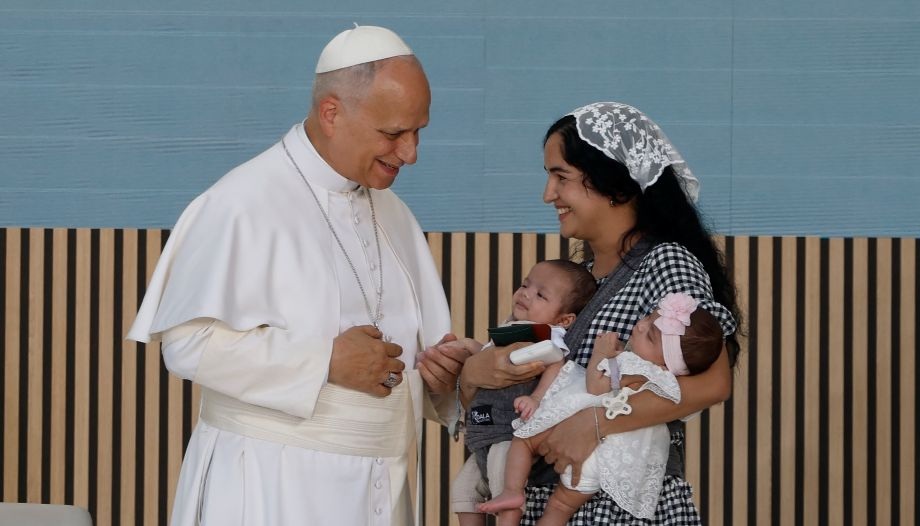
It was not a stage with a great protocol. It was a dining room, a courtyard and some rooms where every night dozens of people who have nowhere to go find shelter. And this Monday, between 18:00 and 18:40, the Pope chose that place -the CEDIA 24 Hours Center in the Lucero neighborhood of Madrid- for one of the most intimate meetings of his visit to the capital. A visit that lasted forty minutes and that left a mark difficult to erase in all those who lived it.
CEDIA: open 24 hours a day, 365 days a year
The CEDIA 24 Hour Center is the heart of Cáritas Diocesana de Madrid's emergency care network for the homeless. It never closes: it is available every day of the year, at any time, to offer basic services, social support and reintegration programs to those who find themselves on the streets.
Beyond immediate care, the project includes sheltered housing for people in the process of recovery, vocational training workshops, personalized intervention programs and comprehensive social accompaniment aimed at promoting the autonomy of each person. A model that has shown, year after year, that with the right resources and will, it is possible to help rebuild lives.
Arrival: welcome at the door of the hostel
At 6:00 p.m. sharp, the Pope arrived at the center. At the main entrance he was met by the Cardinal of Madrid, José Cobo, and the director of Madrid Diocesan Caritas, Luis Hernando Vozmediano, who welcomed him.
Once inside, one of the residents explained to the Holy Father how the center works and the type of assistance provided to the homeless. It was a simple and direct presentation, with the authority that only one's own experience can give. The project coordinator and four collaborators then accompanied the Pope to the dining room, where several residents were waiting. Before going out into the courtyard, the Holy Father signed the visitors' book and, finally, went up to the podium and took a seat next to the Cardinal Archbishop.
The courtyard of the Social Pastoral: almost 200 people and four stories of hope
In the courtyard of the Church of Our Lady of the Crucifixion, annexed to the CEDIA complex, Leo XIV held a meeting with representatives of the Social Pastoral of the Church in Madrid. Nearly 200 people were eagerly awaiting the Holy Father under a sun that gave no respite.
Before the Pope's arrival, attendees were able to write their messages of hope in a space prepared for this purpose, enlivened with musical performances by Migueli and Chito Morales. The event was conducted by journalist Mario Alcudia.
With the Holy Father present, it was Niña Pastori who dedicated one of her songs to him - the artist who had already participated in a meeting with Pope St. John Paul II - in a moment that deeply touched all those present.
Greetings from Cardinal Cobo
During the meeting with the Holy Father, the Cardinal Archbishop of Madrid welcomed the Pontiff, recalling that the identity of the Spanish capital is defined by its capacity to welcome, affirming that «if you are in Madrid, you are from Madrid», and thanking him for also joining in this universal citizenship.
Cobo stressed that the decision to begin the visitation in a socio-charitable environment is an authentic «confession of faith» based on the certainty that Christ is present in the most disadvantaged.
Under the slogan «Raise your eyes», the cardinal invited the attendees to raise their eyes towards heaven, but with the unrenounceable condition of keeping «their feet firmly in the mud», that is, glued to the reality of the streets of Madrid where thousands of people continue to suffer from lack of housing, decent employment or simple companionship.
In a second part of his speech, Cobo translated this «far-sightedness» into concrete data to x-ray the immense network of fraternity that sustains the archdiocese in the face of the current challenges.
As proof of the real commitment of the Church in Madrid, he provided figures of great social impact: the balance of Diocesan Caritas, which last year accompanied nearly 90,000 vulnerable people through its parishes and more than 400 projects for families, migrants and homeless people, a work that is strongly supported by another 300 projects led by the consecrated life in the diocese.
Four stories that represent thousands
The Pope then listened to three testimonies to represent a few stories among many. Niurka's story is that of a mother who arrived in Madrid a year ago, alone, pregnant and in fear, was transformed into a testimony of hope thanks to the welcome of the Church at Hogar Santa Barbara. Listening to her story, it became clear how the daily care of nuns and volunteers not only took away her loneliness, but also provided a real family and a community of faith for her twins, Ares and Atenea, who were born and baptized in the warmth of this institution. «Today I look at my children and I know that we can have a future,» Niurka told the Pope.
Next, Khadry, a young Senegalese man who arrived in Spain in 2020 in the context of the pandemic, recounted how he initially felt lost and alone in an unknown country, until he met people who looked at him with respect and made him feel that his life mattered, culminating his intervention with a gesture of profound symbolism: the presentation to the Pope of a replica of his residence card. «It represents a long time of waiting and effort, but also a life that is back on its feet,» he said with gratitude, making his identity card the living reflection of regained dignity and the hope of a new beginning thanks to human solidarity.
Finally, Alicia, from the Hope Project of the Holy Father Adorers, spoke on behalf of the volunteers of the Social Pastoral of the Diocese of Madrid.
Words of Leo XIV
During his speech at CEDIA, the Pope stressed that the Church's charitable work is not simply a philanthropic endeavor, but an evangelical path that follows in the footsteps of a Jesus who fully identified with human weakness.
In elaborating on the motto «Lift up your eyes,» the Pontiff recalled that charity does not admit of delay, comparing it to a ripe harvest that is lost if it is not harvested in time. This responsibility, he explained, turns every encounter with the needy into a kairos He warned against the risk of allowing the ecclesial mission to be contaminated by worldly ideologies or economic interests that disregard the exercise of charity as something secondary.
«It is not possible to forget the poor if we do not want to go out of the living current of the Church,» he said, placing love of neighbor at the incandescent center of faith.
Charity is a good for the one who exercises it.
In a second part of his address, the Pope called for the recovery of the human dimension and the personal encounter in the act of helping, urging those present to look into the eyes and touch the reality of those who suffer. Citing his own reflections on the true nature of almsgiving, he insisted that almsgiving is not mere charity, but an act where the donor receives the greatest grace by allowing himself to be «looked into the eyes of the Lord» through his brother or sister.
For the Holy Father, to truly love implies going beyond material giving: it requires listening, dialogue and a commitment to the integral promotion of the person. Thus, the gaze he proposes is not distant, but one that seeks to understand the causes of need and to embrace both material and spiritual needs, consolidating aid as an embrace of universal fraternity.
Gift exchange and blessing
Before saying goodbye, an emotional exchange of gifts took place. The Pope presented the CEDIA Center with an icon of the «Face of Christ of Love», a gift full of symbolism for a place where every day they seek precisely that: the face of Christ in the most vulnerable.





 Español
  English
  Italiano
  Français
  Deutsch
  Polski