



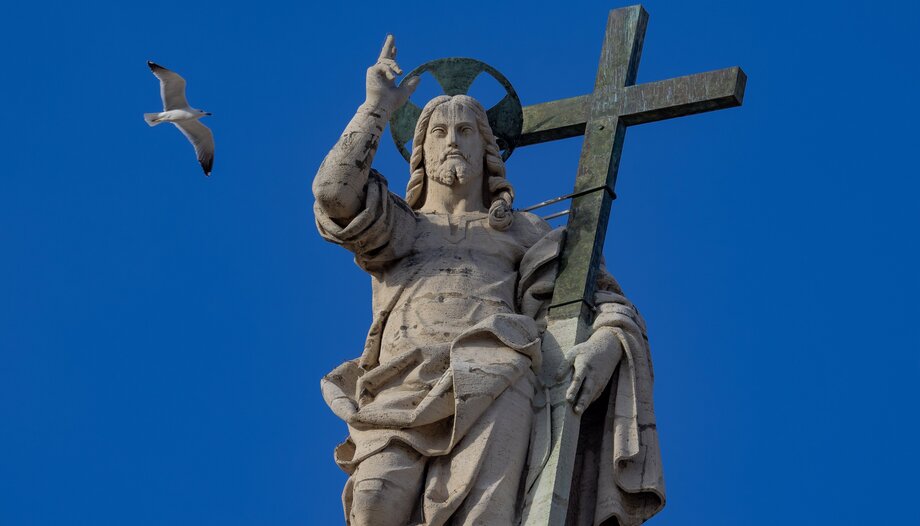
 Which Church, which priests?
Since God himself is the author of the Church - Christ gave himself for her, founding her - she is holy. And to preserve her holiness, the Holy Spirit enlivens her day by day. The Church, in herself, is holy: her holiness is found in her union with Christ and the fullness of the means of salvation she possesses, in particular the sacraments.
Our Faith confesses it, and it is so stated in the Catechism in no. 823, in pointing out that the Church cannot cease to be holy. Christ himself, whom with the Father and the Spirit is proclaimed “the only holy one,” loved his Church as his bride.
The Church, according to the Second Vatican Council, is considered the holy people of God, and already on earth she is characterized by true holiness, although it has yet to be attained (Lumen Gentium 12 and 48). Its members, as St. Paul himself says in his letters, are called “saints”.
Thus, the Church is holy in her divine and creative essence - Christ founds her - and her means. Even though, as we shall see, its members, pilgrims on earth and on their way to Heaven, sin and are in a constant process of purification and conversion.
Limitations -and sins- of the members of the Church
Every time we recite the Creed we affirm that the Church is holy, and this surprises many, when the defects and sins of its members - we could say especially those of its leaders, who are more conspicuous or “scandalous” - are very visible: abuses of multiple types, financial crimes, etc., in addition to other historical deviations such as coexistence with slavery, or the consensus regarding the wars of religion.
At this point we would like to underline the term “visible”, since one thing is what we observe, and even judge - and rightly so - and the other is what may happen in the hearts of those who represent the Church, that is, what may happen in the very heart of the Church.
In other words: should we focus on the sinful error committed, or rather on the capacity of the human heart to embrace God's forgiveness and heal the wound inflicted on the Church of which it is a part? With the passage of time, there are those who appreciate a restored work, which, although it has lost its immaculate condition because it has ceased to be the initial perfect work -in our discourse, the Church founded by Christ-, does not for that reason cease to show beauty -in our discourse, holiness-. This, holiness, as we know, is not associated with not making mistakes, but with rectifying and asking for forgiveness.
And who is able to sustain the lack of repentance of the representatives of the Church who have sinned? No one, only they themselves can verify their repentance and, therefore, request for forgiveness and healing.
The spiritual security of the faithful
On the other hand, referring to the hierarchy of the Church, we note that the unworthiness of its members does not prevent them from carrying out the ministry entrusted to them. Thus, a sinful minister can dispense the sacraments in spite of his sin: this is a sign of the holiness of the Church he serves. Naturally, unless there is some canonical sanction prohibiting him from carrying out such a ministry.
In this regard we would also refer to the term “Ecclesia supplet” - the Church supplies - a juridical principle referring to the fact that the Church validates sacramental or administrative acts that could be invalid due to an error of fact or law, or lack of jurisdiction. In this way, the spiritual security of the faithful is guaranteed, which is due precisely to the sanctity of the Church, and not to the limitations of its ministers.
Which Church, which priests?






 Español
  English
  Italiano
  Français
  Deutsch
  Polski
  简体中文
简体中文