



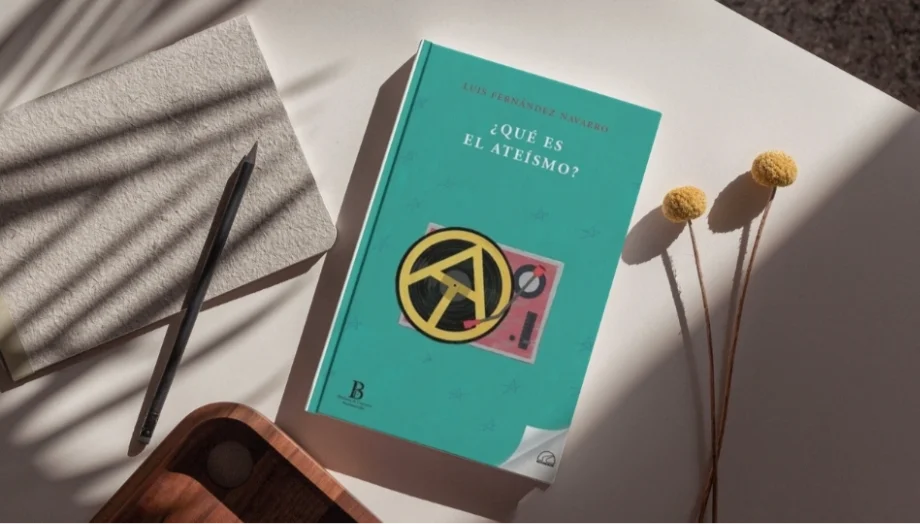
Senderos, a Sevillian publishing house, has just published a book on the market entitled What is atheism? Its author, Luis Fernandez, is a professor member of the research group Philosophy, Culture and Nature of the University of Seville. Author of a study on Skinner (2025), and another on Chomsky's anarchism (2026), he is a regular contributor to conferences and publications of the Tatiana Foundation of Madrid.
Already in the prologue it is made clear to us: “the reader has in his hands a kind of intellectual autobiography”. The author treats the subject with scientific objectivity, but never with the distance of someone who is not affected by these questions.
Although young, he has gone through 68 and the post-conciliar period and has suffered the consequent ups and downs. In search of truth, he enrolled in the Faculty of Philosophy, and exercised the criticism that involves “analysis, independence of judgment, dispassion and impartiality”. He learned to “respect evidence and follow arguments without fear of their fate”, with a notorious intellectual honesty.
To conclude that “the history of religions offers us such a rich and heterogeneous empirical material that it is too complex to fit it into preconceived and universal schemes of evolution”.
The book seems to answer these questions: “God? A fiction. Religion? An invention. Christian morality? An unnatural construct. Matter? The only reality, immortal in its being and mortal in its dispositions. The soul? A finite extension, made up of atoms. Good and evil? Fables. Good and Evil? Utility. Death? Non-being, nothing to fear. The body? A machine. This is the catechism of the enlightened atheist” (p. 93).
The text is structured in three parts of different dimensions: 1. What is atheism (pp. 19-30); 2. History and criticism of atheism (pp. 31-166); and 3. The scientific difficulties of atheism (pp. 167-186). And it culminates with a synthetic but very complete bibliography, which allows those interested in the subject to continue deepening in it.
In less than two hundred pages he discusses the authors and trends of atheism from antiquity to the present day. It is not a history of philosophy or theology, but a selection of relevant intellectuals.
Even in the last part, he shows that he is very up to date with the scientific issues related to this subject. It is difficult to synthesize the contribution of philosophers or scientists, to focus the core of their theses, to expose and comment on them, distinguishing the positive from the wrong. This is undoubtedly achieved here.
The result is worthwhile: the historical review from Antiquity (where there were hardly any atheists) to the present day goes to the essentials, focusing on atheism, but contextualizing it. The Ancient, Middle and Modern Ages are underpinned by their representative philosophers and theologians: Protagoras, Democritus, Critias, Thomas Aquinas, Siger de Bravante, Boethius, Luther, Nicholas of Cusa, Bruno, Spinoza, Bayle, Gassendi... and other lesser known philosophers and theologians who are reviewed, pointing out pros and cons in relation to atheism.
From the eighteenth century onwards, the headings respond to questions such as “agnosticism, deism, naturalism, materialism, hedonism, skepticism, anthropotheism, neo-atheism”, or “system, illusion, freedom”... because these are the concepts that have brought together the leading figures since then. It was not in vain that we had been warned that the basic conceptual quartet of the question addressed was formed by agnosticism, theism, atheism and enlightened deism.
The latter is the birth of contemporary atheism. And in a work of popularization (even a high one) it is always convenient to define the concepts with which one works. Another significant aspect of the book: as one moves towards the contemporary world, the author dedicates more pages to dialogue with the theses of those he studies.
The parade of authors is very complete: Voltaire and the French Encyclopedia (deism); Meslier, an interesting and not so well known figure of naturalism; La Mettrie (materialism), Helvetius (hedonism).
Luis Fernandez goes on to comment: “for many, it is only worthwhile to affirm, to advance verisimilitude, not to set out to prove the truth”. Because “matter, determination, fiction, illusion are recurring notions, indispensable in all atheism” (p. 109). But he is also able to admit the argumentative quality of many atheists, since “not all knowledge can come entirely from a sensible source. It is always a mixture of theoretical elements and experiential data” (p. 100).
The effort to cover contemporary figures who have posed the problem of faith is evident: Feuerbach, Marx (whose atheism is more a critique of religion than an investigation into the existence of God), Nietzsche (so brilliant, complex and unsystematic), Freud (with his psychological explanation of the religious as fiction, illusion, delusion and a universal obsessive neurosis, the nostalgia for the lost father), Sartre, for whom man thrown into the world and doomed to praxis, is condemned at every instant to invent man; or the four horsemen (Harris, Dawkins, Dennett and Hitchens) to whom he devotes many pages.
One of the book's strengths is that it involves the reader and encourages him to reflect on the intellectuals studied. At a certain point, the author concludes: “science in none of its branches has been able to issue a theological opinion and there are already several centuries of work, but there is no laboratory that supports the existence of God, nor its opposite”.
And he adds: “Thinking only of man, from the eyes of theistic faith, the human being, product of God, image of God, has a sacred dimension” (p. 115). And “if we were to think about it, we could also put into play the hypothesis that all religion exists as a human response to the obvious fact that God exists” (p. 158).
A book that every self-respecting intellectual, indeed, any human being in search of truth should read.
What is atheism?

Professor of Spanish-American Literature at the University of Seville.






 Español
  English
  Italiano
  Français
  Deutsch
  Polski
  简体中文
简体中文