


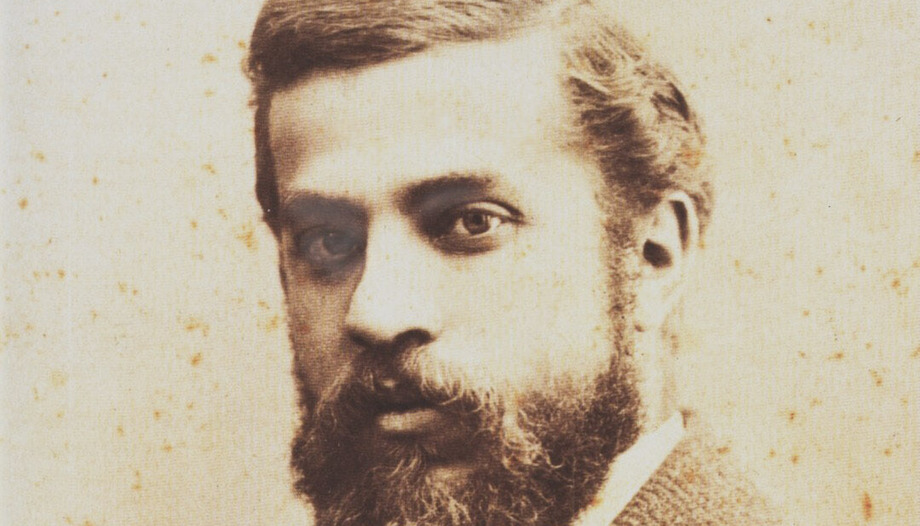
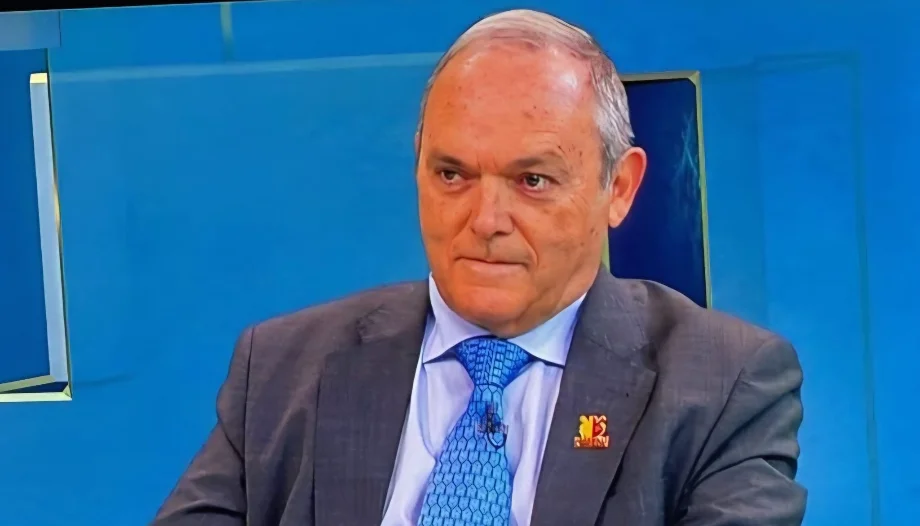
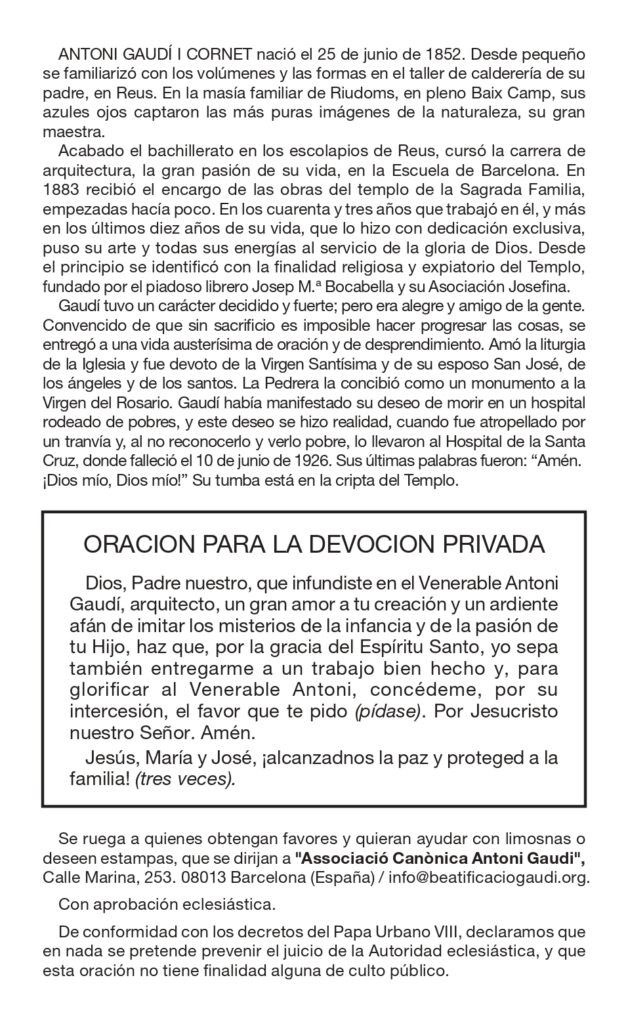
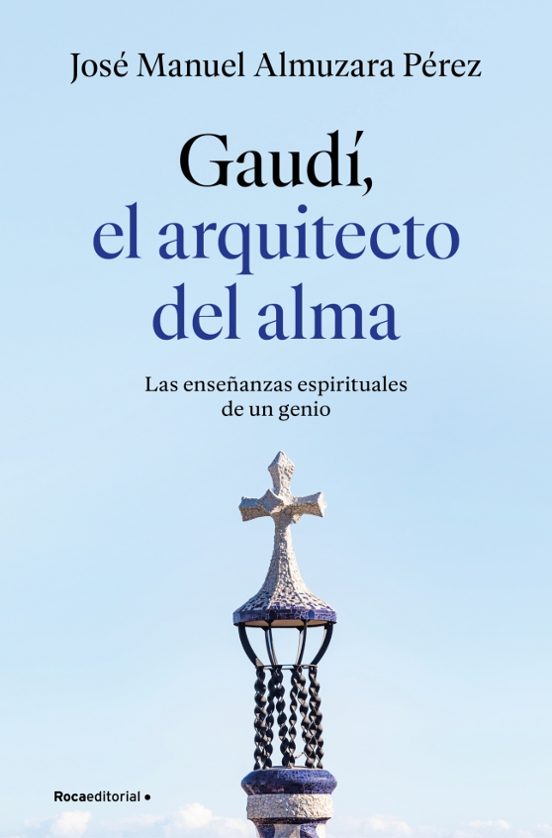
For more than three decades, José Manuel Almuzara has been one of the key figures in the dissemination of the spiritual figure of Antoni Gaudí. An architect by training, he has been president of the Association for the beatification of the Catalan architect since June 10, 1992. He has just published the book Gaudí, the architect of the soul, where he gathers testimonies and experiences of people who, through Gaudí's work, have experienced a profound inner transformation.
The cause took a decisive step forward when Pope Francis signed, on April 14, 2025, the decree that recognizes the heroic virtues of Gaudi, which makes him “venerable”. Almuzara, which has devoted decades to promoting his devotion and the artistic value of his work, talks about the most specific episodes of his spiritual life and his daily religious practice.
You have been promoting Gaudí's cause of beatification for more than 30 years. How did it all begin?
ーAbout fifty years ago I was studying architecture in Barcelona and met two of Gaudí's direct disciples who were working on the Basilica of the Basilica de la Sagrada Familia. They were about 85 years old and they directed the works. They invited me to their workshop and that's where it all started.
I was first attracted to the architecture, then to the man and finally to the Christian. Over time we saw that Gaudí not only made an impact through his work, but that he moved people inwardly, even to conversion.
So five lay people - two architects, an engineer, a sculptor and a retired man - founded the association in 1992 to promote his beatification. At the beginning, many people told us that it was crazy, but here we are now.
The Church asks for fame of sanctity and universal devotion for a cause. What concrete examples have you seen?
ーA lot of them. We received letters from all over the world. I remember a very special one from an executive of the Pusan Chamber of Commerce in South Korea. He was a practicing Buddhist. The government gave him a week to travel to Barcelona to prepare an exhibition on Gaudi. After that week he wrote a beautiful letter. It said: “Gaudí's architecture makes people discover the divine breath that beats in it”. And he added something even more surprising: that he had returned to Korea with the desire to become a Catholic. And so it was: he ended up being baptized.
Another case was that of an Italian architect, Sandro Rondena. He had a cancer considered incurable. His family went to pray at Gaudi's tomb in the Sagrada Familia. Some time later he was cured and returned to Barcelona with fifty friends to give thanks. The doctors studied the case and considered it extraordinary, although he had to wait five years, eventually the disease reappeared and he died years later. But that episode left a very deep mark.
In your book you talk a lot about Gaudí's spiritual life. What was he like in practice?
ーGaudi had a very intense religious life. He prayed the rosary, went to daily Mass, received communion frequently, read the Gospel, participated in processions. But there are lesser known aspects. For example, at Holy Family he joined the days of atonement to ask God's forgiveness for the blasphemies heard in society. It was not something symbolic: he personally participated in these days of prayer.
He also had great devotion to the Virgin. Yes, it is very interesting. In Park Güell he designed some viaducts with stone spheres. If you count them, there are exactly 150. Why? Because they are the 150 mysteries of the traditional rosary. Gaudí would walk through the park and pray the rosary counting those spheres. In other words, his architecture was also a tool for prayer.
What was a normal day like in Gaudí's spiritual life?
ーWhen I lived in Parc Güell I used to walk down to Mass at the church of San Juan de Gràcia. Then I would have breakfast and go to the crypt of the Sagrada Familia. There he would pray kneeling in front of the tabernacle. And something very curious: he never used a kneeler. He put a handkerchief on the floor and knelt on it to pray. In the afternoon he went to vespers at the Oratory of St. Philip Neri, where he also had spiritual direction with the Oratorian Agustí Mas.
One of the most surprising episodes of his life is an extreme fast. It took place in Lent 1894. Gaudi was deeply impressed by the example of Christ in the desert and decided to imitate him. He wanted to do forty days of fasting and penance. A disciple of his, the draftsman Ricard Opisso, was alarmed that Gaudi's condition was dangerous. It was then that he went to the bishop of Vic, Josep Torras i Bages, to intervene. The bishop had to convince him to moderate his penance.
Benedict XVI said that Gaudí “preached with his architecture”. Do you share that idea?
ーTotally. Gaudi did not preach with words, nor speeches, but with stones, strokes, symbols. All his architecture speaks of God. For example, in the crypt of the Sagrada Familia he placed in the keystone of the vault the “yes” of Mary. And if you draw a vertical line from that point you arrive at the star that crowns the tower of the Virgin. It is like a message: if you have Mary in your heart, you can give light to the world.
What does Leo XIV's upcoming visit to the Sagrada Familia mean to you?
ーIt is going to be a very exciting event. When Saint John Paul II and Benedict XVI visited the Sagrada Familia, neither came down to pray at Gaudí's tomb. But there are indications that the current pontiff, Leo XIV, might do so. To see the Pope praying at the tomb of the venerable Gaudí would be the most impressive and exciting thing for me.
There is still a lot of sculptural work to be done in some chapels of the Sagrada Familia, when do you think it will be finished?
(Almuzara smiles and remembers the answer Gaudí himself always gave). ー “My client is in no hurry”. A phrase that sums up the spirituality of an architect who conceived his work not only as an artistic project, but as an authentic catechesis of stone.
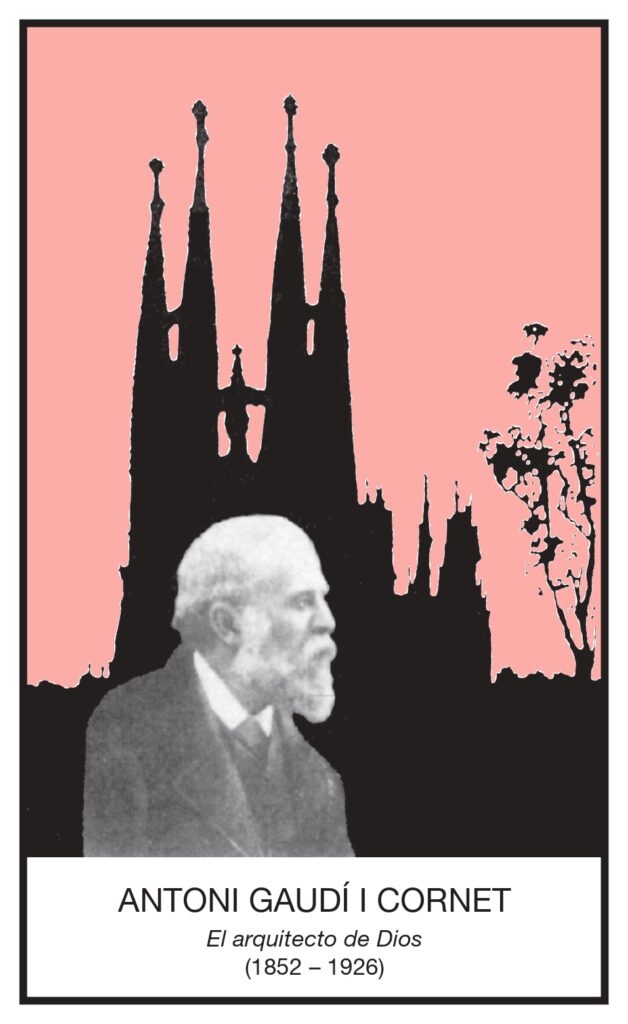
Gaudí, the architect of the soul





 Español
  English
  Italiano