



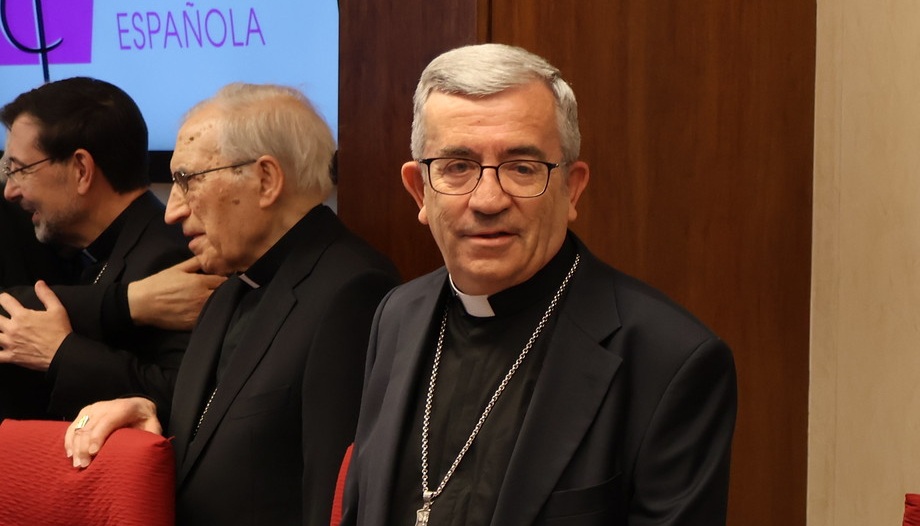
The Spanish Episcopal Conference opened its Plenary Assembly this morning with a speech in which Bishop Luis Argüello made a diagnosis of the social and political situation of the country. Starting from the recent Doctrinal Note «Cor ad cor loquitur» -the heart speaks to the heart-, Bishop Argüello warned about how the excessive management of feelings is leading to a phenomenon of fragmentation that erodes the foundations of coexistence.
In his words he did not refer to the controversies that arose around this document and the new forms of evangelization.
The speech began by appreciating the positive role of the new evangelization initiatives that have emerged within the Church, describing them as a «breath of fresh air» that seeks to «rescue people from the desert and lead them to the place of life.» These tools are necessary to accompany those who approach the faith seeking, like the Samaritan woman, «a fountain of water springing up to eternal life».
However, this positive assessment coexists with a clear warning: the danger of the spiritual experience becoming trapped in a superficial sentimentalism that does not become a true conversion.
Emotivist reductionism in the public sphere
The Church has identified that the so-called «emotivist reductionism» is not only an intramural risk that affects new forms of consecrated life built around «emotional leadership and experiences of affective impact», but it is a pathology that has spread to the public sphere.
This morning's speech underlined that polarization in Spain is not merely a clash of ideas, but, fundamentally, an «affective phenomenon». In this sense, it has been denounced that the current «affective polarization» causes that the rejection towards the other is stronger than the own adhesion to the ideas, transforming the opinions in closed identities.
Emotional identities
Under this prism, the text warns that the citizen no longer simply gives an opinion, but «is» a certain way to belong to a group that offers «emotional security to feel that you are on the right side of history». In this social-psychological analysis, it has been identified that «fear is the strongest glue of polarization», a feeling that leads to perceive the opponent not as someone with whom one disagrees, but as an «existential threat».
This dynamic cultivates the feeling that the triumph of the opposing side would mean the disappearance of one's lifestyle or core values.
Finally, the discourse has linked this crisis of coexistence to a theological and anthropological root. Polarization arises, according to the text, because the «dialectic of opposites» of late Modernity denies the essential polarities that constitute the human being, such as the relationship between self and society or history and eternal life. For this reason, Bishop Argüello concludes that, when these fundamental links are broken, society is left without bridges of dialogue, giving way only to a «struggle for power between the opposing poles» and to a moral superiority that seeks only the emotional relief of the «echo chambers».






 Español
  English
  Italiano
  Français
  Deutsch
  Polski