


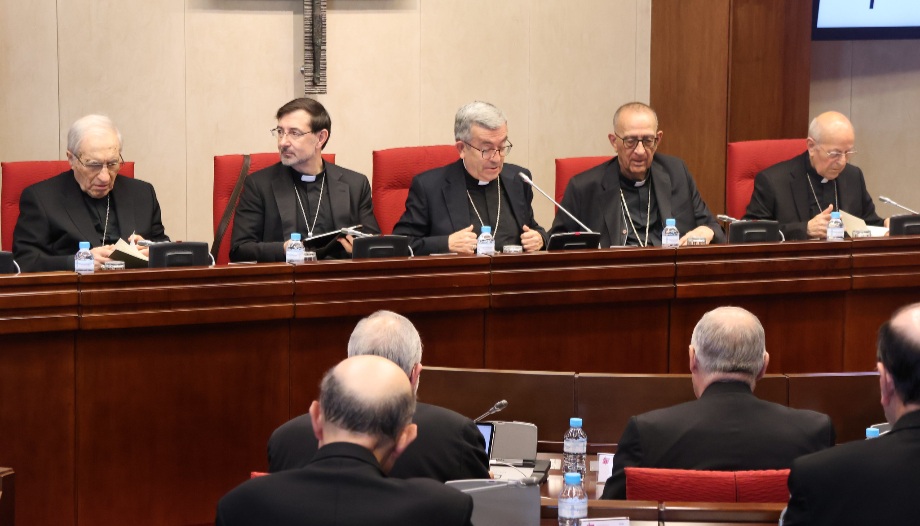
The president of the Spanish Episcopal Conference, Bishop Luis Argüello, opened the plenary assembly with a speech of social, pastoral and political content, in which he denounced what he considered a growing interventionism of the government, as well as a “confessional” drift in anthropological questions and in the interpretation of history.
Bishop Argüello maintained that, although the Spanish state is non-denominational, the executive adopts “confessional” positions in defining aspects such as the beginning and end of life, marriage, the family or human sexuality from what he described as “ideological faith criteria”, outside -he said- science and common experience. Along the same lines, he criticized a “selective” vision of historical memory, with unequal attention to the victims.
The Archbishop of Valladolid also warned of an “excessive desire” to intervene in civil society and to control key institutions, both in the political and economic spheres, as well as of a “double yardstick” in cases of corruption or abuse of power, depending on who is affected. To this he added the concern about the attempt to influence the media.
However, Bishop Argüello qualified that many of these dynamics are not exclusive to the current government, but can be applied, to a greater or lesser extent, to different executives. “Power and money are very strong temptations,” he said, referring to what he described as a structural weakness in public life.
Emotivism, immigration and the Valley
In his speech, he also linked the doctrinal note Cor ad cor loquitur with the current crisis of coexistence. In his opinion, “emotivist reductionism” is feeding an “affective polarization” that transforms opinions into closed identities and turns fear into the main factor of social cohesion, leading to perceive the adversary as a threat rather than as an interlocutor.
The president of the EEC also addressed the institutional relationship with the Government, pointing out that, despite the differences, the Church maintains a commitment to “respectful and critical” collaboration. He mentioned the dialogue in matters such as immigration, housing or education, although he underlined that the main efforts of agreement have been centered on the question of the abuse of minors within the Church and on the re-signification of the Valley of the Fallen. On this point, he acknowledged the “loyal collaboration” in the preparation of the eventual visit of the Pope.
Argüello pointed out that a future visit of Leo XIV to Spain would be a call to communion and an impulse for the Church's missionary zeal.
Pastoral lines
In the final part of his speech, the President of the Episcopal Conference outlined several pastoral priorities. He stressed the need to strengthen Christian initiation in a context in which the faith can no longer be taken for granted by cultural tradition, betting on a greater personalization of the believing process. He also announced the promotion of a vocation ministry that promotes life as a call, involving dioceses, consecrated persons, married couples and lay people.
Finally, he emphasized synodality as a central feature of the current ecclesial moment, in line with the Second Vatican Council, stressing the importance of “walking together” and integrating all vocations in the common mission of the Church.





 Español
  English
  Italiano
  Français
  Deutsch
  Polski
  简体中文
简体中文