



 The resonance of the voice over time
Blessed are those who believe without having seen.
Seeing is not the same as recognizing. Touching and feeling are not the same. Hearing and listening are not the same. We perceive the world through the senses and it is sight on which we mainly rely. Our sensory perception is not neutral. It is oriented, traversed by attention, by what we seek, by what we expect to find. We do not simply receive what is there; we interpret from a previous horizon of meaning. When we see, we do it from what we expect, what we already know and what we are willing to admit. For this reason, the obvious does not always impose itself.
From the sensible we construct knowledge. We name, classify, abstract. Those concepts that we keep in our memory order reality and at the same time cut it down. They select what counts as data and what is left out. Perception requires presence while interpretation decides its meaning.
Recognizing what we see
In the Gospel according to St. John, Mary Magdalene arrives at the tomb with the precise expectation of finding a body. Absence does not fit into this framework. She sees the signs - the moved stone, the linen cloths - but she cannot look at them. Even when Christ is in front of him, he confuses him. There is no lack of information. There is a lack of a way of recognizing what goes beyond what is expected. There is a limit to the interpretation of what the senses perceive.
Something similar happens in the way of Emmaus. The disciples listen, but do not understand. The content is accessible, but they do not yet have the key that orders it. Their attention is focused on their own pain and disappointment. They are not able to find the manifestation of the love of God in the pain. Until they turn their attention to their own burning hearts before Christ who breaks the bread.
The empty tomb is not just a physical void. It is a turning point. It forces us to review the framework from which reality is interpreted. Faith does not replace perception; it introduces a new criterion of reading that exceeds that of reason. It does not add another object; it alters the way in which what is given is understood.
In this sense, emptiness and fullness cease to be exclusive terms. Emptiness can operate as a condition of appearance.
Possibility in a vacuum
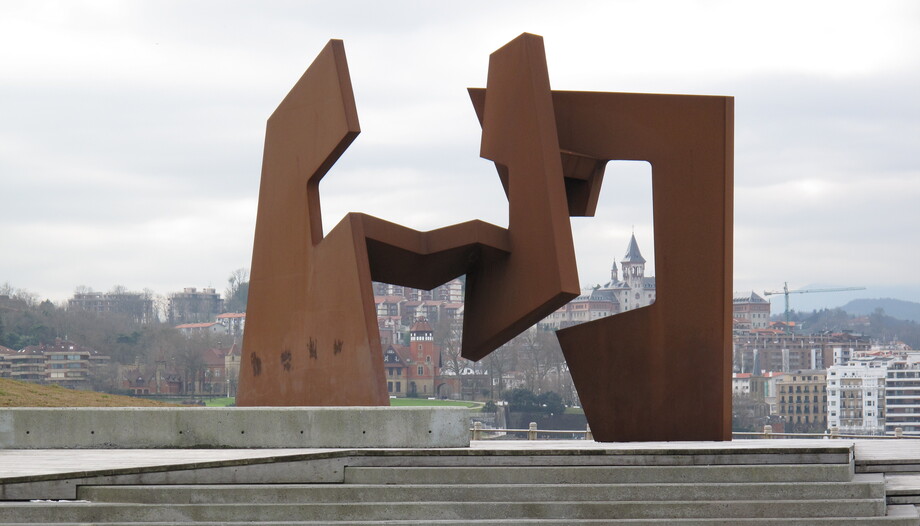
In the sculpture of Jorge Oteiza, emptiness is not the absence of work, but its result. The emptiness that could be considered as a remainder becomes activated space. Matter withdraws to make another form of presence possible. What is perceived is more than volume, it is tension between what is and what is released. There the emptiness that could refer to lack, is possibility.
Also in the symbolic experience the material is not exhausted in itself. It functions as mediation. It makes meaning accessible, it does not hide it.
The question is to recognize the scope of reason without abandoning it. Not everything that is real can be stabilized in concepts. There is a type of knowledge, of recognition that demands involvement, time and an attention that is not limited only to identification. It demands surrender.
In this context, to empty oneself does not mean to deny oneself, but rather to freely and voluntarily suspend the pretension of control over what appears. To introduce a distance with respect to one's own expectations so that what is real is not reduced to them.
Educating the gaze
In our sensitive world that which we touch, see, hear, smell, taste, we can turn into a symbol. Man connects with that which surpasses him through symbols. As ways of reading experience without falling into closed categories. In this horizon, the material is not opposed to the spiritual. It opens to a process.
To walk with Christ in his Passion and Resurrection demands this openness. Learning to look, to listen, to touch in a different way. It is not a matter of abandoning reason, but of letting it not be the only thing that determines what we see.
Faith educates this gaze. It broadens the capacity to recognize without adding something external. It makes visible what was there, but we had not known how to look at it.
And, as in the work of art, this transformation does not remain within oneself. Whoever learns to look also becomes a mediation for others. In a place where something can be seen, which does not close in on itself, but opens up space.
That transformation affects the way one stands in front of what is in front of him. And sometimes it makes it possible for others to see as well. Not as a conclusion, but as an opening.
Peca Macher is an architect and art curator, founder of Präsenz, a project that integrates art, education and conscious leadership through pausing, looking and listening. With more than 25 years of experience in cultural management and reflection, she writes and researches about memory, aesthetic experience and art as a tool for personal and social transformation. She is the author of the book Präsenz. Art as a tool for human and educational transformation.



 Español
  English
  Italiano
  Français
  Deutsch
  Polski
  简体中文
简体中文