


 Navarro-VallsJoaquín left a good part of his memories of John Paul II ready for publication"."The Primate of Poland," a film about the cardinal who paved the way for St. John Paul II.20 years after the death of St. John Paul II
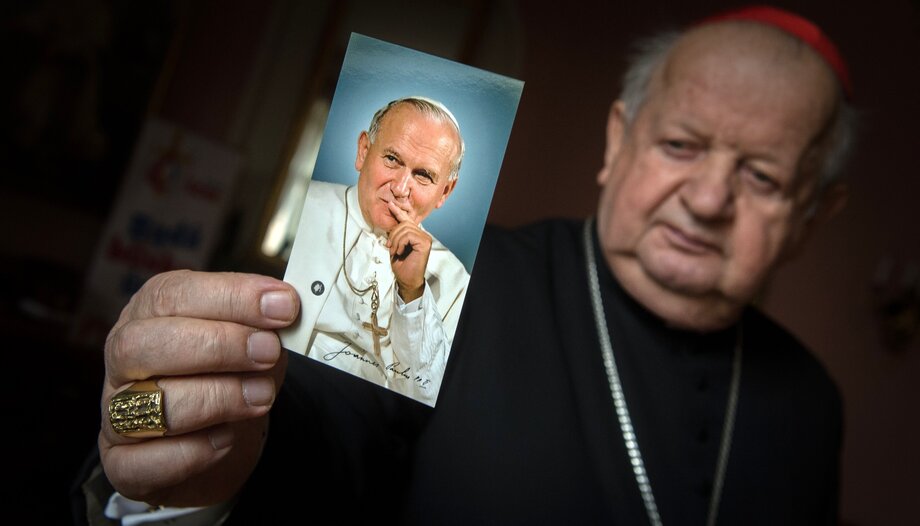
Archbishop Stanisław Dziwisz, the current Archbishop of Kraków, accompanied the Pope John Paul II for almost 40 years as his personal secretary, since he was archbishop in Krakow. From him he received the three holy orders of diaconate, presbyterate and episcopate.
John Paul II will be beatified on Divine Mercy Sunday. How do you remember April 2, 2005, the day of his death?
- It was Providence which chose for the Holy Father the day of his departure from this world to the Father's house. It was a Saturday - the first Saturday of the month - and his great devotion to the Mother of God is well known to all of us. It was also the eve of the Solemnity of Divine Mercy. In the evening, around 8:00 p.m., an inner voice asked me in an imperative way: «Celebrate Holy Mass!.
We concelebrated the Eucharist with the Sunday liturgy, dedicated to Divine Mercy. Cardinal Jaworski, a great friend and confidant of the Holy Father, participated in it. There were also priest Tadeusz Styczeń, Archbishop Ryłko, priest Mieczysław Mokrzycki, and our religious sisters. I was the main celebrant. We were all aware of the absolutely exceptional character of that celebration. The sacrifice of the Blessed Sacrament was united with the sacrifice of John Paul II.
The Gospel of that Mass was also very significant. It was the scene of the apparition of the risen Christ in the Upper Room, eight days after his Resurrection. We prayed at that moment that our Lord would come to us, we needed him... After the Creed, Cardinal Jaworski imparted to the Pope the anointing of the sick; at Communion, we gave him a few drops of Sanguis with a teaspoon. We still keep the spoon... The time came for him to leave... When his heart stopped beating, we stopped the watch, which we also kept as a testimony.
Your Eminence, for many years you accompanied John Paul II closely. We know that the spiritual life is always, in a certain sense, a process. At what point did John Paul II's holiness become more evident to you?
- Obviously, he did not suddenly become a saint; but his personal holiness was already «visible» in his younger years, when he was still a student at the University. On the other hand, his companions in the illegal seminary tell us that already then he was strikingly calm, natural, authentic; and that he maintained a continuous relationship with God. I think he received that spirituality and the ability to pray in his family home. For example, his father taught Karol a prayer to the Holy Spirit that accompanied him throughout his life, until his last day. On Saturday, April 2, when he was leaving this world, John Paul II prayed that prayer with our help.
When did you realize that you were in the presence of a man of great personal stature, a great saint?
- Many of us who were at his side were convinced that we were in the presence of a man of extraordinary capacity, inner strength and charisma. But what was striking was his inner simplicity. During my first year in the seminary and my first meeting with Professor Wojtyła I already had that strong impression.
Let me give you an example: during the breaks between classes, I noticed that he would go to the chapel and remain there in prayer. He had long bangs, and I remember that when he bowed in prayer they fell over his forehead... When he left the chapel, it gave me the impression that he was returning from a meeting in which he had «touched» the Mystery. The seminarians noticed it, with great naturalness, and for that reason they approached him. God was transparent in him; and that was what we were looking for.
We were also struck by the fact that after each Mass he remained in the church in personal prayer of thanksgiving. Later, when I accompanied him on a pastoral visit to a parish, I noticed that before the celebration he did not speak to anyone. He remained recollected, preparing himself to celebrate the Sacrifice of Christ. During his apostolic pilgrimages, his figure of a man recollected in prayer was always impressive.
Could it be said that in Karol Wojtyła's life contemplative prayer had a special importance?
- I think that he did not divide his time into “prayer” and ”work”, because prayer always accompanied him, even in the most prosaic actions. Many times I noticed that the Pope was praying for the people he had received at the audiences, and that, when he said goodbye to them, he entrusted them to Divine Providence. He did it so discreetly that only those of us who were closest to him could notice it. It was something extraordinary.
Sometimes, when he was praised during a visit, he would pray in a half-voice: he did not want to hear it; he laughed at the praise. In addition, each day went according to a planned prayer schedule. He got up early in the morning and began the day with meditation, Holy Mass, thanksgiving and spiritual reading. On Thursdays he spent an hour in adoration before the Blessed Sacrament exposed in the monstrance. And that was the way his life went. He often repeated to us: «Remember the apostles who fell asleep in the Garden of Olives, and how Christ asked them: ‘Why do you sleep? Were you not able to keep watch with me for an hour? It is clear that he wanted to make reparation for the apostles’ failure that night....
What forms did John Paul II's piety take? Did he always have a Marian character? Did he have any special mystical experience?
- No, I have no news of such things. But, on some occasions, when we left him alone in his chapel - so as not to disturb him - you could hear how he sang to Jesus Christ, or how he spoke aloud to him. He probably believed that no one could hear him. The chapel was closed, but sometimes he could be heard... For the rest, he used traditional prayers, the simple formulas of the Church: the Holy Rosary, the Stations of the Cross. But these were means that led him to contemplation.
John Paul II will be beatified by his successor, as had never happened before. He himself raised to the altars a multitude of saints and blessed. Why did John Paul II motivate the work of the Congregation of the Saints so much?
- The Second Vatican Council called for simplifying the canonization process, and the Pope was a Council man. He was very interested in new saints. Moreover, we must remember that it is precisely in the historical stages of secularization of society that saints appear. In Turin, for example, when Freemasonry was at its most intense, St. John Bosco appeared. And, more recently, when a great crisis seemed to be settling in the Church, the Holy Spirit has given rise to a multitude of new movements and communities that today are a force and a «reservoir» of holiness. The Holy Spirit blows where he wills.
Poland has taken a strong step in the defense of life in the womb since the establishment of democracy. Has the preaching of John Paul II influenced this social change?
- The defense of life was one of the most important aspects of John Paul II's pontificate. But this defense was in his preaching already before, during his lifetime. And, as Archbishop of Krakow, he fought resolutely for respect for life without exception.
In reference to the in vitro fertilization“ shared the pain of the parents in the impossibility of having children, but always affirmed that the best method to help these spouses is to investigate the causes of infertility and fight to cure it. He also encouraged adoption, because there are so many children waiting for the love of a family. His position on in vitro fertilization was not based on strictly religious criteria, but was motivated by ethical and scientific reasons.
John Paul II named St. Thomas More patron of politicians, and in the apostolic exhortation Christifideles laici he wrote that «the ‘unity of life’ is of great importance for the lay faithful. They, indeed, must sanctify themselves in ordinary professional and social life.» Karol Wojtyła himself always lived in the inner unity of all his facets, he was always himself. What can you tell us about that concept?
- The Catholic is always a Catholic, regardless of whether he is a politician-deputy, a minister or an ordinary man in the street; he is always obliged to respect the values that are binding on everyone without exception. If in a parliament the majority of politicians would recognize themselves as Christians, then Christian ethics should be present in the laws. On issues such as the defense of life or in vitro fertilization, there should be no compromises.
In many Western countries, quite a few Christians avoid expressing their personal convictions, while atheists and agnostics do so at the slightest opportunity. For this reason, atheists and agnostics do so at every opportunity. Benedict XVI has rightly said that today we see the schizophrenia of the Catholic politician who wants to be Catholic, but not in public, because he mistakenly thinks that he should not bring his convictions into the public sphere. In order to respect pluralism, he forgets that pluralism is a value subordinate to that of life. Moreover, hiding one's convictions in public life will lead to a cultural crisis and a destabilization of the European ethos.
In Poland, the impact of the secularization process is noticeable. Some people are asking for a lesser presence of the Church in public life. Is it possible that the process now observed in other countries, such as Spain, is being repeated there?
- There are secularist currents in Poland, but they do not have the virulence that is seen in Spain. After the entry into the European Union, there has not been a clear «secularization», although some predicted it. The adversaries of the Church try by all means to create an image of crisis. They say, for example, that the Church in Poland is not doing well in these times when figures of the stature of Cardinal Wyszyński or Pope John Paul II are missing. Curiously, these attacks come from the same people who had previously criticized these two great men. Anticlericalism will always base its program on criticism of all Church activity. They do not realize that the work it does for the common good could hardly be replaced by any other institution.
In today's world, and especially in the political sphere, man becomes materialistic and anxiously seeks human goods and glory. What was John Paul II's relationship with material goods like?
- He always led a very sober life. As bishop of Krakow he had only one raincoat, with a lining that he wore in winter. He did not receive a salary for being a bishop. He understood that he should only dispose for himself of the fees received for his publications. And even a large part of that money was given - this was not known to practically anyone - to scholarships for poor students. As pope, he never had any money in his hands (the same as in Krakow). If someone, for example, gave him an amount, he would delicately allocate it to other needs. The Secretary of State helped him in this: everything was written down and sent. Then he thanked us.
There were some extraordinary graces obtained from him while he was still alive. Do you remember any?
- I remember, for example, a parish priest in Trent who went to an audience with his sister, who was ill. She had cancer of the brain, and soon she was going to undergo an operation. He carried with him the image of the Merciful Jesus. The Pope touched her on the head and said: «Let's pray». A few hours later, it turned out that she was completely cured. She did not have to undergo surgery. There are many such graces.
I would like to end by asking you: what aspect of John Paul II's life do you think is most worthy of imitation?
- His prayer. But also his authenticity and transparency. It was characteristic of him to give extraordinary character to ordinary gestures. For example, when he passed through the corridor of the curia in Krakow, he would stop before the crucifix to kiss it and thus honor his Master. I remember that during one of his visits, in Sandomierz, he noticed a piece of bread on the ground; he knelt down, kissed it and put it on the grass for the birds to eat.
Krakow





 Español
  English
  Italiano
  Français
  Deutsch
  Polski