


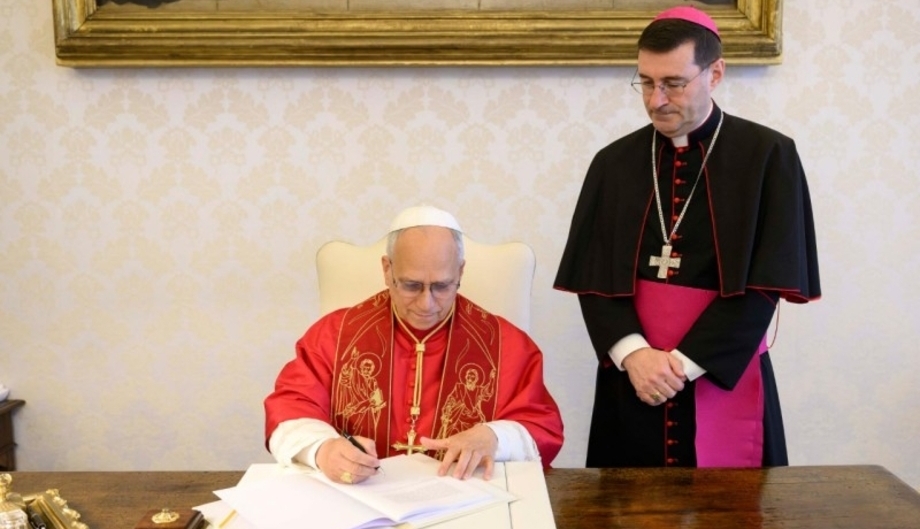
The magisterium of recent Popes, especially St. Paul VI, St. John Paul II and Francis, holy fathers of the Church such as St. Augustine or Aquinas, is present in an encyclical that also quotes Guardini, magisterial documents and even “The Lord of the Rings”.
Magnifica Humanitas is presented as an encyclical addressing the challenges of society in times of AI, not as an encyclical on Artificial Intelligence, an era described by some as the fourth industrial revolution. Indeed, the reference to Rerum Novarum, the encyclical of Leo XIII, from whom Pope Prevost takes his name, is a constant in this document.
If Rerum Novarum marks the beginning of what we know as the systematization of the Social Doctrine of the Church, the social, labor, relational and cultural change that humanity is experiencing, especially with the irruption and universalization of the use of Artificial Intelligence, is the key to reading Leo XIV's first encyclical, which begins by stating that: “the power and omnipresence of emerging technologies intertwine with the fabric of everyday life, mold the processes of decision-making and profoundly affect the collective imagination”.”
The Pope begins his first encyclical with a quick summary of all the aspects that he will develop in this document: the history of the development of the Church's Social Doctrine, the magisterial work in the path of accompanying and guiding people in the different situations of their existence, the prophetic denunciation of the dangers of “progress without God” and the call to “build a city centered on the common good” which “demands, above all, building on the rock of a relationship with God (...), accepting the limits and fragility of humanity without considering them an error to be corrected (...), accepting the limits and fragility of humanity without considering them an error to be corrected (...), accepting the limits and fragility of humanity without considering them an error to be corrected (...).), to accept the limits and fragility of humanity without considering them an error to be corrected (...) and to build a world in which all can ‘flourish’”.
The role of the Social Doctrine of the Church
“IA must be understood not as a thematic appendix, or as an emergency to be managed, but as a transformation that challenges from within the categories of Social Doctrine and demands its further development, in fidelity to the Gospel,” the Pope stresses in the first chapter of the encyclical, in which he retraces the Church's path in the development of Social Doctrine.
Here, the Pope recalls, in the words of Pope Francis, that, “on many specific questions, the Church does not claim to offer «a definitive word», but recognizes the importance of paying attention to scientific research and of fostering a serious and loyal dialogue among scholars, accepting the diversity of opinions”.
Robert Prevost clearly affirms the nature of social doctrine, “which does not claim to replace the responsibilities of politics and institutions, but offers itself as a support for common discernment, helping to recognize and promote what contributes to the dignity of persons, to the vitality of communities and to the good of all”.
In the first pages of this encyclical, Leo XIV offers a broad and profound overview of the key documents of the Church's Magisterium on the Social Doctrine of the Church, beginning with Rerum Novarum, followed by documents such as Quadragesimo anno by Pius XI, published in 1931, the radio messages of Pius XII, Mater et Magistra and Pacen in Terris by John XXIII; the important apostolic constitution Gaudium et Spes, and after the Second Vatican Council, Populorum Progressio, by Paul VI, author also of Octogesima adveniens, written on the occasion of the 80th anniversary of Rerum novarum, and closer to the present time, the Encyclical Laborem exercens, written ninety years after the publication of Rerum novarum, by St. John Paul II, Sollicitudo Rei socialis and Centessimus annus. Of Benedict XVI, the Pope recalls the key political and social application in his Caritas in veritate and, finally, Evangelii Gaudium, Laudato Si’, Fratelli tutti and Dilexit te of Pope Francis.
In the Pope's eyes, all this forms a clear and harmonious pedagogy: “Each one, taking up the challenges of his own time and interpreting historical changes in the light of the Gospel, has highlighted different aspects of a unique heritage: the dignity of the person, the value of work, the universal destination of goods, solidarity and subsidiarity, care for creation, the centrality of peace and fraternity. The result is a harmonious development, although not always linear, marked by different accents, by progressive deepening and, at times, by changes of perspective that do not break with what has gone before, but rather bring its implications to maturity”.
Human dignity
In the second chapter, the Pope dwells on the foundations of the Social Doctrine of the Church, recalling that “the Social Doctrine of the Church leads us to the very heart of our faith: the mystery of the living God, revealed in Jesus Christ as a communion of persons”.
In this sense, he emphasizes that the dignity of the person “does not depend on the abilities he possesses, on the wealth or the role he plays, nor on the right or wrong decisions he makes, but is a gift that precedes and exceeds him, given by God,” denouncing ideologies that consider people as mere means to obtain results.
The Pope warns of the danger that the protection of human rights may remain a mere formal declaration and that, in addition, its foundation of universality may be avoided because it is not based on solid principles. Here the Pope makes a special denunciation of the conditions of many women in the world, recalling that “doubly poor are the women who suffer situations of exclusion, mistreatment and violence, because they often find themselves with fewer possibilities of defending their rights” (...) “As long as this disparity exists”, emphasizes Pope Prevost, “we cannot say that society truly and profoundly recognizes that women have the same dignity as men”.
The Pope, in this chapter, reviews the implications of the search for the common good in the political sphere, recalling that “when politics renounces a long-term vision and is reduced to short-term calculations or sterile polarizations, discourses on the common good lose credibility, and at the same time inequalities and social fractures grow”. Here, the pontiff invites us to “think of forms of cooperation and more effective international institutions, capable of caring for the global common good without nullifying the legitimate plurality of peoples and states”.
In this line, he updates this call made for decades by the Church to emphasize that “where the wealth of nations increasingly depends on knowledge and technologies, when these goods remain concentrated in the hands of a few, without adequate forms of exchange and access, a new imbalance is created that contradicts the universal destination of goods and feeds the gap between the included and the excluded, between those who can participate in the digital revolution and those who remain on the margins”.
The Pope dwells specifically on the principle of solidarity, explaining that fraternity is “a social and political form that must be incarnated in shared decisions and itineraries. Solidarity, then, is the concrete recognition that the destiny of each is linked to the destiny of all; truly «no one is saved alone»” and stressing that “solidarity is both a principle and a virtue. As a principle, it expresses the objective order of relationships between individuals, groups and peoples, and alludes to the awareness of interdependence, so that the good of each passes through the good of others. As a virtue, on the other hand, it requires a «firm and persevering determination »102 to work for the common good.
“Social justice must be confronted with digital technologies.”
In this chapter, he recalls the teachings of St. John Paul II and his immediate predecessor in explaining the concept of social justice: “The recent Magisterium has insisted on the fact that social justice demands an outlook whose starting point is the last. St. John Paul II spoke of a preferential option for the poor that must mark personal and social decisions, while Pope Francis denounced a «throwaway culture“ (...) The idea of ”social justice“ helps to recognize that injustices are not only born of wrong decisions of individuals, but also of structures, mechanisms, economic and cultural systems that produce inequality almost automatically. St. John Paul II spoke in this sense of structures of sin that are opposed to the will of God and require an effort of personal and social conversion”.
For Pope Leo XIV, “at this time, social justice must also be confronted with the environment created by digital technologies. The spread of global networks, platforms and AI systems changes the way we inform ourselves, communicate and access services (...) A just social order in the digital age is one that guarantees equal access to opportunities for all, protects the smallest and most vulnerable, opposes hatred and disinformation, and subjects the use of data and technologies to public control, so that the criterion is not only profit but the dignity of each person and the good of peoples”.
Migrant reception
An updating of the concept of social justice that, of course, refers directly to migrants, towards whom we must “protect the right to hope of those who are forced to leave, guaranteeing them safe and legal channels, dignified reception conditions and real processes of integration. On the other hand, we must also promote the right to remain in one's own land in peace and security, addressing the root causes that force people to migrate, including those linked to economic injustices and the climate crisis.
True social development
Leo XIV addresses in this chapter the concept of Integral Human Development. At this point, he explains that “development which increases the consumption of some at the expense of costs and wounds others, or which relegates whole regions to subordinate roles and prevents them from expressing their own potential, is not human”. On the contrary, the Pope affirms, “The quality of development, in fact, is measured by its capacity to maintain together, without separating, justice towards persons and the care of the common home, favoring conditions of dignified life, access to necessary goods, just social relations”.
Along these lines, he states emphatically that “technological innovations - including artificial intelligence - are not neutral; they can increase participation and justice, or widen inequalities, control and exclusion. For this reason, they must be examined with a decisive question: do they really contribute to the growth of individuals and peoples in humanity and fraternity, in respect for the common home and future generations?.
Service-oriented power, also in the Church
In what is his first encyclical, the Pope did not wish to evade responsibility and, therefore, the need for the Church to examine and ask forgiveness for her errors throughout history.
On this point, the Pope also defends an authority at the service of the community: an authority of the community. diaconiaThe following is to be promoted: “Regular forms of evaluation of the exercise of ministerial responsibilities should be promoted, which are not a judgment on individuals, but instruments of formation and correction oriented to the mission”.
Building Jerusalem, not a new tower of Babel
The Pope uses two powerful images to illustrate the possible ways of human progress: the selfishness and incommunication of Babel “where the common work is guided by a project of domination that ends up dehumanizing (cf. Gen 11:1-9); on the other hand, the ruins of Jerusalem, which with Nehemiah are rebuilt piece by piece, as a work of shared responsibility (cf. Neh 2-6)”.
“The danger of humanity becoming a victim of its own achievements had already been lucidly perceived by St. Paul VI, when he warned that «the most extraordinary scientific progress, the most astonishing technical prowess, the most prodigious economic growth, if they are not accompanied by authentic social and moral progress, are ultimately turned against man”, the Pope emphasizes in this third chapter of the encyclical.
The Pope calls for “a discernment of the anthropological vision” of technological progress. “If technological development advances without adequate ethical and social maturation, it can happen that the means increase without humanity growing in the same measure: one “has more”, but does not “be more”, and the person runs the risk of being valued primarily on the basis of the performance he or she offers.”.
Artificial Intelligence
As already announced, Magnifica Humanitas is not an encyclical on Artificial Intelligence, and this is what the Pope affirms in this third chapter. “I limit myself to recalling some essential elements for a moral and social discernment that protects the primacy of the person, so that it will always be human intelligence, with its conscience and its freedom, that guides technical innovations and responsibly establishes their use and their limits,” Leo XIV emphasizes.
The Pope clearly points out, in point 99 of this encyclical, that “it is not possible to give a single and complete definition of AI. What we can say is that we must avoid the misunderstanding of equating this “intelligence” with human intelligence”. In this line, the Pope recalls: “AI is based on data processing but “they do not go through joy and pain, they do not mature. Nor do they have a moral conscience: they do not judge good and evil. They can imitate languages, behaviors, evaluations; they can simulate empathy or understanding, but they do not know what they produce, because they do not reside in the affective, relational and spiritual horizon in which the human being becomes wise”.
Some dangers of AI
The pontiff does not hide the areas in which we can grant a kind of absolute criterion to Artificial Intelligence. In this regard, he dwells on three aspects, “in particular, must be taken into special consideration: the ease of achieving the result, the impression of objectivity and the simulation of human communication”. The first “can accustom us to delegate too much and to look for quick answers”, the second “risks making us forget that they reflect the cultural parameters of those who have projected them” and the third “can be dangerous when introduced in a poor context of relationships and real affection”.
The Pope calls for ethical governance and special transparency to the mechanisms of this Artificial Intelligence: “For AI to respect human dignity and truly serve the common good, it is essential that responsibilities be clear at all stages: from those who design and program the systems to those who use them and those who decide to entrust them with concrete decisions (...) Calling for prudence, rigorous controls and, at times, also a slowdown in the adoption of AI does not mean being against progress, but exercising responsible care towards the human family”.
New riches and new poverty
In this new social context of data, “to speak of universal destination of goods means finding ways to ensure universal access to technologies and training. To speak of subsidiarity requires protecting the ability of communities to decide and correct, without relegating their intervention to later monitoring, once the standards have been established elsewhere”.
Disarming AI and guarding humanity
The Pope speaks of “disarming” AI, which “does not mean renouncing technology, but preventing it from dominating the human. It means subtracting it from monopolies, making it debatable, refutable, and therefore habitable, restoring in it the plurality of human cultures”.
Along these lines, the Pope makes a “vehement appeal to those who develop AI systems. Technological innovation can be, in a certain sense, a human form of participation in the divine act of creation”, therefore, for the Pope, these developers have an “ethical and spiritual weight, since each choice of project expresses a vision of humanity”.
Leo XIV encourages us not to lose our humanity. To be clear that “the quality of a civilization is measured not by the power of its means, but by the care it knows how to offer, by the ability to recognize a face in the other and not a function”.
Transhumanism and posthumanism
In this encyclical, in which the Pope gathers magisterial documents, the magisterium of recent pontiffs and external references, there is also an interesting reflection on two “background narratives” present in our society: transhumanism and posthumanism. “Transhumanism,” explains Leo XIV, “imagines an empowerment of the human being by means of technologies - biomedicine, body engineering, devices, algorithms - with the aspiration to increase performance and capabilities. Posthumanism, especially in its more radical versions, goes further: it criticizes anthropocentrism and proposes a form of hybridization between the human being, the machine and the environment, to the point of imagining that it will cross the threshold where humanity will surpass itself, entering a new evolutionary stage.”.
Both intellectual systems directly attack human dignity, leading even to “accepting that some are considered less useful, less desirable, less worthy. In the name of progress we can even think of “necessary sacrifices”, and make the most vulnerable pay the price of an alleged optimization of the species”.
On this point, the Pope considers it “necessary to make a clear distinction: it is one thing to integrate technologies into a human and relational vision; it is another to allow oneself to be guided by an imaginary that scorns the limit and promises a purely technical “salvation””.
Here, the pontiff reminds us, we must remember that the human being “does not flourish in spite of the limit, but often through the limit”. For it is in the limits that we exercise clearly human acts: care, compassion, love. At this point, the Pope takes a hopeful look at history in which we find how the commitment of a man or woman can change society, referring to figures such as Luther King or Dorothy Day, but also to St. Maximilian Maria Kolbe, St. Oscar Romero or Francois-Xavier Nguyễn Văn Thuận.
Our “most human” is Christ
Thus, concludes the Pope, “humanity - magnificent and wounded - must not be replaced or surpassed; it can welcome the progress of technology to alleviate suffering and open up new possibilities, provided that it does not renounce that which makes it itself, namely, the capacity for relationship and love. At this point a decisive question arises: if there is an authentic “more than human”, where is it to be found? The Christian faith responds by indicating a fullness that does not derive from a technological divinization, but from that which is produced by the grace of God, received in Christ.
Ecology of communication: transparency also in the Church
The fourth chapter focuses on the nature of work and its role in human development and freedom.
A chapter in which Robert Prevost sets his sights on the polarization, often created and fed through algorithms, that pervades our society. “The
disinformation”, the Pope affirms, “does not arise with AI, but finds in it today a powerful multiplier”. In this regard, he recalls that “those who control the digital platforms and the media have a remarkable ability to influence the collective imagination and present a certain vision of reality as desirable”. A scenario that makes desirable, for the pontiff, ”an ecology of communication” that establishes rules that make more transparent the criteria by which content is selected and amplified.
The Church too, the Pope points out, must “commit itself to transparent communication and to an honest search for the facts. Unfortunately, this has not always been the case. We have witnessed, with shame, the arduous uncovering of painful truths even about members of the Church and about ecclesial realities. In particular, some journalists committed to the truth have played a fundamental role in bringing to light injustices and abuses”.
Educate not to use AI
Likewise, the Pope makes an interesting call to “educate in the use of AI implies, therefore, educating to decide when and for what not to use it”.
In this sense, he encourages an educational task that teaches to “dispense with AI and protect our young people from the promise of the perfect machine, from that subtle seduction that makes human thought seem useless precisely when it is most needed.”.
Education is one of the key points to read in this papal document, which advocates care for access to education and the right of families to an education in accordance with their beliefs.
Encouraging work, not welfare
On the subject of work, the Pope recalls that “work is not simply an instrument, but expresses and enhances the dignity of our life” and for this reason, “economic aid to the poor is still sometimes necessary in emergency situations, but it cannot become the only response, since the goal is to offer each person the conditions to live in dignity through his or her own work”.
In this field, the pontiff is also particularly clear when he recalls the need to promote decent and accessible work and to avoid “exacerbated capitalism” that leads to “justifying decisions that systematically sacrifice employment” for the sake of greater profits. He also makes a singular appeal to trade union organizations to “open themselves to new forms of work and to new workers, to represent and defend them”.
The true parameters of wealth
Leo XIV echoes in this letter the growth of world wealth, noting, however, that “world wealth has grown in absolute terms, but its concentration in the hands of a few has increased and imbalances have become more marked, both between countries and within countries. A reality that takes on new perspectives in times of AI and that make necessary ”economic-technological dynamics towards the common good, promoting decent work, social inclusion and an equitable distribution of the benefits of innovation“.
The family, the center of society
Although it might seem a digression within the text, the Pope focuses on the family as “the primary social good. Founded on the stable union between a man and a woman, it is the first environment in which each person develops his or her potential, becomes aware of his or her dignity and learns the first forms of truth and goodness”.
This is the framework for the call to the states to promote and encourage socio-labor models that help families, allowing the reconciliation, their formation and the maintenance of these families. “It is necessary to support social bonds: networks and educational communities that accompany life choices and prevent uncertainty from generating loneliness and dependence,” the Pope concludes.
New slavery and new colonialism
In the age of Artificial Intelligence, the Pope makes a special reflection on the new slavery, whether it be the slavery generated by algorithms that trap and “decide” the lives of many people or the fact that “in the world of AI, nothing is immaterial or magical. Every response that seems immediate and perfect comes from a long chain of mediations, from an extensive network of natural resources, energy infrastructures and, above all, people. A significant part of the functioning of the digital economy is sustained by the silent work of millions of human beings, employed in activities that are not very visible”, with little pay and, above all, women.
In this sense, he highlights the power of networks in new forms of slavery such as human trafficking or the emergence of “new colonialisms”: “vital information that, once correlated, can be used to train predictive models, guide investment strategies, anticipate crises and, above all, select who and what matters”.
“It is here,” the Pope emphasizes, “that one of the most urgent moral questions of our time is at stake: to transform shared knowledge into a common good, not a tool of domination; to give back to the people not only the data that describe them, but also the possibility of deciding how it will be used, who will use it and for whom.”.
Pope Leo XIV closes this first encyclical with a call to build the civilization of love. In this sense, he brings back the image of the Tower of Babel as “the globalized technocratic paradigm, but also the confrontation at a distance between opposing imperialisms, between powers that want to preserve their primacy and powers that aspire to conquer it, with a multiplicity of local conflicts”. In the face of this, a large part of humanity emerges that wants to continue safeguarding that human nature founded on divine filiation.
AI cannot act as a moral agent
The Pope does not evade the evidence that “we are witnessing a real paradigm shift in public discourse and rearmament decisions, with a worrying rehabilitation of war as an instrument of international policy”, a warmongering thinking that feeds on social polarization and the growth of the war industry itself.
In this sense, the Pope explains, AI cannot have control over moral decision making since “moral judgment cannot be reduced to a calculation, it implies conscience, personal responsibility and recognition of the other as a person.”.
Five areas of personal responsibility
Here, and to close this diagnosis of today's society and its moral implications, the Pope makes a strong appeal to personal responsibility, proposing “five ways of daily and public responsibility: disarming words, building peace in justice, taking on the gaze of the victims, cultivating a healthy realism and relaunching dialogue and multilateralism”.
Leo XIV recalls how “the power of words is enormous and we experience it in our daily communication, when someone tells us something that changes our state of mind, whether for better or for worse” and encourages us to “give space, in information and education, to the gaze and voice of the victims; it helps to become truly aware of the abyss of evil that war and, in general, all forms of violence contain; not to accept the logic of conflict as normal; not to look away when an affront to human dignity is committed; and to restore to the people affected the dignity of being recognized and heard.
As he has been doing since the beginning of his pontificate, Robert Prevost, appeals to the need for a real dialogue: from everyday circumstances to high diplomacy and in which “dialogue between religions has a decisive role, because at the heart of the great spiritual paths lies a message of peace. Whoever uses the name of God to legitimize terrorism, violence or war betrays his face; to fight in the name of religion means, in reality, to strike at religion itself”.
Eucharistic Spirituality
In conclusion, the Pope emphasizes that “there is no moment or human condition that is not worthy of God”. An affirmation that he further develops in the invitation to “contemplate in the face of the Son a magnificent humanity that also illumines the age of AI. In Christ we understand that man is called to be a collaborator in the work of creation”.
The Pope emphasizes that “the spirituality we need is a Eucharistic spirituality, that is, a spirituality of ecclesial unity in love (...) This gift remains present and operative in the Eucharist, in which the Lord communicates himself and gathers the Church, so that his self-giving becomes the principle of unity and the source of new life. Christian solidarity is also born of this communion” since “the Eucharist moves us to justice and sharing, with a preferential attention to those who suffer the burden of poverty and marginalization”.
The encyclical ends with a profound Mariological reflection in which the Mother of God is shown to us as “poetess and prophetess of redemption” who sings in the Magnificat despite the fact that nothing had apparently changed in her world.






 Español
  English
  Italiano
  Français
  Deutsch
  Polski
  简体中文
简体中文