


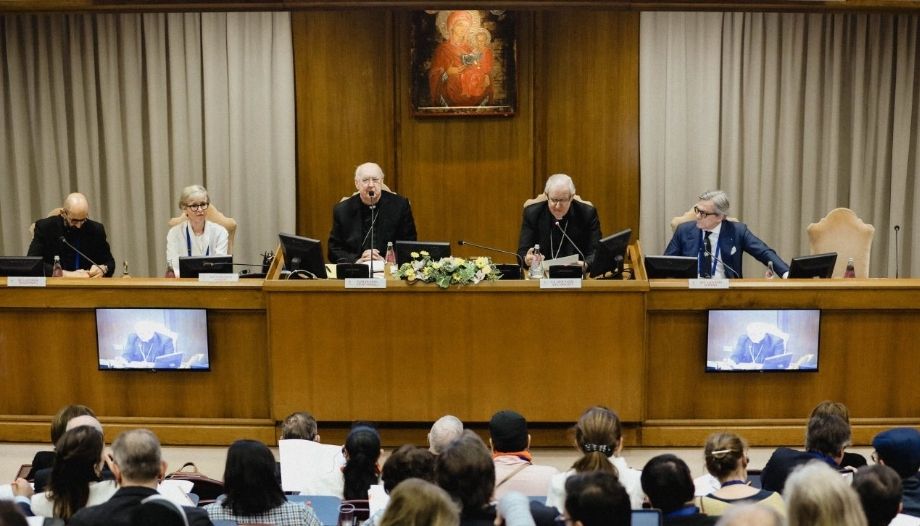
At the same meeting at which Pope Leo XIV addressed to those responsible for associations of the faithful, ecclesial movements and new communities, the Archbishop of Seville, José Ángel Saiz Meneses, gave a talk entitled ‘Relationship between moderators and bishops. Conciliation as a style of government’.
Saiz Meneses started from his personal experience, when at the age of seventeen, he joined the Movement of Cursillos in Christianity -he is now spiritual advisor to his worldwide organism-. And he shared his conviction that movements, associations and communities “are, for the diocesan Church, a privileged way through which the Holy Spirit renews, again and again, the life of the Church.”.
The Pastor of the Church in Seville added that “the bishop must look at the movements not with the suspicion of the administrator in the face of something he does not control, but with the gratitude of the pastor in the face of what the Spirit stirs up”.
In other words, “the bishop is not the owner of the Spirit in his diocese”; on the contrary, “he is its first servant and first guarantor of discernment”.
Cardinal Ratzinger: the movements, a response of the Holy Spirit
The Archbishop of Seville recalled Cardinal Ratzinger's 1998 address to members of associations of the faithful, ecclesial movements and new communities.
In that intervention, he referred to the institutional dimension and the charismatic dimension of the Church, and “he did not present them as poles in tension, but as two co-essential dimensions of a single mystery”.
The then Prefect of the Congregation for the Doctrine of the Faith, later Benedict XVI, said that the movements are “a response raised up by the Holy Spirit to the challenges of the present”. Therefore, “their appearance in the history of the Church is not the fruit of human planning, but the sign that the Spirit continues to be the protagonist of the mission”.
Having said this, he also added that every authentic charism needs to be purified and needs the mediation of ecclesial discernment. The latter, its ecclesial integration, “is not always easy”.
Saiz Meneses then highlighted the three fundamental tasks of the bishop in his relationship with associations, movements and communities: discernment, integration and mission.
Conciliation: communion and synodality
In his opinion, the relationship that the bishop is called to maintain with the leaders of associations, movements and communities “has a precise theological name: communion”.
In allusion to the magisterium of St. John Paul II, Saiz Meneses affirmed that this communion and “conciliation (between the bishop and those responsible for movements) is not an exercise of diplomatic skill or a balance of forces in tension”.
It is, rather, the “mutual recognition, anchored in faith, that both are servants of the same Spirit that precedes them both and that acts in an inexhaustible way”.”
Recalling the magisterium of Pope Francis, the Archbishop of Seville affirmed that communion, in its historical form, has a name today: “synodality”. In fact, “the very meeting of the bishop with the leaders of movements is a synodal act”.
“Grammar of listening.”
The Archbishop of Seville also alluded to the magisterium of Pope Leo XIV, who, since his election, has insisted that “synodality is a spiritual and missionary category”.
In his address to some two hundred leaders of associations of the faithful and movements, convened by the Dicastery of the Laity, Family and Life, Monsignor Saiz Meneses emphasized the following. “It is not enough that they (the bishop and the movements) coexist in peace, not even that they collaborate in common projects, they must be able to mutually engender each other in faith, to correct each other with charity, to question each other with the truth.”.
In addition, the Archbishop alluded to what Pope Leo calls “the grammar of listening” to explain “the readiness to be surprised, to discover that the Spirit speaks through voices that we had not foreseen”. This conciliation between bishop and movements is, according to the speaker, “a dynamic process that needs to be renewed with realism continuously”.
Pastoral experience in Seville. The bishop, “welcome and discern”.”
Monsignor Saiz Meneses concluded by looking back at his pastoral experience in Seville. “There, associations, movements and communities of very diverse origins and spiritualities coexist with the brotherhoods and confraternities, which," he said, "constitute an important part of the pastoral life of the city," he said. fabric of religious affiliation which cannot be ignored and which also calls for ongoing pastoral discernment”.
As Archbishop of Seville, he recalled that his task is to welcome and discern, recognizing the gifts and integrating them into “a common project of evangelization”, without fearing diversity.
Finally, he stressed that the bishop who welcomes associations, movements and communities into his diocese, “is not managing pastoral resources”. His work consists, according to the website of the archbishopric of Seville, He was also the first to recognize that “the gift of the Spirit is greater than any diocesan program; that the Church over which he presides is not his own, but Christ's. And that his task is not to limit the action of the Spirit, but to serve him with all the love and lucidity he is capable of. And that his task is not to limit the action of the Spirit, but to serve him with all the love and lucidity of which he is capable”.






 Español
  English
  Italiano
  Français
  Deutsch
  Polski