



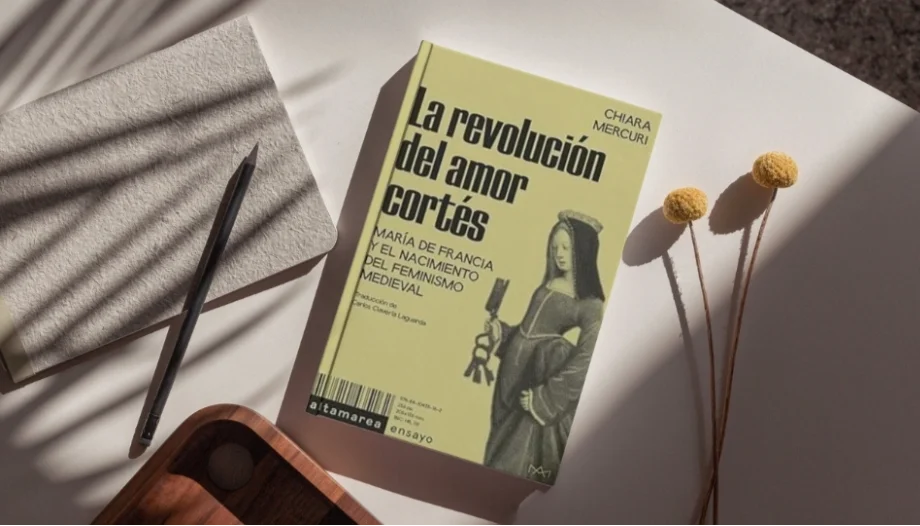
In the twelfth century a revolution of great depth and impact took place in France, it is said that like that of 1789 or 1968, and that it was called the revolution of “courtly love”. It was promoted by Mary of France, a French noblewoman of whom we have little information, but who was endowed with a great poetic conscience and who enjoyed the protection of the life of the Court and the royal family, which at that time was essential.
As her life and writings denote, she would break, in a certain way, the laws and customs of the time with an unusual anthropological feminism (21). The authors point out, and no doubt exaggerate, that she would have raised in a certain way what John Paul II called in his famous theology of the body “the love of donation” (30) and, moreover, she would have done it in the vernacular language, with which she would have immediately reached the entire French society of her time (39).
Romantic love based on freedom
It is very interesting that what, according to this author, will solidly build the true family - the one that has always lasted, the one that works, the one that builds a luminous and joyful home - would be romantic love, that is, the one based on freedom (50). As Mary of France affirms: “to live of love is indispensable”. For this reason, she will emphasize: “there is no right to be loved in exchange for love, and to love is in any case a privilege. We should feel gratitude to those who are capable of awakening in us such a high and profitable feeling” (84).
This is very similar to what St. John Paul II affirms at the beginning of his extensive and continuous catecheses that would eventually converge in the magisterial body of the theology of the body: “you must fall in love with love”.
Then, he will explain to us in a very meaningful way: “When a spring gushes forth, the one who calculates the water it can give, who builds a dam, who intends to exploit the flow, is not a lover, but an engineer. The lover must concentrate on fighting so that the water of the spring will always remain crystalline” (84).
Nobility of spirit versus submission
The feminine outburst will appear many times in this work. For example, when the word submission appears: love requires nobility of spirit (87) and, above all, daily conquest, daily love (89). This is very important, because whoever considers himself a prisoner will always and constantly try to escape (90). In fact, jealousy “seeks to push into the abyss” (91). Whereas the one who loves will never seek the evil of the beloved (91).
Certainly, at that time, the responsibility for the children remained primarily with the woman, but not always and at all times (99), because “the law of love” will always be above, which could be translated as the solution to all problems is to love (115). Moreover: “only throbbing love is of interest” (120).
The twelve rules against heartbreak
Logically, it should be remembered, as Mary of France does, that “courtly love” is not a right, but something that must be conquered continuously, because true love, that which endures and grows, is not compatible with habituation or with asking for an account (121).
The most striking of the “twelve rules of love” (129) that the author of this work discovers is overabundance. The summary, therefore, of the matter is that it is necessary to exercise the virtues, each and every one of them: generosity, magnanimity, romanticism, respect for freedom, and in this way love can always offer itself to love without being invasive, and, moreover, always with the secret of nascent love.
In fact, evil is defined as the absence of due good; therefore, the rules of love are opposed to the rules of lovelessness, such as selfishness, superficiality, corporality or betrayal: affective coldness (132).
Apostolic celibacy is reflected in the dialogue of Jesus with the Samaritan woman (Jn 4:4-42), when the Lord tells her: “If you knew the gift of God and who it is that asks you ‘give me a drink’”. Indeed, our author tells us: “It consists in placing supernatural love above natural love” (137).
A democratic and generous gift
Mary of France will summarize, once again, the question with these words: “to love is first of all a religion, first of all faith is needed”; and then she will add: “love is democratic and transversal, it is an opportunity truly granted to all. Indeed, neither illness, nor physical imperfection, nor poverty, nor origin prevent one from being loved, but only the fact of lacking nobility of spirit (...). It is a constant training to give rather than to receive (...) Only those who are powerful by excess of generosity will receive the love they give. The lover must not only give, but he must do it with full hands, without taking into account what he has given and without expecting anything in return; otherwise it is not love, but vile mercantile barter” (140).
Interesting, as in the catechesis of St. John Paul II on the “theology of the body”, are the constant references to the “Song of Songs”, a book of Sacred Scripture that should be read by spouses and those who wish to advance and mature in their love for God and others.
The cultural context and the reality of women
In the last part of this work there are several texts of the time that refer to the books of chivalry and other glosses on the lives of the great kings and nobles of the time, such as Charlemagne, Alcuin of York or Eginardo (180-181). There are also extensive references to the palatine and cathedral schools, true centers of knowledge of the time.
Finally, we must refer to the harshness of the life to which women were subjected, always exposed to constant rape, abduction, rape and duels of honor. That is why María de Francia writes about the story of Lanzarote and Ginebra: “a woman always falls in love with the man who saves her from rape and abuse, because it is not possible for a woman to protect herself in a world of armed men. Roland's song is written by a man with the aim of convincing men to go to war” (180-181).
We will end with a brief reference to the world of relics, a sign of faith in prayer and of the abundance of superstition (199).
The revolution of courtly love. Mary of France and the birth of medieval feminism.







 Español
  English
  Italiano
  Français
  Deutsch
  Polski