


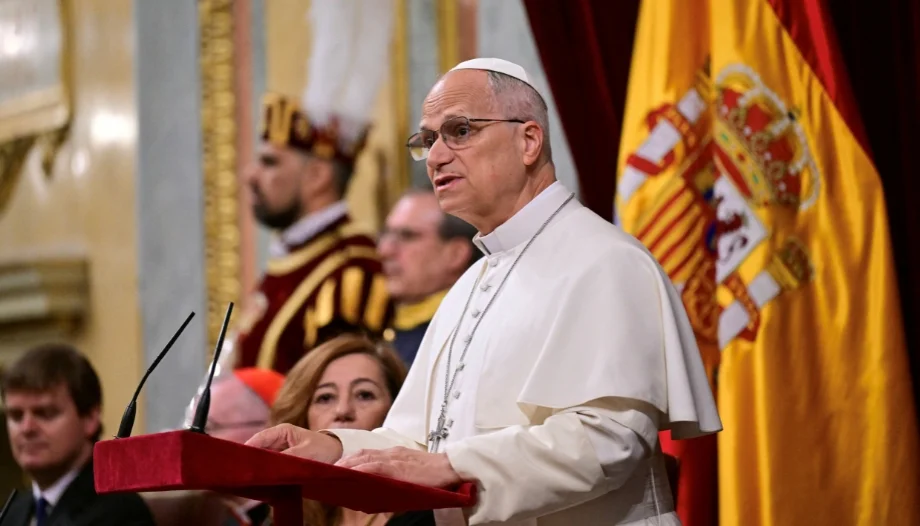
Pope Leo XIV made history today by being the first Pontiff to speak at the seat of the Spanish Cortes.
The Pontiff was received at the main entrance of the Palacio de las Cortes by the President of the Congress of Deputies, Francina Armengol, the President of the Senate, Pedro Rollán Ojeda, and six other members of the Cortes.
Before entering the Congress, the national anthems of Spain and the Vatican were played and then the Holy Father entered the Hall of the Lost Steps where he signed the Book of Honor.
At the time of the gift exchange, the Papa presented silver medals of the Apostolic Journey to the President of the Senate and the President of the Congress.
A Pope at the heart of Spanish politics
A resounding applause accompanied the entrance of Pope Leo XIV to the Plenary Hall of the Spanish Congress of Deputies.
The president of the Chamber, Francina Armengol welcomed the Pope with a speech in which she stressed the willingness of the House to “listen with the conviction that understanding is irreplaceable” and defending the “multilateralism as a condition for international peace”. Armengol described the political activity as the “fight against poverty, precariousness and violence” and expressed her wish that political activity be “the search for the dignity of people and the good of the people, not the power struggles that we are now witnessing”.
The Pope addressed a plenary session in which, in addition to the current political representatives of the Spanish people, there were politicians of different political persuasions, the former presidents of the Government, except José Luis Rodríguez Zapatero, the Ombudsman, and various representatives of Spanish civil society.
A long and comprehensive speech
In a long speech, the longest of those delivered by Leo XIV to date in Spain, The Pope introduced himself, “before all of you as Bishop of Rome and Pastor of the Catholic Church,” showing that, as he responded to Trump a few weeks ago, he is not a politician, but speaks from faith.
The Church, the Pope recalled, “when she addresses herself to public life, she does so with respect for the proper mission of institutions and the legitimate responsibility of those who have received the mandate to legislate. She recognizes «the autonomy of earthly realities» and «the distinction between ecclesial community and political community»; and, precisely from this awareness, she offers a reflection”.
What conception of man does the law translate?
“My presence among you wants to be a gesture of closeness to Spain, within the framework of mutual cooperation, and a word offered from the service to the human person,” continued the Pope, who praised the history of Spain and the humanist thought of which it has been the cradle, with examples such as the school of Salamanca, one of the Pontiff's favorite quotes.
In this line, Leo XIV defended that “every legislative task ends up facing a decisive question: what conception of the human person inspires the laws and what type of society builds those laws” and wanted to collect some of the answers that, historically, the Spanish nation has given to this question, emphasizing the defense of freedom and the recognition ”of the human being as something more than a piece of the social, economic or political order: it has recognized him as a creature open to the truth”.
The humanist revolution of the School of Salamanca
One of the central themes of the papal speech in the Spanish Cortes was the profound and reflective memory of the Pontiff to the importance of the school of Salamanca in the development of the legislative and social order at the time when the world became bigger, when, with the arrival in America “Spain was placed before historical responsibilities of universal scope”.
At that time, the Pope stressed, “some masters understood that reason could not be invoked to clothe with legitimacy whatever force or interest presented as convenient. They thus introduced into historical discernment the question of the irreducible value of every human being and the moral limits of power”.
The Pontiff did not overlook the fact that “society and the Church itself were not always up to the task”, Leo XIV emphasized that “the reflection of the School of Salamanca - and in a particular way Fray Francisco de Vitoria, together with other Dominicans and Jesuits - contributed to the formation of a juridical and moral conscience capable of remembering that authority always carries with it a responsibility and that every human being must be recognized as a subject of rights and duties”.
Updating this question, the Pope underlined how today, with technological advances and, in particular, Artificial Intelligence, the limits can also become blurred. He also recalled Benedict XVI's address to the German parliament to assess that human dignity “precedes every concession of the State and cannot be subordinated to social consensus”.
Can a nation be called just? Respect for life, family and freedom of education.
“It falls to me today to speak a serene and firm word to those who have the grave responsibility of juridically ordering social coexistence,” continued the Pope, who did not avoid mentioning some of the most serious issues that plague today's juridical and social systems. Can a community be called fully just if it leaves in the shadows the unborn child, the elderly, the sick, those who suffer in silence or those who depend entirely on the care of others? The defense of human life is not a partial question or a denominational interest: it is a goal of civilization: every human life must be recognized and safeguarded from conception to its natural end.
The Pope referred to the family as “the first human reality and the natural foundation of the community”, and to educational institutions in which “many parents, desirous that their children learn to relate to one another, to think critically and to acquire solid values, place great hopes in them as valuable allies in their education”.
A particularly interesting point in the Spanish Parliament before which the Pope has defended “the ‘primary and inalienable right’ of parents to ‘choose the type of education and formation their children receive, in coherence with their own moral, cultural and religious convictions’.”.
The migration issue
The migration issue, one of the fundamental lines of this trip, has entered fully into this speech in which Leo XIV has affirmed that “wherever a person is discriminated against because of his national, ethnic, religious or linguistic origin, or because of his economic or social condition, the universal principle of the equal dignity of all human beings is seriously violated”.
In this line, the Pontiff defended the need to “strengthen prevention, rescue and assistance to victims, especially within the framework of regional and multilateral cooperation”.
Prevost called for international cooperation in the face of a drama that cannot be tackled by a single nation.
Plurality does not mean attacking the adversary
“The world is going through a profound spiritual and cultural crisis,” the Pontiff said. “Peace requires diplomatic courage, ethical responsibility and a vision of the future grounded in respect for the identity of each people and in the obligation of States to resolve their disputes by the peaceful means offered by international law,” said the Pope, who expressed his concern over the advance of rearmament as “an almost inevitable response to the fragility of the international scene.”.
Faced with this international scenario, the Pope called for “a rediscovery of the indispensable value of dialogue”.
Peace, internal and external, marked the last large part of the speech in which the Pope defended that “political plurality should not degenerate into permanent disqualification of the adversary”.
Protection of and respect for religious freedom
The Pontiff went further, calling for a clear and firm protection of religious freedom and personal conscience: “The freedom on which the contemporary State is built, if it is authentic, recognizes the religious dimension of the human being, respects it and protects it legally; and prevents anyone from having to renounce contributing to the society in which he lives because of his faith”.
“In this context,” Leo XIV pointed out, “the sacramental seal of confession is of special importance for the Catholic Church. It falls within the broader sphere of religious freedom, which guarantees to believing communities a proper space of life, organization and internal discipline”. To protect it juridically, he indicated, “means preserving a sacred space of inner freedom, where the believer can open his soul before God without fear of external pressures”.
At the same time, he stressed that “faith is not intended to be imposed through privileges or coercion, but neither can it be relegated to silence as if it were irrelevant”.
The law must appear before human dignity
Making a visual tour of the images of the Spanish Chamber, the Pope pointed out forcefully that “a law does not reach its true greatness by the mere fact of having been formally approved; it reaches it when, in addition to being valid in its form, it can appear before the dignity of the person and emerge from that examination without embarrassment”, encouraging Spaniards whose “cultural, juridical and spiritual tradition has known how to put faith and reason, law and conscience, unity and plurality in dialogue” to be part of this path of social progress.
The longest applause of democracy
The Pope concluded this historic speech to the accompaniment of what could already be described as the longest applause of democracy.
The applause began at the end of the papal speech and continued for about ten minutes until the Pontiff left the room, accompanied by the president of the chamber and various authorities.
Several “Long live the Pope!” could also be heard, which were seconded by those attending this historic intervention.
During all this time Leon XIV has been especially moved. He thanked the deputies and guests with gestures for a token of affection that has gone down in the history of the Spanish Chamber.





 Español
  English
  Italiano
  Français
  Deutsch
  Polski