


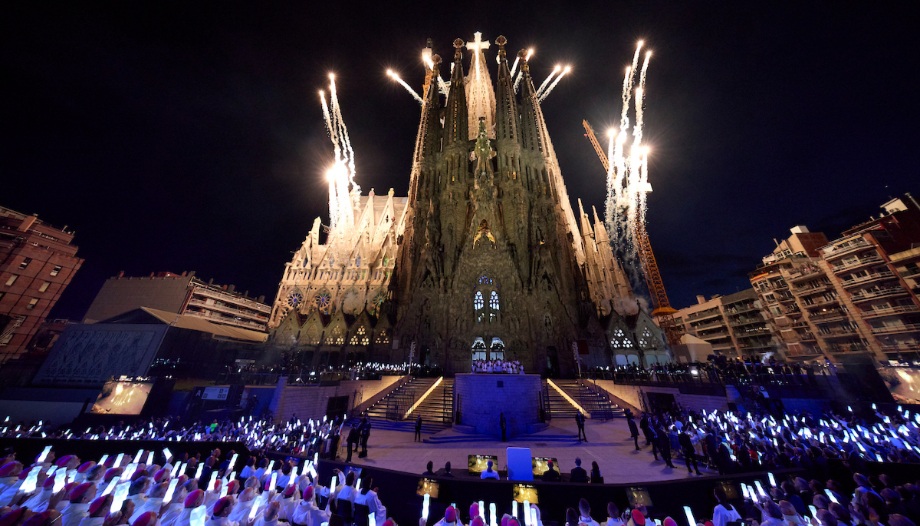
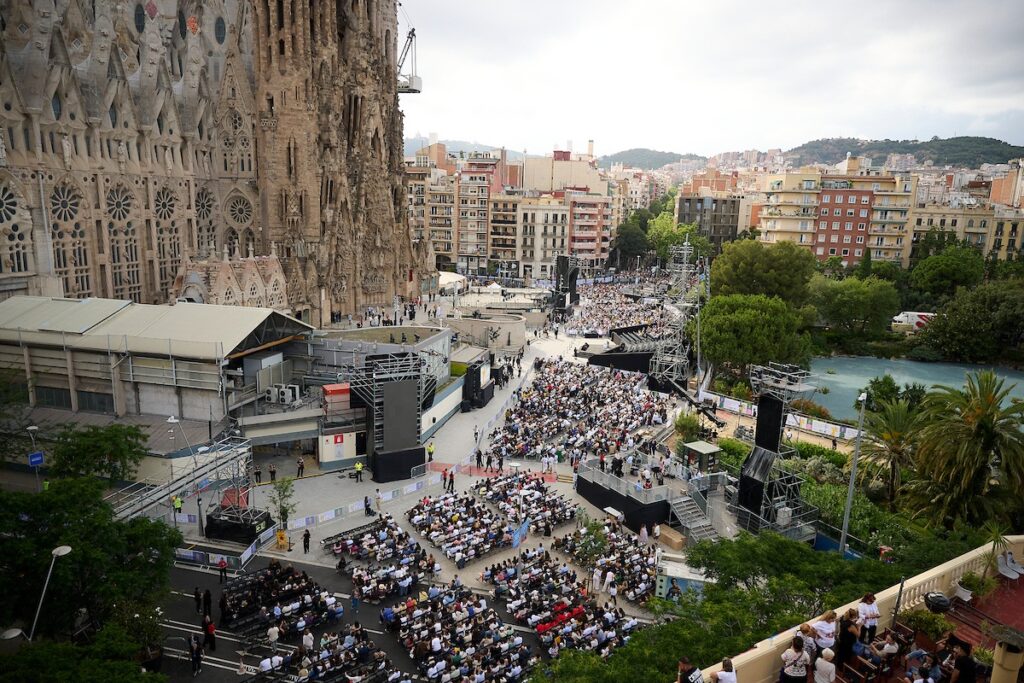
The night of June 10, 2026 will remain engraved in the history of Barcelona. Pope Leo XIV presided over a solemn Eucharist in the Basilica of the Sagrada Familia before the King and Queen of Spain and thousands of faithful, before blessing from the Nativity façade the tower of Jesus Christ, whose cross illuminates the city with its beams of light, just as Antoni Gaudí had dreamed almost a century ago.
The day began with a surprise that did not go unnoticed. At 7:15 p.m., Valentina, a blind girl, explained the architectural details of the new tower to the Pope and the King and Queen of Spain, with remarkable ease and using only her touch on a model of almost two meters. The moment, captured by the television cameras that transmitted it to the whole world, was very moving.
600 voices under Gaudí's vaults
The Holy Mass began punctually at 8 p.m., in which the Pontiff alternated between Catalan and Spanish, along with chants in both languages and in Latin, interpreted by a choir of more than 600 singers. The monumentality of the church, consecrated by Pope Benedict XVI in 2010, added to the splendor of the liturgy.
The number of authorities was very large, starting with the King and Queen, Pedro Sánchez and 14 government ministers.
The homily: faith, beauty and responsibility before the world
In his homily, Leo XIV took as his starting point the eighth psalm - «Lord, our God, how wonderful is your name in all the earth»- to weave a reflection that covered theology, the history of art, the moral responsibility of believers and the profound meaning of the temple that welcomed him.
The Pope began by giving thanks for the basilica and linking his intervention with that of his predecessor Benedict XVI, who consecrated it in 2010, defining it as «a visible sign of the invisible God. In the same vein, Leo XIV presented the building not as a finished monument, but as a living image of the Christian community: »We are all the living stones of this work, which has Christ as its foundation and summit, its beginning and its end. A work that grows steadily following the same project, just like faith, which is always a journey and never a goal reached once and for all.
To substantiate this idea, the Pontiff turned to the Scriptures and recovered the dialogue between God and King David in the Second Book of Samuel. When David wishes to build a house for God, it is the Lord himself who answers him by reversing everything: it is not man who gives a place to God, but God who gives a place to man. And that place, Leo XIV stressed, is none other than his own heart: «the place of the Son, for us who were strangers; the place of the Beloved, for us who are sinners». A gratuitousness that, in the Pope's opinion, defines the entire logic of the Gospel.
This divine will, the Pontiff continued, is fulfilled through Jesus. Leo XIV dwelt with particular intensity on the words that the Lord addresses to the Pharisees in the Gospel of John: «If you do not believe that I am he, you will die in your sins». Far from interpreting them as a threat or blackmail, the Pope read them as an invitation to freedom: Christ wants for human beings «the definitive, eternal good,» and in the face of evil he always remains on man's side. The divine name «I am,» revealed to Moses from the burning bush, is in Jesus the source of grace, forgiveness and new life. Hence the cross is not an instrument of condemnation but a sign of hope: God transforms death into light.
Consistency in the works
It was precisely at this point that the Pope pronounced the words that resounded loudly inside the temple: «We cannot believe in Jesus and promote war. We cannot believe in Jesus and kill the innocent. We cannot believe in Jesus and abandon those who suffer, those who weep, those who flee from misery». Three resounding affirmations, pronounced under the vaults of the highest church in the world, that drew the profile of a faith that cannot be separated from its ethical and social consequences.
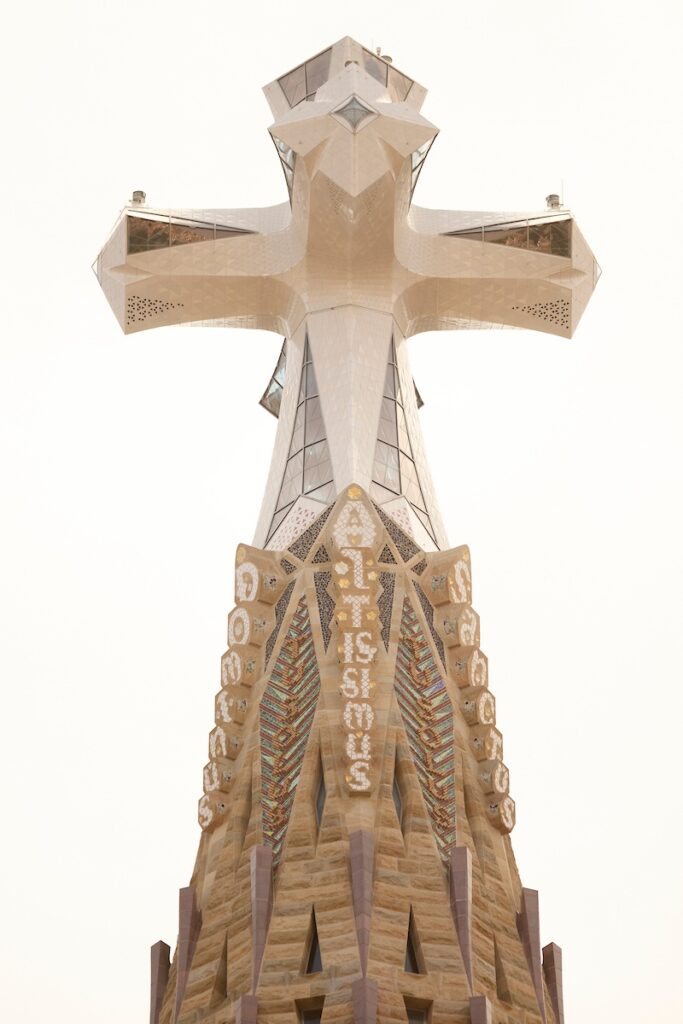
The Pontiff then looked up at the tower he was about to bless. The cross that crowns it, he said, is the summit of the Christian faith, as the inscription at its base proclaims: Tu solus Sanctus, Tu solus Dominus, Tu solus Altissimus. That cross shines by day with the light of the sun and by night illuminates the city like a lighthouse open to the Mediterranean. To be illuminated by the glory of the Risen One, Leo XIV explained, it is necessary to pass through the passion of the Crucified One: the Father has always taught to give life, and the Son receives it and gives it to all with the power of the Holy Spirit.
The homily also reserved a central place for art as a form of evangelization. It is faith, the Pope affirmed, that «gives form to the stones and meaning to the building we inhabit together». The artist turns talent into praise and creativity into a witness to the Creator. In this context, Leo XIV paid explicit homage to Antoni Gaudí - whose centenary of death is commemorated this year - whom he defined as «an ardent architect of faith» who conceived these spaces with the desire to narrate the mysteries of the Lord's life. The Pope extended recognition to all the promoters, benefactors, artists and workers who over generations have cooperated in the construction of a masterpiece that is, at the same time, «an eloquent catechesis made of stones, colors and light.» The Church, he pointed out, is thus renewing the ancient tradition of medieval cathedrals -the Biblia pauperum, The Bible of the poor - at a time when images are a more powerful channel of evangelization than ever before.
Leo XIV closed his homily with a call to action that united the contemplative and the committed: just as we look up to the Risen Crucified One, we must commit ourselves to «raise the faces of those who lie in the dust. The Holy Family, he concluded, is the highest church in the world not to stand out in worldly rankings, but to »guide the steps of the people of God who are on pilgrimage in this land of Catalonia, with the cross that lights the way, like a lighted lamp awaiting the return of the Bridegroom«.
Blessing and lighting of the cross
At 9:45 p.m., from the central point of the horseshoe of the Nativity façade, the Holy Father blessed the tower of Jesus Christ. With its 172.5 meters, the Basilica of the Sagrada Familia officially becomes the tallest church in the world. Gaudí decided not to make it two meters higher so that the work of man would not surpass the work of God in nature, represented in the nearby Montjuïc mountain.
The cross that crowns the tower is covered with glass and 15,000 pieces of white glazed ceramic. Its arms incorporate large windows through which light penetrates and from which, from 2028 - when the interior works are completed - it will be possible to contemplate the surroundings. Inside hangs the Lamb of God, the work of sculptor Andrea Mastrovito. On the outside, trencadís palms are inscribed in Latin with the phrase: «Tu solus Sanctus, Tu solus Dominus, Tu solus Altissimus.» -You are the only Holy One, You are the only Lord, You are the only Most High.
The blessing was followed by the inaugural ceremony on the exterior of the tower, an artistic proposal created specifically for the occasion that combined music, choral singing and light, and culminated with the lighting of the great cross. Illuminated by powerful spotlights projected from the other towers, the cross shone over the city like a lighthouse open to the Mediterranean, thus fulfilling the vision that Gaudí himself had set forth in the Fourth Album of the Atonement Temple, In 1927: «The cross will be made of glass; during the day it will reflect the sunlight and at night, by means of powerful spotlights, it will project beams of light over the city».
The Sagrada Familia, whose construction began in 1882, is still a temple under construction. The new landmark does not close, but rather underlines that unfinished and living character that Pope Leo XIV himself celebrated in his homily: a cathedral that, like the Christian faith, «is always a journey».





 Español
  English
  Italiano
  Français
  Deutsch
  Polski