


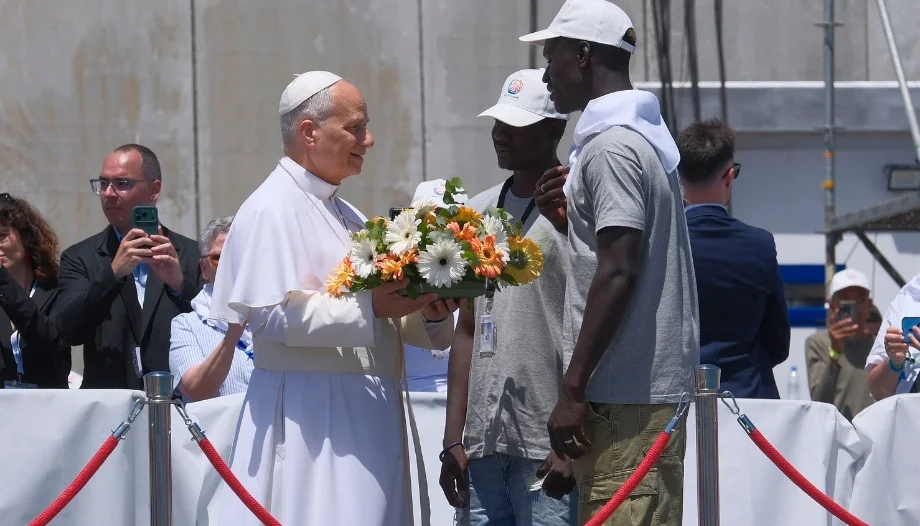
At 11:51 a.m. on Thursday the 11th, Leo XIV stepped on Canary Island soil. It was the first time in history that a Roman Pontiff did so. Received by the authorities, among them, a good part of the Spanish government, his first act was in the Port of Arguineguín. There he delivered one of the emblematic speeches of his trip, in which he insisted on the dignity of migrants and called for a fight against indifference and against those who take advantage of them.
The Pope's speech was preceded by several interventions. Among them, Tito Villarmea, captain of Salvamento Maritimo, who has saved more than twenty thousand people in 18 years. Or Blessing, a woman victim of trafficking, whose testimony he did not read in person for security reasons, logically. The Pope also blessed a cross, which will be left in place, made of wood from canoes.
Not to be oblivious to the cries of those who cry out
On a platform symbolically built facing the sea, and with a dike erected in a couple of days, the Holy Father elaborated from the testimonies, a nuanced speech on migration: it is about human beings and we must fight the causes that make them leave their countries.
At the beginning, he made a reference to the island of El Hierro. “This island, small in size but great in humanity, has seen the arrival of thousands of people torn from their land and entrusted to the fragility of a cayuco. Here there are people recovered from the sea and lifeless bodies rescued from the waters”. And he cried out: “The Church cannot ignore these waters or any place where hunger, thirst, violence, fear or exile continue to wound human dignity”. With force, he insisted: “The disciples of Jesus cannot consider the cry of those who cry out from the night as alien”.
Leo XIV had harsh words: “Even today there are monsters lurking in these seas: mafias that traffic in desperation, traffickers who enslave women and children, and the indifference of many who allow the poor to be swallowed up by exploitation or by oblivion. But faith is not paralyzed by the power of the sea”.
Bowing to the dignity of the migrant
He referred to the need to do something for others, sometimes from the most humble: “Mercy begins with small gestures: sometimes with a few cookies and a little milk. It is not a matter of solving everything, but of putting everything in God's hands and being present where human beings suffer, where resources are not enough and there is no common language, but where gestures can still speak”. He stressed that “human life is a blessing from God. No one can buy it, sell it, use it or discard it”. Moreover, he affirmed: “Dear migrants: before saying any other word to you, I want to bow before your dignity. You are not numbers or files. You are people with a family and a home left behind; with dreams that no one has the right to despise. But I also want to tell you that your life must be protected.”.
The situation of emigration demands solutions. Leo XIV asked that “This drama must become an examination of conscience: for the nations of origin, which must create conditions of peace, justice and development; for the nations of transit, called to protect and not to leave the weak in the hands of criminal networks; for Europe, which cannot proclaim human dignity and get used to the Mediterranean and the Atlantic being cemeteries without gravestones; for the international community, called to effective and persevering cooperation”. These words were particularly applauded.
A call for coherence in the Church
And also for the Church: “The reception of migrants cannot be something secondary or delegated only to a few volunteers. He asked for coherence: ”We kneel before the altar to adore Christ present in the Eucharist, from whom we receive the strength and the motive to live charity; for this reason, we cannot then “pass by“ in front of the canoes and the boats, because from prayer springs every service and every commitment returns to it”.
Pope Leo made an appeal to all those who face this drama: «from this island, I would like the voice of those who have spoken today to reach those who have decisive responsibilities in their hands - civil authorities, parliaments, governments and international organizations», and also the Christian communities: «it is not enough to manage arrivals, distribute numbers, reinforce borders or lament deaths when they have already occurred».
“We can't get used to it.”
Every boat that arrives does not only bring migrants; it brings with it a question: what kind of world have we built if so many brothers and sisters have to risk death to seek life? He called for “legal and safe ways, rescue and assistance, real cooperation against traffickers, effective protection for victims, serious processes of reception and integration.” He spoke of “While there is a right to seek refuge when life is threatened, there is also the right not to have to migrate: the right to remain in one's own home without hunger, without war, without persecution, without violence.” He claimed: “We cannot get used to counting the dead. Human dignity has no passport.
He concluded: “Every life that comes along asks us what remains of our humanity. Sooner or later, it will be known if we knew how to guard it or if we let indifference speak for us”.
An offering in «the port of shame».»
After the Pope's speech, a wreath was laid «for those who are no longer with us». The Pope went to the dock near the water to throw a wreath of flowers into the sea. After this gesture, there was an instrumental minute of silence, seeing an overwhelmed Pontiff. Then he blessed the cross, made with pieces of canoes.
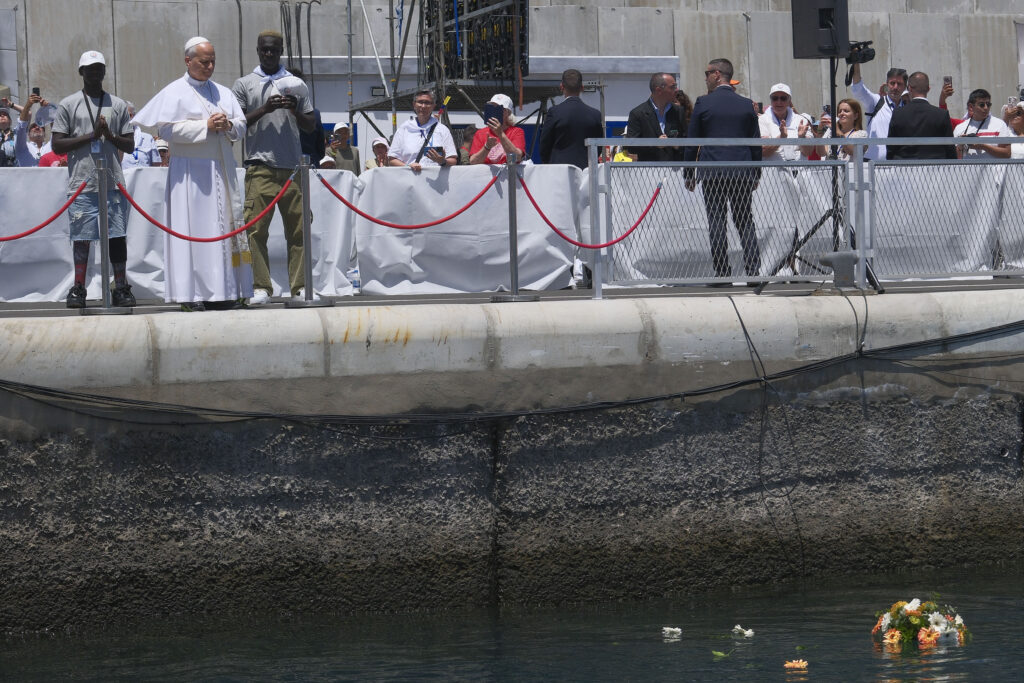
The dock of Arguineguín, which many have called “port of shame”, “has witnessed the arrival of thousands of people fleeing hunger, war and despair”, recalled the bishop of the Canary Islands, Monsignor Mazuelos. Following the Atlantic Route, one of the most dangerous in the world, they have arrived in dinghies and small boats mainly from Senegal, Mauritania, Gambia, Mali and Morocco, making crossings that can exceed 1,600 kilometers. The Pope leaves the port to the shouts of «Thank you!» from the faithful.
The expectation for the Pope's visit to the Canary Islands is tremendous. One of the 1,500 volunteers who have been working these days in the organization, explained to Omnes: “It is the greatest gift we could have. The Pope visiting the two islands. ”Expectations are very high, especially seeing how the reception in Madrid and Barcelona has been“.





 Español
  English
  Italiano
  Français
  Deutsch
  Polski