


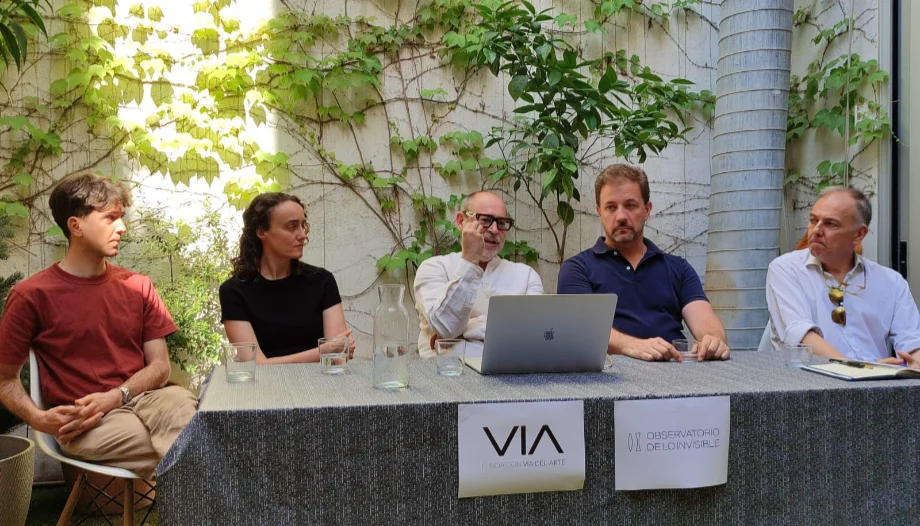
This summer, the Observatory of the Invisible (OI) celebrates its sixth edition, having already become the premier event for those working at the intersection of art and spirituality in Spain. For one week, 150 artists from various disciplines will gather at one of the most impressive sites in Spain’s cultural heritage, the Monastery of El Escorial, to create, reflect, and pray together, under the guidance of some of the most prominent creators on the national and international scene.
A week of intense creativity, reflection, and prayer
Organized by the Vía del Arte Foundation and hosted by the Real Colegio Alfonso XII and the Archdiocese of Madrid, the OI is not just your typical summer school.
From day one, participants—known as «observers of the invisible»—are immersed in a program that combines workshops by artistic discipline, lectures and forums, polyphonic prayers, Masses, interdisciplinary evenings, and, as the culmination of the final night, a grand closing celebration. All of this is steeped in an atmosphere of spiritual seeking that, according to the organizers, is difficult to replicate outside its walls.
A project that fosters an ecosystem
What makes OI unique is not just what happens during that week in July, but what it has spawned over the past six years. Initiatives have emerged from its community that now have a life of their own: in Barcelona, Madrid, and Pamplona, a series of lectures is held every two weeks under the title The beauty of Christ; the first Spanish magazine dedicated to art and spirituality has been launched, Transfiguration; this year, they launched a course in Artology, a discipline that explores the teaching of theology through art; and twice a year, they organize a retreat for artists.
Without a doubt, OI is the artistic activity in Spain that brings together the most people interested in this realm that straddles the line between creativity and the sacred. Its active WhatsApp group has over 500 members, most of whom are young people.
Javier Viver's final year
At the presentation of this year’s event, Javier Viver, who has directed the initiative since its inception six years ago, announced that this is likely to be his final year at the helm of the project, though he made it clear that the Vía del Arte Foundation—of which he is president—will continue to organize it and that he will participate in future editions.
With his usual sense of humor, Viver admitted at the press conference that every year they approach the project with the same concern: «We’re always worried that this year the sacred flame that makes the event so magical and inspires enthusiasm among the participants might go out.» So far, that fire has not gone out. On the contrary, it continues to grow and spill over into new initiatives
Viver also shared a detail that perfectly captures the spirit of the event: the painter Antonio López, who has just turned 90, eagerly awaits this event every year and visits the monastery one day to spend time with the participating artists.
The 2026 Workshops
As has become tradition in each edition, the event will be structured around a central theme that will serve as the common thread linking all the scheduled workshops. This year, the chosen theme is «…HE BROUGHT THE BREATH OF LIFE INTO HIS NOSE…,» an inspiring motto that will guide the focus of the various educational and creative activities.
French philosopher and writer Fabrice Hadjadj, one of the most eagerly awaited speakers at this year’s event, has revealed that his writing workshop will revolve around an idea as simple as it is radical: breathing, which he «considers the first word.» Starting from this premise, Hadjadj invites his students to write about air: to describe a scent, a breath, an atmosphere, an absence, the timbre of a voice. With no prerequisites whatsoever. The challenge, he says, is to approach a phenomenology of elemental discretion.
This year, the OI is offering nine disciplines taught by top-notch instructors:
Curated — Maider Montalbán and Javier Ortíz Echagüe, an art historian and researcher who has curated exhibitions at the Reina Sofía Museum and the MNAC, propose in their workshop PNEUMA: to breathe life into to explore curation as a dynamic process, drawing on the biblical motif of the breath to consider how an idea can breathe life into a collection of works, spaces, or experiences.
Music — Ignacio Yepes, conductor of the Kairós Orchestra, flutist, composer, and winner of the Spanish Episcopal Conference’s Bravo Music Award, works at Mary, Breeze from Heaven Marian works for choir and chamber orchestra that evoke the Virgin Mary’s contemplative silence and her role as the bearer of the Spirit.
Dance — Elisabet Biosca, a principal dancer with the National Dance Company who has trained under choreographers such as Nacho Duato, William Forsythe, and Ohad Naharin, discusses in Air as a creative force to explore breathing as a biological, relational, and creative foundation; it does not seek technical virtuosity, but rather presence and listening.
Writing — Fabrice Hadjadj (see above) directs Words and melody are air, with the challenge of writing about what cannot be seen but holds everything together. No prerequisites.
Poetry — Daniel Cotta, a poet from Málaga and winner of the Fernando Rielo Prize for Mystical Poetry, proposes in Poets of Heaven and Earth to use the poem as a pair of glasses to see what everyday myopia hides from view, until we look up through the telescope and find God whispering verses in our ear.
Theater — Lluís Homar, a Barcelona-based actor known for his collaborations with Pedro Almodóvar in Bad Manners y Broken Hugs, and Luis d’Ors, a stage director with more than twenty productions to his credit and a professor at CEU and UNED, direct The Word Made Flesh: Each participant chooses a text by spiritual masters to learn by heart and put into practice.
Painting — Carles Belda, an artist from Alicante trained in the classical tradition and winner of the Best Small Portrait of the Royal Society of Portrait Painters in 2023, proposes in The Magic of Objects to revive a traditional style of painting from before the 20th century, in which the still life ceases to be merely a decorative motif and becomes a gateway to the spiritual dimension of things.
Photography — José Manuel Ballester, winner of the 2010 National Photography Prize and the 1999 National Printmaking Prize, combines in From capturing reality to capturing it online traditional photographic processes—cyanotype, gelatin-bromide—combined with contemporary digital techniques, in a theoretical and practical course open to anyone interested, with no prior knowledge required.
Relief — Matilde Olivera, who holds a Bachelor of Fine Arts degree from the UCM and studied at the Florence Academy of Art, offers Air and Space in the Landscape An introduction to the techniques of bas-relief, half-relief, and high relief, where space begins to envelop the forms and give them a sense of independence. No prior experience required.
Sponsors and Scholarships
The 2026 edition is sponsored by the Herrera Oria Cultural Foundation and is supported by a wide range of institutions that offer scholarships to their students or the general public: ONCE Foundation, Rey Juan Carlos University, Estudio Javier Viver, Villanueva University Foundation, University of Navarra Museum, San Pablo CEU University, Tatiana Foundation, Puerta Gótica, Francisco de Vitoria University, UIC Barcelona, Mainel Foundation, Art and Faith Association, Nartex, as well as several private patrons.





 Español
  English
  Italiano