



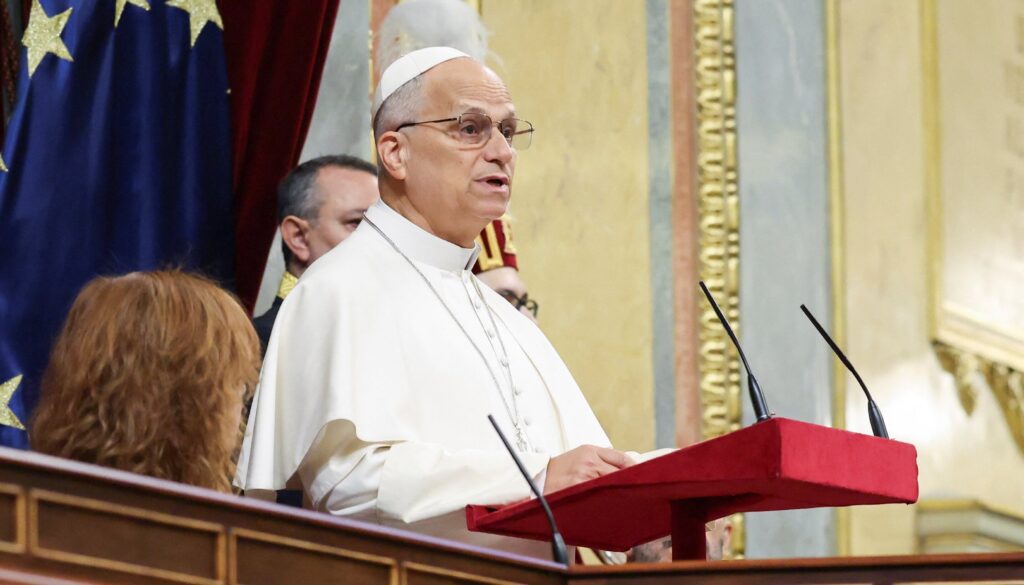
Pope Leo XIV left the Spanish Parliament to thunderous applause, and entrusted their Excellencies with great and solemn duties amid an atmosphere of cordial discussion, free from paralyzing and stifling rhetoric. Before an expectant chamber, the Holy Father delivered a speech of profound political and moral significance, accurately diagnosing the ills that are suffocating contemporary global coexistence. The Pontiff was unequivocal in stating:
“The world is undergoing a profound spiritual and cultural crisis, which manifests itself in multiple forms of violence, polarization, and mutual distrust. In this context, peace emerges as a political aspiration and, even more so, as a genuine moral imperative. It calls for public discourse that respects those who think differently, institutions dedicated to fostering dialogue, a historical memory that seeks truth and reconciliation, and a social life capable of sustaining civic friendship and mutual respect even in the face of disagreement.”.
The Debate on Memory
The Pope showed courage by directly mentioning “Historical Memory” on the floor of the legislature itself: “Historical Memory that seeks truth and reconciliation… an arduous task when there is such great polarization.” Although this reflection transcends our borders and applies to any part of the world, his remarks at the seat of Spain’s legislative branch inevitably invite us to reflect on a series of realities that shape the current historiographical landscape:
- The sad “black legend” of Spain. Historians—curiously, most of them foreign—have already come forward to refute this regrettable event, from which we are still recovering, and which is currently being used to fuel populist rhetoric that is far removed from the reality of Spain’s role in Ibero-America.
- Many young people today are unable to place, both in the present and historically, figures of great significance in the history of Spain during the 20th century.
- The independence of the current Latin American states during the 19th century was achieved through highly personalized programs inspired by strong anti-Catholic sentiment; from the “mud, this mud” from which a deep polarization has emerged, aimed at severing the strong ties that bind Spain to all the countries of South and Central America.
- The political system of the Second Republic is being held up as a model, (…) even though renowned historians denounce it and blame it for the Civil War that ravaged the country.
The Power of Words in the Face of Rearmament
The controversy is already brewing! However, the purpose of this article is not to focus on the dispute, but rather to find a way to discuss these issues calmly without using, as the Pope pointed out in his speech, “words [that] can open paths or close them; they can illuminate reality or distort it to the point of making encounter impossible.”.
This encounter is essential if we want a free, just, and truly democratic society. As the Pontiff recalled, “From this respect for others also arises the duty to safeguard the space where their convictions, their conscience, and their relationship with God mature. Attention to this inner realm allows us to better understand a crucial issue for any truly democratic society: freedom of thought, conscience, and religion—a fundamental right that safeguards the most intimate sphere of the individual.”.
The papal message also took a hard look at the current geopolitical landscape, warning that all war is a failure, since “it ultimately constitutes a painful defeat of the capacity to negotiate and also of that common conscience of humanity that recognizes bonds of justice among nations.”.
Furthermore, Leo XIV’s condemnation of “rearmament as an almost inevitable response to the fragility of the international scene” still resonates today. Faced with this tendency toward war, the Pope concluded firmly: “True security, on the other hand, stems from justice, patient dialogue, respect for international law, and a policy capable of placing the lives of peoples above the interests that profit from war.”.
This criticism is not unfamiliar to us: at the root of armed conflicts lie deeply personal interests—often economic—that make them morally deplorable, as they disregard the voices calling for a peace that is difficult to achieve. Hence the continued relevance of Leo XIV’s call to rediscover the value of “dialogue as a patient path toward just and lasting agreements, founded on respect for treaties, transparency in diplomatic action, and a sincere willingness to prioritize peace over the use of force.”.
Cohesion in Diversity
The Holy Father brought the European Union’s motto—“In varietate concordia»—to the forefront. Giving it contemporary meaning, he reminded us that “true unity does not standardize, but rather fosters cohesion amid diversity, turning cultures, sensibilities, and traditions into an opportunity for mutual enrichment.” Likewise, within societies themselves, it is urgent to build a culture of reciprocity. Political pluralism should not degenerate into the constant disparagement of one’s adversary.”.
This polarization, evident both in Spain and in numerous international conflicts—many of which have been forgotten and are outside the media’s spotlight—represents a collective failure. In this troubling global context, it is “important to reiterate the theory of just war, which is all too often invoked to justify any war, without prejudice to the right to self-defense, understood in the strictest sense” (cf. Francis, Encyclical Letter “Fratelli Tutti”, 258, October 3, 2020)”.
The reality is indisputable: “Humanity has at its disposal far more effective means of promoting human life and resolving conflicts, such as dialogue, diplomacy, and forgiveness. The use of force, violence, and weapons is evidence of a relational poverty that always has disastrous consequences for civilian populations” (Encyclical Letter “Magnifica Humanitas”192, May 15, 2026).".
In short, the Holy Father has issued a stern warning—a call for dialogue! An insistent reminder that “words can open paths or close them; they can shed light on reality or distort it to the point of making encounter impossible.”.
This call is directed not only at the members of Congress who filled the chamber, but also at all people of good will and, most especially, at journalists, who bear an enormous responsibility in the exercise of their profession. In this new media ecosystem, ethical rigor and responsible behavior in the use of new technologies and artificial intelligence will determine whether the media become bridges for dialogue or amplifiers of division.






 Español
  English
  Italiano
  Français
  Deutsch
  Polski