



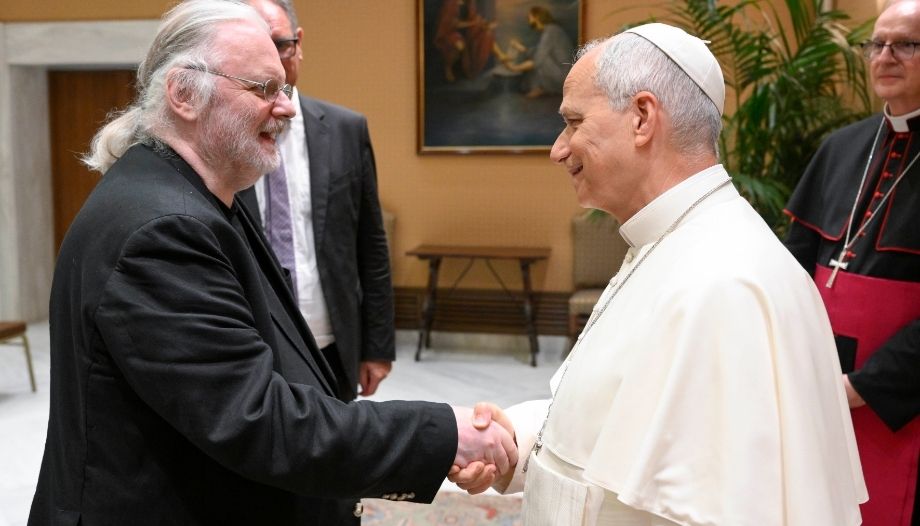
– Courtney Mares, Vatican City, OSV News
“Writing, as you know, is an act of truth, of revelation, for it reveals who we are, what we believe in, and what we hope for—the world to which we aspire and the future of which we dream,” said Pope Leo XIV to Pulitzer Prize-winning writers, novelists, and authors from various countries during an audience held on June 24 at the Vatican.
In his address, the Holy Father added that “in this search for truth, we realize that truth is subtle, and it is revealed to us in our inner dialogue with God and in our open and respectful dialogue with our fellow human beings.”.
Among those in attendance was the Nobel laureate Jon Fosse, a Catholic convert and one of Norway’s most award-winning writers, along with Pulitzer Prize winners Elizabeth Strout and Marilynne Robinson. Jonathan Safran Foer, author of “Everything Is Illuminated,” and Irish author Colum McCann, who wrote “Let the Great World Spin,” winner of the U.S. National Book Award for Fiction, were also among those who met with the Pope.
León XIV: When we delve deeper into our humanity, we are not far from God
In his remarks to the authors, Pope Leo quoted C.S. Lewis’s observation that reading a literary text puts us in a position to “see through the eyes of others,” broadening our perspectives and fostering empathy.
“When we delve into the very depths of our humanity, we are not far from God; for there, in the midst of very human stories, God reveals himself,” said the Pope. .
Strout, whose novel *Olive Kitteridge* won the Pulitzer Prize for Fiction in 2009, described her meeting with the Pope as ‘absolutely charming.’.
She said she felt a deep connection to Pope Leo XIV’s description of writing as “an act of humanity,” calling it “absolutely true.”.
“Only through writing can we get inside another person’s mind,” Strout told OSV News. “That’s the only way to know what it feels like to be someone else. And in that way, we can feel much less alone.”.
Strout, on AI: It is essential that the written word come from a human mind
On the subject of artificial intelligence and the future of the written word, Strout emphasized: «I believe it is essential that the written word come from a human mind, because then it can also have a human soul.».
Lila Azam Zanganeh, a Paris-born writer of Iranian descent and global ambassador for ‘Libraries Without Borders,’ described Pope Leo as “a person full of grace and beauty” who made every writer feel his presence “in a profound and meaningful way.”.
“He’s an incredible listener,” she said.
Zanganeh added that he was particularly impressed by Pope Leo XIV's emphasis on the connection between Scripture and revelation.
“Words create reality,” he said. “Words connect with the spirit and, in their own way, move worlds.”.
“Parables, stories, and fables always tell us who we are and what we’re made of,” he added.
Creating Spaces of Freedom
The event was held to commemorate the centennial of the Holy See’s modern publishing house, Libreria Editrice Vaticana, established in 1926 as an independent entity separate from the Vatican Printing Office, which was founded by Pope Sixtus V in 1587.
Pope Leo XIV urged writers to “create spaces of freedom and authenticity within which divine grace can make the promise of comfort and peace resound.”.
“We need your imagination, your narrative creativity, and your lively thinking,” said the Pope. .
The Pope's Arguments in Defense of Printed Books
The audience with the authors was not the first time Pope Leo XIV had spoken out in defense of the written and printed word. A few weeks before publishing “Magnifica Humanitas,” the Pope urged people to read books as “an antidote to closed-mindedness.”.
“When we hold a book in our hands, ideally we encounter its author. But at the same time, we encounter those who have read it before us, or those who are reading it now or will read it in the future,” said Pope Leo.
“In the digital age, the physical nature of the book reminds us of the importance of thought, reflection, and study,” the Pope added. “Reading nourishes the mind; it helps cultivate a conscious and well-formed critical sense, protecting us from fundamentalism and ideological shortcuts.”.
———–
Courtney Mares is Vatican editor for OSV News. Follow her on X @catholicourtney.
This information was originally published on OSV in English, and you can view it here.
———–





 Español
  English
  Italiano
  Français
  Deutsch
  Polski
  简体中文
简体中文