


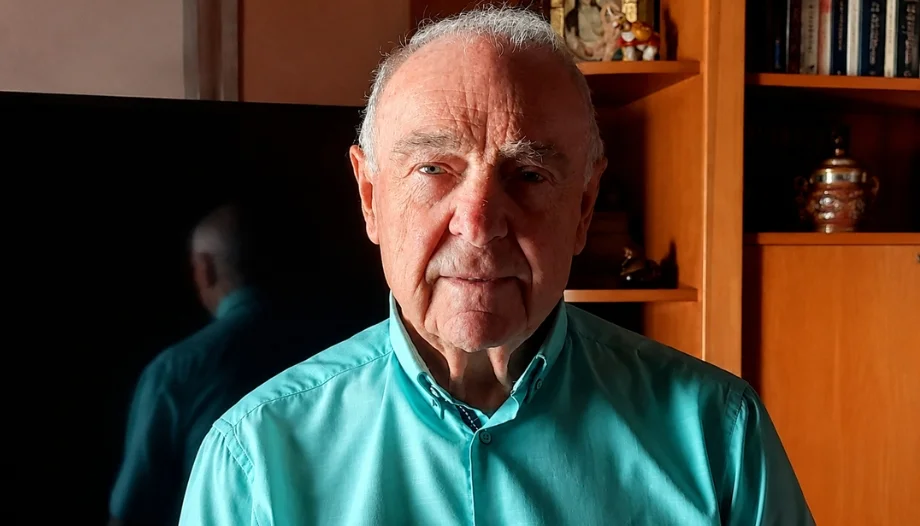
José Molero (Alfacar, Granada, 1937)—known as Pepe—has led a rich and happy life, but above all, a surprising one, especially during his youth. This native of Granada, a mining engineer—a field to which he devoted his early professional years—eventually found his way into teaching, a field in which, in addition to his dedication and undeniable talent, he also began to make his mark as a writer. Focused on young adult literature, though with a few forays into poetry,
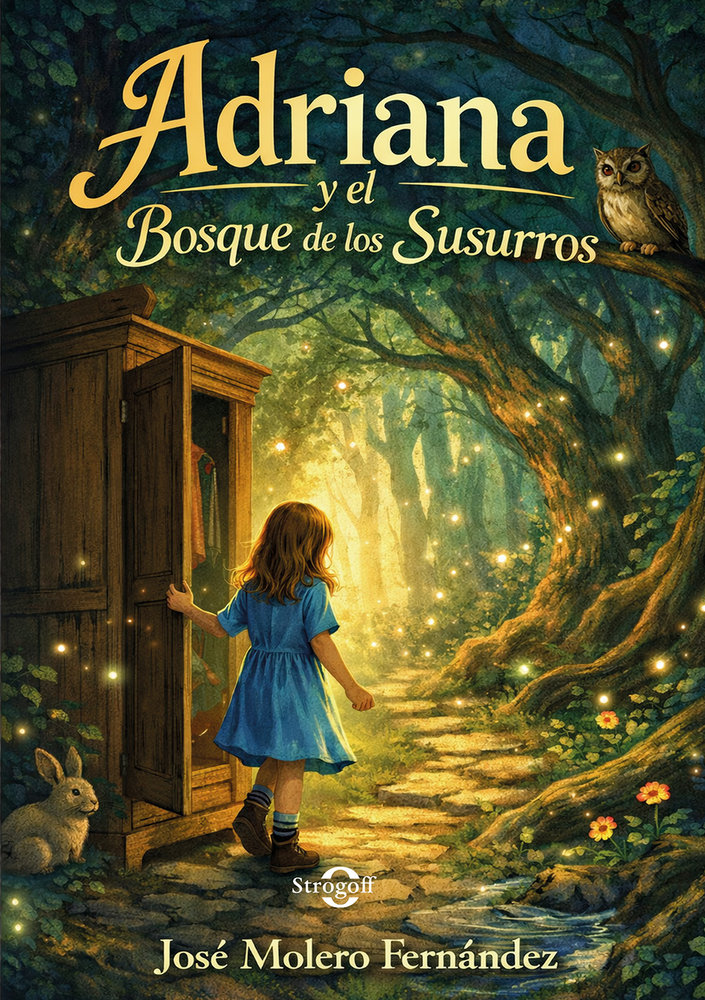
His latest book Ariadne and the Whispering Forest, published by the Strogoff Publishing House, delves into a magical forest, filled with voices and characters through whom a young girl, Ariadna, unravels the essential questions of life: friendship, respect, solidarity…
In this conversation with Omnes, Molero emphasizes that today the enemy is not “a shortage of books—more are being published than ever before—but the dictatorship of distraction.”.
Mining engineer, professor… How did you get into writing for children and young adults?
–I think I got into it quite naturally, although even back in high school I was writing short stories and enjoyed making up stories. When I chose a primarily technical major, creative writing took a back seat.
The real turning point came years later when I began teaching. My daily interaction with students reignited my passion for writing, and, almost without realizing it, I discovered that children’s and young adult literature was an extraordinary way to spark curiosity, instill values, and inspire a love of reading. Since then, I have published more than 500 short stories and several young adult novels.
Over time, I’ve come to realize that teaching and writing are two activities that feed into each other. Spending time with children and teenagers allowed me to better understand their way of thinking, their concerns, and their sense of humor, and all of that found its way into my stories. Thus, what had started out as a youthful hobby has ended up becoming one of the most exciting aspects of my life.
You've been a teacher for many years—how has young people's access to reading changed?
–I think people have never read as much as they do now, at least if we consider the number of words that pass before our eyes every day. Just look at how glued we are to our cell phone screens: instant messages, subtitled videos, constantly updating news…
Today, the greatest enemy is by no means a shortage of books—more are being published than ever before—but rather the tyranny of distraction. We live under a constant barrage of stimuli that push us to quickly move from one piece of content to another, making it increasingly difficult to engage in the slow, reflective, and quiet reading that a good book demands—and that leaves an indelible mark.
That’s why I always encouraged my students to set aside at least ten minutes a day for reading. I didn’t suggest they start with the great classics or turn reading into a chore, but rather that they discover the pleasure of opening a book on their own initiative. Once that small habit takes root, everything else follows almost naturally: concentration improves, vocabulary expands, expression becomes more refined, and, above all, one’s understanding of reality broadens.
I believe that every child or young person who discovers the joy of reading represents a small victory over the superficiality of our times. And that discovery almost never happens by chance. Behind it, there are usually parents who read with their children at first, or a teacher who enthusiastically recommends a book. That is almost always where a reader’s true journey begins—a journey that, once truly embarked upon, lasts a lifetime.
Are there any «surefire» stories? What books do you consider essential for a family library?
–I don’t think there are any foolproof stories, because every reader is different—just as there are no definitive lists of books. Rather than searching for the perfect book, what’s important is putting the right story in each child’s hands at the right time.
In a family library, however, I do consider the great classics to be essential—The Little Prince, Alice in Wonderland, Peter Pan, Pinocchio, The Wizard of Oz…— because they have stood the test of time and continue to captivate generations of readers. Alongside them, it’s worth including magnificent contemporary works such as The Chronicles of Narnia, poetry books—encountering poetry is essential during childhood—and adventure novels that fuel curiosity, imagination, and the desire to continue discovering the world.
But, above and beyond any list of titles, the best book is the one that, once finished, sparks a child’s desire to pick up another one. That’s where the true habit of reading begins—and with it, a journey that can last a lifetime.
These days, many parents feel «overwhelmed» by the vast selection of children’s and young adult literature. How can they choose books of high literary quality that also convey a sound worldview and a positive view of humanity?
–That’s a very timely question, because there have never been as many children’s and young adult books as there are now, and yet that very abundance can be overwhelming for many families. My first piece of advice is not to be swayed by trends or bestseller lists. A good book isn’t necessarily the one that sells the most or the one with the biggest marketing campaign. marketing not the most striking one, but the one that lingers in the reader's memory after the book has been closed.
It’s a good idea to look for well-written works with careful language, believable characters, and clever plots. But literary quality, while essential, isn’t enough. Books also nurture sensitivity and help shape a way of looking at the world. That is why it is important for them to convey a hopeful vision—so necessary today—of what it means to be human, where values such as friendship, truth, generosity, hard work, good humor, responsibility, and forgiveness are embodied in the characters’ lives rather than presented as a sermon.
I would also advise parents not to try to navigate the thousands of new options on their own. It’s worth trusting the judgment of good teachers, librarians, and digital platforms such as Delibris or prestigious institutions and media outlets. And, whenever possible, read with your children or, at the very least, take an interest in the books they read. Sharing a story and talking about it is one of the best ways to educate.
Ultimately, a good book does not indoctrinate, but neither is it morally neutral: every story or poem conveys a certain view of people and life. The best literature does not lecture; it offers guidance. I know from experience that a child learns much more from an admirable character than from a brilliant speech.
Children's and Young Adult Literature: What Can It Teach Us Adults?
–Children’s and young adult literature can teach adults a great deal because it doesn’t trivialize life’s big issues; it makes them clearer. Children retain a sense of wonder that we adults lose almost without realizing it. That’s why, when a writer truly connects with a child, they’re also building a bridge to adult readers.
The best children’s books don’t have two levels of interpretation: one for children and another for adults. They convey a single truth, told with such depth and simplicity that anyone can be moved by it. They explore themes of friendship, fear, loss, hope, and love with an authenticity that we often miss in many books written exclusively for adults.
It's no coincidence that some of the great classics of children's literature continue to stay with us throughout our lives. Platero and I, for example, was never intended by Juan Ramón Jiménez to be a book exclusively for children. In fact, in the preface he admits that he wrote it «…I don’t know for whom…,» making it clear that it was intended for any reader capable of being moved. The same is true of The Little Prince and so many other works that, over time, have come to find readers of all ages.
This shows that great books are ageless; they have readers. And perhaps that is one of the main lessons of good children’s literature: to remind us that growing up isn’t about losing the ability to be amazed, but about preserving it. An adult who shares a good book with a child isn’t just teaching them to read; they’re also rediscovering, almost without realizing it, a purer, freer, and more human way of looking at the world.
What does your latest book of short stories offer, Adriana and the Whispering Forest?
–My latest book, Adriana and the Whispering Forest, is, in a way, the embodiment of everything I’ve been telling you about children’s and young adult literature. It brings together fifteen stories featuring Adriana—though it could be any boy or girl—during her adventures in a forest where fantasy becomes a path to discovering reality.
Each adventure presents a different challenge and offers readers the chance to grow alongside the protagonist. There is a clear homage to some of the great classics of children’s and young adult literature, from The The Chronicles of Narnia, from C. S. Lewis to characters and myths such as Merlin or King Midas, because great stories never cease to engage with one another and continue to have much to say to readers of different generations.
I wanted to write a book in which adventure, humor, mystery, and imagination are not merely a form of entertainment, but rather a vehicle for exploring essential questions: good and evil, fear and courage, friendship, solidarity, the importance of knowing how to listen, and the ability to marvel at the beauty of nature.
If, upon closing the book, a child feels the urge to keep reading and also asks themselves an important question about life, I’ll consider the goal achieved.
As an author, it gives me great satisfaction to see that Adriana and the Whispering Forest It is winning over young readers, educators, and families alike.
Adriana and the Whispering Forest






 Español
  English
  Italiano
  Français
  Deutsch
  Polski
  简体中文
简体中文