



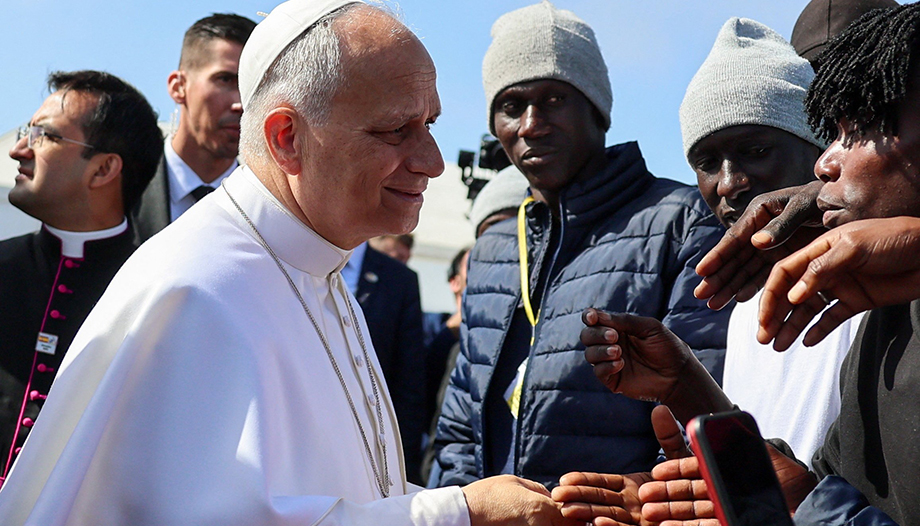
 The Pope calls on people to “look up” with love and respect, and sees the Canary Islands as “a key to dialogue” Pope in Tenerife: "we are all migrants and pilgrims on the way to the heavenly homeland"."Bishop José MazuelosCanary Islands is not a prison for young people".
I still find it hard to put into words everything I experienced. The excitement of those days still lingers within me. Seeing thousands of people spontaneously pour into the streets to greet the Holy Father, watching entire families wait for hours for him to pass by, discovering the sincere affection with which the people of the Canary Islands welcomed him… these are images that will remain etched in my heart forever.
But if there was one thing that particularly impressed me, it was seeing how the Pope never stopped looking at people. Every greeting, every gesture, every blessing sprang from a genuine closeness. Even while traveling, whenever he spotted someone waiting by the roadside, he would roll down the car window to greet them. These are seemingly small details, but they reveal a profoundly evangelical way of exercising the Petrine ministry.
The entire visit was structured around three main themes that, in my opinion, perfectly summarize the pontificate of Leo XIV: evangelization, beauty, and charity. Madrid showcased the richness of the faith passed down over the centuries; Barcelona reminded us how beauty leads to God; and The Canary Islands embraced the powerful message on the dignity of every human person, especially those who are forced to leave their homeland in search of a better future.
It was no coincidence that the Holy Father chose to stop in Arguineguín. There, he did not merely deliver a speech on the phenomenon of migration. He invited us to contemplate the real faces of men, women, and children whose dignity can never depend on a document, a border, or a political interest. He listened to heartbreaking testimonies, embraced real suffering, and reminded us that no person can be reduced to a problem or a statistic.
The migration issue requires political, legal, and social responses, but above all, it demands a moral response. Europe cannot grow accustomed to watching human suffering from a distance. We must work to combat human trafficking syndicates, facilitate legal migration channels, and promote development in countries of origin. Defending human dignity must never become an ideological issue.
Indeed, one of the great values of this visit has been its ability to once again place the person at the center. The Pope spoke about life in all its breadth. He did so in Parliament, he did so in the Canary Islands, and he did so at each of his meetings. He reminded us that the defense of human dignity does not allow for fragmentation or self-serving interpretations. Every life deserves to be protected, from its beginning to its natural end, and every person deserves to be respected, regardless of their circumstances.
I’ve had the opportunity to share moments of casual conversation with Leo XIV during our travels. We talked about many topics, including everyday matters. That closeness allowed me to discover a man who is deeply human, serene, cheerful, and an extraordinary listener. One only had to look at his face to see that he was happy to be among us.
I was also deeply moved by the affection he showed toward the people of the Canary Islands. He was aware of the efforts made over the years to welcome thousands of migrants and wanted to publicly thank our society for its generous response. He was well aware of the difficulties we have faced, and precisely for that reason, he wanted to acknowledge the greatness of a people who, far from letting fear get the better of them, responded with solidarity and brotherhood.
At the Cathedral, I experienced another particularly meaningful moment when he referred to our traditional Ascension flowers. It was a gesture of immense pastoral sensitivity. He had sought to understand our expressions of faith and knew how to integrate them naturally into his message. He did not come simply to deliver speeches; he wanted to engage with the history, culture, and spirituality of this pilgrim Church in the Canary Islands.
If I had to sum up in a single sentence what Pope Leo XIV has left behind after his visit, I would say that he has restored our hope. We live in times marked by polarization, disillusionment, and mistrust. However, the Pope reminded us that Spain possesses immense spiritual and human wealth; that we are heirs to a tradition capable of enlightening the world; and that we cannot resign ourselves to pessimism or fruitless conflicts.
The visit has come to an end, but now the most important task begins: bringing to life all that we have received. A pope comes and goes; the Gospel remains. And the greatest tribute we can offer to Leo XIV is not to preserve the memory of these historic days, but to turn his words into a daily commitment.
The Canary Islands are already part of the history of apostolic journeys. But above all, I hope that this event will become part of the history of our Church’s conversion. For the hope that the Holy Father has sown among us will bear fruit only if we are able to live it out and pass it on to future generations.
Bishop of the Canary Islands. President of the Episcopal Subcommission for the Family and Defense of Life.





 Español
  English
  Italiano
  Français
  Deutsch
  Polski
  简体中文
简体中文