




– Rachel Minkin, Luona Lin, Dana Braga, and Kiley Hurst
For many American parents who work full time, the line between work and family is not clearly defined, according to a Pew Research report based on a survey of 2,242 working American parents conducted between March 2 and 15, 2026.
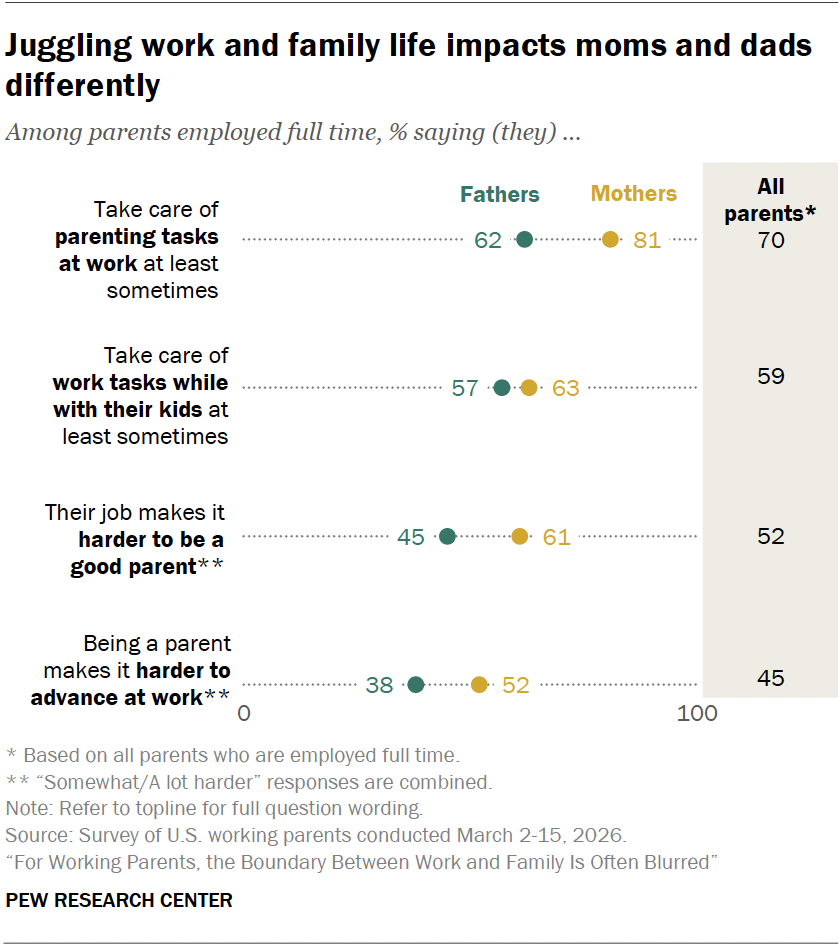
– The 70% states that she handles child-rearing responsibilities while working.
– 59% states that he handles work-related tasks when he is with his children.
– The 54% group says they find it difficult to balance their work and family responsibilities.
The Special Burden on Mothers
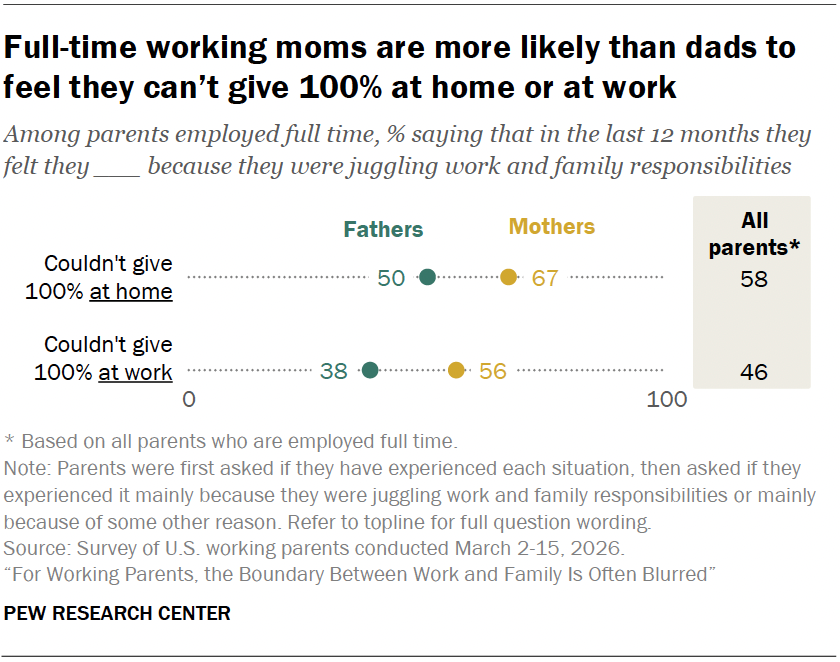
Parents—especially mothers—often bear the mental burden of trying to balance their families’ needs with the demands of their jobs. And with so many responsibilities, it’s no wonder they sometimes feel they can’t give 100% at home or at work.
As one mother commented in the survey on the difficulty of balancing work and family: “I’m supposed to work as if I didn’t have children and be a parent as if I didn’t have a job.”.
For this project, Pew surveyed 2,242 working parents between March 2 and 15, 2026, to understand how they manage these aspects of their lives. Their responses give us food for thought.
Key Findings
Approximately half of parents who work full time (52%) say that their job makes it difficult for them to be good parents. On the other hand, 45% say that being a parent makes it difficult for them to advance in their careers.
Compared to fathers, working mothers take on more responsibilities at home and find it more difficult to strike a balance. 62 % of full-time working mothers say they find it difficult to balance work and family responsibilities, compared with 47 % of fathers.
In heterosexual couples where both parents work full-time, 52 % state that the mother takes on more parenting responsibilities, while a smaller percentage indicate that the father does more (10 %) or that these tasks are shared equally (39 %).
Access to employee benefits for working parents varies depending on income.
Parents who work full-time and have lower household incomes are consistently the least likely to report having access to benefits such as paid time off (PTO), paid leave separate from PTO, and employer-provided health insurance (among those who are not self-employed).
This group is also the most concerned about losing their pay—or their job—if they miss work because their child is sick or they cannot arrange childcare.
The Benefits of Working from Home When Necessary
Most parents who work full time say that having the flexibility to work from home when necessary would be extremely or very helpful to them (among those who are not self-employed). However, only 24 % of these parents say they have a great deal of flexibility to work from home.
People who regularly work from home see some advantages to this arrangement, such as being able to attend their children’s activities when they overlap with their work schedule. Even so, they are no more likely than those who work from home less frequently to say that they find it easy to balance work and family life. Read more about the Experiences of parents who work from home.
Child Care: The Costs
Across all income levels, parents say that cost is the biggest obstacle to finding child care. Low- and middle-income parents are more likely than those with higher household incomes to rely on family members, friends, or neighbors to care for their children. Most high-income parents use paid child care services, such as daycare centers or preschools.
This analysis focuses primarily on the experiences of parents who work full time, who account for 73 % of U.S. parents with children under the age of 18 (including 89 % of fathers and 59 % of mothers, according to a Pew Research Center analysis based on data from the U.S. Census Bureau) for 2025. Read more about the Experiences of parents who work part-time and how The work arrangements of American parents have changed.
“My work responsibilities are never-ending…”
Working parents don't always see a clear distinction between their work and family lives. As one father wrote in the survey: “I feel like my work responsibilities are never-ending, which makes it hard for me to disconnect at night and focus on my family.”
For most parents who work full-time, work responsibilities follow them home, and parenting responsibilities stay at work.
This overlap is particularly noticeable among mothers. Approximately eight out of ten mothers who work full-time (81%) report taking care of parenting tasks during their workday at least occasionally. This includes 38% of mothers who say they do so very frequently—nearly twice as many as the fathers who say the same (17%).
However, many parents also feel this tension. Most parents who work full time say they handle parenting tasks while at work (62%) and work tasks while with their children (57%), at least occasionally.
When Work Interferes with Parenting
Most parents who work full time (60%) believe they spend very little time with their children, and many more say this is due to work obligations rather than other reasons.
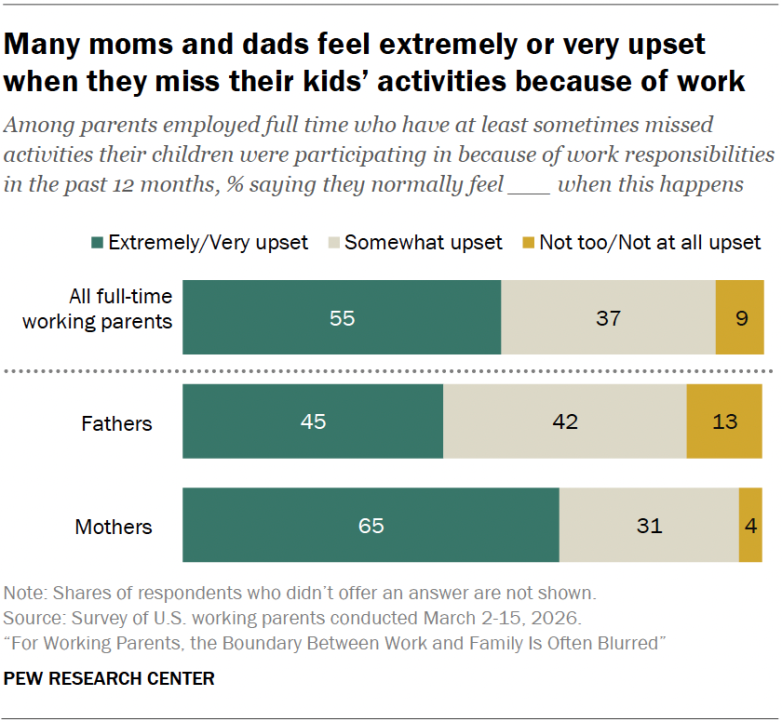
In addition, nearly half (47%) say that their work responsibilities prevent them, at least sometimes, from attending activities in which their children participate, such as school concerts or sporting events.
Mothers are particularly likely to say they feel upset when they miss their children’s activities due to work: 65% feel extremely or very upset, compared with 45% of fathers. Even so, most parents say they feel at least somewhat upset when this happens.
They don't have enough time for hobbies, relationships, and self-care
Among parents who work full-time, about half or more say they don't have enough time for things like hobbies, seeing friends, exercising, or relaxing.
Mothers are much more likely than fathers to say they do not have enough time for each of these activities. For example, 65 % of mothers say they do not have enough time to exercise, compared with 52 % of fathers. Similarly, mothers are more likely than fathers to say they don’t have enough time to relax (67 % versus 53 %).
How They Share Household Chores parents who work full-time
We also found differences in the way mothers and fathers who work full time manage parenting responsibilities and household chores. (This analysis focuses on families in which both parents work full time, as this is the most common employment situation among heterosexual couples with children.).
Among parents who are married or living together in this type of family, 52% states that the mother performs more parenting tasks than the father, while 39% believes that both contribute equally. A similar percentage indicates that the mother performs most of the household chores (43%) or that they are divided equally (40%). A much smaller percentage states that the father performs more parenting or household tasks.
PDifferent points of view
Mothers and fathers often have very different views on how parenting responsibilities and household chores are divided. Most mothers say that themselves take on more responsibilities than their spouse or partner. Parents, on the other hand, tend to say that these tasks are share equally.
With regard to paid work, similar percentages of parents in these families report that the father works longer hours on a typical day (41%) or that both parents work approximately the same number of hours (39%).
About one in five (21%) say that the mother works longer hours. But even in families where the mother works more time that the father—parents are much more likely to say that the mother does more parenting and household chores than the father.
Part-time working parents: Most are women (79%)
Parents who work part-time share certain characteristics. Most are women (79%). In addition, most (58%) live in low-income households, while 33% have middle incomes and 6% have high incomes.
The nature of their work schedules also differs, as parents who work part-time are more likely than those who work full-time to say the following:
– Work hours are unpredictable (23% compared to 11% for parents who work full-time).
– A great deal of flexibility in choosing when to work the required hours (41% vs. 26%).
The Same Challenges for Full-Time and Part-Time Working Parents
Parents who work part-time are less likely to have access to employment benefits such as health insurance, paid vacation, and other paid leave. For example, 37 % of parents who work part-time have access to health insurance through their jobs, compared with 87 % of those who work full-time.
Despite their different work styles, Parents who work part-time face many of the same challenges as those who work full-time.
A similar percentage of parents who work part-time (51 %) and full-time (54 %) say they find it difficult to balance work and family responsibilities.
Similarly, similar percentages indicate that, over the past year, they felt they could not perform at 100 % at work due to the need to balance both responsibilities (42 % and 46 %, respectively).







 Español
  English
  Italiano
  Français
  Deutsch
  Polski
  简体中文
简体中文