


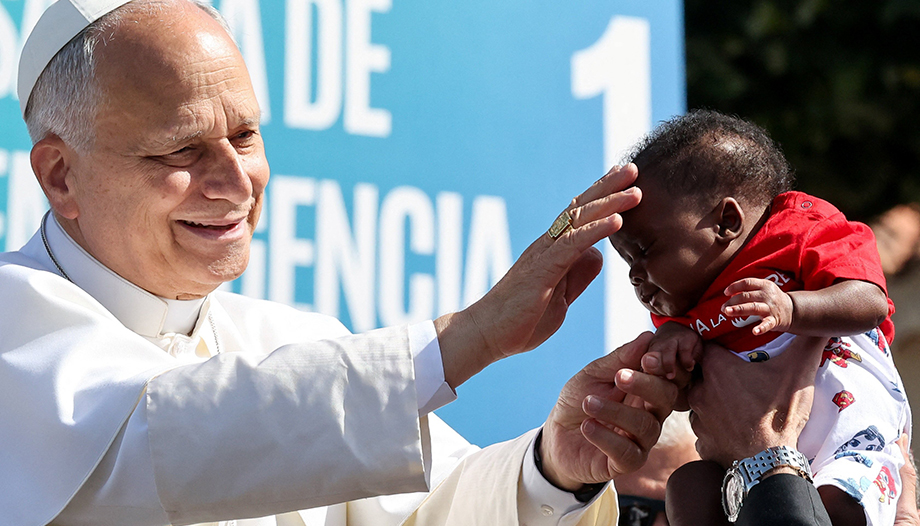
The images from Pope Leo XIV’s recent visit to Spain will remain in our memories for a long time. These were days of shared faith and ecclesial joy. But among so many memorable moments, one detail in particular caught my attention: how eager the people were to touch the Pope.
It wasn’t curiosity, nor a desire to be the center of attention. There was something deeper. You could see it in the faces of those waiting patiently behind the barriers and in the emotion of those who managed to brush the Holy Father’s hand for just a moment. It was as if that physical contact were the visible expression of an affection that had long been waiting for an opportunity to manifest itself.
Contributors to Tenderness
The scene with the young children was particularly moving. It inevitably brought to mind those passages from the Gospel in which mothers brought their children to Jesus so that he might lay his hands on them and bless them. Over the past few days, we have seen security personnel pick up small babies and bring them close to the Pope.
We must give credit to those bodyguards. Accustomed to ensuring security, they also knew how to become partners in tenderness. Thanks to them, many parents were able to experience a moment they will never forget.
It was equally beautiful to see how the crowd shared in that privilege. No one seemed to want to monopolize the moment. One hand would touch the Pope and then immediately make way for another. There was a collective thoughtfulness, a kind of silent agreement so that everyone could share in that treasure.
The Signs That Love Needs
Why this need to touch? Perhaps because we humans need love to be visible. We need signs. Affection seeks to express itself through the senses. We touch what we love, and we want to get physically close to those who mean a great deal to us. However, during this visit, there was another, even deeper form of contact.
The two great Eucharistic moments experienced in Madrid left an indelible impression. At the vigil with the young people, the silence of adoration was striking. Thousands of people had gathered, and yet there was such an intense stillness that it seemed as though one could hear grace passing through their souls. Something similar happened during the celebration at Cibeles. After Communion came the time of thanksgiving. Then the voices, the singing, and the hubbub faded away. All that could be heard was the singing of the birds. That immense crowd remained silent before a Presence infinitely greater than that of any human being.
A Parable of Invisible Heat
I had the opportunity to distribute Communion that day. We priests were given some unusual containers. They were metal hemispheres covered by a transparent methacrylate lid that protected the consecrated hosts from the wind.
It was a good idea, but the organizers hadn’t anticipated one detail: the blazing sun that morning in Madrid was heating the metal to surprisingly high temperatures. Many priests wrapped their stoles around the containers to protect them from the heat. Their hands could clearly feel the rising temperature.
As I held the chalice, an unexpected thought came to me. The physical heat we were experiencing was nothing compared to the invisible warmth that the Body of Christ transmits to the soul. That fiery hemisphere became a small parable for me. Touching God always warms us from within.
The Christian faith is, in a sense, the story of a God who allows himself to be touched. Jesus’ contemporaries touched his hands, his clothes, and even the wounds on his resurrected body. Today, we can still touch him sacramentally in the Eucharist.
That is why, as I watched so many people eager to touch the Pope, I thought that gesture concealed a deeper truth. Our affection for the successor of Peter stems precisely from what he represents. We want to touch the Pope because he brings us closer to Christ. We are moved to shake his hand because we see in it the visible continuity of the mission that the Lord entrusted to Peter.
But a Christian’s heart cannot stop there. Every closeness to the Pope is meant to lead us toward a greater closeness. Every human emotion must lead to an encounter with God.
Thousands of people wanted to touch the Pope over the past few days. And it was beautiful to see. But it is even more beautiful to remember that, at every Communion, it is God who touches us. And when that happens, the soul reaches the true warmth of grace.
Priest






 Español
  English
  Italiano
  Français
  Deutsch
  Polski
  简体中文
简体中文