


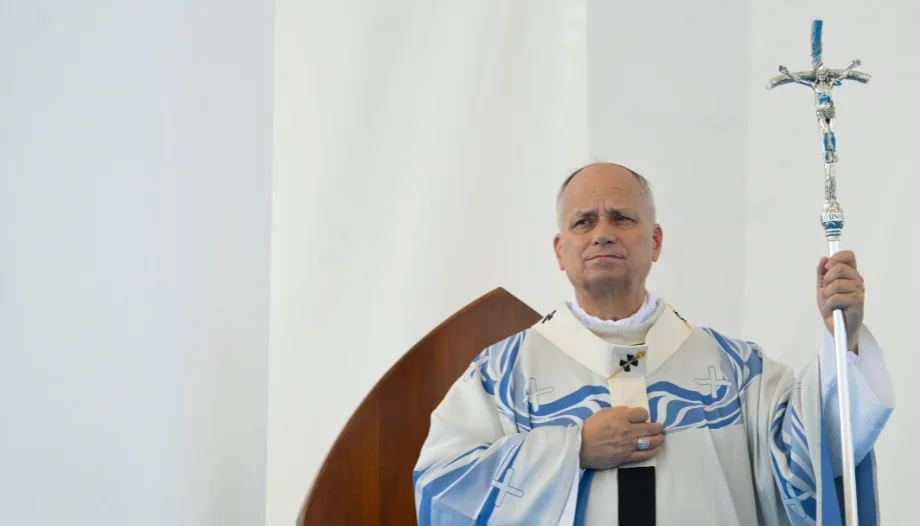
For more than 30 years, Dr. Pietro Bartolo has examined more than 350,000 people and performed autopsies on those who died during the journey to Lampedusa, the first place where migrants rescued from the Mediterranean arrived.
One story, he said, has really stuck with him.
After a shipwreck near Malta, a father told Bartolo how he had tried to keep his family alive in the water. As he swam, he held his youngest son against his chest, his wife with one hand, and his three-year-old son with the other. When he realized he no longer had the strength to save everyone, he let go of his oldest son.
«If I had held on for just one more minute, my son would still be here,» Bartolo recalled the father telling him. Rescue teams arrived moments later.
«Understand,» Bartolo said in an interview with Catholic News Service on June 3, «how terrible it is for a parent to have to choose which child to let go.».
According to him, stories like this explain why Pope Leo XIV visited Lampedusa.
Lampedusa, a symbol of solidarity
For Bartolo, who spent decades as a doctor on Lampedusa and is a former member of the European Parliament, these human tragedies explain why Pope Leo chose this small Mediterranean island for one of the most important visits of his pontificate.
«People ask why the pope is coming to Lampedusa,» Bartolo told CNS. «Because this is a symbol of solidarity.».
When the first American pope commemorated the 250th anniversary of the United States Declaration of Independence on July 4, he did not do so to celebrate his homeland, but rather at a point of entry for European migrants, praying for the migrants buried in the island’s cemetery, meeting with survivors, and celebrating Mass in a place where tens of thousands of people are fleeing war, persecution, and poverty.
Before delivering a single public speech, Pope Leo XIII laid flowers on the graves of migrants who died trying to cross the Mediterranean. He met with a migrant family at the «Gate of Europe» monument, blessed a plaque naming the Favaloro pier in honor of Pope Francis, and later celebrated Mass beneath an image of Our Lady of the Safe Harbor.
The visit was deliberately intended to evoke Pope Francis’s first trip outside Rome in 2013, when he visited Lampedusa to denounce what he called the «globalization of indifference.».
Compassion and Responsibility
«I thank the Lord for the opportunity to visit you, following in the footsteps of Pope Francis,» said Pope Leo XIII in his homily at the Arena sports field in the Salina district of Lampedusa.
But while he reiterated the emphasis his predecessors had placed on migrants, Pope Leo gave the message his own theological emphasis.
Reflecting on the parable of the Good Samaritan, he said that Lampedusa today finds itself «on a road as dangerous as the one leading down from Jerusalem to Jericho.».
«Those who have lost their lives in this sea are victims both of decisions that were made and of decisions that were not made,» he said.
The Pope praised the fishermen, volunteers, rescue workers, civil authorities, and ordinary residents of the island who have been taking in migrants for years, thanking them for demonstrating «the miracle of compassion.».
«There is no love for God without love for one’s neighbor,» he said, «and there is no neighbor unless I reach out to him.».
«Indifference toward the common good and corruption in their countries lead to poverty and exclusion,» said Pope Leo XIII. However, citing his first encyclical, «Magnifica Humanitas,» he added: «No one is exempt from responsibility.».
Pope Leo XIII also urged Europe to go beyond emergency responses, calling for long-term policies capable of «receiving, protecting, supporting, and integrating migrants,» while helping developing countries so that «no one is forced to emigrate.».
His message spread beyond the borders of Europe.
Migration: A Priority of the Pontificate
In addition to his homily on July 4, Pope Leo XIII issued a message on the occasion of the 250th anniversary of the United States, in which he praised the nation’s founding ideals of liberty and religious freedom, while reminding Americans that immigrants «have been part of this country’s history since its inception.».
«Defending human life also means welcoming, protecting, and helping immigrants,» he wrote, describing such hospitality «not only as an act of charity, but also as a recognition of the dignity inherent in every human person.».
For the first American pope, immigration has been a priority as a matter of human dignity. Pope Leo XIII took advantage of his visit to a migrant entry point to celebrate Immigrants« Day in the United States, stating that immigrants »have been part of this country’s history since its inception.”.
«Welcoming them with compassion and generosity is not only an act of charity, but also a recognition of the dignity inherent in every human person.»
Pope Leo XIII stated that the 250th anniversary of the signing of the Declaration of Independence is not only an invitation to celebrate, but also to reflect on the responsibilities that the sons and daughters of this country have toward one another.
That message resonates deeply in Lampedusa.
The Numbers and Faces of the Tragedy
According to Mediterranean Hope’s annual report on the Lampedusa Migration Observatory, nearly 40,000 migrants arrived on the island in 2025, of whom more than 80% had departed from Libya. The observatory documented at least 1,314 deaths along the Central Mediterranean route during that year, although it noted that the actual number is likely higher, as many shipwrecks go unreported.
For Bartolo, however, the statistics tell only part of the story. The retired doctor said that performing autopsies on drowned children and families «completely changed my life.» Now, he spends his time traveling throughout Europe, giving talks at schools and universities about what he witnessed during his years at the migrant entry point.
Remembering the dead has also become the life's work of Tareke Brhane, an Eritrean refugee who crossed the Mediterranean before arriving in Italy in 2006.
Restoring a Name to the Victims
After surviving the crossing, Brhane founded the October 3 Committee in the wake of the 2013 shipwreck off the coast of Lampedusa, in which more than 360 people lost their lives. The organization works to identify those who die at sea and restore the identities of victims buried as unidentified migrants.
«Most of them just have numbers,» Brhane said.
As he told CNS, his committee has helped identify approximately 100 bodies and has successfully led a campaign to have Italy designate October 3 as a national day of remembrance for migrants who died trying to reach Europe.
For Brhane, Pope Leo’s decision to begin his visit at the cemetery was the most significant gesture of the day. Brhane has dedicated his life to identifying migrants buried without names.
Historically, many bodies recovered from the Mediterranean have been buried with only a case number, since authorities were unable to identify them. The October 3 Committee has worked with forensic experts, Italian authorities, and the victims’ families to change this situation. As he told CNS, there is a huge difference between the graves of local residents and the unmarked graves of migrants.
«People will talk about the port,» he said. «But the real message is that he went to the cemetery first to pray for those who died.».
He described Lampedusa as «a place of suffering and a place of hope.».
As he explained, many immigrants who later become British, Swedish, or Dutch citizens return simply to set foot once again on the island where they first arrived alive.
«They say this is where we were reborn,» Brhane told CNS.
Conveying a similar message, Mayor Filippo Mannino told the pope during his visit that the island is like a lighthouse that «does not judge» and «does not choose whom to illuminate,» but rather remains lit throughout the night for anyone seeking the shore.
«No one is too small to lead the way,» he said.
A Challenge for Europe and the World
The visit echoed the Pope’s apostolic trip to Spain in June, where he made some of his strongest statements on migration regarding the Canary Islands, another major entry point for migrants seeking to reach Europe. There, he urged Europeans not to allow tourism to obscure the human suffering experienced along migration routes and encouraged visitors to «have the courage to think differently,» stating that a true vacation should lead people to rediscover the meaning of life and solidarity with others.
Pope Leo reiterated this point in Lampedusa, once again using the image of the Good Samaritan to argue that Christian discipleship requires reaching out to those in need rather than «passing them by.».
«Have the courage to think differently,» the Pope urged those vacationing on the island, encouraging them not to ignore the suffering taking place in the surrounding sea.
«From this »remote corner of Europe,'" he said, "the challenge facing both Europe and the rest of the world can be seen with unusual clarity.".
«All of this must be done with care, ensuring respect for the dignity of every person,» the Pope said on July 4. «This is a task not only for public institutions, but also for civil society as a whole and for the Church.».






 Español
  English
  Italiano
  Français
  Deutsch
  Polski
  简体中文
简体中文