


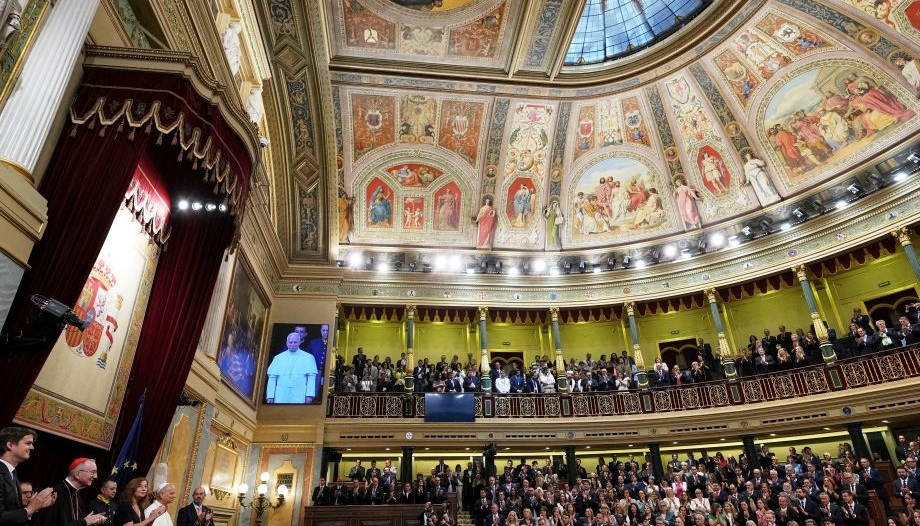
The visit of the Pope Leo XIV to Spain June saw a parliamentary event that goes beyond mere political reporting or diplomatic protocol. Its speech before the Spanish Parliament, capped off by a stunning ovation lasting more than seven minutes, calls for a thorough analytical reflection.
In a legislative landscape marked by the immediacy of partisan debate, the Pontiff chose to raise the bar and delve into the realm of fundamental principles, focusing his address on a three-part framework that underpins Western civilization: Freedom, Law, and Democracy, under the indispensable umbrella of Human Dignity.
The core of his warning was aimed directly at the foundations of peaceful and pluralistic coexistence. For the Pope, the health of a democracy is measured by how political power stops at the threshold of the citizen’s privacy, noting verbatim: “From this respect for others also arises the duty to safeguard the space where their convictions, their conscience, and their relationship with God mature. Attention to this inner realm allows for a better understanding of a decisive issue for any truly democratic society: freedom of thought, of conscience, and of religion—a fundamental right that safeguards the most intimate sphere of the person.”.
This statement positions respect for inner life not as a gracious concession by the state, but as a priority treasure that institutions must actively protect—and not merely tolerate with resignation.
Paradoxically, in a society obsessed with protecting its digital data, we often neglect the true foundation of all privacy. If we are so zealous about protecting our digital footprint, we should be infinitely more committed to safeguarding freedom of conscience.
The Anthropological Labyrinth: Consciousness Versus Consciousnesses
To understand the significance of the papal message, it is essential to conduct a serious anthropological study that prevents us from falling into a common error: confusing «freedom of conscience» with «the freedom of consciences.» Although this may seem like a mere semantic distinction, the conceptual gap is enormous.
Freedom of conscience, in the singular, functions as an ontological principle linked to the very nature of being. It defines the intrinsic capacity of human beings to possess an inviolable inner sanctuary. At its core is the faculty to judge good and evil, allowing the individual to adhere to a worldview without any external agent being able to force that inner thought. From this perspective, human beings are sovereign subjects, endowed with reason and fundamental dignity. It is a freedom «by right» that every human being possesses by virtue of being born, and it serves as the driving force behind their moral responsibility.
However, the picture changes when language is embodied in the freedom of conscience. Here, anthropology moves beyond abstraction and turns its attention to real people. We move from legal theory to everyday practice, marked by cultural diversity and human frailty. At this level, the core issue is the right of every individual conscience—yours, mine, your neighbor’s, and so on—to exist, to make mistakes, to express itself, and to coexist in the shared space.
This view recognizes that consciousness does not arise in a vacuum; it is shaped by education, language, trauma, and culture. Therefore, it implies accepting that human beings are multifaceted and fallible.
These two dimensions are inextricably linked: anthropologically speaking, the first is the foundation of the second. It is impossible to defend freedom of conscience without first believing in the dignity of the individual conscience. But the former is reduced to a dead letter if it does not take shape in the latter: an active respect for the way in which each real individual navigates their existence. It is the ethical leap from applauding an abstract provision in the Constitution to defending your neighbor’s right to live according to their convictions, even if they do not coincide with your own.
The measure that transcends politics and the grandeur of the law
Pope Leo XIV continued his address by calling on the legislative branch to oppose reductionist views of personal autonomy: “Without confusing the legal sphere with the moral one, it is also worth remembering that freedom requires a full understanding of itself. Being free does not mean merely being free from coercion or having many choices; it means being able to recognize the good and commit to it responsibly. For this reason, every truly free society also requires a proper delimitation of public power, so that the freedom of individuals, communities, and associations is not unduly restricted.”.
This solemn appeal calls on the members of Congress not to give up on the search for truth as they make laws. Far from being dogmatic, the Pontiff encouraged them out of empathy, recognizing that legislators and parliamentary groups, as human beings, are fallible and can make mistakes. Gazing up at the skylight that crowns the chamber of Congress, he offered a powerful reminder: “That light coming from above may serve as a reminder that politics, too, needs to acknowledge a higher standard that precedes and transcends it.”.
Referring to the paintings on the main wall depicting the reception of the Decalogue and the Gospel, and while upholding institutional secularism, Leo XIV argued that: “…these symbols invite us to recognize that modern freedom has also been shaped by a long process of education of the conscience, deeply marked by the Christian tradition. In that inner school, peoples learned that the law must serve the common good, that justice sets limits on force, that power requires legitimacy, that the poor are full members of the community, that the foreigner must be welcomed in accordance with his or her dignity, and that human life can never be treated as a commodity.”.
This premise undermines absolute legal positivism. A law does not attain its moral greatness merely by virtue of being passed by an arithmetic majority. Its true stature is demonstrated when, in addition to being valid in form, it can stand before the dignity of the person and pass that test without shame.
An Ethical Mandate: To Look Up
The speech concluded with the invitation that served as the motto for his trip: “Look Up.” Not to turn away from reality, but to remember that every parliamentary decision and vote affects real, flesh-and-blood human beings—especially the vulnerable who have no voice.
A broad perspective involves taking a deep look at what is at stake in every public decision. That is why technical solutions and legal reforms are futile without moral renewal. The practical implication for the members of this House, regardless of their political affiliation, is the ethical imperative to maintain an open mind and a willingness to amend whatever laws are necessary. Only by holding ourselves up to the mirror of human dignity will it be possible to achieve a democratic society that is authentically just, healthy, and truly free.





 Español
  English
  Italiano
  Français
  Deutsch
  Polski