



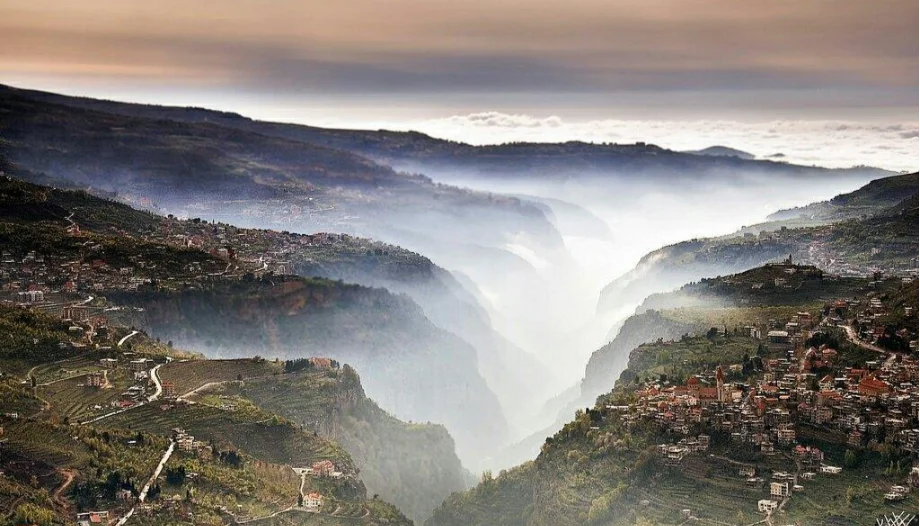
To Lebanon We've already devoted several articles to it: a small country with a vast cultural, human, and religious heritage. Now, just as I did with some Syrian shrines which I had the privilege of visiting on that same trip in 2008, I want to write about its heart: the Qadisha Valley and its monasteries.
Lebanon in the Morning
Lebanese mornings have those scents and flavors that aren't easily forgotten. And if you wake up in the mountains, with a breathtaking view before you—from the southern foothills of the Port of Beirut to the coast of Jounieh—the awakening is even more delightful.
The horn honks, and two black Range Rovers, packed with boisterous Lebanese, come to remind you of the day’s itinerary: breakfast with «kanafeh» on the outskirts of Beirut, a visit to the cedars of the Forest of the Cedars of God («Arz ar-Rabb»), arrival at the Holy Valley, and a visit to the monasteries.
The trip
In Lebanon, even cars have personality: from personalized license plates to roaring engines ready to tackle the grueling climbs and steep gradients that, over the course of about ten kilometers, take you from the sea to an altitude of 2,000 meters through twists and turns, narrow streets, and intersections.
And don't expect the trip to be a breeze if they're stuffing you like a turkey at every turn and your head won't stop turning to take in the wonderful scenery—the mountains, the sea peeking out from one curve to the next, and villages perched on the cliffs.
Nor can one expect the large group of hikers—all Lebanese except for yours truly—spread out among three SUVs, to move in an orderly and precise manner. Everyone stops wherever they want and for as long as they want; while you’re visiting a spot, you lose sight of the other two cars and might discover that one has gone ahead to the next stop and the other is still parked at the last rest stop.
The Cedars
First stop: one of Lebanon’s two most important nature reserves dedicated to cedars. This one is called «Arz ar-Rabb.» It is a wonderful place, a symbol of a country that was once completely covered by cedar forests, which, over the millennia, were even used for King Solomon’s Temple and contributed, along with purple dye, to the prosperity of the Phoenicians. Today, not much remains, but what we behold in the shade of these immense trees is a glimpse of paradise.
“No one’s going to touch you here! You’re in our territory!” a friend from the region—a Maronite stronghold for centuries—smiles at me, patting me on the back. And in that single sentence alone, I sense the reality of Lebanon—made up of peace and coexistence, but also of wars and entrenchment in one’s own ethnic and religious identity. And it all alternates, accumulates, and is assimilated, but it is never forgotten.
The Qadisha Valley
It is said in Lebanon that the fog rising from the Qadisha Valley is, in fact, the incense rising from its monasteries. And, in a way, that is exactly what Qadisha is: a holy valley («qadisha» in Aramaic means precisely «holy»), literally carved into the mountainside, opening up like a treasure cave.
Here, centuries of Maronite monasticism have shaped not only the spiritual landscape but also the physical one, leaving a visible mark on the cultivated terraces, the houses clinging to the rock face, and the trails connecting hermitages and monasteries—just as in the Mount Athos.
One detail that often catches the attention of visitors to Maronite churches and monasteries is the coexistence of monastic communities and hermitages. A monastic community (from the Greek «koinós bios«, «life in community») refers to a way of sharing life and prayer among two or more monks. The hermitage, on the other hand, is the retreat to which some monks withdraw for periods of more intense prayer—sometimes for the rest of their lives—while still welcoming pilgrims and the devout.
This valley is the stronghold of the Maronite Church. This Church, which follows the Syro-Antiochene rite and is in communion with Rome, originated precisely in these mountains, following in the footsteps of Saint Maron, a Syriac monk of the 4th–5th centuries. For centuries, during times of persecution and instability, the Maronites literally entrenched themselves in Qadisha, building monasteries, communal monasteries, and hermitages where they preserved texts, liturgies, and memories; and it was from here that the Lebanese national identity that shaped the country in subsequent centuries emerged.
The monasteries of the valley
Beyond the cedars, the car I’m riding in is the first (and the only one for several tens of minutes!) to arrive at the first monastery we visit: Deir Qannoubin, perhaps the most unique site for the Maronite Church. A monk explains to me that between 1440 and the 19th century, the patriarchs of the Maronite Church resided here (today the official seat is in Beirut, while the summer residence is in Dimane, also in the valley). In the chapels of Deir Qannoubin, as if cradled in the belly of the rock, lie the tombs of numerous Maronite patriarchs.
We stop for a moment of quiet reflection and then set off again before the others. “They’ll catch up with us anyway!” my carmates explain.
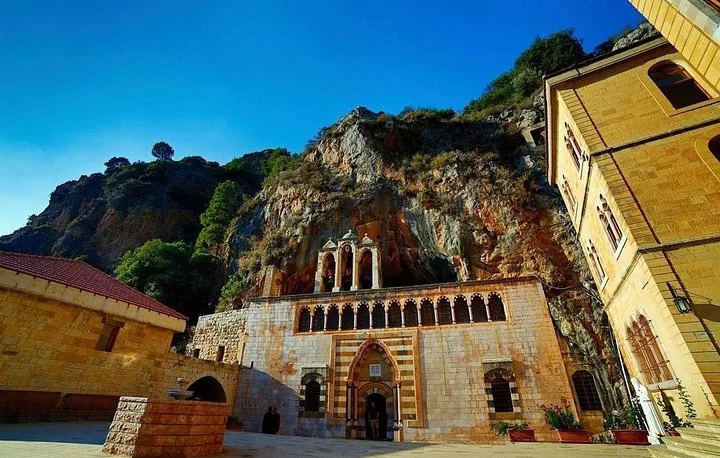
So, we headed toward Deir Mar Licha, another monastic center in the valley where it is evident, given the lush natural surroundings, that true monasticism is not a «fuga mundi,» but rather, I would say, an authentic «intelligentia mundi»: a way of being and understanding creation more deeply, and helping to shape it. Examples of this, in addition to the cells, are the vegetable gardens, the paths, and the terraced fields, which remind me of those at the Benedictine monasteries in Subiaco, near Rome.
A stop in Qozhaya (whose name, in Aramaic, means «treasure of life») is also a must. This monastery is famous not only for the age of its structure but also because, since 1584—thanks to a former student of the Maronite College in Rome—it has housed the first printing press in the Middle East. This makes it clear that its treasure also lies in the preservation and dissemination of culture.
We continued on toward Dimane (and I remember that, along the way, my questions about why we weren’t all traveling in a single, orderly convoy caused more surprise than indignation, as did my requests to stay a little longer at a monastery). This is where the Maronite patriarch’s summer residence stands, like a beacon overlooking the valley.
The stop under the waterfall
At last, the trio of all-rounders has managed to get together for what matters most: lunch!
In fact, between one monastery and the next, we stop in the shade of a small waterfall to enjoy a delicious Lebanese lunch at a local restaurant.
The wooden tables under the trees, the paper tablecloths, and the slightly rickety chairs, with the stream below us accompanying the parade of «hummus, tabbouleh, fattoush,» grilled meat, warm bread, and tomatoes—are the perfect setting for a way of life—the Mediterranean and Lebanese way—that is a continuous interweaving of the sacred and the profane, laughter and tears, heated arguments, hugs, and smiles.
And at the end of that day in August 2008, what remained with me was, certainly, the chaos of a disorganized group, the rush to run from one monastery to another (along with my stubborn insistence on straying from the itinerary), ancient cedars, and delicacies of every kind; but also a sense of nostalgia for a country I hope to visit again soon—a country I hope will always be, as Pope Francis described it, a message of peace—and for its people, that they may preserve “the dignity of faith, the nobility of hope. Just like the dignity and nobility of the cedar, the symbol of the country!”.






 Español
  English
  Italiano
  Français
  Deutsch
  Polski
  简体中文
简体中文