


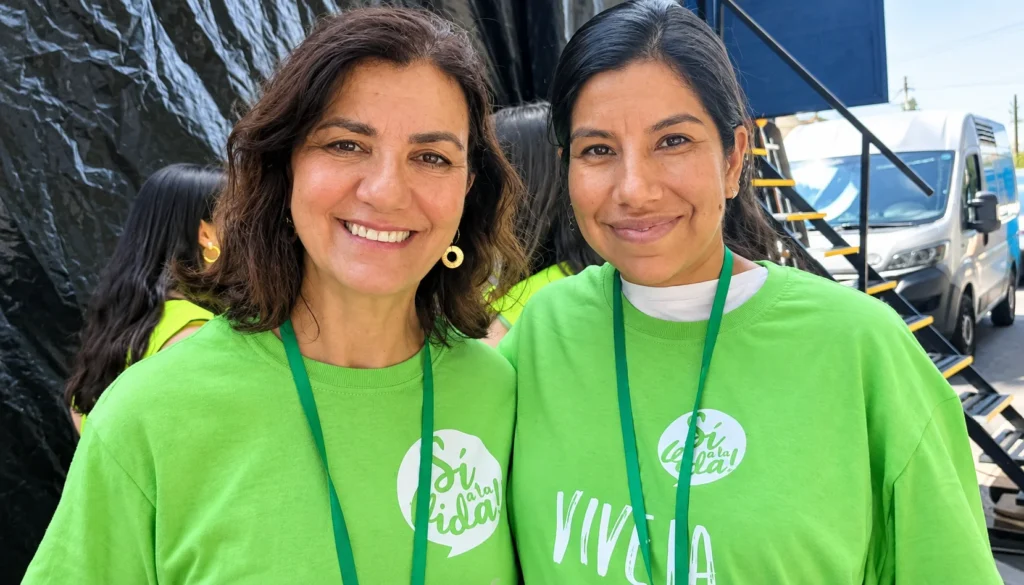
 Ana Ruiz: “Abortion not only affects the baby, but also the woman”.”What do you need in order not to abort?Helping Mothers After Childbirth: A Pro-Life Issue
The origins of this work date back to 1978. Abortion was not yet legal in Spain—it wouldn't be decriminalized until 1985—but the debate was beginning to reach high schools and colleges. That year, a group of six students began to organize in defense of the unborn. Among them was Marta Velarde, the current president of Rescatadores Juan Pablo II and the MasFuturo association.
Velarde acknowledges that the early years were difficult and points to her meeting Bernard Nathanson, the American doctor who performed thousands of abortions before becoming a leading figure in the pro-life movement, as a turning point: “When I met him in person, I couldn’t stop.” Since then, she says, there are no vacations or set hours when it comes to saving a baby. Years later, Rescatadores Juan Pablo II (John Paul II Rescuers) was founded.
At street level
The rescuers discreetly position themselves near most abortion clinics in Madrid and throughout Spain. Their work involves striking up conversations with women as they enter or leave. According to Velarde, most agree to talk and end up sharing their stories: “When a mother is considering ending her child’s life, but is listened to, the situation changes.”.
Sixty percent of the volunteers are between 18 and 28 years old. They are spread across different cities in the country. More than 1,500 young people have already gone through their rescue school, where they learn how to handle these conversations. In addition to direct rescues, there are what the organization calls indirect rescues: women who initially seemed to ignore the volunteers and who, after giving birth, contacted them to thank them.
Support without deadlines
The association insists that its work doesn't end at the clinic door. From this emerged MasFuturo in 2013, which welcomes women after their rescue and offers them lifelong support. Its president explains: “The choice to return or to know God isn't a matter of just one year.” She admits that this extended support makes the service more expensive, but the association considers it essential.
Some of these women have since shared their experiences publicly. Miriam, who had an abortion at eight months of pregnancy, was assisted by the rescuers a year ago and gave her testimony at the 2026 Madrid Pro-Life march; she is now preparing for her baptism and that of her son. María Elena, who considered aborting her fifth child, spoke at the 2025 event.
MasFuturo's work is organized into four projects:
- Project Light: the rescue phase, from the clinic door to the association.
- Walking Project: She accompanies women who have undergone one or more abortions—some more than six—in their return to faith. Many end up becoming involved in the defense of the unborn.
- Together Project: seeks reconciliation with family and community.
- Future Project: The most recent one finances the schooling in Catholic schools of rescued children over six years old.
MasFuturo also maintains a 24-hour emergency hotline (693 632 326) that anonymously handles hundreds of cases each month. Most calls come in between 11 p.m. and 5 a.m., especially on weekends, and not only from Spain: it also receives inquiries from North America, Europe, and South America.
Who supports it
The association receives no subsidies, and none of its members are paid for their work. Funding comes from donations, flea markets, and part of the salaries of the volunteers themselves, who include doctors, nurses, secondary and university teachers, students, social workers, psychologists, journalists, homemakers, and retirees. The organization assists any woman who requests it, regardless of origin, religion, or economic or social status.
When MasFuturo was founded, Velarde recalls, some feared that society would turn its back on an initiative so clear in its principles. She prefers to focus on the hundreds of children baptized since 2013 and the families who have grown closer to the Church.



 Español
 English
 Italiano
 Français
 Deutsch
 Polski