


 Leave me alone... I want to be free! The abortion debateWhy not excommunicate politicians who support abortion?
The Government of Spain has recently approved a project for the reform of the Constitution, The idea is to protect the right to the ”voluntary interruption of pregnancy”. In view of this news, we can ask ourselves several questions: is abortion a right? Does it not achieve the opposite of what it seeks: to perpetuate the greatest obstetric violence that a woman can receive -that of removing something as intimate as a child from the womb-? Are we shielding the greatest silent genocide in history?
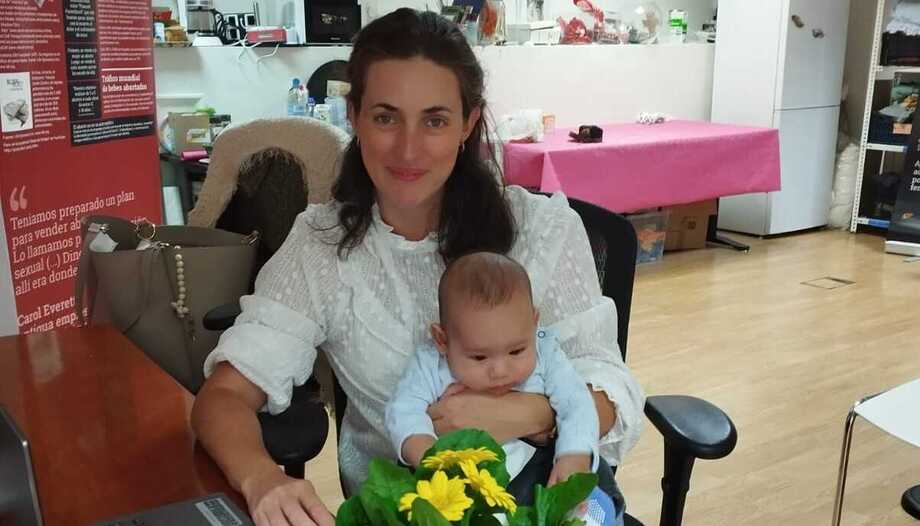
To shed light on this issue, we have the postabortion expert and social worker at the Provida Shelter, Ana Ruiz.
Why do you think this proposal is more than just a smokescreen?
- Yes, it is more than a smokescreen and it is not casual. It is a strategy to consolidate what we call the culture of death and to do so, moreover, as a mechanism to stay in power. Doing so at the cost of something as serious as the lives of thousands of babies.
Is abortion a constitutional right?
- No. Abortion is not a right. Neither constitutional nor of any kind. The right is life, and that is what we stand for. In fact, we should start to stop normalizing it with language: abortion is murder, and murder can never be a right.
Let's talk about you, about your personal experience. Why did you decide to have an abortion? How was your transformation process?
- I did it without thinking about what I was doing, I lived in a world far away from reality and I did not stop to think about anything, even I had not thought about abortion at that time. I was young and led a crazy life, I thought it was the easy solution to the problem, when in fact it was the beginning of the problem of always living with a great burden of conscience.
After the abortion I quickly realized what I had done and went to church to confession without much success, because I did not believe in Jesus Christ and so the priest did not give me absolution. I only knew that I had done something very bad that transcended this world, and little by little I found my way in the Catholic Church.
When and why did you decide to “rescue” women who were going to have abortions?
- After having an abortion, I always tried to avoid abortions wherever I met a woman who was considering having an abortion. I managed to get a good friend to have her child and some other cases that came to me through acquaintances.
It was a huge satisfaction to see those children being born and growing up. So I started working in a foundation that helps vulnerable women to have their children and later I was offered the possibility to work in El Refugio Provida and it is a dream fulfilled to be able to work here saving lives, with God's help.
Can you tell us about a rescue that has had the greatest impact on you?
- All rescues are exciting, they are miracles of the Lord that he gives us. That a woman who was about to kill her child changes her mind because of a conversation is a true miracle. I always tell my abortion experience to all the women I talk to, and it makes many of them think twice..
A particularly exciting rescue was that of a woman who had taken the abortion pill at 9 weeks of pregnancy to expel the fetus at home. The excuse she had given was that she had no steady job, after telling her that the perfect time was now, that God had chosen it that way, we went for an ultrasound and saw the baby formed with its heart beating, then we went to the hospital chapel, prayed and I asked the priest to bless her child. I was very upset because I thought that she would not be able to give birth because she had taken the abortion pill, but she, conscious of wanting to have her child, took a reversal treatment to the pill and kept informing me during the pregnancy that everything was going well. She had a beautiful daughter, a miracle.
I assume that a special bond is generated with the person rescued. Is this the case?
- Well, in most cases, yes. They are all very grateful and happy to have their children. No woman regrets having her child.
I am the godmother of one of the rescued babies, her name is Catalina and I have a special bond with the mother.
I have also made friends with a woman who is a neighbor of mine and is a psychologist and due to an unforeseen need, she found herself sleeping in the car pregnant because, being Spanish and with studies, she did not meet the profile to enter a maternity home. Among the volunteers of the Refuge we paid for a room for her and she has moved forward, now we are friends and we tell each other our things, I have a lot of affection and admiration for her and she is very happy with her daughter.
Going back to the Government's proposal... Does this proposal not achieve the opposite effect to the one it seeks? That is to say, to perpetuate the greatest obstetric violence that can exist against women -that of removing something as intimate as a child from the womb-?
- Yes. What happens is that the left has constructed a narrative in which it sells as liberation what in many cases ends up being a lifelong emotional condemnation for the mother.
We must not forget that there is not only a physical dimension to abortion, but also a very deep emotional dimension. In many cases, this imprint lasts a lifetime. This is what is known as post-abortion syndrome. That is why I insist that abortion affects not only the baby, but also the woman. It is a reality that people try to hide.
There are many of us who think that we live in times in which we will be held accountable in the future. Are we not shielding the greatest silent genocide in history? That is precisely the title of the documentary that Derecho a Vivir and Terra Ignota promoted in 2024 and that we premiered in December of that year, «The Silent Genocide».
It has already happened in France, and in Spain we must be very vigilant. Because if that happens, a direct consequence will be the attempt to silence even more those who defend.
What can we in civil society do to change today's society? How can we shed light on the terrible consequences of abortion?
- Inform, speak out and spread the word. We must not remain silent. We must do everything in our power to defend life, break the single narrative and give visibility to the reality that many try to hide.
And there is something key: that the media begin to take a real interest in the defense of life, in the work of pro-lifers and to offer a complete vision. Only in this way will we be able to reach more people and generate a real change.





 Español
  English
  Italiano
  Français
  Deutsch
  Polski