


I have already written in these pages about the Syria which was: a country at the crossroads of civilizations and empires, languages, religions, and alphabets—a lost world of peoples and communities that a terrible, protracted war has torn apart, and it is unclear whether it will ever be able to pull oneself together.
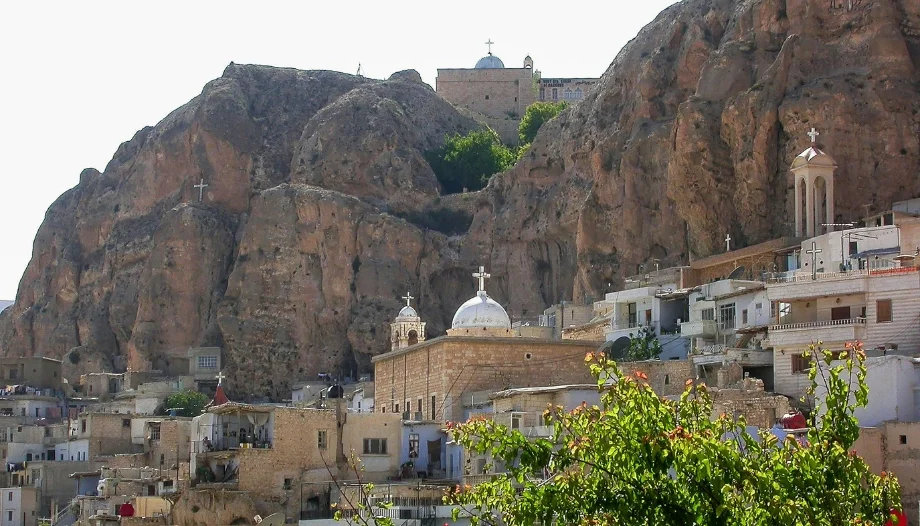
Today I want to continue talking about this, with nostalgia and a desire to return there, to share a journey that, in August 2008, took me to visit two places that preserve the oldest heart of Eastern Christianity: the Saydnaya Monastery and the village of Maaloula, where a variant of Aramaic—the language of Jesus—is still spoken.
The Desert and the Border
Imagine you're in Lebanon. Three wonderful weeks traveling the country from top to bottom, taking in the mountains, the sea, ancient and modern monasteries, wonderful cities, incredible food, and people who are as welcoming as you rarely find anywhere else.
But something was missing: the desert! I had always dreamed of seeing it, of setting foot on that expanse of ochre-colored sand that I had only ever seen in photographs. So I convinced my friends to contact a travel agency and organize a trip across the border: Saydnaya, Maaloula, and finally, Damascus. It was early August. It was hot, yes, but nothing compared to the heat waves we’ve been enduring lately. And first thing in the morning, we climbed into a van—two Lebanese Christian friends and I—with a Druze driver, also Lebanese, who would also serve as our guide.
I still remember the typical Middle Eastern nonchalance with which our driver navigated the roads winding up through the Lebanese mountain range, skirting the abandoned tanks on the sides of the road: silent remnants of the long Syrian occupation, which ended in 2005 after thirty years of military presence.
As I descended into the valley, with the Anti-Lebanon Mountains and the nearby border already in sight, the road became straighter, and at the border, as an Italian, I crossed without any problems: a cordial handshake, a few dollars for the visa, and a «see you later,» while the Lebanese and Syrians waited in line under the sun. A paradox—unacceptable in many ways—the same one that exists between Israel and the West Bank.
And then, once we crossed the border, the first breathtaking sight. My Lebanese friends, accustomed to green mountains, cultivated terraces, and cedars, couldn’t understand how I could be so captivated by the desert. And yet, that’s exactly how it was: that immense expanse, ochre-colored and scorched by the dazzling light of the August sun, the flat horizon stretching endlessly before the van—it won me over immediately. There is something mystical about the deserts in that part of the world: it is no coincidence that the three Abrahamic religions were born there. Clearly, there, people are more inclined to listen to God.
Saydnaya: The Virgin on the Rock
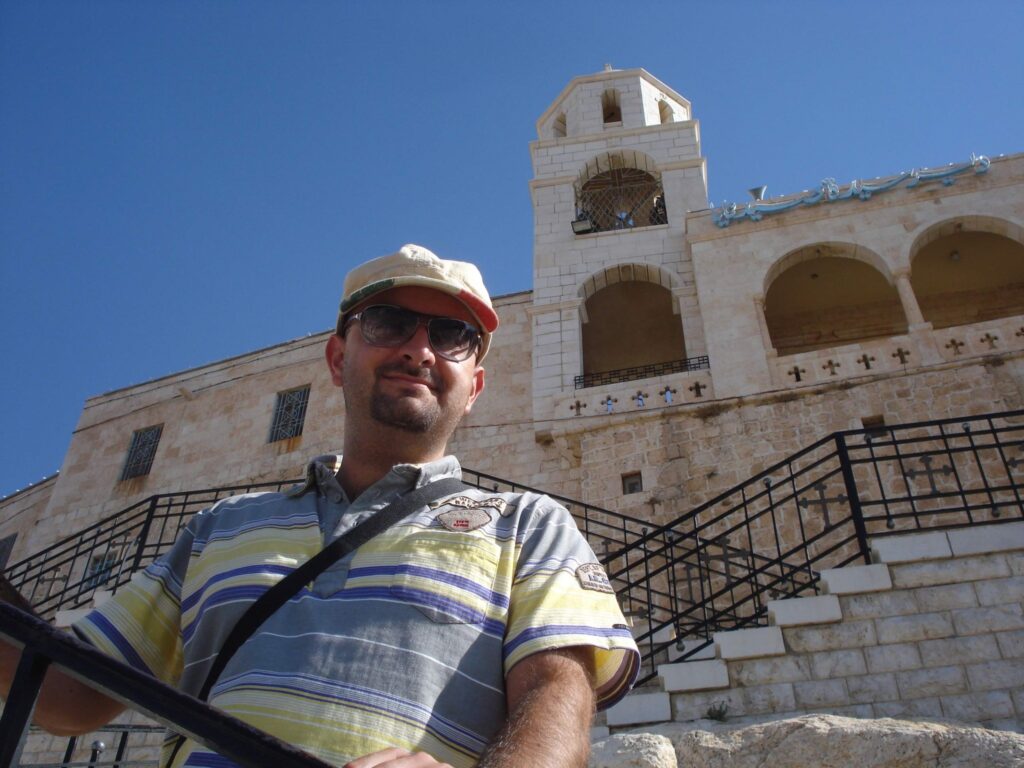
The first stop was Saydnaya (from the Aramaic Saidnāyā: «Our Lady»), a Greek Orthodox monastery founded, according to tradition, by Emperor Justinian in the 6th century, on a rock about 30 km north of Damascus, which houses one of the oldest and most venerated Marian icons in all of Eastern Christianity.
Arriving at the monastery felt like ascending to heaven: the steep climb, the August sun beating down on the structure that rose from the rock, almost merging with it. The thick outer walls, made of light-colored stone, discreetly protected what lay within: neither the flower-filled courtyard nor the quiet paths connecting the monastery’s various rooms—a small world unto itself.
Inside the main church, the gilded iconostasis stood like a wall guarding the holy of holies, and the candelabra, with their flickering light shining on the ancient icons, created an ethereal atmosphere. There were very few of us, and the silence—along with the coolness and the refuge offered by the church—made us want to stay there forever.
In the center, in a reliquary, was the icon of the Virgin of Saydnaya, which, according to tradition, was painted by the evangelist Luke and brought here from Byzantium.
My Lebanese friends pointed out to me a small group of Muslims who showed great respect and reverence for that place, which is also sacred to them.
Once outside, I gazed at the valley that stretched out at the foot of the monastery, the expanse of ochre that embraced the horizon as the sun’s rays reflected relentlessly off the convent’s white walls.
Now that I think about it, it moves me to realize that such a beautiful country would suffer an immense tragedy just a couple of years later.
Maaloula: The Language of Jesus
Maaloula made an even greater impression on me than Saydnaya, if that's possible.
I couldn't stop gazing in awe at the landscape through the window, while one of my Lebanese friends was suffering from terrible motion sickness (but I didn't really care!): How could anyone not be captivated by the beauty of that flat desert, which suddenly became rugged and then rocky, opening up into a gorge dominated by Maaloula?
That is how the village appeared to me, clinging to the rock—one of the few places in the world where Western Aramaic is still spoken: the language that Jesus spoke.
It should be noted that there are several modern variants of ancient Aramaic, which—like Latin—has evolved, giving rise to languages such as Syriac, Palestinian Jewish Aramaic (spoken in the time of Jesus), and the Chaldean dialects (in Iraq).
In Maaloula, this language continues to echo through the streets, in the prayers at churches, and in the voices of children.
First, we visited the Monastery of Saints Sergius and Bacchus (Mār Sarkīs wa-Bakhūs), one of the oldest Christian places of worship in the world (4th century), built on the site of an ancient pagan temple. The fountain in the courtyard, the dark wooden doors, the silence of the cloister—everything conveyed a sense of being outside of time.
At the Greek Catholic church, our guide—a young woman from the area—gathered us in a square formation around the altar (which dates back to pre-Christian times) to recite the Lord’s Prayer in Aramaic. The emotion I felt at that moment mingled with the pain of having seen, in television reports, how that very same altar was smashed to pieces with hammers by Islamic fundamentalists during the civil war. Two thousand years of coexistence between pagans and Christians—and later, between Muslims and Christians—swept away with the blows of a hammer!
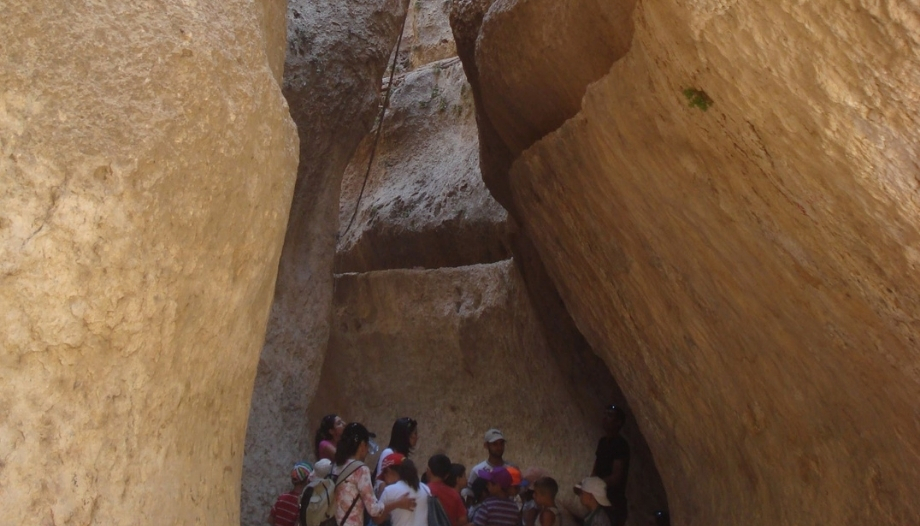
As we left the church, we made our way through the gorges and among the rocks leading to the shrine of Saint Thecla, one of the first Christian martyrs and a disciple of the Apostle Paul. Tradition has it that when Thecla was being pursued by her persecutors, the rock miraculously opened to give her refuge. The crevice is not very different from the one you walk through to reach Petra in Jordan, and at certain points, where it narrows, you find yourself literally trapped between the ochre color of the rock and, high above, the intense blue of the clear sky.
What Remains
Without a doubt, that journey, which ended in Damascus at Ananias’s home, has been indelibly etched in my memory and in my heart. On our return to Beirut, as evening fell, we left behind the vast outskirts of the Syrian capital, with the gigantic posters of Bashar al-Assad still standing everywhere, and the desert shifting in color toward orange and brown.
I may never see those places again just as I left them.
In fact, in September 2013, Maaloula was one of the first Christian villages in Syria to be occupied by Jabhat al-Nusra rebels (linked to Al Qaeda), whose founder and leader was the current Syrian president so beloved by Trump, Ahmed al-Sharaa Al-Jawlani!
The clashes caused immense damage to historical and artistic heritage: the Monastery of Saints Sergius and Bacchus was ransacked, and some of its millennia-old icons were stolen or destroyed. However, it was the Convent of Saint Thecla that became the most poignant symbol of that era: the twelve nuns who lived there were abducted by militiamen and held hostage for nearly three months, between December 2013 and March 2014, before being released following lengthy and complex negotiations mediated by Qatar.
Saydnaya was also ravaged by the war. In fact, according to reports by Amnesty International, the Assad regime imprisoned thousands of people in the notorious prison located near the monastery. Many were tortured and killed; just as many never returned, disappearing amid the wounds and scars of a conflict that has destroyed a country.
The hope is that, as has happened so many times throughout history, Syria—and those places of enchanting beauty and immeasurable cultural value—will once again become a beacon of civilization, tolerance, and the good life.






 Español
  English
  Italiano
  Français
  Deutsch
  Polski
  简体中文
简体中文