


 Manuel López: "In Alzheimer's, the most important thing is silence".
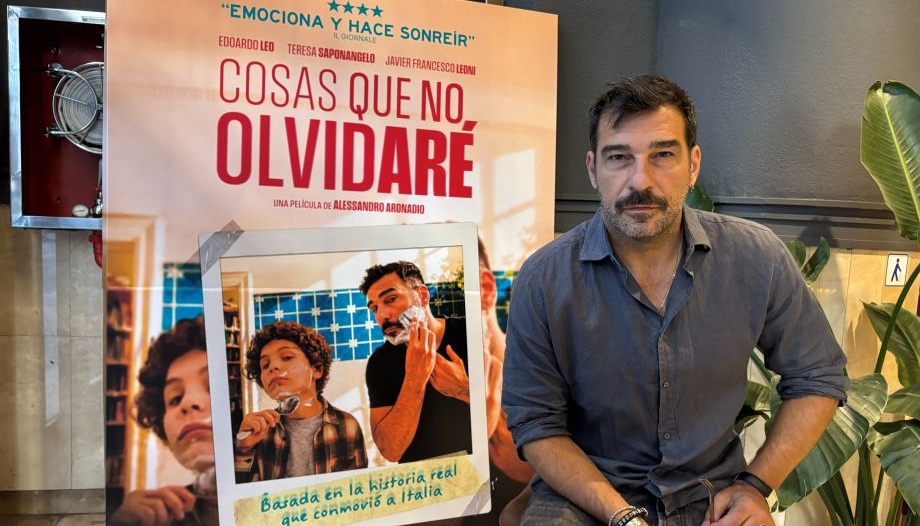
Paolo is 40 years old and has been diagnosed with early-onset Alzheimer's. He begins to lose his memory and decides to live in the moment and enjoy time with his wife, Michela, and his 11-year-old son, Mattia. This is the story he tells in “Things I'll Never Forget”, which just premiered in Spain.
The story is based on the real-life experiences of Paolo Piccoli himself and his son Mattia, who were honored by the president of Italy. Edoardo Leo, the film’s lead actor and producer, has been in Spain and explains what motivated him to take on this deeply human drama, which explores themes of family, illness, and the meaning of life.
In 115 minutes, the film delves with humanity and humor into the world of Paolo, whose mind is beginning to fade due to Alzheimer’s. He decides to create moments worthy of being remembered—moments that help him enjoy his increasingly hazy life more fully. It’s not a tear-jerker, despite the gravity of the subject matter. The director and screenwriter is Alessandro Aronadio, who works with a sensational cast, especially Edoardo (Paolo in the film) and the young Javier Francesco (his son). It is produced by Bosco Films, and the website where you can find out which theaters are showing it is thingsIwillneverforget.com.
Where did the idea for the movie come from?
– It’s a fact of life, unfortunately. Because President Mattarella, the President of the Republic, presented this boy (Mattia) with an award for the way he took care of his father.
We discovered this story through this news article about the award ceremony. Then we found out that Paolo’s wife had written a book telling Paolo’s story. At that point, we bought the rights and decided to write the screenplay. This story really moved us. Because we saw the emotion of this young man, this kid, being honored by the President of the Republic—something incredible.
Was a movie like this necessary? Alzheimer's isn't a topic that's often addressed in movies.
– For me, at my age, just making another comedy—just for the sake of it—didn’t make sense. So, together with Alessandro (the director and screenwriter), we took on this challenge: to make people smile and move them with such a dramatic subject. We might have been wrong, but we had to do it while respecting the family’s grief. It was a huge responsibility. But for me, that’s the primary purpose of comedy.
What was the most difficult part of taking on this role?
– The hardest part is conveying that feeling. What I’m about to say may sound paradoxical, but it’s easier to portray the disease itself. The hard part is embodying something that only Alzheimer’s can cause—knowing that you’re sick, but having no awareness or perception of it.
That phase is the hardest to interpret. It has something to do with consciousness and memory. It's very complicated. Just as it's complicated to convey nuances, the gray areas make it harder to tell a story.
What has your relationship with the royal family been like?
– I didn't want to meet with them before. I didn't want to see Paolo before either because he was too sick.
Before the film screening, I met Michela and Mattia. And I told them: Don’t look for your father in the movie. Film has to distort or betray stories so they can become cinematic. Don’t look for your father’s biography, but rather the essence of your father’s story. Because it could have been a disappointment. And the beautiful part was the hug at the end of the screening. They told me that in that hug, I had the same smile as Paolo.
Was the purpose of the movie to touch the audience's hearts? To raise awareness about Alzheimer's?
– Yes, because movies don't teach; there's nothing that can be taught through film. I don't believe in films that convey messages; I don't believe in didactic films, because otherwise they become moralistic.
Movies, on the other hand, stand on their own; they tell stories. And if that story touches people’s hearts, it inspires them. It teaches each person something different—there’s no single message.
Perhaps one message it conveys is that you don't have to be someone special to be a hero. Even as an ordinary person, you can perform heroic acts in everyday life.
– That's right. Here, a child becomes a hero because he acts as a father to his own father. It's incredible—a child should never have to bear that kind of responsibility, ever—but it's wonderful. He's a kind of superhero of emotions.
This emotional scene is one of the most beautiful parts of the movie.
Now that it has been released in Italy, what impact has it had?
– It was a hit—it's incredible. Because it's a movie about Alzheimer's; it's not a lighthearted comedy about a group of friends going on a trip. It's a movie that could have inspired a certain amount of respect for people. But that wasn't the case.
On a personal level, the most amazing thing is the number of messages, letters, and social media comments from people who have gone through or are currently going through this experience with an Alzheimer’s patient at home. They’ve thanked me because we try to highlight the only positive aspect of this disease: the memory of emotional bonds.
How did you manage to incorporate humor into the film? It's very difficult to strike the right balance between making jokes and dealing with such a dramatic subject.
– That’s the point of comedy. The hardest part is laughing in the face of pain and illness. But the thing is, you’re not laughing at them—you’re laughing with them, alongside them.
It’s the most complicated part, but it’s what has inspired us the most. Every day on set, Alessandro and I would ask ourselves, “Can we say this? Where’s the line?” We wondered where the line was so as not to offend the family.
When we wrote the script, we shared it with the family. We offered to use their real names only if they were okay with it—if they accepted the script. If not, we would use made-up names. And after reading it, they said, “Okay.”.
We didn't want to make a sad movie about the father's story. We wanted to make a fun, emotional movie. Paradoxically, it would have been easier to make a movie about the illness—a kind of emotional blackmail.
On a personal level, how has the movie affected you?
– This film has reinforced ideas that we all think about but don’t put into practice. That is, focusing on the depth of memories, not the quantity of them. We don’t have to wait for special moments to come to us from the outside. Sometimes the most special moments are very, very small. But you have to go out and find them—you shouldn’t just wait for them to happen.
At its core, the film is a call to highlight the dignity of every person, including those who are ill.
– Today, Paolo—who is very ill—remains an incredible source of joy and love for his family.
I watch private videos of him, and even though he doesn’t recognize his children anymore, he’s still a source of joy for that family. It’s a matter of perspective—whether you choose to give in to the sadness of a story or try to find a way to survive. And one way is to hold on to that little bit of beauty that’s there to keep the family together, with care as a very powerful, very strong emotion.





 Español
  English
  Italiano
  Français
  Deutsch
  Polski
  简体中文
简体中文