


 The Pope's visit to France is taking shape: Notre Dame, Lourdes, and MetzLeo XIV to visit France in SeptemberHere's What Pope Leo XIV's Visit to France Will Look Like
The French Bishops' Conference (CEF) met this Tuesday at its Paris headquarters to present the Pope Leo XIV's apostolic journey to France, September 25–28. Participants in the press conference included Cardinal Jean-Marc Aveline, Archbishop of Marseille and president of the French Bishops’ Conference (CEF); Bishop Benoît Bertrand of Pontoise and president of the trip’s organizing committee; as well as Archbishop Laurent Ulrich of Paris; Bishop Jean-Marc Micas of Tarbes and Lourdes; and Archbishop-Bishop Philippe Ballot of Metz, as well as the logistics coordinators for the papal visit.
The visit will last four days and include five stops: UNESCO headquarters, Paris, Saint-Denis, Lourdes, and Metz. Leo XIV will be the tenth pope to visit Paris. The last papal visit was by Benedict XVI in 2008.
Cardinal Jean-Marc Aveline, Archbishop of Marseille and president of the CEF, said that the preparation for this trip is not just a matter of logistics. We should prepare ourselves to listen to the Pope and experience this event as a gift given to us, he said.
The cardinal did not wish to reveal the content of the messages in advance, though he did highlight their central theme: the defense of human dignity, in light of his encyclical “Magnifica humanitas.”.
Monsignor Benoît Bertrand, Bishop of Pontoise, vice president of the CEF, and president of the organizing committee, summed up the preparations in three words: joy, diversity, and anticipation. Diversity, he explained, ranges from large crowds to gatherings of about five hundred people and to meetings that will bring together no more than ten.
Regarding the expectations of the French people—which he considers to be numerous and not limited to Christians—he spoke of being strengthened in the faith, of being guided along the paths of mission, of the Church being at the service of the little ones and the poor, and of those who seek God.
“The Holy Father is also coming to France to nurture our hope, because we need it so very much,” he said. “Without a doubt, this trip will be historic.”.
"So that the world may have life": a motto born on a street in Rome
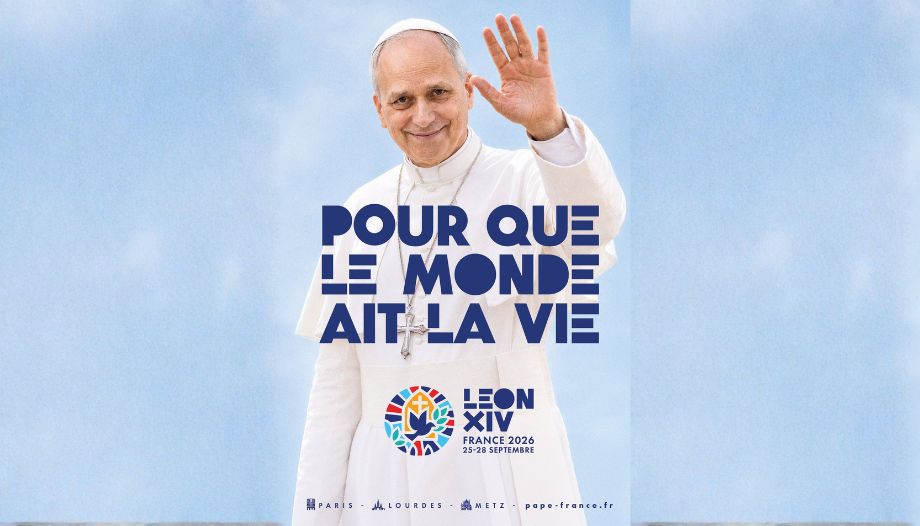
The official theme of the trip is “So that the world may have life.” It comes from the sixth chapter of the Gospel of St. John, the Sermon on the Bread of Life.
The proposal came from Cardinal Aveline, and Leo XIV himself personally approved it. Aveline has recounted how it came about: “One morning, as we were returning to the French Seminary along the Street of the Antiquarians in Rome, walking with the two vice presidents, we were reflecting. Then the idea came to me: “So that the world may have life.” That very night I wrote a brief letter to the Pope. The next morning, the pontiff replied: “Yes, that’s a good one.”».
The cardinal explained why he finds it significant: “Because it expresses, in a few words, a fundamental truth: a saying of Christ: “I have come that they may have life, and have it to the full.” Also because it defines, for the Christian faith, who Christ is: “I am the way, the truth, and the life.”».
The “Right to Assisted Dying” in France
The slogan is not trivial. On July 15, the National Assembly passed the law establishing the “right to assisted dying” in its final reading, with 291 votes in favor, 241 against, and 29 abstentions, after the Senate had rejected it three times.
Prime Minister Sébastien Lecornu and the President of the Senate referred it to the Constitutional Council, which on August 14 declared it constitutional with three interpretive reservations, including a conscience clause for pharmacists and healthcare facilities. Emmanuel Macron signed it into law on August 18, and the text appeared in the Official Gazette the following day.
The law grants access, under certain conditions, to adults with a serious, incurable condition that threatens their life. It is expected that the Pope will emphasize the importance of protecting life while in Lourdes.
The Catechumens: The French Surprise
The second backdrop is a phenomenon that the French Church itself did not anticipate: the steady increase in the number of adults and adolescents seeking baptism.
According to the CEF’s annual survey published on March 25, 21,386 catechumens were baptized at the 2026 Easter Vigil: 13,234 adults and 8,152 adolescents. That is 28 % more adults and 10 % more adolescents than in 2025.
In ten years, the number of adults has tripled, from 4,124 in 2016 to 13,234 this year.
Young people aged 18 to 25 are the largest group, accounting for 42 %, followed by those aged 26 to 40.
Paris is a special case. The diocese accounts for about 10 % of the country’s catechumens and supports seventy student chaplaincies, sixty-five seminarians, and sixteen new priests ordained in 2025. Across the ecclesiastical province of Paris, which encompasses the eight dioceses of Île-de-France, the number of adults seeking baptism rose from 1,249 in 2021 to 3,158 in 2026, an increase of 153 %.
In light of this, the bishops of Île-de-France convened in April 2025 what was to be a provincial council on the theme “Catechumens and Neophytes: New Perspectives for the Life of Our Church in Our Dioceses.” The name «council» had to be changed because the number of invitees exceeded the limits set by canon law, and it was renamed the Provincial Ecclesial Assembly. It was solemnly opened on May 31 at Notre-Dame in Paris and will convene in three sessions: October 2026, January 2027, and May 2027.
That is why, on the morning of Saturday the 26th, Leo XIV will meet at the Catholic Institute of Paris with the members of the assembly, catechumens, and neophytes. There, he will also pray before several statues of saints and blessed who once lived in the former “des Carmes” convent.
Paris: Six Scenes in a Day and a Half
The Paris leg of the trip is the most complex. The Pope will land at Orly on Friday, the 25th, at 10:00 a.m. He will then go to the Élysée Palace to meet with the President of the Republic and address government officials, civil society, and the diplomatic corps. At 3:00 p.m., he will visit UNESCO headquarters, where he specifically requested to go in order to speak to the international community about education.
He will then travel in the popemobile along a 2.5-kilometer route from the Church of Notre-Dame des Champs to Place Saint-Michel, along Boulevard de Montparnasse and Boulevard Saint-Michel.
At 5:15 p.m., the pontiff will preside over Vespers at Notre-Dame with bishops, priests, deacons, men and women religious, consecrated persons, and seminarians. That same evening, he will preside over a vigil at the Stade de France in Saint-Denis before more than 80,000 young people between the ages of 17 and 35. Tickets sold out within hours of registration opening, and there is now a waiting list.
On Saturday the 26th, following the visit to Casa Bakhita, the largest celebration will take place: Mass at Place de la Concorde and the Champs-Élysées. More than 500,000 participants are expected. Organizers believe the crowd could spill over the Arc de Triomphe.
“We can hope that the celebration of the Eucharist will be a powerful sign in the life of the Church and that this sign may be shared by the people of France as a sign of unity,» said the Archbishop of Paris, Archbishop Laurent Ulrich. These moments, he added, express at once unity, inner reflection, intimacy, and the desire for a connection that has meaning far beyond the Church.
Lourdes: Pilgrim and Shepherd
Leo XIV's visit to Lourdes It follows the two encyclicals by St. John Paul II, issued in 1983 and 2004, and the one by Benedict XVI in 2008, on the occasion of the 150th anniversary of the apparitions.
Pope Leo XIV will arrive at the Tarbes-Lourdes airport at 7:05 p.m. on Saturday, the 26th, and will then visit the Massabielle Grotto.
Monsignor Jean-Marc Micas, Bishop of Tarbes and Lourdes, says he will be a pilgrim among pilgrims: he will touch the rock in the grotto, drink the water, light a candle, kneel, and pray in silence, just as pilgrims do.
As universal pastor, he will preside over Sunday morning Mass on the sanctuary lawn and lead the Marian torchlight procession on Sunday evening.
The expected turnout is considerable for a city with just over 12,000 residents: 50,000 people on Saturday night, 150,000 on Sunday morning, and 25,000 on Sunday night.
Lourdes will also be the site of the most sensitive meeting of the trip. Leo XIV will meet privately with seven victims of sexual abuse.
Monsignor Pierre-Antoine Bozo, coadjutor bishop of La Rochelle and spokesperson for the CEF, explained that the group was put together with the aim of achieving the greatest possible balance.
Metz: The Other Regime
The final day, Monday the 28th, will take place in Metz, at the intersection of the French, Luxembourgish, and German borders. This is no coincidence. In France, two systems coexist with regard to religious worship. The general one is the law of December 9, 1905, which established the separation of church and state.
Religious buildings dating from before that time, which had already been nationalized in 1789, remained in public hands: cathedrals belong to the state, and parish churches to the municipalities.
The other, lesser-known system is the Concordat system in effect in Alsace and the Moselle. There, the 1905 law was never implemented because, at that time, those departments were part of the German Empire. When they returned to France in 1918, the existing law remained in force, including the Concordat signed in 1801 between Napoleon and Pius VII. The law of June 1, 1924, confirmed this exception, and the Constitutional Council upheld it in 2013.
In practice, the Concordat recognizes four religious denominations: Catholic, Lutheran, Reformed, and Jewish. Their ministers are paid by the state, and religious instruction is provided in public schools. Metz and Strasbourg are the two dioceses covered by the Concordat, and their bishops continue to be appointed by decree of the President of the Republic.
The procedure is unusual: the Holy See proposes a candidate, the president accepts the nomination through an initial decree that remains confidential; the Pope then grants canonical investiture through a papal bull, and a second decree—following review by the Council of State—is published simultaneously in the French Official Journal and in *L’Osservatore Romano*.
Monsignor Philippe Ballot, Archbishop of Metz, emphasizes the significance of the location: «The Moselle is the ideal setting for a message of peace. It is a region that has endured three wars and two annexations, and where yesterday’s enemies have become friends,» he says. «So it is possible everywhere where there is war.» He also speaks of the power of forgiveness through Franco-German reconciliation and notes that the event will have a European and international dimension.
In Metz, at 10:00 a.m., the Pope will preside over an interfaith gathering at the Robert Schuman Convention Center. Six religious leaders will read and sign a joint declaration with him: Cardinal Aveline on behalf of the Catholics, Christian Krieger on behalf of the Protestants, Chief Rabbi Haïm Korsia for the Jews, Chems-Eddine Hafiz for the Muslims, Monsignor Dimitrios for the Orthodox, and Antony Boussemart for the Buddhists. An hour later, he will participate in the event «At the Roots of Europe for Peace and Unity.».
The tribute to Robert Schuman will last all day. Born in Clausen, on the outskirts of Luxembourg City, to a Moselle father and a Luxembourgish mother, Schuman served as a deputy for the Moselle for more than four decades; he lived and died in Scy-Chazelles, on the outskirts of Metz, and is buried there. Pope Francis declared him venerable.
In the afternoon, the pontiff will tour the streets of Metz in the popemobile, and at 4:00 p.m. he will celebrate Mass at St. Stephen’s Cathedral. His departure is scheduled for 6:30 p.m. at the Metz-Nancy-Lorraine Airport.
The Logistical and Economic Challenge
The overall figures give an idea of the scale of the operation. The trip will cost 27 million euros, financed largely by donations; as of the date of the press conference, 5.5 million had been raised.
On the 25th and 26th, 15,000 police officers, gendarmes, riot police, and soldiers from Operation Sentinelle will be deployed. The Paris leg alone will mobilize 15,000 volunteers.
Although the French government will not subsidize the organization, it will be responsible for the security of the events, the Pope, and his entourage
How France Is Experiencing This Moment
The atmosphere described by the organizers is one of enthusiasm and joy. Many churches in France are organizing days of prayer and spiritual preparation, one such place being the Basilica of the Sacred Heart of Montmartre, a site of perpetual adoration since 1885 and a national shrine of Mercy, which is organizing a novena and prayer sessions in preparation for the papal visit.
Aveline spoke of her own excitement at the enthusiasm generated by the visit—a joy she perceives as widespread throughout the country and across all social media platforms—which, in her view, reveals a deep spiritual thirst among the French people.
"France is of interest to the Pope," the cardinal admitted. With the new influx of new converts and catechumens, he said, the country is proving that it is resisting secularization. He also mentioned that Leo XIV is learning French so he can express himself more fluently.
The bishop of Pontoise concluded the press conference with an open invitation: that all French people—whether Catholic or not, believers or not—come to welcome and listen to Pope Leo XIV in Paris, Saint-Denis, Lourdes, or Metz.
As the Archbishop of Paris, Monsignor Laurent Ulrich, pointed out: the Pope is coming «to nurture our hope, because we certainly need it very much.».




 Español
  English
  Italiano
  Français
  Deutsch
  Polski