



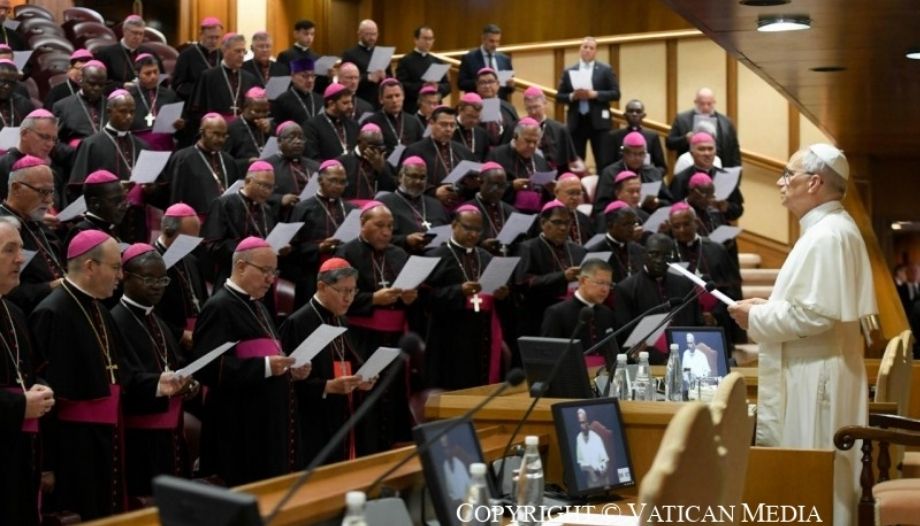
This morning at the Vatican, the Holy Father emphasized the concept of “service” in his ministry to the new bishops from the five continents who are participating in a formation course in Rome. There are 147 bishops from countries such as India, Congo, Papua New Guinea, Zimbabwe, Kyrgyzstan, and Thailand, although the Pope raised the number to 200 in his address.
After encouraging everyone to sing the ”Veni Creator”—“I think you all have a copy. I hope someone has a better voice than I do this morning… Let’s start a cappella”—the Pope wanted to recall in his Speech the central theme of his remarks: service to the faith and to the Church.
“The bishop is a servant”
“First of all, something as simple as it is often overlooked: the gift you have received is not for yourselves, but to serve the cause of the Gospel. You have been chosen and called to be sent forth as apostles of the Lord and as servants of the faith,” said Leo XIV.
Before engaging in a fraternal dialogue with you, I would like to pause briefly on this point, he added: “The bishop is a servant; the bishop is called to serve the faith of the people. It is something that has to do with our identity.”.
"Why was I chosen? I, at least, ask myself that," the Pope revealed.
“Service is not an external characteristic or a way of fulfilling a role. On the contrary, those whom Jesus calls as disciples and proclaimers of the Gospel—especially the Twelve—are asked to possess inner freedom, poverty of spirit, and a readiness for service born of love, in order to embody the very choice of Jesus, who became poor to enrich us (cf. 2 Cor 8:9).
“He has revealed to us the nature of God, who is not revealed to us in power, but in the love of a Father who calls us into communion with Him,‘ he added, recalling the words of St. Augustine: ’Regarding the ordination of a bishop, Augustine states: ”First of all, the one who presides over the people must understand that he is a servant of many’ (Discourse 340/A, 1).”.
“A certain desire for greatness” among the apostles: Jesus had to intervene
Shortly thereafter, the Holy Father recalled that “a certain desire for greatness” (ibid.) had begun to take hold among the Apostles, prompting Jesus to intervene as a healer to cure them.
In fact, we recall the Lord’s warning when he saw the Twelve arguing about who was the greatest: “Whoever wants to be great among you must be your servant, and whoever wants to be first among you must be the slave of all” (Mark 10:43–44).
What Does It Mean to Be Servants?
At the same time, the Pope continued, “today we must ask ourselves what it means to be servants of the people’s faith. As important and necessary as it may be, it is not enough to simply be aware that our ministry is rooted in the spirit of service, in the image of Christ.”.
”In fact, it must also be reflected in the style of the apostolate, in the various forms of pastoral care and governance, and in the desire to proclaim the Gospel—in ways that are as diverse and creative as the specific situations they face.”.
"A humble service," said Pope Francis
The Pontiff quoted Pope Francis here, who has said on several occasions: “The only authority we have is service—and humble service!” It is truly important that we reflect on these words and try to live by them.
"That is why I ask you to always remain vigilant and to walk in humility and prayer, so that you may become servants of the people to whom the Lord sends you," continued Leo XIV.
“Our closeness to the people entrusted to us is not an opportunistic strategy, but our very essence,” said Pope Francis (Address to the bishops participating in the training course, September 12, 2019).
Passion and Courage in Proclaiming the Gospel
As he was concluding, the Pope mentioned the difficulties and called for passion. “The crisis of faith and its transmission, together with the difficulties affecting church membership and practice, call us to rediscover the passion and courage needed for a new proclamation of the Gospel.”.
We must not forget, the Successor of Peter added, “the other challenges—of a more cultural and social nature—that affect us all and that, in particular, affect certain regions: the tragedy of war and violence, the suffering of the poor, the aspiration of many for a more fraternal and compassionate world, the ethical challenges that call us to reflect on the value of life and freedom, and the list could certainly go on.”.
“As watchful shepherds”
In this context, “the Church sends you forth as attentive shepherds who know how to share in the journey, the questions, the anxieties, and the hopes of the people; shepherds who wish to be guides, parents, and brothers and sisters to the priests and to their sisters and brothers in the faith.”.
Finally, Leon XIV said that he prays for them, “so that they may never lack the breath of the Spirit and so that the joy of their Planning, like a gentle fragrance, may also spread to those they are going to serve. ”Thank you!”.






 Español
  English
  Italiano