



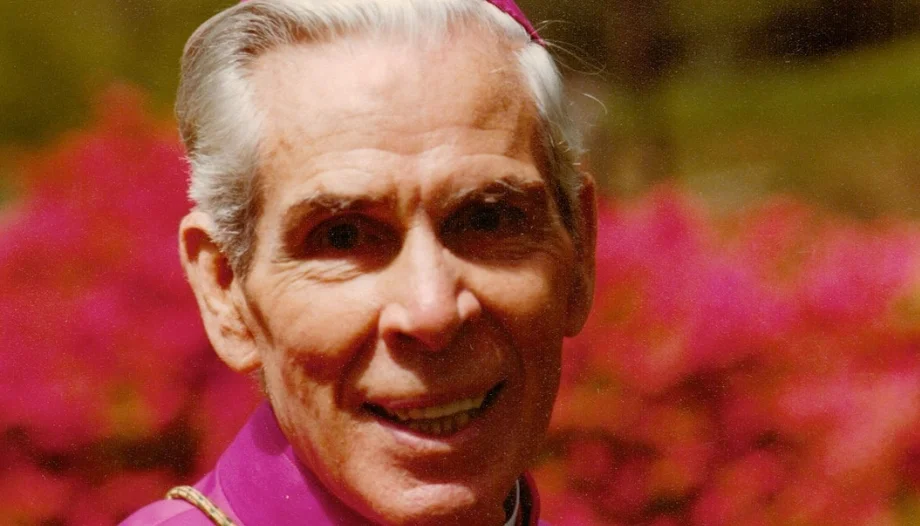
- Jude Andrew Link, program director for the beatification of Fulton Sheen in St. Louis.
«What virtues do you think Sheen exemplifies?» A fellow sister asked me that question as she was preparing her classroom for the start of the school year. Here in Peoria, Illinois, we’ve already been in school for several weeks. But in other parts of the country, students and teachers just had their first few days of school this week. This sister was preparing a mural about saints and virtues.
I haven't been able to stop thinking about that question. His beatification tells us that the Church considers Sheen a man of heroic virtue. Fulton Sheen, who would soon be beatified, was undoubtedly a man of faith. His deep and personal devotion to Jesus Christ was evident in his famous commitment to the daily Holy Hour.
«If you want to know about God,» he said, «get down on your knees.» On the day of his ordination, Sheen promised to devote one holy hour each day, and his faithfulness to that promise prepared him to reap the fruits of theological faith.
The light of faith illuminated his mind and gave him a profound understanding of the mysteries of Christ, which then influenced his teaching, preaching, and writing, endowing them with a power born of the Spirit.
His strength: prayer
He knew about Christ from his studies, but he came to know Him through prayer.
That fidelity sometimes came at a high price. In *Treasure in Clay*, he writes about the extremes he went to in order to keep his daily appointment with Our Lord, even during periods of spiritual dryness and distraction, or that time when he accidentally got locked inside a church in Chicago, climbed out a window, and fell into the coal bin.
The Blessed Lord rewarded his faithfulness in the most moving way, coming to meet Sheen one last time during his Holy Hour on December 9, 1979, to lead his faithful disciple to the Father’s house.
The Holy Hour was the cornerstone of Fulton Sheen’s life—the place where he found his identity, drew inspiration for his teaching, and gathered strength for the task ahead. It was the source of his admirable integrity. He was the same person regardless of the situation or the audience; he felt just as comfortable among the rich and famous as he did among the cleaning lady and the street sweeper.
Love for One's Neighbor
However, his stories reveal that he felt most at ease among the poor and the simple. He told the story of the street sweeper in Rome, who was unimpressed by the cardinals and bishops gathered for the Second Vatican Council, and who reminded him that the simple man doing his work for the love of God was doing something more worthwhile than any «important» task performed for other reasons.
This spiritual vision fostered a deep respect for each individual and for the wisdom and integrity of the common person. This respect sprang from his love for God, which enabled him to see every person as a brother or sister, with a deep and practical love for his neighbor—a love that inspired his zeal for souls and sustained his preaching and missionary work.
Sheen, a hard worker
Fulton Sheen was known for his great dedication to his work. As a college professor, he would tear up his lecture notes at the end of each quarter and rewrite them every semester so he could approach the material with a clear mind.
He spent more than 30 hours preparing for each television episode, rehearsing his performance in several languages. It would be easy to label Sheen a workaholic, but perhaps it was a form of asceticism—a kind of spiritual discipline and devotion to duty—a refusal to succumb to the complacency that can accompany success and the arrogance that justifies slacking off with the argument that «I already know how to do it.».
Obedience
All of his activities—preaching, teaching, writing, radio and television appearances, and missionary work—were in the service of the Church, an expression of his unwavering obedience to Christ and the Church, as expressed by his superiors in the hierarchy.
In this order, his vision was clear, and he stood up to Cardinal Francis Spellman as an equal when he believed it was the right thing to do. This obedience was, as every obedience is at some point, a trial by fire in his later years—a trial he accepted and embraced out of love for Christ and his Body, the Church.
During the turbulent and chaotic 1960s and 1970s, Sheen—who had a platform and an audience at his disposal—chose to remain discreet, deliberately keeping his ecclesiastical disagreements out of the public eye. In his autobiography, he mentions them only in passing.
Patience
His faith in Christ, present in his Church, and his obedience even in the face of the failings of its members and leaders, endowed his love with that spirit of perseverance and sacrifice that characterizes the—sometimes old-fashioned—virtue of patience. His trials and physical sufferings during the last decade of his life transformed him into Christ the victim, making him a witness to the enduring reality of Christian hope.
It is no wonder, then, that St. John Paul II told Sheen, just two months before his death in 1979: «You are a faithful son of the Church.» The Polish pontiff saw in the frail bishop a man whose entire life and identity had been surrendered to Christ and placed at the service of the Church.
On September 24, the successor to St. John Paul II, through his representative, Cardinal Luis Antonio Tagle, will declare Fulton Sheen blessed. With this act, the Church, our Mother, offers us the gift of a teacher and guide, showing us that Sheen’s teachings and writings can form us in the faith, and that his life is a model of holiness through the imitation of his practice of heroic virtue. As students fill classrooms across the United States this September, Catholics are invited to get to know a new teacher in the school of holiness: Archbishop Fulton Sheen.
Dominican Sister Jude Andrew Link is a member of the Dominican Sisters of Mary, Mother of the Eucharist. She teaches theology at Peoria Notre Dame High School and serves as the director of programming for the beatification of Fulton Sheen in St. Louis.






 Español
  English
  Italiano