


 Fabrice Hadjadj creates an institute in Madrid to train “horticulturalists of culture”.”Fabrice Hadjadj: "Freedom comes from tradition".
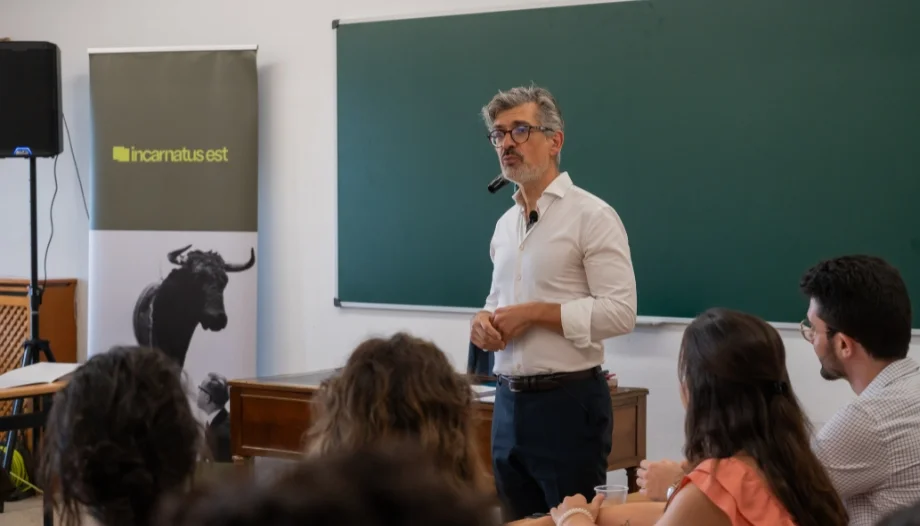
Incarnatus Est is no longer just a project. On Monday, September 7, the school for humanistic education led by French philosopher Fabrice Hadjadj welcomed the students of its first graduating class to its campus in Boadilla del Monte (Madrid). The opening ceremony began with a lecture by Hadjadj himself and concluded with a Mass presided over by the Bishop of Getafe, Monsignor Ginés García Beltrán, whose diocese provides institutional support for the initiative.
Barely seven months have passed since its presentation in Madrid in February of this year until its opening. In that time, the school has nearly reached full capacity: more than thirty students, with an average age of 24. The student body is diverse. There are high school graduates looking for a year to settle in before college, graduates in philosophy, engineering, or architecture who want to round out their education, and professionals who have decided to take a break from their careers to gain some perspective.
“The response from the candidates has been enthusiastic,” says Miguel Gabián, one of the driving forces behind the initiative. “The more than thirty students in the first graduating class—both Spanish and Latin American—demonstrate that there is strong demand for the study of the humanities, especially in a confusing world where AI is turning everything upside down.”.
A School of Life
For nine months, students will live as boarders at the school’s campus (a former convent), in the tradition of medieval university colleges where students resided alongside their teachers. The program combines the study of philosophy, theology, anthropology, literature, and history with theater, singing, manual labor, liturgical life, and personal guidance: three dimensions—intellectual, spiritual, and fraternal life—that the project views as inseparable.
In addition, there is a travel and pilgrimage program that begins with the Camino de Santiago and continues on to Covadonga, Guadalupe, and Zaragoza. The motto that has accompanied the project since its inception sums up its purpose: “To be a school of life—not just to learn something, but to become someone.”.
Thanks to the agreement signed in July with Francisco de Vitoria University, students will pursue the Minor in Philosophical and Theological Anthropology, a 60-ECTS program offered by the university itself and consisting of courses from the Bachelor’s Degree in Humanities. Once a week, they will travel to the UFV campus to participate in academic activities with faculty and students from that bachelor’s program.
The faculty at Incarnatus Est includes, alongside Hadjadj, Rémi Brague, Salvador Antuñano, Higinio Marín, Juan Manuel de Prada, María Calvo, and Elena Postigo, among other professors from Spanish and international universities. The monthly cost of the program is approximately 2,300 euros, covering tuition, full-board accommodation, and travel; for students with limited financial resources, the school has established a scholarship fund supported by donors.
From Freiburg to Boadilla
At the helm of the school is Fabrice Hadjadj, a French philosopher, writer, and playwright who directed the Philanthropos Institute in Fribourg, Switzerland, for thirteen years and has moved to Madrid with his family to personally lead the project. Incarnatus Est was, in fact, born out of its founders’ fascination with Hadjadj’s work at Philanthropos and their desire to plant that seed in the Spanish-speaking world.
At the February presentation, Hadjadj described the school’s spirit with an image that has become widely known: “There is a lot of talk about the culture war. They station soldiers in front of the garden to protect it. But in the meantime, the plants are withering; what we want above all is to train gardeners of culture.”.
With the arrival of the first students, that intuition begins to take shape in the school's daily life: studying, living together, working, and praying together.





 Español
  English
  Italiano