



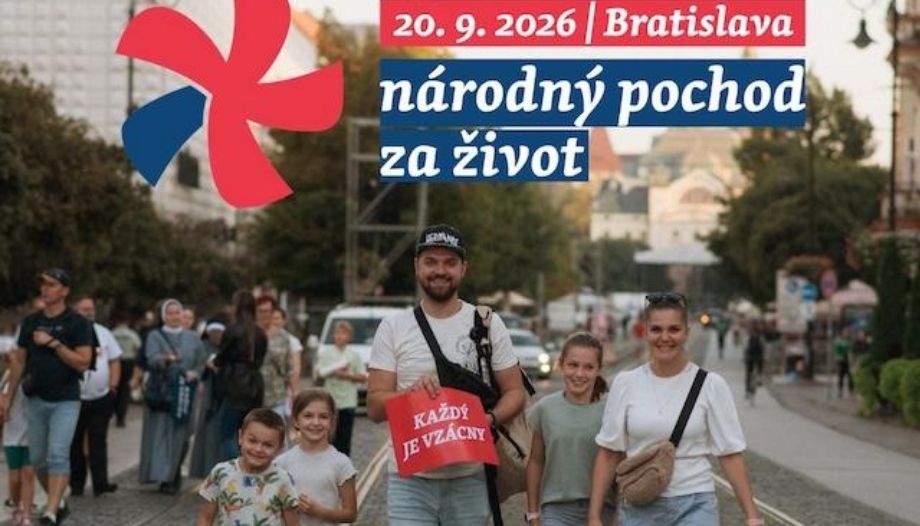
Along with the Pope’s call for a renewed awareness of the “precious gift of life,” thousands of people gathered in Bratislava this Sunday for the National March for Life, an event that took place in the capital’s Freedom Square.
Pope Leo XIV sent a message to the participants, in which he expressed his hope that the March for Life would be “a time of prayer and witness, awakening a renewed awareness of the precious gift of life, received from God, which must be welcomed and protected at every stage, from conception to its natural end,” the Vatican news agency reported.
Support for the Most Vulnerable and Defenseless
Likewise, the Holy Father encouraged the promotion of a “culture that shows special concern for the most vulnerable and defenseless, thereby contributing to the building of a more fraternal society marked by solidarity.”.
Father Iván Ružička, secretary general of the Slovak Bishops’ Conference, expressed his gratitude for the Pope’s support of the march, in statements to Vatican News. “We have come together to defend the dignity of all human life, from conception to its natural end,” he said.
With Women and Families
Father Ružička added that the march's goals combine the protection of unborn children with helping those facing difficult circumstances.
“Our long-term goal is to protect all human life, especially that of unborn children,” he explained. “At the same time, we want to support women and families who are facing difficult situations. No mother should feel that abortion is her only option.”.
“In our Slovak context, this means, first and foremost, the repeal of the unjust abortion law, which discriminates against unborn children and denies them the right to life,” said Dmitrij Olšovský, spokesperson for the National March for Life, according to the agency news from the Slovak Bishops' Conference,
The specific goal of this year’s march was to draw attention to three provisions of last year’s amendment to the Constitution of the Slovak Republic that have not yet been implemented in legislation: the ban on surrogacy, parental consent for sex education, and provisions regarding biological sex, the statement adds.
Total rejection of surrogacy
The National March for Life has sought, in particular, to draw attention to the need for a total ban on surrogacy. The organizers believe that this practice is incompatible with the dignity of both the child and the woman.
“Surrogacy turns the child into a commodity and the woman’s body into a tool to satisfy another person’s desires. However, a child is not a commodity, and a woman should not be a means to obtain one. We are convinced that surrogacy undermines the dignity of both women and children,” stated Milena Olsovska, spokesperson for the National March for Life.
Enact a total legislative ban on this type of pregnancy
For this reason, the organizers have launched a petition urging members of the National Council of the Slovak Republic to rigorously enshrine the constitutional ban on surrogacy in law. They are calling for a ban on all surrogacy arrangements, not just those involving the exploitation of women.
“The Constitution prohibits surrogacy. For this reason, we welcome the governing coalition’s efforts to address its prohibition in the Penal Code,” said Patrik Daniška, lead coordinator of the National March for Life.
“However, the bill currently before Parliament does not ban surrogacy as such, but only certain forms of it. We urge members of Parliament to pass a total legislative ban on this practice and, in doing so, give practical effect to the constitutional prohibition,” added the coordinator.
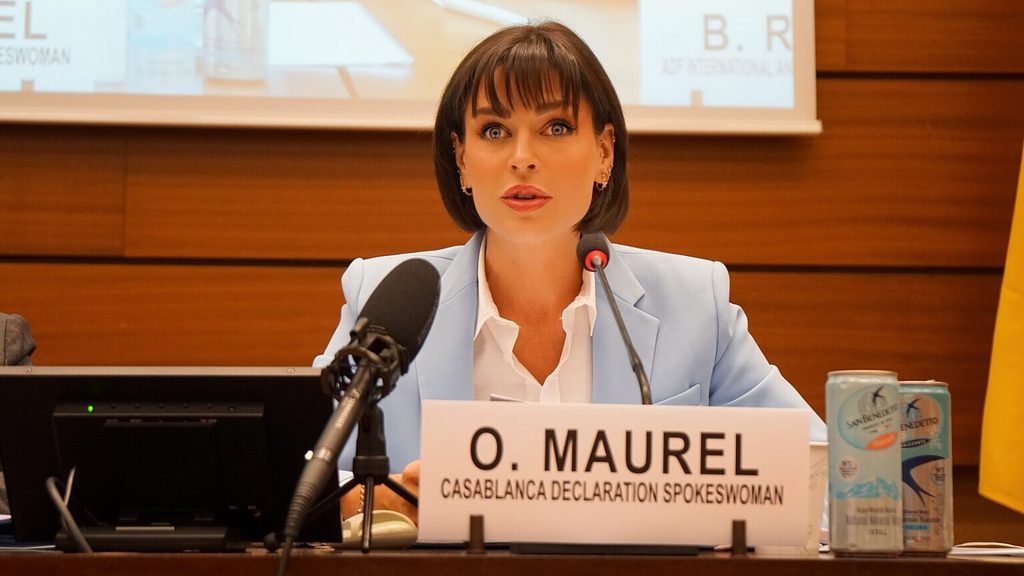
Olivia Maurel, Aleš Primc, and Marie-Lys Pellissier, guests
Olivia Maurel, one of the most prominent international advocates for a global ban on surrogacy, was scheduled to speak at the march.
Maurel had already spoken in Slovakia in 2025, including at the National Council of the Slovak Republic. He is attending the march to call for the constitutional ban on surrogacy to be strictly reflected in legislation, particularly in the Penal Code.
Aleš Primc is a Slovenian civic and political leader who organized three successful referendums on the family in 2001, 2012, and 2015.
Marie-Lys Pellissier holds a degree in the philosophy of ethics from the Sorbonne and is the spokesperson for the French movement Marche pour la vie. She is a co-founder of Génération pro-vie and the Académie Lejeune, which trains young people committed to defending life. In 2026, she also campaigned against the legalization of euthanasia and assisted suicide in France.
Also in Berlin and Cologne
On Saturday, the 19th, two Marches for Life took place simultaneously in Berlin and Cologne, with several thousand people participating, just as reported Omnes.
Organized by the Federal Association for the Right to Life, the marches were supported by the churches. On the Catholic side, Bishop Dr. Rudolf Voderholzer (Regensburg), Auxiliary Bishop Dr. Josef Graf (Regensburg), and Bishop Emeritus Gregor Maria Hanke OSB (Eichstätt) attended the march in Berlin.
Support and rejections
Other cardinals, such as Cardinal Rainer Maria Woelki, Archbishop of Cologne, sent messages of support for the demonstrations in the two cities, to defend the dignity of human life from conception and address issues such as abortion, assisted suicide, surrogacy, and non-invasive prenatal testing (NIPT).
Augoustinos of Germany, an Orthodox metropolitan, had also expressed his support. So had Friedhelm Holthuis, president of the Federation of Free Pentecostal Churches.
The Pro-Choice-Bündnis Köln group, in counter-protests, and the LAG Säkulare Grüne (the secular wing of the Green Party) expressed their opposition to the rallies.






 Español
  English
  Italiano