



 Swiss March for Life Held Amid Counter-Protests and Water CannonsReducing the Abortion Debate to Religion Misses the Point
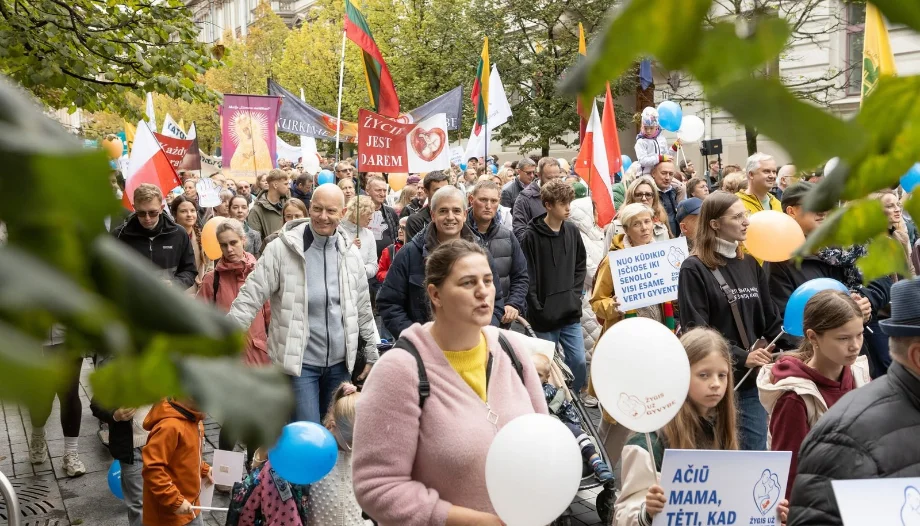
More than 3,000 pro-life advocates gathered in Lithuania’s capital on Saturday for the annual Vilnius March for Life, calling for greater support for mothers and families amid growing national debates over abortion, IVF and the country’s declining birth rate.
This was the second consecutive year in which Lithuania held the March for Life after the event was revived in 2025, following a nearly 30-year hiatus. Its return comes at a time when Lithuania, like much of Eastern Europe, is confronting profound demographic change, with fewer marriages, fewer births and a growing concern about the future of family life.
A public witness to life
Despite heavy morning rain, cold and fog, participants gathered at the Martynas Mažvydas National Library before marching to Cathedral Square. Once there, what followed was a mixture of music, testimonials and moments of silence and solidarity for the lives of the unborn lost to abortion.
Organizers wanted to make clear that the pro-life movement is not defined only by what it opposes, but also by what it celebrates, that being life, family, community and the responsibility people have towards one another.
That message was illustrated by the testimony of Saulius Karosas. After his fourth child, Iva, was born with Down syndrome, the family later adopted Motiejus, a boy with the same condition. Karosas described how welcoming both children transformed the family’s understanding of human worth and beauty, teaching them to recognize the value of others in a deeper way.
Such testimonies are central to the organizers’ vision. Rather than presenting the defense of life solely as a political or legislative question, the Vilnius March for Life sought to show how a culture that welcomes life is built through concrete relationships and everyday choices.
Lithuania’s pro-life movement
Abortion is currently legal in Lithuania up to 12 weeks, while euthanasia remains illegal. The country’s pro-life movement operates within a wider public discussion about abortion and the declining number of children being born.
Against this background, the return of the March for Life provides a visible public platform for those who believe that unborn children should be protected and that women and families facing difficult circumstances should receive greater support.
For Simonas Streikus, one of the organizers of the Vilnius March for Life, the message of the march extends well beyond the streets of Vilnius. “We are responsible for one another,” he told Omnes, stressing that individual choices can affect others and contribute to a culture that values life.
He said the march should encourage women facing difficult decisions during pregnancy to choose life while reminding them that “they are not alone”. That witness, he explains, begins in ordinary daily life, as people become “apostles of goodness and life” through their families, friendships, workplaces and communities.
Streikus also hopes the march will strengthen those who participate, giving them “renewed strength, faith and courage” to live their convictions beyond the event itself.
For him, the most powerful witness may not be “a speech or a political campaign”, but the example of someone who lives according to their pro-life convictions “with joy, courage and love”.
This is why the organizers see the march as more than an annual demonstration. They want it to help create a culture in which mothers are supported, families are valued and vulnerable people are treated with dignity.
A region facing a demographic winter
This pro-life message comes as Lithuania and its neighbors face a demographic decline.
Across Eastern Europe, birth rates have fallen well below the level needed to maintain populations over the long term. The causes are complex. Following the collapse of communism and the independence of many countries in the region, large numbers of people emigrated to Western Europe and the United States. At the same time, rising housing costs, economic uncertainty and changing cultural attitudes have made marriage and parenthood more difficult or less attractive for many young adults.
For Polish pro-life advocate Marcin Perłowski, the demographic crisis cannot be separated from wider questions surrounding marriage and the meaning of parenthood.
Speaking to Omnes in Vilnius, Perłowski explained that one of the difficulties facing the pro-life movement is the way its message is sometimes received in public debate. He mainly noted accusations of “hate speech” directed at people defending unborn life. He said that portraying pro-life advocates as people who “hate women” or seek to restrict their freedom can make it harder for the movement to reach new audiences, particularly on social media.
Additionally in his view, modern media often portrays marriage as oppressive and motherhood as a threat to women’s freedom. Men, he said, can encounter a parallel message in which their independence is separated from family commitments or responsibility.
“I wouldn’t say that the crisis of families lies on the weakness of men or on the weakness of women,” Perłowski said. Instead, he pointed to broader cultural forces that affect both sexes, while explaining that the pro-life movement should speak to the particular responsibilities and experiences of men and women.
Perłowski also questioned whether financial incentives alone can reverse demographic decline. Drawing on Poland’s experience, he argued that increased financial benefits had not produced the demographic boom some expected.
Instead, he said governments should concentrate on creating conditions in which families can flourish. “The best way to help families is to leave them alone,” he said, explaining that families need greater freedom from excessive taxation and other burdens, together with stronger social recognition on the importance of family life.
For Perłowski, therefore, the demographic question is not simply about the number of children being born. It is also about whether young people see marriage, parenthood and family responsibility as realistic and worthwhile parts of adult life.
Building a Culture of LifeBuilding a culture of life
The deeper challenge, Perłowski explained, is cultural. Large families were once viewed negatively in parts of Polish society, but he believes that perception is slowly changing. Governments and public institutions, he said, should reinforce that change by showing that marriage, fatherhood, motherhood and larger families can bring meaning and human flourishing.
This broader vision helps explain why the Vilnius march matters to its organizers, including Streikus. Their message is not limited to opposition to abortion but rather it connects the protection of unborn life with the social, cultural and practical conditions that shape whether people feel able and willing to marry, have children and build family life.
For those gathered in Vilnius, the march was therefore both a public statement and an attempt to place these questions more firmly in the wider conversation about the future of families and societies across the region. What follows from that witness, organizers say, depends less on a single event than on whether its message finds expression in the ordinary choices and institutions that shape family life.





 Español
  English
  Italiano
  Français
  Deutsch
  Polski
  简体中文
简体中文