


To speak of the permanent diaconate, it is essential to begin with the family. God's call is not received in solitude, but in the bosom of a concrete home, with names, faces and a shared history. In our case, we can say with simplicity that God has knocked at the door of our house and that, to this day, we have tried to respond to him with fidelity and generosity. We ask the Lord to keep us firm in our dedication to our brothers and in our fidelity to the Church.
None of what I have experienced would have been possible without the presence of the magnificent woman that God has placed in my path. Her trust, her availability and her constant accompaniment have been a true pillar in this vocational process. Her testimony of living faith, of love for the Church and of silent dedication has sustained our common journey. Together with her, the Lord has blessed us with two sons, a true reflection of his love and a sign of his grace poured into our family.
The origin of vocation
We were first approached about the possibility of the permanent diaconate in 1998. Our pastor spoke to us about the option of applying for admission as an aspirant to the diaconate. After a time of shared reflection as a family, we decided to accept the proposal. However, the subsequent change of parish priest meant that the decision was postponed and did not materialize at that time.
In 2006, a new pastor raised the question again. Again, we reflected on it as a family, sharing doubts, concerns and hopes. A particularly significant step was the explicit consent of my wife who, with joy and full willingness, signed the document accepting my availability to be admitted to the diaconate. Her support was, once again, a clear confirmation of the shared call.
On St. John's Day, June 24, 2006, our parish priest was summoned to a family audience with Don Antonio Ceballos, then Bishop of Cadiz and Ceuta. That day was engraved forever in our memory. In that audience, the bishop received, on the one hand, the request for admission to the Conciliar Seminary of Cadiz of our son Antonio Jesus and, on the other hand, my admission as an aspirant to the permanent diaconate. As we usually say, the Lord does not allow Himself to be outdone in generosity and, when one gives oneself to Him, He always returns a hundredfold.
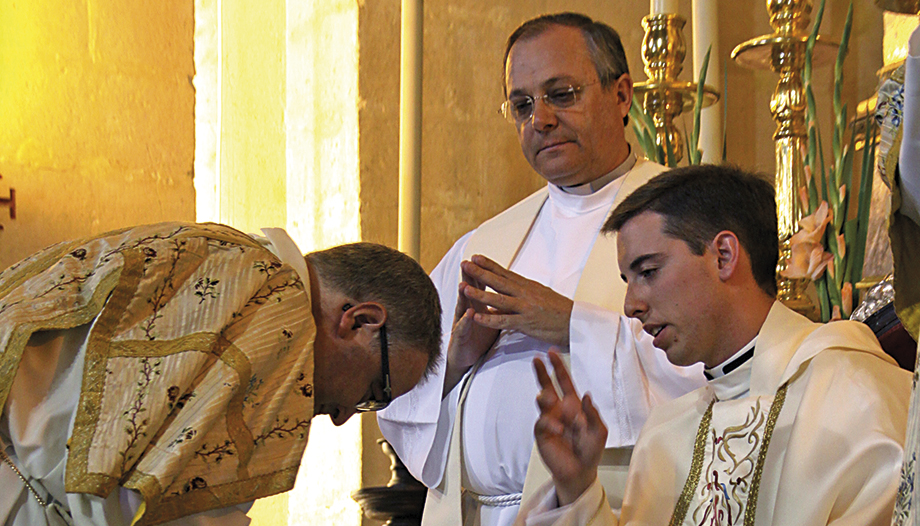
In February 2008 I was ordained a permanent deacon, and in October 2013 our eldest son was ordained a priest. It is deeply moving to experience the experience of asking your own priest son's blessing to proclaim the Gospel. I remember jokingly telling him that on the day of his first Eucharist, before proclaiming the Gospel, I would say to him: “Son, give me the blessing.”, instead of the usual “Bless me, Father.”. In the end, the scene remained only an anecdote, but it expresses well the depth and beauty of this shared vocational mystery.
Day to day
The life of a permanent deacon in a family is filled with moments of deep joy and satisfaction, especially when faith is lived and celebrated in common. Even in times of pain and difficulty, the experience of shared faith becomes a source of unity, consolation and strength.
There is a moment that often catches our attention when we attend the Eucharist. My wife usually sits alone in the pew while I, as a deacon, assist the celebrant at the altar. Occasionally, some people ask her: “Are you always alone at Mass?”. She usually responds serenely that when her husband, as a deacon, raises the chalice in the doxology, both are united in a special way, sealed by the marriage covenant, which is also a visible sign of God's grace.
Our youngest son, together with his wife and daughter, today forms a family with deep Christian convictions and a coherent life of faith. We share with gratitude the joy of feeling blessed by God and we raise a sincere thanksgiving for the gifts he gives us every day to be, in the midst of society, his presence and announcement that God loves us beyond our failures and sins. Friends at the christening of our granddaughter ask “Who will baptize her?” and some are surprised that the niece's uncle celebrated the Eucharist and the grandfather is the one who baptized.
Along the path of the permanent diaconate, there is no lack of anecdotes that highlight the lack of knowledge that still exists about this ministry, despite the fact that in some Eucharistic prayers deacons are expressly mentioned together with the Pope, bishops and priests. In the celebrations of the Word in the absence of a presbyter, it is not uncommon for someone to come forward at the end and say: “Father, you forgot to consecrate.”. Or that, upon seeing the deacon arrive accompanied by his wife, someone would be scandalized and comment: “And who is that lady?”.
Normalization of the diaconal reality
Even so, from my own experience I can affirm that the permanent diaconate is making steady and encouraging progress. Little by little new deacons are being incorporated and we can see how this ministry is beginning to be valued and welcomed in diocesan life. It is also a source of joy to note that dioceses where the permanent diaconate has not yet been restored are taking decisive steps to make it a reality. This has happened recently in archdioceses such as Granada or Mérida-Badajoz, an eloquent sign that the Spirit continues to stir up servants and to show new ways of service to the Church.
And although there is no vocation ministry specifically oriented to the permanent diaconate, there are still men willing to serve. They are few in number, but their human, family and ecclesial quality is admirable. Each aspirant is a source of genuine amazement: men with a life already dedicated to family, work and the Christian community, who wish to offer themselves even more to the Church. In them we can clearly perceive that a vocation does not come from planning, but from God's fidelity and a generous response to service. Each of these candidates is a gift and a confirmation that the permanent diaconate is, above all, the work of the Holy Spirit in the Church.
Permanent Deacon of the Diocese of Cádiz and Ceuta





 Español
  English
  Italiano