


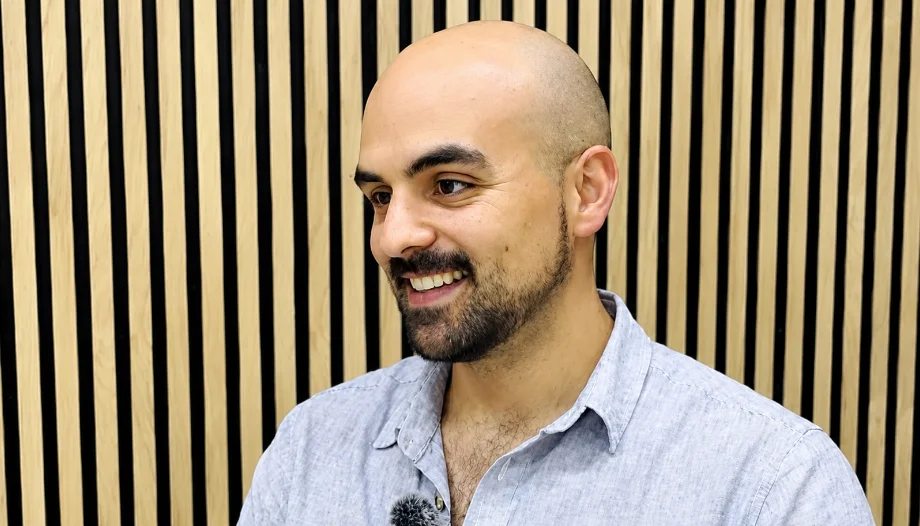
Abel de Jesús is a theologian, high school teacher, and Catholic content creator. Originally from Tenerife, he has turned social media into a space for evangelization and theological reflection, without shying away from the most controversial issues. Those who have followed him for some time are also familiar with his life's ups and downs, which he has never hidden.
In this interview, he addresses the challenges of the digital mission, the boundaries between evangelization and marketing, the need for greater theological formation, and the risks of reducing faith to traditionalism or sentimentality. He also reflects on the pontificate of Leo XIV and its capacity to foster unity in the Church.
At what point are you a digital missionary? Are you a Catholic influencer or a Catholic person who creates content of various kinds?
–This is a topic the Church is developing extensively. There is a great effort on the part of the papal Magisterium to delve deeper into this issue. Pope Leo XIV recently addressed it in a document of great magisterial significance., Magnifica Humanitas, where he refers to the need for missionaries in the digital world. He defines them as "generous and mature missionaries at the service of evangelizing this continent." Therefore, the digital mission is no longer an invention, a fad, or an empty word, but rather has its own substance and responds to a papal call. It is a kind of new crusade, promoted by the Pope, urging us to go to this continent.
The digital mission is very much alive. This term expresses what the creation of Catholic content on social media should be: a service to evangelization. And here's an important distinction: being Catholic and having a presence on social media is not the same as having a digital mission.
The digital mission is not about adopting a Catholic lifestyle or bearing witness to being Catholic in the midst of one's activities. It has a specific nature: to proclaim the Gospel. The digital missionary is a missionary. This is what the Pope and the work of the Dicastery for Communication help us understand. It is a missionary who possesses digital training, gifts, and talents at the service of evangelization, which is the Church's perennial evangelization.
Within the Church, mission is understood as a free gift, in response to the mandate received from Christ. However, digital missionaries also need to make a living. A question often arises: should they charge for creating missionary and evangelistic content?
"It's a very delicate issue. Precisely because it's so new, it can lead to confusion and even abuse. If we mix the concept of influencer with Catholicism, we could end up putting marketing at the service of the individual, instead of at the service of the Gospel.".
Marketing, understood as the pursuit of economic gain from an activity, can contradict the Gospel. Therefore, great care must be taken.
I believe that the digital missionary, as a missionary, should not be driven by profit or seek to increase their assets or generate wealth through their work. At least, with regard to their digital mission, they should live it in poverty. It's another matter if they receive donations, aid, or stipends that allow them to continue carrying out this mission with flexibility, but also with austerity. They may need to finance their travel, move from place to place, or cover their living expenses. And, if they have a family, even more so.
There are many lay people who are digital missionaries. In that sense, communities should be generous with them financially, because they also have family obligations. If they didn't receive this financial support, in the form of contributions or donations, they would have to abandon the mission. That would also represent a loss for the Church. Therefore, this support is provided for. I myself receive donations and accept them gladly.
You can even set fees, but you have to be very careful with them. It's not the same to charge for providing theological training, for which you've prepared, completed formal studies, and invested time and effort, as it is to charge a high fee for sharing your testimony of faith. The latter could constitute a kind of spiritual simony.
I don't know if it could be considered a canonical offense, but charging for sharing a free gift received from the Holy Spirit, such as faith, raises many moral questions for me. On the other hand, I understand charging for teaching at a university. If you and the other professors teach as part of your professional activity, it's reasonable that you receive the same salary as other employees.
Do you think those of us who are not in the digital mission world understand this issue well?
–There is still some hesitation. I always remember those words of Saint Paul: whoever does not work, «that he doesn't eat«"He was working with very apostolic communities, where the mission was, in a way, part of their work. However, we find it difficult to strike a balance between not turning this into personal enrichment and charging a fair price, within our means.".
It's crucial to distinguish between a digital communications professional, an influencer or content creator who is also Catholic, and a digital missionary. They are different things. The problem arises when they become intertwined. You are a communications professional; you have trained for this, you have a track record, and you assume a series of professional, ecclesial, or institutional responsibilities. This requires a salary because you are carrying out a professional activity. Moreover, this is your professional activity, and it's what allows you to provide for your children. That is perfectly legitimate.
Another thing entirely is asking yourself what your digital mission is and at what point you stop acting as a professional and start acting as a missionary. In that case, it would be just as immoral to charge for your digital mission as it would be to charge for your mission in general.
Imagine someone saying, "I'm going to Africa on a mission" or "I'm going to Asia." If they're going to evangelize and charge €8,000 for a talk, we have to ask ourselves what the point is. A mission unites humanitarian work and evangelization in an inseparable act of preaching the Gospel. It's something you receive freely and give freely, in an act of total and radical surrender of your life to the service of the Gospel. That is what it means to be a missionary.
The term "digital" doesn't change the nature of the mission at all. When you charge €8,000 for a digital mission, you should consider what would happen if, going to Uganda to evangelize in a place where they don't know Christ, you charged the people you intend to preach the Gospel to exorbitant amounts because you have a certain prestige. Then the very nature of evangelization is distorted and perverted.
You've spoken a lot about the mission, and you were recently in Latin America for one of the digital missionary gatherings held this summer. Before we started recording, you told me that you had, quite literally, discovered America. You've discovered a landscape that perhaps we in our old Europe still don't know enough about.
–There is a crisis of vocations and mission here, and sometimes it is also difficult to find adequate responses from the Church. Perhaps we don't always know how to adapt to the mission that God asks of each of us.
To put it simply, I get the feeling that we have more supply than demand here. There are many institutions, movements, and groups offering weekend retreats, training courses, and spiritual exercises. We find a huge number of options, but little demand. Generally, we have to go out and find people, and sometimes the same people participate in different places. And I'm speaking from Madrid, which is a privileged location because there's a lot of Catholic activity here. In other places, the demand is practically nonexistent.
In contrast, in Costa Rica and the southern United States, where you've been, there's a deeply Christian society, though not always in the Catholic sense, and there's also a very strong Catholic movement. There's a huge demand there. People want to be trained and have opportunities. However, there's often a limited supply because there are few priests, and they're very focused on the exercise of their ministry, the sacraments, and other tasks. They can't dedicate time to the kind of training and evangelization that goes beyond worship and liturgy. They're overwhelmed, not for lack of pastoral zeal. That's why this mission is so needed and desired there. And often, the digital mission as well.
I've been so impressed by the gratitude people show for the few videos I've uploaded. They might be of varying quality or more or less informative, but they're received like water in a drought, like a long-awaited rain. They say, "Thank you for this." That really touched me. I'm so grateful.
In Spain, we currently face a cultural, political, and religious challenge. Catholicism is becoming fashionable again, which has positive aspects, as it greatly facilitates the work of missionaries in this digital age. However, at the same time, there are risks. One of them is that Catholicism will be instrumentalized in the service of this cultural shift. In other words, this resurgence, of a more traditional or conservative nature, which is legitimate, will find in Catholicism a cushion on which to rest. Or, Catholicism will become merely the veneer for this return to conservatism, without any genuine interest in God.
Ultimately, God uses everything, through the Holy Spirit, to bring about whatever He wills. But we run the risk of Catholicism becoming a cultural fetish at the service of certain political and economic interests. It's something I've experienced to some extent.
There is a risk that Catholicism could become a class-based religion, a bourgeois religion that protects certain interests. This is a risk we must consider. I don't want to be dramatic, but we must be vigilant to prevent the faith from becoming ideologized. The antidote to the ideologization of faith is theology. Theology allows us to put the Gospel before other interests.
How can we meet the challenge of forming those who approach the Church in the faith in a society with increasing difficulties in understanding and learning?
–Honestly, I don't know. I'm a high school teacher, and one of the hardest things is sparking a desire to learn or helping people understand the importance of education. If I can't do it with my students, I don't really know how. What I do is offer training. And the truth is, people want it. Deep down, I think there's a thirst for education.
Often, theological ignorance is an impediment to faith. We might think the opposite, that theology destabilizes us and makes us doubt things, but I see it almost the other way around.
Often, theological doubts are suppressed, and one remains complacent. All questions are eliminated, leaving behind a secure, solid, and falsely protected discourse. But that is not faith. It quickly becomes ideology. You build ideological scaffolding to prevent the structure from collapsing.
However, many people, who are more honest with themselves, realize that these theological questions and legitimate doubts that arise during the natural process of faith deserve an answer. Not because they are doubting God's love, but because they want to respond to that love with all their heart and mind. This involves solving the unknowns in the equations and also discovering the reasonableness of God's love, which is given for us.
When we clarify these questions, or begin the process of doing so, the obstacles that prevent us from fully committing ourselves are removed. That is why I am more convinced than ever that theology is an essential part of evangelization and also of the Church's digital mission. Without it, especially at the cultural crossroads where Spain finds itself, we will hardly be able to carry out a holistic evangelization.
I find it striking that you don't avoid any conflict, that you get involved in every controversy.
"I don't do it for the mission, but because of my personality. I'm incapable of leaving a question for later. If a doubt about my faith arises, ever since I started, I can't rest. I find no peace until I draw up a plan and try to understand what's happening, why I don't understand something, or why I can't clarify it.".
If someone asks me a question I don't know the answer to, I become personally obsessed with it. It's not something I do in service of evangelization. It's my own psychological struggles, my obsessions. I need to know.
Those who know me know that I sometimes become obsessed with certain topics. It happens less often now, because I've already tackled many issues. When a question has been posed to me fifteen times in fifteen different ways, I can study it with a bit more peace of mind.
But that's just how I am. I can't avoid controversy, not so much because of social media, but because I live and learn from it. That's why I can't help but share it. I think that's very healthy, because it allows many people to raise issues they might find difficult to express in other settings or with other people.
You've talked about the questions people ask you. What kind of questions do your followers have?
"It makes me sad when people ask me really good questions, send me current news, or tell me stories that pose a theological challenge. They say, 'Look what this person said' or 'Look what came out here.' I'd love to answer everything.".
Right now, I have a lot of current events that people are sending me. I tell them I want to respond, but the afternoons slip by and I can't.
In light of current events, many people find themselves facing a kind of Pandora's box. Suddenly, doubts arise and everything is turned upside down. "Look what this priest said," or "Look what that one said." And one thinks that a response is necessary.
People raise all sorts of questions. Some people share very intimate personal experiences that pose a huge challenge. We often live in a safe environment, with our families. But sometimes things happen that make you doubt everything. You wonder how something like that could be possible or how you can continue to trust in God.
These are very challenging situations that pose theological dilemmas and require responses. I receive all sorts of things, and sometimes I wonder how to respond. In these situations, my theology has often been thrown into crisis. And I believe it should be this way. A theology that has never been in crisis, a theology complacent with itself, can write a book, but we have to see if that manual can withstand the weight of reality. Perhaps it won't.
And how do we deal with that crisis?
–In my case, in three ways.
First and foremost, by listening carefully. You have to listen, because if you don't, you can remain on the surface. If you limit yourself to thinking about what people should think or say, that's the death of theology. You don't listen, you don't see reality, and you don't understand the depth of people's questions.
Secondly, by praying a lot. Only in prayer can the Spirit give you the freedom necessary to face the challenge of these questions. It's impossible to advance in theology without humility. There's a kind of self-sufficient pride that wants to cling to old, outdated answers. You close yourself off to them because changing your mind is harder than changing your kidneys. Changing your mind is hard. Sometimes there's no other option but to forge new paths, and that can only be achieved with the humility you receive from the Spirit of God in prayer.
Third, by studying hard. We must study and understand that things are more complex than we think. Only by acknowledging the complexity of theology can we make progress. If we believe it is simple and that things are as straightforward as we think, we will never be able to advance.
How do you interpret the return to religious traditionalism among young people and the rise of sentimentalism in faith, and what positive and negative aspects do you identify in these phenomena, taking into account their possible roots in a poorly understood post-conciliar period and the need to foster dialogue between the different sensibilities of the Church?
–It depends on how we define traditionalism. If we understand it as an uncritical return to a kind of liturgical archaeology, projecting the desires of the present onto the past, I believe it originates in the excesses of the second half of the 20th century in liturgical matters: liturgical abuses, the desacralization of the liturgy, and a significant loss of the Latin spiritual heritage. This loss left many people feeling abandoned.
The project of a completely horizontal Church, based on grassroots communities, without hierarchy, order, or formal structures, failed. As a result, people were left exposed to emptiness, to lifeless churches, devoid of new vocations and lacking inner life. Therefore, it is understandable that what is desired in the present is projected onto the past.
I believe that humanity must reclaim the ritual dimension, because Christianity denies nothing human. Ritual is something profoundly human. It is not divine: God does not need rituals. This is evident, fundamentally, from Sacred Scripture. Ritual is something human that allows us to plunge into the abyss of God through the mystical and the mystagogical, leading us toward the mystery of the liturgy. If you deny this dimension, you are denying a part of what it means to be human.
Since humankind has been self-aware, this ritual dimension has existed. That's why we must recover solemnity, liturgical beauty, sacred music, and sacred architecture, which elevates us; a more vertical and theocentric architecture. If you lose all of that, it's logical that traditionalist and medievalist movements will arise. Why? Because there is a longing that remains unfulfilled.
The other possibility is to fall into sentimentality. If the liturgy doesn't satisfy us intellectually or emotionally because it lacks contemplation, symbolism, and transcendence, it also lacks what Rudolf Otto calls the tremendous and fascinating mystery, the luminous and captivating. When that disappears, what do we do? We turn the liturgy into a collection of feelings and seek out experiences.
I'm waiting for a TripAdvisor app for religious experiences. I'm convinced it will come eventually. We'll be able to rate experiences with five stars: because there were lights, because there was music, or because certain reflections were shared. We're seeking out and collecting emotional experiences. In the end, we rate priests, retreats, movements, and concerts. And the more sentimental they are, the better, because they satisfy that need.
But this is just another element of a bourgeois religion. On Thursdays I go to the golf club, on Fridays I go to yoga, and on Saturdays I have a vigil with young people. It's all part of the same thing: I need experiences to fill my week after work. Added to that is the precariousness of life, the difficulties we face, and the lack of dreams and hobbies, partly due to screens. In the end, all that's left is sentimentality.
Some would say it's the new opiate of the masses. Sentimentalism in the Church can indeed become that. Why not accept that criticism as well? This doesn't mean we should criticize the emotional dimension itself. Every pastoral experience must be grounded in an emotional experience. If that dimension fails, the very structure of the faith experience suffers.
Pathos is a fundamental basis. If you don't feel loved, if you don't feel welcomed by your community and don't establish relationships of friendship, affection, tenderness, and understanding, then the contemplative dimension cannot be reached, nor can you embrace theological convictions. The problem arises when this feeling is cultivated to the point of confusing it with the true experience of God, which transcends any feeling.
I was reminded of that passage from Evangelii Gaudium, which is probably one of the most quoted: «Being Christian is not the result of an ethical choice or a lofty idea, but the encounter with an event, a Person, which gives life a new horizon and a decisive direction.» Perhaps we have repeated it so many times that we have forgotten what that personal encounter, face to face, heart to heart, truly means.
How do you see Leo XIV, especially regarding his revival of the Second Vatican Council and his appreciation of the liturgy, and what do you expect from his pontificate?
–From what we're seeing, I hope his pontificate is very long and we're only just beginning to glimpse what will happen. He's a Pope of unity, a Pope of synthesis. After many ups and downs, I think he can be a Pope who stabilizes things and prepares the Church for what's to come.
I hope his pontificate is long, that it consolidates what has been built, and that it prepares the Church. May it strengthen and solidify the charisms of previous popes: the expansion of John Paul II, the reasonableness of Benedict XVI, and the openness to the poor and the peripheries of Pope Francis, something the Church also urgently needed. All of this sometimes remains scattered or in conflict, in an unstable tension. I hope the Pope will succeed in bringing it all together.
Not because he has great charisma, although he does. The Pope is captivating in his simplicity. I believe he has a charism of the Holy Spirit which, ultimately, is what makes the apostolic ministry effective: the ability to reconcile what is scattered. I hope the Church will be receptive enough to receive his message.






 Español
  English
  Italiano
  Français
  Deutsch
  Polski
  简体中文
简体中文