


 Holy Week baptisms confirm religious revival among young peopleSt. Augustine and the search for God: reality of modern man.
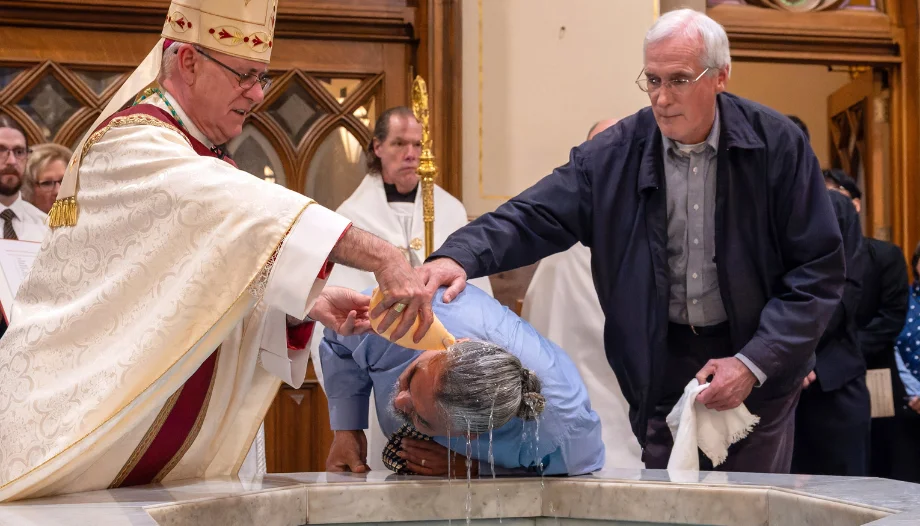
It is not insignificant that something that could be called a “Catholic turn” has recently emerged. We could interpret it in many ways or offer several reasons for it. We see it in the news, especially in France, with more than 20,000 new baptisms, and among them, the majority of between 18 and 25 years old. The increase in Catholic Christians in Africa is no longer news, which is a precious thing, though difficult because they do it at the cost of their lives, as we increasingly witness. But what is this? What's happening? Is it a fad? A yearning or emptiness? Is it witness and truth?
Let's take it one step at a time. We understand that more and more people are approaching faith in a more genuine way. This means that faith is becoming, in some ways, a public experience, no longer closed off. In one way or another, the “fear” of openly expressing one's faith is gradually disappearing. However, this is not the case in many countries, especially those suffering intense persecution, such as in parts of Africa, where living one's faith can even be a life-threatening risk.
The so-called “Catholic movement”
It is true that we live in a world of networks, where everything is connected, and a person on one side of the world can learn in minutes what is happening on another continent. The Church is not exempt from this; its spirit is not separate from being reserved for a specific nation or territory, but rather, as its own authority, it is universal. It is true that one of the things that immediately stands out about religion is its beauty, including its liturgical beauty, and this generates a certain attraction. “The liturgy, like Christian Revelation, is intrinsically linked with beauty: it is veritatis splendor. In the liturgy, the Paschal Mystery shines forth, by which Christ himself draws us to himself and calls us to communion” (Sacramentum caritatis, 35). Many people have returned to, or have been dazzled by, this beauty, especially in the liturgical action that is the center of the Church's life.
The restlessness of the heart and the search for God
Now, the question is, “Why God?” And I believe that in this we could turn to the figure of Saint Augustine as a key reference point. Surrendering to God is not an external adherence, but a quest that engages the whole person. The search for happiness (which is often discussed) is distorted by the fact that we sometimes compromise the means and make them so worldly that we reduce happiness to a mere repetition of acts that stimulate and lead to "feeling good." But that is not happiness, because if anything characterizes happiness, it is that it is eternal and immutable, and only the perfect being, who possesses these characteristics, can give that. Perhaps questioning happiness is a fundamental step in human quests; we usually ask ourselves many questions that shape our existence. But this quest, perhaps, does not arise from a material or psychological lack, but from an attraction or a search to feel a void that questions our existence. And these questions, which in one way or another interrogate our being, might be: "Why am I here?" "Is something missing from my life?" Or many others, are a sign that something inside is trying to find what it lacks, which is the divine character.
As mentioned earlier, one of the figures who remains timeless and is helpful in understanding this need to seek the divine is Saint Augustine. «You have made us for yourself, O Lord, and our hearts are restless until they rest in you» (Confessions 1, 1) is, let's say, how any Christian's restlessness might begin—a restlessness of the heart that is not bad; it is a beginning, because the soul always seeks the Creator, just as the Creator opens his arms to his creation. Reciprocity is evident in this restlessness; we would not be restless if there were not something divine waiting for us so that we might find rest. It is a reciprocal relationship. Saint Augustine speaks of nothing more than the human heart, which desires many things—that is why it is called “restless”—but which only finds rest in the one thing that can completely satisfy it: God.
If we continue along the line of unease, we encounter the act of recognizing creation. “I fell facedown on the beautiful things you have made” (Confessions, X, 27, 38). Beauty is not bad, it never will be, because ultimately it reveals the hand of the Creator. We can enjoy the beauty of a church's architecture, and that is not bad, or a song, but it cannot remain there; it must transcend into something more: discovering that beauty is meant to be worshipped and lead us to Him. Therefore, the external things that attract us must lead us to an internal reality that challenges us.
We could distinguish several facets or reasons why a young person loves what they love. Are they drawn to the Church as an institution? Are they drawn to the liturgy for its beauty? It's a simple perception, but it always begins there, because that's where the question ultimately arises: “What do I love when I love you?” (St. Augustine, Confessions X, 6, 8). In reality, the emotion that unfolds within me leads me to love God, and it seems so, because that would explain many cases of adult baptisms, where people are already aware of a more mature life and a commitment to God. And this, in a certain sense, brings us back to the question St. Augustine poses when he speaks of what one truly loves. Those who return to the faith or those who discover it for the first time grapple with this, asking whether they are beings capable of loving someone, a person who truly loved them from the beginning of creation.
Saint Augustine's words perfectly reflect what is happening in some societies today: the inner desire to seek the truth. Ultimately, we are all called to seek it, but finding it is even more beautiful, because discovering the truth makes you a participant in it, and at the same time, a messenger of that truth. The questions of the heart that may be grappling with people today are: What is the meaning of my life? What will happen after death? Who is Christ? And this is more common than we think: What is the meaning of my life? And that, even if they don't realize it, leads them into a theology of creation, where we are created with a purpose. Because if we think about it carefully, the idea or assertion that life is simply “to be born, to live, and to die” is so superficial that it brings more confusion than answers.
In these matters, we must be careful with emotions. Yes, they can establish a real connection, but some are confusing. Feelings are important insofar as, as the word itself indicates, they make us feel something. But this cannot lead to the idea that knowing Christ is conditional upon only what evokes a strong emotion or simply what pleases me guaranteeing a more perfect relationship with the Creator. It's not about searching or trying to question our lives in a particular emotional moment, but about finding meaning in the whole picture. The challenge will always be not to abuse emotions. It's about knowing how to manage them while not underestimating their crucial role in the Christian life.
Freedom or trend?
The dimension we could address concerns freedom, as a fundamental part of choosing or taking ownership of a decision. A person might approach faith through a friend, which is, let's say, an essential and precious part of the journey, but at some point, they have to move beyond the collective and become individual, and this is where freedom comes in. It also leads us to choose, or rather, to ask ourselves what a person seeks when they seek the truth. But then, what do we choose? Leonardo Polo tells us: “Personal freedom is not freedom of choice, which is a freedom derived from the former, an appearance of human freedom but not a radical one” (The Essence of Man, lecture, University of Malaga, November 25, 1994). This means that it's not the same to see several options and choose the one that brings the most satisfaction to me, or because of the environment. Rather, it's a choice that must be made with one's whole being, not among several options, but the one true choice. It's asking oneself if it's a personal choice, one that commits my entire being, or simply an option. It is knowing where my person, my whole being, and with the freedom of the children of God.
“Freedom is discontinuous, a restart” (Leonardo Polo, Person and Freedom). Faith does not exhaust all possibilities; each person, from their life of faith, begins and restarts when they fall. It is not a perfect path, but rather one that can be sanctified, and that includes its mistakes. But the important thing is not to remain merely at the point of choosing faith, but to begin to live it, and to do so seriously.
A statement we often hear is that “faith takes away freedom,” but that's not true. Recognizing God's existence doesn't make us puppets of faith. The recognition of being a child of God doesn't isolate us, but rather opens us to life, now with a divine touch. We see this in the freedom we enjoy, not as something we have to do, but as something done for God—studying, working, family. When we understand that the freedom to do these things has a deeper purpose, we see them differently. Human beings are open beings, but at the same time, they give of themselves, seeking to love when they discover they are being loved. It is there that the freedom to love God leads me to love others in an exceptional way.
Therefore, the man who discovers faith for the first time or who manages to rediscover it finds in it the challenge of freely accepting faith, not as a range of possibilities that is the one that fills me the most, but rather as the only option that fills my life and that brings freedom with it.
Happiness, where?
There is an important distinction we could make between what attracts us and what constitutes and builds our lives. We have already seen that the rediscovery of faith is something that challenges the heart and then leads us to freely choose, with our whole being, only what we truly want for ourselves.
“It is impossible for man’s blessedness to be found in any created good” (Summa Theologica, I-II, q. 2, a. 8). Is friendship, beauty, or knowledge something bad? No, that is not what Saint Thomas is trying to explain; rather, our happiness, which is the ultimate thing we seek, does not correspond to something earthly or subject to temporality.
The yearning for the eternal is nothing new for humankind. From the very beginning, we have asked, “What is there after death?” or «Where do we come from?» These questions certainly don't remain mere theoretical attempts to provide answers, but rather manifest as what we might call a hunger to know what lies beyond the finite. The "emptiness"—as the lack of a relationship with God, or a cold relationship with Him, is often described—is what leads many to believe that there is something within us that yearns, not to satisfy a temporal reality, but rather to fill a void. "Blessedness is the perfect good that completely satisfies the appetite." (Summa Theologica, I-II, q. 5, a. 8). This statement is not foreign to us, and we see it reflected in our reality: how humanity is so saturated in a carousel of fleeting satisfactions that do not lead to the complete fulfillment of human desire. One consequence of this is that we see the world so stimulated by temporary satisfactions that we crave eternal ones, because they make us reflect on whether what we seek as human beings is not fleeting. It's normal for many people to tire of the ephemeral, because that's not what humanity was created for. Humanity is called and created for eternity, and eternity in heaven, seeing God as He truly is, the divine essence. Here we see another approach to faith: the yearning for the eternal in the face of such a fleeting world.
Faith in everyday life
Faith cannot remain merely a matter of emotions or simple gestures; it goes beyond that, although those are the first steps. Christianity, whether embraced as a faith or returned to the Church, offers something that pertains to the whole person. Because faith attends to the entire person, during every moment of life, and like a beacon, it illuminates existence.
A life of faith is not about extraordinary events, but rather about making ordinary things like work, study, family, etc., a path that the whole person takes, but in which they encounter God. Our work is not something that prevents us from living a life of faith; on the contrary, it is through our work that we are formed. And faith is included in this. When? When I know that I am making ordinary life a praise of God, trying above all to do things well and with love. On this point, Saint Josemaría tells us, “Give your ordinary professional work a supernatural motive, and you will have sanctified your work” (The Way, 359).
Therefore, when we speak of a “Catholic turn,” especially among young people, we are not talking about particular interests in a form, a particular interest, an aesthetic, or a religious culture, but about something deeper. It is true that perception brings to mind what the eyes see, but this leads to unanswered questions, to a hunger for knowledge, and to a void to be filled. It is there that the answers begin to emerge, but this is a personal journey for each individual. “Being Christian is not the result of an ethical decision or a lofty idea, but the encounter with an event, with a Person” (Benedict XVI, Deus Caritas Est, 1). The act of encounter is the response of those who seek to be filled with the Bread of Life that satisfies their hunger for eternity. Thus, returning to the Church or beginning a new journey within it is a precious and personal path, but one that always culminates in an encounter with Christ.
Growth in persecution
We have spoken of the growth of the Church, which many call the “Catholic turn.” But there is another part of the world, brothers and sisters in Christ, who live their faith amidst persecution, risking their lives to participate in the Eucharist or in a Christian community. This is the young and courageous Church in Africa, which is not the same everywhere, but one thing is certain: at its most deeply Christian roots lies the blood of those who have washed away their stains through martyrdom.
Martyrdom has always been present in the life of the Church, from its beginnings to the present day, and it is not something indifferent to ecclesial life. But martyrdom should not be understood as a defeat; those blessed for the sake of the Lord are now those who intercede for us, they were blessed beforehand.
“The blood of the martyrs is the seed of new Christians” (Tertullian, Apology, 50, 13). Their shed blood, like that of Christ, is the grain that dies and bears much fruit (cf. Jn 12:24). Those who die to this life, because they know and hope in heaven, are those who live forever. For the Church growing in Africa is not a reality indifferent to these words; even with the passage of time, they remain palpable in its reality.
Our faith needs works; otherwise, it is a dead faith. But the life testimony of the martyrs is a total surrender to Christ, and it is a clear example that when truth is defended, even life itself is given. After all, who dies for a lie? Life, being the most precious good, is given only to defend the truth: “Be faithful unto death, and I will give you the crown of life” (Revelation 2:10). The young Church that journeys in Africa is a source of hope, a palpable fidelity and a defense of the truth; it is what keeps them steadfast even in persecution. The Church is growing, and we already see that it is growing in many ways, and this should motivate us, because it is what we are truly called to be: a living image of Christ. We are all called to the building up of the Kingdom of God and the salvation of souls.





 Español
 English
 Italiano
 Français
 Deutsch
 Polski