



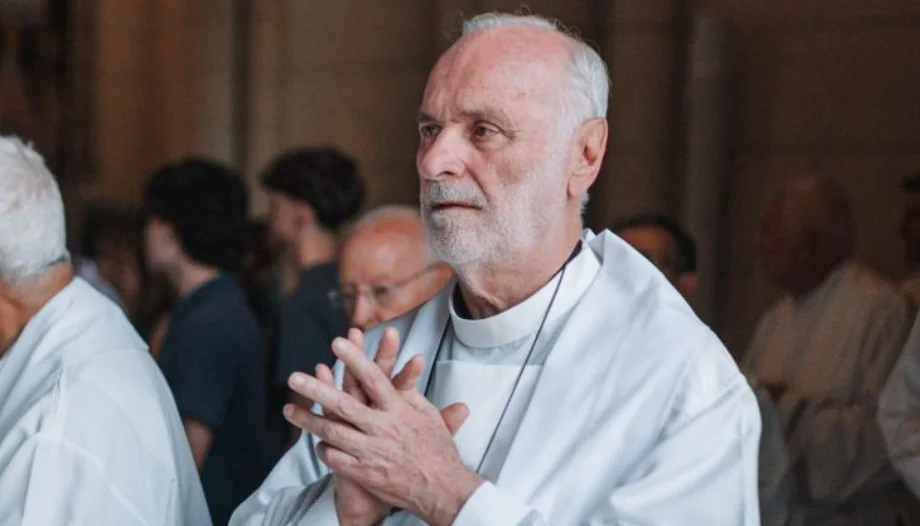
Ezechiele Pasotti's relationship with the Neocatechumenal Way began at a decisive moment in his life. He was 26 years old and in his final year of theology at the Society of St. Paul in Rome when a crisis provoked by a conflict with one of his superiors led him to leave the seminary. It was then that a friend invited him to participate in a celebration of the Word of a newly initiated community of the Way in a parish. That experience marked a turning point: “The Word of God illuminated my story in a surprising way. I returned to the seminary and the first thing I did was to go to the superior and ask for forgiveness, with a very strong and sincere gesture. It was the first time I had ever done anything like that in my life,” says Ezechiele Pasotti, who never left the community after that experience.
Shortly afterwards he met Kiko Argüello and Carmen Hernández during an encounter: “I immediately felt a call from the Lord to itinerancy, that is, to leave everything behind - studies, work, religious life - to dedicate myself to proclaiming the Gospel wherever the Lord wanted to send me,” says Pasotti. Since then he has carried out his missionary work in various countries, including Scandinavia, Bolivia and Africa, maintaining close collaboration with the initiators of the Way.
In this interview, Ezechiele Pasotti reflects on the history, challenges and future of the Neocatechumenal Way.
You have been working very closely with Kiko. What is Kiko like on a daily basis, outside of the big meetings and celebrations?
-He is a normal man, capable of getting into the kitchen to prepare a good plate of spaghetti carbonara or a good fish dish. His daily routine is drawing, designing, answering a thousand phone calls, writing poetry, scrutinizing the Word, reading the Holy Fathers... as well as visiting communities, itinerant gatherings, seminaries, catechists, bishops....
His life has been profoundly marked by his encounter with Jesus Christ. He has a special way of dealing with the poor, a freedom, a capacity for self-giving that has always given me, coming from a poor family, serious food for thought. Then, when it comes to working with him, you discover a man with a great intellectual openness, an intuitive capacity, a truly exceptional artistic preparation. A man with an uncommon capacity for work.
Could you tell us about the history of the Camino?
-The Neocatechumenal Way is a mystery of God's love; born from Kiko's encounter with the poor of Palomeras Altas (Madrid's outskirts) and later with the Servant of God, Carmen Hernandez, with all her academic and theological preparation, in contact with the renewal of the Second Vatican Council. The experience that both contribute is crystallized in an itinerary of Christian initiation, according to the model of the ancient catechumenate; based on a tripod:
- – Supernatural Word that summons the kerygma as a proclamation of salvation, the love of Jesus Christ for you and sets you on a journey with concrete brothers and sisters reached by the same proclamation.
- The Liturgy who, through forgiveness and the weekly Eucharistic celebration, returns to visit you, to make you a sharer in the grace of the Lord, in his Holy Spirit, and, little by little, with a journey of years, through the different stages of the Neocatechumenate, introduces you to all the fullness and beauty of Easter.
- The Community, This, together with the gift of the Holy Spirit who gradually builds it up, is the most beautiful gift of the Church, of being Church, an expression of the Father's love, giving to the world - and first of all to her own children and brothers and sisters - the signs of love and unity: the two signs indicated by Christ in the Gospel of John (13:14-15; 17:22-23).
It gradually goes through the different stages of Baptism, bringing back, little by little, all the richness, the depth and the gift of holiness that the wonder of this sacrament brings with it: from a first phase of humility, of pre-catechumenate, leading little by little to an existential listening to the Word of God - a word for me, for my life -, introducing to a truly participatory celebration of the Eucharist and to the gradual formation of a living ecclesial community; towards a fuller catechumenal phase, of simplification (simplicity), made of scrutinies, which help you to know yourself as you are, of initiation to prayer (with the handing over of the Psalter and the Our Father), up to the final stages of the renewal of the baptismal promises, in the presence of the Bishop, in the cathedral, during the Easter Vigil, which introduces to a life of praise to the Lord and of mission.
In the meantime, over the years, various charisms and services emerge and manifest themselves in the community: from the simplest, such as lector, cantor or ostiary, to responsibilities of greater commitment, such as collaboration in various areas of the parish, service as a local catechist, the sending of itinerant catechists called to exercise their mission outside the parish, or the availability of families for the mission. Even the entire community, once the itinerary has been completed, can offer itself to be sent to a particularly needy area of the parish or diocese.
What have been the most decisive moments for the Neocatechumenal Way?
The most delicate and decisive moments have certainly been those in which the initiators found themselves in dialogue with the Vatican Congregations (the Congregation for the Faith, the Congregation for Worship, and in particular, with the Dicastery for the Laity, constituted by Pope St. John Paul II as our point of reference for relations with the Holy See) and the meetings with the Popes (from St. Paul VI, who told Kiko: “...").“Be humble and faithful to the Church and the Church will be faithful to you.”(St. John Paul II, Benedict XVI, Pope Francis and now Leo XIV): all of them had a word of esteem and encouragement for the Way. Another very special moment was the definition of the Statutes of the Way and the approval of the “Catechetical Directory of the Way”.
What would you say are the challenges facing the Neocatechumenal Way?
-The main challenge has been to be recognized by the Holy See not as an association or a movement, but as “one of the diocesan modalities of Christian initiation” (Bylaws, Art. 1,2). In my humble opinion, few - even among Pastors and Bishops - have understood this constitutive element of the Way, which also responds to some difficulties and misunderstandings, including the Sunday liturgy in the Sunday vigil in small community, approved by Benedict XVI in the Bylaws. The Way cannot be an association, because Baptism is a constitutive element of the Church and therefore “...".“Auctor totius Initiationis Christianae Episcopus”(author of all Christian initiation), as stated in the Caeremoniale Episcopororum.
This is the greatest task before us: to help the Church to embrace what the Popes have recognized as “a modality of Christian Initiation”, which through the “tripod” - Word, Liturgy, Community - has a truly precious instrument consolidated by tradition - the Catechumenate - to move from a traditional pastoral ministry of sacramentalization to a pastoral ministry of evangelization, forming adult communities in the faith, capable of giving the world the signs of love and unity.
How do you envision the Camino in 20 years? What role do young people have in its future?
-To see the Church that has once again found in the Catechumenate (through the Way or other realities), authentic ways of evangelization, with the formation of Christian communities that are signs in the world. The catechesis of the Way on the family, open to life, that has earned Kiko a Honorary Doctorate at the Lateran University in Rome, has placed the family at the center of Christian Initiation and, with the family, the children, the young people, to whom so much pastoral attention is dedicated in the Way, with the “Scrutatio”The results of this are seen in the vocational calls where thousands of young men and women offer their willingness to begin a vocational journey to the priestly or religious life.
What would you say to someone who had a bad experience on the Camino?
-I would tell them not to be discouraged: the Church has always been holy and in need of conversion... There are certain dynamics that are consubstantial to life in common, including tensions. There is no need to dwell on this. Every person has to find his place in the Church. A difficult experience can be the basis on which to build one's vocation. Sins also exist after so many years on the Way, but personal sin, which certainly stains and can sometimes destroy the Christian community, does not cancel all the good that grace continues to pour out... Sins also make us more humble, more attentive to others, less full of ourselves.





 Español
  English
  Italiano
  Français
  Deutsch
  Polski