


In 2017, David Arratibel directed “Converso,” a documentary in which he attempts to understand—through conversations with his mother, sisters, and brother-in-law—why his entire family has embraced a faith he does not share. Nine years later, the film was screened at the Real Colegio Alfonso XII in El Escorial, as part of the 6th Edition of the Observatory of the Invisible, the summer school of art and spirituality that the Vía del Arte Foundation, led by sculptor Javier Viver, held at the Royal Monastery, with “air” as its overarching theme.
The event brought together about 150 participants, who took part in workshops on music, relief art, dance, and writing, among others. Each afternoon, they gathered for group activities, such as the film screening and discussion held this evening.
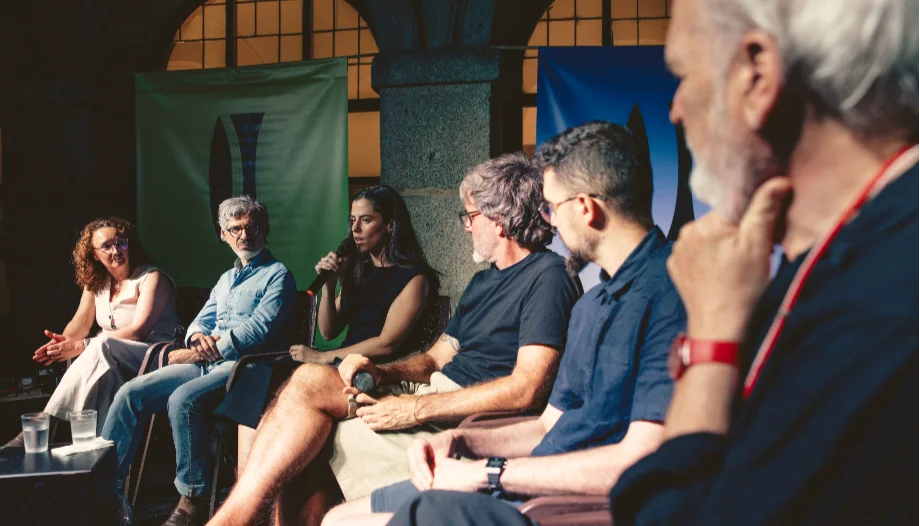
The film was followed by a discussion. Seated alongside the director were four people who have taken a different path from that of skepticism, three of whom are instructors in the Observatory’s workshops: Actor Lluís Homar led the theater workshop; philosopher Fabrice Hadjadj, the writing workshop; and art curator Maider Montalbán Errasti, the curatorial workshop, while Ernesto Castro, also a philosopher, attended as a guest.
One word
The moderator kicked things off by asking each guest to summarize in one word what conversion means to them. Homar, who received a thorough Catholic upbringing and drifted away from the faith as a teenager, needed no more than three: “Coming home.” Castro, who was baptized and confirmed as an adult during the most recent Easter Vigil, responded with a reference to Lope de Vega and his sonnet “mañana le abriremos” (“tomorrow we will open”): “Don’t say tomorrow.” Montalbán chose “harmonize”: the first conversion consists of finding the right pitch, as in Gregorian chant, and what follows is a constant exercise in harmonization through the sacraments.
Hadjadj, born into a Jewish and atheist family, rejected the idea of a “return home”: his parents, he has said, viewed his conversion to Christianity as a betrayal. For him, following Christ is “an intensification of life’s drama”: “More joy and more anguish, more open hands and more nails in the hands.‘ His former life, he said, resembled the beads of a rosary that had burst; his conversion was the discovery of the thread that weaves the fragments into a story. Arratibel, for his part, has focused on the etymology that gives his film its title: ’”Converso’ from ‘conversar’ (to converse): trying to understand one another in order to understand.”.
What separates
The director laid bare the experience at the heart of his documentary—one that, as he admitted, has made him reflect and suffer: the distance that his family members“ conversion created within the family. A distance he described as ”a very subtle barrier,“ almost imperceptible, yet compatible with affection: ”We care for each other, we love each other, but there’s still something that separates us.“ He wasn’t speaking of hostility or reproach, but rather of the feeling that his own ”tribe“ has changed its code—almost its language. And he gave a personal example: the Bible his sister gave him with a card—”I want you to be happy”—seemed to him like a gesture of love tinged with a touch of condescension, made from a place he is expected to reach someday.
Homar responded by drawing on his own life story: the eighth child in a family where five siblings stopped practicing their faith, he is the only one who has returned to the Church, and a year ago he celebrated his wedding in the Church with all his siblings in attendance. In his case, he said, the fraternal bond created by his parents outweighs the divide between believers and non-believers, and he himself strives to serve as a point of connection between the two sides.
The key response came from Hadjadj, who has reversed the meaning of separation: God creates the world through separation, and the distance that concerns Arratibel is also the condition for the other to appear as the other. He dedicated one of the night’s most memorable quotes to the director: “I want your consistency, more than your conversion.” And he concluded with this statement: “Communion is found in truth, not in affection.” The drama of Christianity, he added, does not stem from persecution but from love, because the more one loves, the more exposed one is to being wounded.
Montalbán suggested reinterpreting one of the film’s central scenes—the director’s conversation with his mother—as what it is in Catholic terms: an examination of conscience, including a request for forgiveness for the sin of pride. Maider explained that her own conversion began when she sat in the back pew of a church in Bilbao with an observer’s attitude—“let’s see what’s going on with these people”—and she acknowledged that this sense of moral superiority over believers also exists, even though converts rarely speak of it.
Castro, for his part, recalled the first comment his atheist mother made after his recent baptism: “You’re welcome.” He believed that not having been baptized as a child had allowed him to say “yes” in a conscious, adult way.
“I’ll pray for you”
The symposium found its second focal point in another film, “Los domingos” by Alauda Ruiz de Azúa, about a teenage girl who contemplates a religious vocation within a secular family. Arratibel said he was devastated after the screening: in it, he encountered once again the phrase “I’ll pray for you,” which he had heard dozens of times at the “Converso” symposiums and in which he perceives a non-horizontal relationship between the one who prays and the one for whom the prayer is offered.
The line divided the table. Homar, a believer, considers it unnecessary coming from the character: “I would have conveyed it with a glance.” Montalbán, on the other hand, defended it against what he calls the transformation of kindness into do-goodism, and turned the question back: it’s also worth examining how much paternalism the non-believer exercises over the believer, and what secular dogmas of faith—the religion of experiences, the theology of progress—are at work in those who lament what the young woman “is going to miss out on.”.
Castro shifted the discussion to the realm of language: if there is one thing that unites religion and art, it is the struggle against clichés, and the problem with “I’ll pray for you” is not the prayer itself but the stock phrase: “True charity would have been for them to pray for you without telling you so.”.
Hadjadj brought the discussion full circle: for him, even a “good morning” can be a blessing, because the essence of the word lies not in what it expresses but in its tone and intention. The discussion continued afterward with comments from the students.
The French philosopher concluded by emphasizing that the Church is not a club; it embraces otherness without absorbing it, and for that reason, one should be wary of fusion, “which is not confusion.” This idea connects with the image that opens and closes “Converso”: the organ being repaired by the director’s brother-in-law, a metaphor for a Church in which the air flowing through the pipes is what inspires each member to create harmony. Singing without the instrument, Arratibel once said, is seeking that harmony through the body. In an issue of the Observatorio dedicated precisely to air, the metaphor has found its place.





 Español
  English
  Italiano