



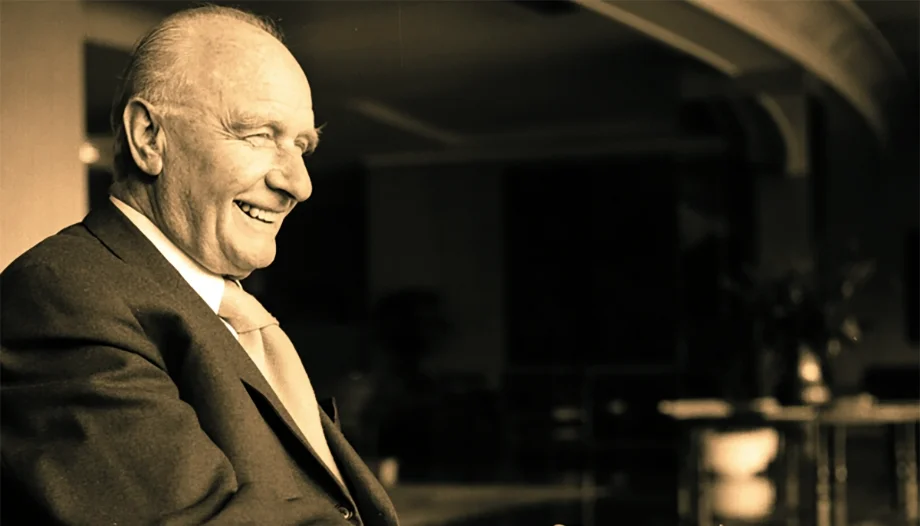
Josef Pieper’s biographical entry is as brief as his bibliography is extensive. He was born on May 4, 1904, in Elte, a village in Westphalia, and completed degrees in philosophy, law, and sociology at the universities of Berlin and Münster. He is currently a full professor—or, in German terminology, a “professor ordentlich”—of Philosophical Anthropology at the University of Münster and at the Essen University of Education.
Many of his works have been translated into Spanish—specifically in Spain—and this reference is limited to their titles, since it is intended for Spanish-speaking readers. These works are: *The Relevance of Thomism* (1952), *The Christian Catechism* (which corresponds to the German title *Christenfibel*, equivalent to the expression “Christian Primer,” and which he wrote in collaboration with Heinrich Raskop; it was translated in Spain in 1954), *On the End of Time* (1955), and *Leisure and Intellectual Life* (the latest, expanded Spanish edition from 1962), on the one hand. On the other hand, in addition to the works cited, there is a series of works that are very characteristic of Pieper and that address basic Christian and human virtues, set against the backdrop of modern man’s anguish: On Hope (1953), Prudence (1957), and Faith (1966).
In the second half of last year, two new books along the same lines were added to the list of works cited, published by Ediciones Rialp in Madrid and Sígueme in Salamanca, respectively: *Justice and Fortitude* and *Hope and History*. For all the works mentioned, the date of the first Spanish edition has been provided, even though some of them are now in their third edition. It should be noted that, at this time, Pieper has sold more than half a million copies of his books in the most important nations and linguistic regions, despite writing primarily for minority audiences.
Pieper began his theological work in 1934 with his study on fortitude, from which he moved on, the following year, to his study on hope. His work has consisted, from his clear stance as a layperson and philosopher, of adapting theology to modern thought in its conceptual and literary expression—but always with exquisite care not to alter the essential content of classical theological formulations. Existentialism and Hiroshima were not, for him, abstruse issues arising from another planet; rather, they were reasons to use the humanism studied in anthropology to lead the restless man of our time to an encounter with himself through God.
In the following conversation—held at his home in Münster—Pieper, who has so skillfully defended the existential roots of Thomism, by framing his anthropology through Thomistic ethics, discusses current issues of debate, concepts such as secularization and spiritualization, the synthesis of the human and the divine in the Christian as a human being, the relationship between traditional and modern culture, and even about that last bastion of the revolution against technology—against the absence of humanism—which is and represents the student rebellion.
How do you view the integration of Christian culture and that modern culture that has been called «secular»?
–I do not view Christianity as a monolithic entity. The Christian—every Christian—is first and foremost a human being, and must achieve that synthesis within himself: at the very least, he must try to do so. Precisely, what is non-Western is an anti-secular religion such as might be found, for example, in the Russian or Greek Orthodox churches, which are devoted solely to contemplation and liturgy, without any engagement with the world. However, there is also another danger at the other extreme, and that is secularization. Both poles are equally dangerous.
Nihilism and Secularization
The nihilistic stances taken by the standard-bearers of the revolution—regardless of their political affiliation—may call into question the relationship between modern and traditional culture. What would you say to our readers regarding this entire issue?
–I believe that the ancient culture of the West has always been—and continues to be—in a process of constant transformation, through which it interprets itself at every moment, which—as we know—involves the ongoing resolution of tensions or polar conflicts. Something else, something quite different, occurs, for example, in India, where traditional culture and modern culture are separate. But in the West, this duality does not exist; as I have said, it can instead be observed in the religious culture of the Hindu people, on the one hand, and, on the other, at the modern University of Calcutta. In this framework characteristic of India, the transition to modern culture entails abandoning tradition, because there is no such effort made there toward continuous interpretation or new interpretation. This clearly distinguishes the East from the West—from Western culture, which is, incidentally, based on the Bible, on the Word of God that shapes humanity. Here in the West, traditional culture is not spelled out by repeating its body of knowledge word for word each time, but rather is synthesized into conceptual phrases through the interpretation of theologians, who contrast it, for example, with evolutionism and paleontology, etc.
This Western way of understanding history constantly gives rise to new, apparent conflicts; but it is precisely because it is prepared to confront them that it preserves the essence of Western culture. I believe that if this difference between Eastern and Western culture were to disappear one day, we would be witnessing the end of Western culture.
And for that reason, I would also say that today even student protests are part of Western culture, although the possibility of the conflicts I have referred to—which stem from broader and more comprehensive social dynamics—arising should not be limited to the student world.
In any case, if one day there were only a secular culture—that is, one divorced from religious foundations—in the West, it would no longer be part of the Western spirit.
Specifically, what are your thoughts on this so-called «secularization» of Christian life that some people advocate?
–I would say that in Catholic theology, and consequently within the Church, there is a group or movement that advocates such secularization, but since this is not my view, I cannot support it.
In a book, translated in his homeland, he warned that there is an obstacle to be overcome—one that poses a significant challenge precisely for the people of our time. This is not something for which the people of our time are «to blame»; that is, it is not a difficulty they have arrogantly brought upon themselves. Rather, it is something that is inevitably linked to the change in our understanding of the natural world and its scope—a change that simply means our knowledge of created reality has been significantly corrected and enriched compared to ancient and medieval conceptions. Vox facta est de caelo—“A voice was heard from heaven”—: for Dante and his contemporaries, this was something intuitively conceivable, an act that could be carried out without question.
Such unquestionability is no longer available to Einstein’s contemporaries, now that even the material reality of the world has become increasingly less intuitive. «We cannot sense God’s presence in our world with the same naivety as previous generations did,» Rahner said. On the other hand, we must admit—whether we like it or not—that contemporary theology has provided few conceptual tools to overcome this difficulty, which has arisen legitimately. But I do not view the desacralization of life as legitimate.
Is the middle ground between the two dangerous extremes of extreme spiritualism and secularization the one that recognizes the legitimate relative autonomy of the temporal realm?
–Undoubtedly, that relative autonomy is part of the great tradition represented by St. Thomas. But that relative autonomy is one thing, and the autonomy sought by so-called secularization is quite another; the latter consists in severing the polar tension by conflating it with a separation between the Christian and the human, which is impossible.
Catholic intellectuals?
What you’ve been saying in your answers to these questions brings us to the topic of the layperson. What—or who—does “layperson” mean to you?
–The layperson is a baptized Christian who is not separated from the Church, but rather situated within that healthy polar tension. It is not easy to find a formula for this, but neither can we speak of a separation. If the layperson, who is a Christian, aligns with secularization, he or she thereby ceases to be a Christian. On the other hand, however, the layperson must confront this responsible relative autonomy, and this tension will never end.
Years ago, I wrote that what characterizes a Christian is Christian faith and the Christian life. Both faith and life are intertwined, just as knowledge and action are. Christian faith is the foundation of the Christian life, and the Christian life is the fruit and full realization of that faith. Christian life cannot exist without Christian faith, and Christian faith without Christian life is fruitless. Certainly, today it seems that Christian life can exist without Christian faith; it seems that one can have a Christian orientation in life without a living faith in Christ.
But, in reality, Christians who live this Christian life only in an external way are doing nothing more than enjoying and consuming the heritage bequeathed to them by their forebears: the living faith upon which they built their lives and shaped the customs and traditions of society. But this heritage is in danger of being completely nullified if it is not renewed by a faith that has been revitalized. Therefore, being a Christian in this day and age and among our people means returning to live the Christian life from its very foundation, guided and driven by a living and personal faith. The Christian «lives by faith.».
What is your opinion of a figure who is relevant to the context of this interview—that of the Catholic intellectual?
–Speaking of intellectual pursuits, I have written: «If one says that someone is Christian in their philosophy, this cannot simply mean that their worldview coincides with Christianity as a doctrine. For Christianity is essentially reality, not mere doctrine!”
The problem with a Christian philosophy does not lie solely in the fact that these must be linked, and how they should be linked, theoretically, between natural knowledge of the world and supernatural faith; rather, it is a matter of transforming philosophical inquiry into Christian philosophical inquiry by grounding the philosopher in Christian reality and understanding how that transformation is achieved.
Christian philosophy is thus enriched in its content of worldly knowledge, precisely because it is linked to the prior counterpoint of Christ’s truth. Provided, of course, that not only its Christian character but also its philosophical character is strong and true (this must be repeated constantly, for it is so far from obvious!).
A famous book on the history of medieval philosophy, by Maurice de Wulf, concludes with these words: «Scholasticism declined not for lack of ideas, but for lack of minds.».
I believe that, first and foremost, there are intellectuals, and among them there are those who are Catholic. Aside from that, I am strongly opposed to the concept of a «Catholic intellectual.» I think an intellectual is someone who participates politically and through the media in society, whereas a Catholic is someone who thinks globally about everything. In reality, the term «Catholic intellectual» was coined by politics and for a specific political direction—that of a political party.
Student Rebellion
As a professor and intellectual, you are surely in a position to offer your opinion on the student rebellion, which you touched on briefly when answering a previous question. What do you think is the cause of it? Is it rooted in humanistic reasons?
–In reality, there is much to be said about that student movement, as it is difficult to analyze its causes. That said, I see its ultimate origin, here in Germany, in the fact that the German university is no longer truly a university, but rather a collection of technical institutes, with the sole and simple purpose of training professionals. In any case, this fact constitutes at least one of the causes that have given rise to the movement.
What I understand as a university necessarily includes a theological and philosophical dimension, operating within society. This is how the university came into being in the Middle Ages. In the early days of the university, the discussion of contested issues was a reality. This very intellectual controversy is at the heart of the universality that defined the university itself and gave it its origin. Thanks to that contribution, students at that time were able to maintain a universal perspective—that is, they did not lose sight of the university’s point of view. Today, when that possibility for discussion and debate on universal topics no longer exists within the university, the resulting harm affects not only the student but also the professor.
Incidentally, one of the newest universities in Germany, the University of Bochum, recently opened its doors. And it has chosen to do so by responding to what I have called «offenheit für das Ganze»—a sense of openness to the whole. At that university, this universal sensibility—which goes beyond the technical—is even institutionalized as an academic element. Regarding that experience, I wrote: «The academic debate that extends across faculties and disciplines is embedded in the university’s organization. However, there are many difficulties; for example, the lack of a common language among the faculties; and also the fact that professors are afraid to express their personal opinions, since these cannot be scientific in the strict sense.».
The university should be open to everything. It must be an institution dedicated to free thought—a free space within society, a sanctuary of intellectual freedom. In other words, in that place that is—or should be—the university, direct attitudes and concrete stances must be set aside, left in abeyance. And it is in this sense that academic freedom is rooted in its very origin. Such freedom no longer exists in German universities, and even less so in American ones.
So, could the ultimate cause of the student rebellion lie in a desire to defend the university as an institutional bastion of free thought?
–In my opinion, students don’t rebel just for that reason. I insist that their rebellion stems from a very complex set of motivations. One of the causes lies in their reaction to what students here call «those idiot specialists»—that is, professors who solely cultivate and promote their own technical specialty. I’d already said that, because that’s what I thought.
I pointed out that the university cannot be divorced from the general philosophical idea that constitutes its essence. On the other hand, however, when students—who represent the working world as a whole—devote themselves to what they call the “politicization of the university,” they undermine that free intellectual space that constitutes the true essence of the university.
Is it, therefore, a bad thing for students to be interested in politics?
–In my opinion, students should not get involved in politics, whether theoretical or practical. It’s another matter entirely for them to discuss politics at the university, but only in a theoretical sense.
In short, students should not reject this theoretical discussion, as do those student groups that seek to introduce partisan politics into the university. It is one thing for students to discuss the arguments put forward by political parties at the university; it is quite another to turn the university into a arena for politics and partisan politics.







 Español
  English
  Italiano